Share crypto content and earn up to 60% commissions through content mining.
placeholder
gatefun
Has the BTC cycle failed? Or is it just being 'smoothed out'—a mid-2026 mid-term assessment
After the market close on May 29, Bitcoin closed around $73,000, with an approximate gain of 8% since the beginning of the year. This performance is quite average among all "risk assets"—the Nasdaq gained 12% in the same period, gold 18%, and the S&P 500 10%. If you go back a year, everyone would think it’s incredible that "BTC’s gains lag behind gold"; but by 2026, this has already happened.
There is an increasingly loud voice in the market—"Bitcoin cycle failure theory." The core of this argument
BTC-4.02%
ETH-0.38%
IBIT-2.71%
View Original
post-image
Ryakpanda
Has the BTC cycle become invalid? Or is it just being 'smoothed out'—Mid-2026 Midterm Judgment
After market close on May 29, Bitcoin closed around $73,000, with an approximate 8% increase since the beginning of the year. This performance is quite average among all "risk assets"—the Nasdaq gained 12% in the same period, gold 18%, and the S&P 500 10%. If we go back a year, everyone would think that "BTC's gains lagging behind gold" was unbelievable; but by 2026, this has already happened.
There is a growing voice in the market—"Bitcoin cycle failure theory." The core of this argument is: the past three cycles (2013, 2017, 2021) all followed a pattern of a "main rally" 12-18 months after halving events, but this pattern has broken after the fourth halving (April 2024). According to "traditional cycle theory," BTC should peak between late 2025 and mid-2026 ($150K–$200K), but the actual trend shows it surged to $120K in December 2024, then entered consolidation, and by May 2026, it’s still hovering around $70K.
Is this cycle failure? Or just a "lengthening" of the cycle? What is the mechanism behind this? This article aims to clarify this question. Because this judgment determines the core strategy for crypto asset allocation over the next 12-24 months—if the cycle is still intact, just delayed, then the answer to "should we reduce or increase positions now" is completely different.
What was the logic of the previous three cycles?
First, let's clarify the logic of the past three cycles. Bitcoin halves every four years (block reward halved), and the market generally believes halving reduces supply and drives prices up. This is the surface explanation. The real mechanism is more complex.
**2013 First Cycle:** BTC rose from $13 to $1,100, with the main rally occurring around the November halving. The real driving force was the rise of centralized exchanges like Mt.Gox + the influx of Chinese miners + the recognition of BTC by early retail investors. "Halving" was just an event trigger; the main driver was the explosive industry growth from zero to one.
**2017 Second Cycle:** BTC rose from $1,100 to $19,500, with the main rally occurring 12-18 months after the 2016 July halving. The real drivers were the ICO craze + Ethereum's rise + the first recognition of crypto assets by global retail investors. "Halving" was a trigger; the main driver was use case expansion (from pure BTC to smart contracts + altcoins).
**2021 Third Cycle:** BTC surged from $19,500 to $69,000, with the main rally happening 12-18 months after the 2020 May halving. The real drivers were post-pandemic global liquidity injections + institutional entry (MicroStrategy, Tesla) + narratives like DeFi, NFTs + dollar depreciation expectations. "Halving" was a trigger; the main driver was macro liquidity + institutional expansion.
Looking at these three cycles together, one key insight emerges—the so-called "halving cycle" is only a surface pattern. The true driver of BTC prices is the "new demand source that appears once every four years." The first cycle was driven by centralized exchanges, the second by ICOs, and the third by institutions + DeFi. Each cycle brought a wave of new incremental buyers.
So, what is the new incremental demand in this 2024–2026 cycle? That is the core question.
**The new buyers in this cycle: ETFs and corporate treasuries**
The two main new buyers of BTC in this cycle are spot ETFs and corporate treasuries.
The ETF story is very clear. On January 11, 2024, the SEC approved 11 spot BTC ETFs. By the end of May 2026, the net inflow into BTC ETFs in the US exceeded $150 billion, with nearly 1.3 million BTC held (about 6.5% of total circulating supply). This is an unprecedented capital influx—nothing in traditional finance has ever absorbed this much BTC.
Features of these ETF buyers:
1. **Very stable**—according to BlackRock’s internal data, over 60% of IBIT clients are pension funds, insurance companies, family offices, and long-term institutions, with very low turnover.
2. **Almost emotionless**—most ETF funds come from allocation portfolios (automatic monthly dollar-cost averaging), not reacting sharply to price swings.
3. **Continuous growth**—Q1 2026 still sees net inflows exceeding $20 billion, similar to 2024–2025.
The other line is corporate treasuries. As of May 2026, over 200 publicly disclosed companies hold BTC as part of their treasury, totaling over 800k BTC (about 4% of total supply). Among them, MicroStrategy (now called Strategy) holds over 600k BTC at an average cost below $40k per BTC, making it the largest player. Companies like Japan’s Metaplanet, Brazil’s Méliuz, and Hong Kong-listed Tezzion are following suit, using BTC treasury holdings as a core strategy against fiat devaluation.
Combined, these two buyer groups account for over 10% of BTC’s total circulating supply, and monthly they continue to accumulate. Interestingly, this steady accumulation pattern has disrupted the previous explosive "price surges"—because the new buyers are entering too steadily, too slowly, and institutionally, preventing the kind of retail-driven blowouts seen in 2017 and 2021.
**The core logic of "cycle smoothing"**
This is the biggest difference between this cycle and the previous three—cycles are "smoothed out."
Previous cycles were "retail-driven." Retail investors tend to be emotional, short-term, highly leveraged, and trend-following. Each cycle started with "FOMO" buying, ended with "panic selling," and was filled with 50%+ retracements and 200%+ rebounds. This structure naturally created alternating bull and bear markets.
This cycle, however, is driven by "institutional + retail" forces layered together. Institutional funds account for 30-40% (ETFs + corporate treasuries + stocks indirectly holding BTC). Their characteristics are the opposite of retail: low leverage, long-term, dollar-cost averaging. Once these funds enter, they tend not to exit quickly—unless a true extreme event occurs (like a 2008-level financial crisis).
This "long-term + short-term" capital overlay essentially transforms BTC from a "commodity" into a "financial asset." Commodity prices fluctuate based on supply and demand, while financial asset prices depend on valuation multiples + liquidity. The fluctuations in valuation multiples + liquidity are much more moderate than pure supply-demand swings. That’s why BTC seems to "rise less explosively" this time—it has matured to the point where it shouldn’t surge like 2017.
This is not a bad thing. Lower volatility means BTC’s "Sharpe ratio" (risk-adjusted return) in traditional portfolios is actually improving. For long-term holders, "slow growth but less decline" is a sign of maturity.
**The Fed’s role**
By late May, market expectations for the June FOMC meeting are divided. CME FedWatch shows about a 45% chance of a 25bp rate cut in June, and about 50% chance of holding rates steady. This near 50/50 split is rare over the past six months—usually, markets converge on a clear direction a week or two before the meeting.
The split is due to conflicting data. On one hand, April core PCE inflation rose to 2.9% (above the 2% target), and tariffs further pushed up goods inflation risks; on the other hand, April non-farm payrolls added only 125k jobs (far below expectations), and the unemployment rate rose from 4.1% to 4.3%. On one side inflation pressures, on the other weak employment—Powell faces a tougher dilemma than in 2024.
This "dual split" macro environment is mildly positive for BTC. If the Fed cuts in June, liquidity easing will generally boost risk assets (including BTC). If the Fed stays on hold but signals dovishness, market expectations of a delayed rate hike will support BTC. The only scenario that’s unfavorable is runaway inflation forcing the Fed to hike again, but that’s currently very low probability.
Tariffs are another key variable. The Trump administration’s "reciprocal tariffs" policy has been bouncing back and forth since mid-2025—raising, lowering, delaying, then raising again. Each policy flip causes big swings in market sentiment. The critical turning point may be July—if US-China trade talks see major progress or breakdown, market expectations for global growth and inflation will be re-priced, and BTC will fluctuate accordingly.
**The increasing divergence among altcoins**
Another very clear feature of this cycle is that the "altcoin season" (excluding BTC, ETH, SOL) is unlikely to return.
In previous cycles, there was a clear pattern: after BTC’s rise, funds flowed into ETH, then into main altcoins (XRP, ADA, DOT), and finally into long-tail altcoins. This "waterfall effect" happened in 2017 and 2021, with nearly all coins multiplying dozens of times.
In 2024–2026, this waterfall effect is absent. Funds flow into BTC ETFs but rarely spill over into altcoins. Two reasons: first, institutional crypto allocations mainly focus on BTC and ETH (a little SOL), with little interest in long-tail altcoins; second, the supply of altcoins has exploded from a few thousand in 2017 to millions in 2026 (including memecoins), diluting the market and making a broad market rally nearly impossible.
Instead, what replaces the "all-market altcoin season" is "narrative rotation." AI-related coins (Bittensor, Render), DePIN, Layer 2 concepts, RWA, memecoins—each sector has its own mini bull run, but none can lift the entire market. This is a sign of market maturity—no longer do all assets rise and fall together, but they differentiate based on fundamentals.
This pattern is actually friendly to long-term investors. It forces everyone to research project fundamentals, business models, tokenomics, rather than chasing "get-rich-quick" schemes. But it’s very unfriendly to short-term traders—those old environments of "buy and it will go up" are gone.
**The true position of "peak" and "cycle"**
Returning to the initial question: Is the BTC cycle invalid? My view is—no, it’s just being lengthened and smoothed out.
The main rally of this cycle has not yet arrived. Past main rallies were characterized by at least two features: retail FOMO reaching extreme levels, a sharp increase in on-chain active addresses, and large-scale distribution by long-term holders. None of these features appeared in May 2026—Google search interest in "Bitcoin" is only 30% of the 2021 peak, new addresses are growing modestly, and Glassnode data shows long-term holders are still accumulating.
This suggests that the "cycle top" is likely still ahead, just with a longer time window—possibly late 2026, or the first half of 2027, or even mid to late 2027. No one can predict the exact timing, but the "location" of the top is not yet reached, supported by strong on-chain data.
What could invalidate this judgment? Two black swans: first, macro—if the US economy hits a hard landing and stocks plunge 30%+, BTC won’t be immune; second, industry internal—if a major institution (like a large BTC-holding listed company) faces a financial crisis and is forced to sell, triggering a cascade. Neither scenario is the base case now, but both require ongoing monitoring.
**Advice for those crossing cycles**
Back to the most fundamental question—how should long-term investors respond in this environment of "smoothed cycles + macro split"?
First, recognize this is not 2017 or 2021. Don’t expect explosive "multiples in months" rallies. This cycle is likely to produce a "moderate long bull"—annualized returns of 30-50%, maximum drawdowns of 25-30%. If you play with 2017 expectations, you’ll either endure sideways pain during big rallies or sell prematurely in the middle.
Second, accept that "narrative rotation" is the new normal. Don’t go all-in on a single altcoin; diversify across a few core sectors you understand (public chains, DePIN, AI, RWA, stablecoin infrastructure). Allocate proportionally and adjust based on fundamentals. No miracle "100x SHIB" type gains are expected this cycle.
Third, focus on real on-chain data—don’t be swayed by influencers or media sentiment. Use free data from Glassnode, CryptoQuant, Dune to gauge market sentiment—long-term holder changes, miner flows, stablecoin market cap, ETF net inflows/outflows. These are far more reliable than "big V" calls.
Fourth, set your positions well and accept a long wait. The maximum returns from BTC always come from "not moving during the most uncomfortable times"—the 2018 bear bottom, the 2020 pandemic crash, the 2022 FTX collapse. Those "most painful" moments are the biggest opportunities. The current environment isn’t "most painful," nor is it "most comfortable," but the key is to develop the ability to cross cycles.
By May 2026, BTC will still be around $70K, Nasdaq at record highs, gold hitting new all-time highs, and the Fed walking a tightrope between inflation and employment. It’s a period full of uncertainty. But for truly long-term thinkers, this is the best window to build understanding—markets are not extreme, sentiment is not extreme, and you can calmly see every clue clearly.
The most valuable judgment is always contrarian + long-term. This cycle’s "contrarian" view might be: cycles are not invalid, just slower; BTC has not peaked, just rising less frenetically; altcoin season is gone, but good projects will still emerge. Keep these three judgments in mind, and the rest is patience.
repost-content-media
  • Reward
  • Comment
  • Repost
  • Share
$CAKE Only a little while ago, Near was ahead; now it’s been left twice as far behind—so pathetic.
CAKE-2.79%
View Original
  • Reward
  • Comment
  • Repost
  • Share
$HYPE (1h) - Bullish Continuation
Bias: Long
Entry (Zone): 74.20 - 75.20
Targets:
TP1: 76.80
TP2: 78.40
TP3: 80.20
Stop Loss: 71.90
Why this Setup:
I’m looking for continuation as long as price holds above the recent breakout area and keeps printing higher lows. The trend is still strong, and I want to buy pullbacks into support for a move back toward the prior highs and extension beyond them.
HYPE0.05%
post-image
  • Reward
  • Comment
  • Repost
  • Share
🔮 There's now a 95% chance #BTC will fall to $70,000 before going back up to $90,000, according to Polymarket.
HODL!
$BTC
BTC-4.02%
post-image
  • Reward
  • 3
  • Repost
  • Share
QuietQuants:
Polymarket’s odds are just for fun—if you truly believe in them, you’d trust your own wallet more.
View More
Seeing $TA the market chart, I know that the long position this time is not a fake move.
Earlier when I was analyzing the chart, it was still hovering around 0.06176.
After watching it accumulate at the low level for a while, it suddenly surged with increased volume, showing a clear rebound signal, so I initially abandoned the idea of shorting.
The price reached 0.09226, +1211.89%, which has already been reflected on the account, and the rhythm has been established.
Protect the profits already in hand first, take 70% off the table, and keep 30% to see if there’s another move later.
TA12.3%
BTC-4.02%
ETH-0.38%
View Original
post-image
  • Reward
  • Comment
  • Repost
  • Share
$ESPORTS (1H) - Bearish Rejection Short
Bias: Short
Entry (Zone): 0.0510 - 0.0530
Targets:
TP1: 0.0470
TP2: 0.0435
TP3: 0.0395
Stop Loss: 0.0570
Why this Setup:
I’m looking to short into the failed push above the recent highs because price was rejected hard and is now losing momentum around the 0.051 to 0.053 area. I expect a rotation back into the prior support zones if this rebound continues to fade.
ESPORTS53.53%
post-image
  • Reward
  • Comment
  • Repost
  • Share
U.S. stocks hit new highs, but the crypto market has cooled off? Funds are quietly switching tracks
Recently, an interesting phenomenon has appeared in the market.
U.S. stocks are continuously reaching new highs.
The crypto market, however, has noticeably cooled down.
Why?
Because capital always pursues efficiency.
As AI giants keep delivering impressive results,
Some funds naturally tend to flow into more certain directions.
This does not mean the crypto market has lost its opportunities.
Instead, funds are beginning to rotate phase by phase.
Such situations are not uncommon in history.
Somet
TON5.78%
View Original
post-image
post-image
post-image
  • Reward
  • 10
  • Repost
  • Share
LittleGodOfWealthPlutus:
Direct to the Moon🌕
View More
Ethereum ancient giant whale dumps again! After selling 60k ETH, the market starts to panic
What is the scariest thing in the crypto world?
It's not the decline.
But someone selling while the price drops.
Recently, an old player, known as the "ETH OG" by the market, has made a move again.
Latest data shows they sold another 5,000 ETH, with the total sell-off exceeding 60k ETH plus a large amount of wsETH.
As soon as the news broke, the market instantly exploded.
Many investors began to worry:
Does this mean the old player is not optimistic about the future market?
Actually, not
ETH-0.38%
BTC-4.02%
View Original
post-image
post-image
post-image
  • Reward
  • 9
  • Repost
  • Share
Ryakpanda:
Just charge forward 👊
View More
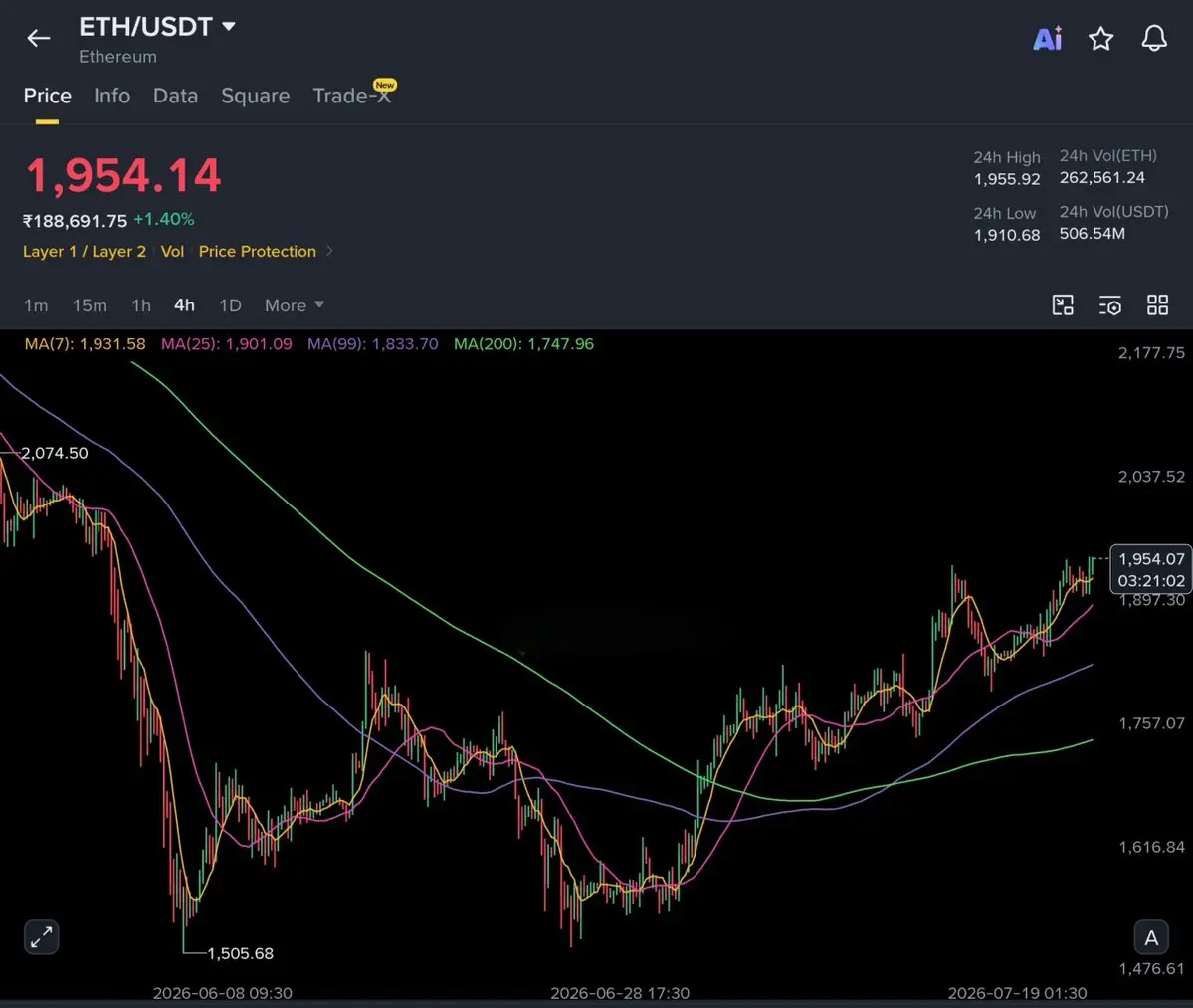
Bitmine snaps up another $52M in ETH, eyeing ~5% of circulating supply and nearing the target after this purchase. This could signal deeper accumulation while ETH price resilience remains under observation. $ETH
ETH-0.38%
post-image
  • Reward
  • Comment
  • Repost
  • Share
Want to find your next favorite mutual? 🤝
Comment “found me”.
You might be surprised who replies.
post-image
  • Reward
  • Comment
  • Repost
  • Share
Gate Contract Stock Section Launch: $SKHYNIX (SK Hynix) & $SAMSUNG (Samsung Electronics) & $HYUNDAI (Hyundai Motor)
🔹 Trading pairs: $SKHYNIX / $USDT, $SAMSUNG / $USDT, $HYUNDAI / $USDT
🔹 Trading time: June 2, 2026, 14:00 (UTC+8)
🔹 Supports 1 - 20x leverage
Trade $SKHYNIX: https://www.gate.com/futures/USDT/SKHYNIX_USDT
Trade $SAMSUNG: https://www.gate.com/futures/USDT/SAMSUNG_USDT
Trade $HYUNDAI: https://www.gate.com/futures/USDT/HYUNDAI_USDT
More details: https://www.gate.com/announcements/article/51477
SKHYNIX-12.32%
SAMSUNG-18.79%
HYUNDAI-1.03%
post-image
GateLaunch
Gate Contract Stock Section Launch: $SKHYNIX (SK Hynix) & $SAMSUNG (Samsung Electronics) & $HYUNDAI (Hyundai Motor)
🔹 Trading pairs: $SKHYNIX / $USDT, $SAMSUNG / $USDT, $HYUNDAI / $USDT
🔹 Trading time: June 2, 2026, 14:00 (UTC+8)
🔹 Supports 1 - 20x leverage
Trade $SKHYNIX: https://www.gate.com/futures/USDT/SKHYNIX_USDT
Trade $SAMSUNG: https://www.gate.com/futures/USDT/SAMSUNG_USDT
Trade $HYUNDAI: https://www.gate.com/futures/USDT/HYUNDAI_USDT
More details: https://www.gate.com/announcements/article/51477
repost-content-media
  • Reward
  • Comment
  • Repost
  • Share
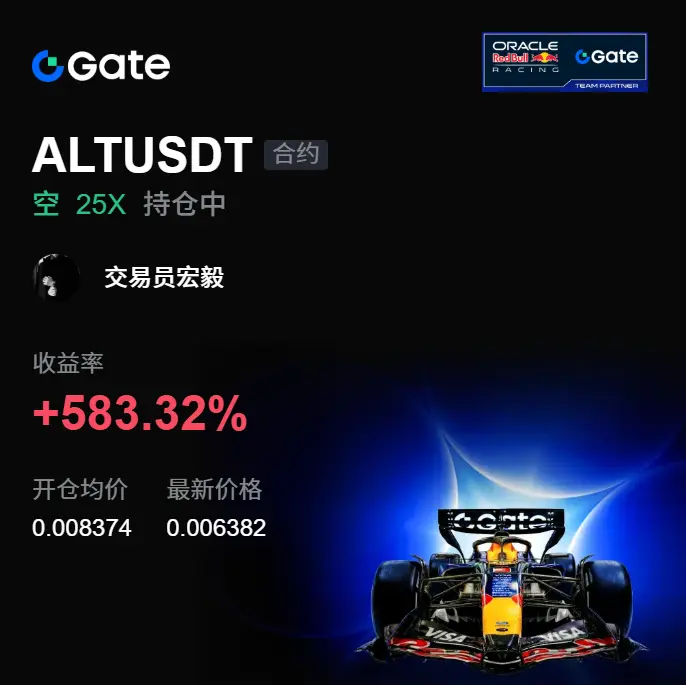
Brothers, a while ago, I followed the long positions in the layout, and now everyone is enjoying the gains! $PRL At that time, it rose to 0.21266, and I could tell the market was off, buying pressure couldn't push it up, and the big players weren't protecting the market, it was all selling pressure. I immediately led everyone to go long. Now it has directly risen to 0.21266, and this wave of profit has reached +249.48%! Family members who followed, don't be greedy, take profit and lock in 80%, keep the rest, and see if it can break below the low of 0.18876; execute the stop-loss as planned to
PRL7.97%
View Original
post-image
  • Reward
  • Comment
  • Repost
  • Share
Traders who survive long-term all know what they are doing.
Trading isn't about always getting it right.
The ones who can truly survive over the long run rely on knowing what they are doing every time.
Why did I enter?
What if I was wrong, how do I exit?
If I made a profit, how do I take it?
Under what circumstances does the market change?
What kind of money does this trade really aim to make?
The clearer these questions are, the simpler trading becomes.
The market's biggest punishment is for those who get overly excited before entering and then change their plan on the spot
View Original
post-image
post-image
  • Reward
  • Comment
  • Repost
  • Share
Good morning fam ☀️
Today is gonna be a blessed one
post-image
  • Reward
  • Comment
  • Repost
  • Share
$BTC #BTC
Sharply declined after breaking down below multiple support levels around $75K and now trading at a major support/resistance pivot zone.
A short-term bounce could trigger a recovery toward the nearest resistance level. However, bearish momentum may extend its decline toward the next key support around $65K. ✍️
BTC-4.02%
  • Reward
  • Comment
  • Repost
  • Share
Mt. Gox just transferred 10,306 $BTC ($731M) to a fresh wallet for the 10,000th time.
BTC-4.02%
  • Reward
  • 1
  • Repost
  • Share
Madhhope:
2026 GOGOGO 👊
[New Streamer] Crypto stocks dive together CRCL and BLSH drop over 7 percent sending market
gate liveLIVE
1,203
  • Reward
  • Comment
  • Repost
  • Share
75 million dollar bet goes wrong? Polymarket has left the entire market stunned
What is the biggest charm of prediction markets?
Betting on the future.
What is the biggest risk of prediction markets?
The future has truly arrived.
Recently, the controversy over Strategy selling tokens has plunged Polymarket into a major storm.
What was originally a simple judgment question, but due to different interpretations of the timing, caused settlement chaos.
As a result, trading volume exceeded 75 million dollars, but the market was in an uproar.
Some investors believe the rules are clear.
HYPE0.05%
SOL-2.44%
View Original
post-image
post-image
post-image
  • Reward
  • 12
  • Repost
  • Share
CoinRelyOnUniversal:
Buy the dip 😎
View More
#ShareYourUSStocksWinNvidia
🚀 NVIDIA AI Supercycle Strengthens as Market Liquidity, Infrastructure Demand, and Cross-Asset Trading Converge via USDT Rails
The current market positioning around NVIDIA is no longer just a typical tech rally—it is increasingly behaving like a full-scale AI infrastructure supercycle. The key driver remains relentless demand for high-performance compute, as hyperscalers, enterprise AI platforms, and sovereign tech initiatives continue scaling GPU procurement faster than supply normalization can catch up.
Recent market flow data and price structure suggest that NV
NVDA-0.22%
BTC-4.02%
post-image
post-image
post-image
  • Reward
  • Comment
  • Repost
  • Share
Load More