













Yang Guang bit | July 23 $BTC precise strategy—mastering the trend end to end
Today's game plan
Short entry timing: on the bounce to 66,300-66,600
Short add-on zone: on the bounce to 66,800-67,000
Stop loss: above 67,500
Layered take-profit:
First target: 65,400-65,600
Second target: 65,000-64,500
Light-position long reference: pull back to 65,000-65,200, stop loss below $64,600, target $65,900-66,100, quick in and quick out
Core takeaway
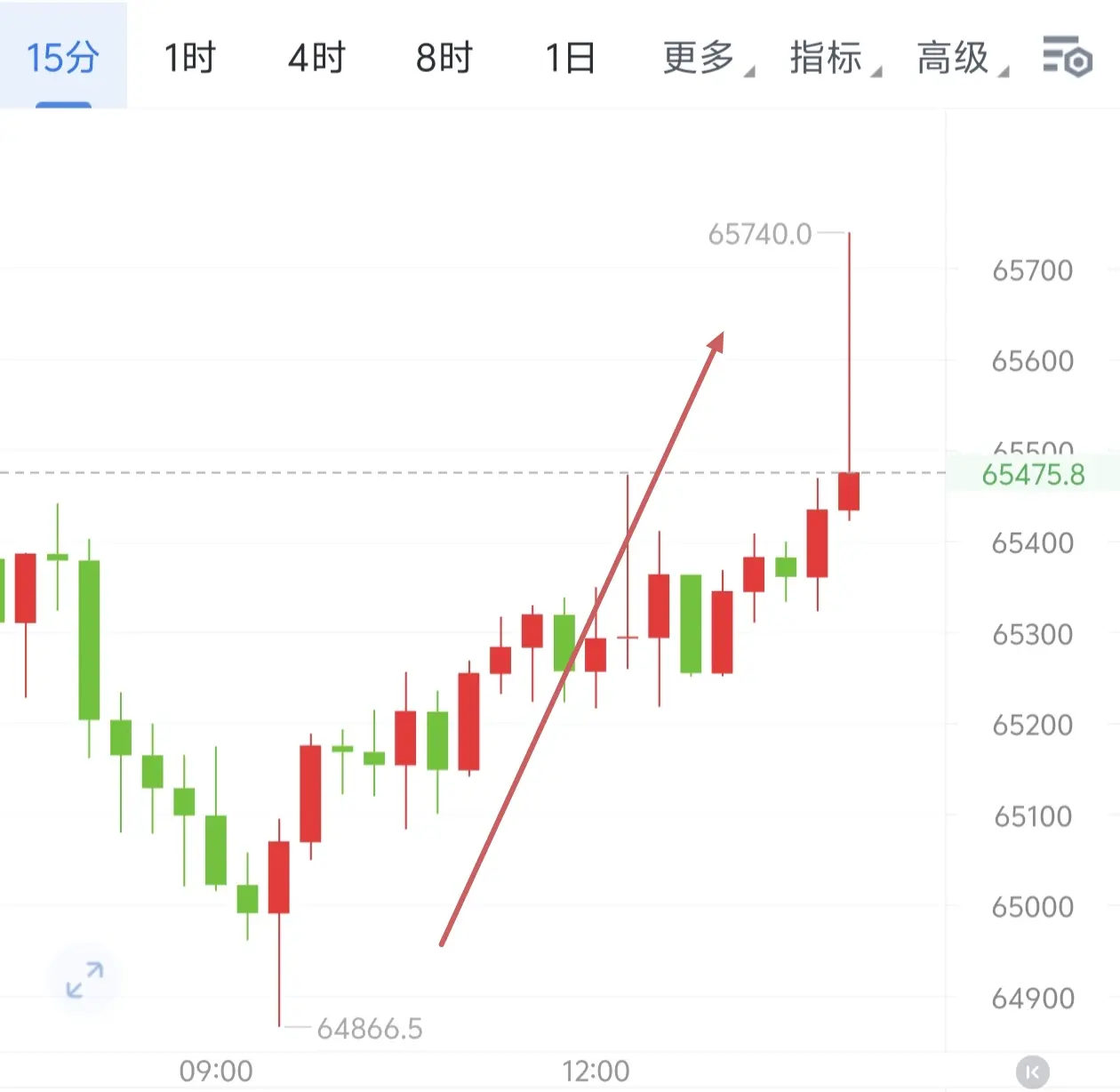
BTC previously surged to form a local high at $66,928, and is now falling back to around $65,790 for range consolidation. The Federal Reserve’s policy meeting will be held on July 28-29; market expectations for a rate hike in July have risen to 34.7%, and funds are gradually entering a “policy divergence” phase. The Middle East geopolitical conflict continues to escalate: both sides in the Iran-U.S. conflict refuse the 10-day ceasefire proposal; shipping through the Strait of Hormuz is nearly stalled. International oil prices have broken above $94 per barrel, and expectations of a rebound in inflation are heating up. Spot ETF inflows have clearly slowed at the fund level, and institutions’ willingness to chase has weakened. Mid-sized whales continue to cash out at high levels, but the largest whale keeps funds locked; incremental long-side capital is insufficient. In the short term, the market has shifted from one-way rebound to range-bound consolidation. Resistance is at $66,300-66,600, while the key support is at $65,200-65,400. Today adopts a range-bound approach: prioritize high shorts on the rebound to $66,300-66,600; lightly test longs on the pullback to $65,200-65,400, but be cautious—if crude oil breaks above $100 per barrel or the Fed releases a hawkish signal, support could shift down to $64,000.
News & insights—fund flow breakdown
1. International finance & geopolitics news
- International finance: Market expectations for the Fed’s July 28-29 meeting show significant divergence. The probability of holding rates unchanged is 65.3%, and the probability of a 25 bps hike is 34.7%. Economists broadly agree that July will see no change, but traders have partially priced in September rate-hike expectations (probability 54.9%) due to the escalation of the Iran-U.S. conflict and rising oil prices. Fed Chair Waller refused to provide forward guidance, emphasizing that inflation control is the priority and that the policy path is unclear. The 10-year U.S. Treasury yield remains above 4.6%; the high-rate environment for the year is unchanged, and long-term valuations are under pressure. Powell has stepped down as Fed Chair, and current policy is led by Waller—watch for any hawkish signals in his remarks.
- Geopolitical situation: The Iran-U.S. conflict continues to escalate. The U.S. military has carried out airstrikes on Iran for the 11th consecutive night. Iran says it conducted strikes on U.S. military bases in Jordan and Bahrain and destroyed U.S. military radar facilities. The U.S. Department of Defense released the latest casualty data: 18 U.S. personnel have been killed, and 482 have been injured. Iran has clearly refused the 10-day ceasefire proposal. Shipping volumes through both the Strait of Hormuz and the Strait of Mandeb have fallen. On July 21, only 9 ships transited the Strait of Hormuz, down 31% from the prior day. Brent crude oil prices have broken above $94 per barrel. Rising energy costs may weaken market expectations for Fed rate cuts, and in turn weaken BTC’s safe-haven support.
2. On-chain & capital data
- Institutional capital: BTC spot ETFs have posted net inflows for 6 straight days, but daily inflow size has shrunk significantly. On July 22 it was only $203 million (down from the early-July peak). Institutional capital is concentrating into compliant spot ETFs such as BlackRock and ARK, but year-to-date it still has net outflows of $540 million. Capital efficiency is significantly lower than in historical cycles. June spot ETF net outflows were $4.06 billion, setting a historical record for the largest outflow in a single month, indicating institutions remain cautious about the long-term trend.
- On-chain positioning of holdings: On-chain data shows large whale positions are diverging. The largest whale (>10,000 BTC) increased net holdings by 371k coins over the past 30 days, the highest on record, but mid-sized whales (1,000-10,000 BTC) have continued to reduce holdings since May, with the fastest sell-down pace this year. From July 12-16, two whale wallets that had been asleep for 8 and 7 years transferred 5,908 BTC and 2,931 BTC respectively, but they did not directly flow into exchanges—possibly for asset allocation or OTC trades. The supply from long-term holders has risen to 16.34 million coins, accounting for 79% of total circulating supply; but short-term holder supply has fallen to 4.2 million coins. This shows the market is in a complex state where both “locked coins and scarcity” and “mid-sized whale de-risking” coexist.
- Futures capital: Derivatives long positioning is crowded, creating pressure for profit-taking in the $66,000-67,000 range. Open interest has dropped from $42 billion at the beginning of May to $25 billion, but has recently rebounded, showing leveraged funds still exist. The total liquidation size across the market is $464 million, with shorts dominating; however, crowded longs could trigger an exit of profit-taking positions. $BTC #BTC突破66000美元
Today's game plan
Short entry timing: on the bounce to 66,300-66,600
Short add-on zone: on the bounce to 66,800-67,000
Stop loss: above 67,500
Layered take-profit:
First target: 65,400-65,600
Second target: 65,000-64,500
Light-position long reference: pull back to 65,000-65,200, stop loss below $64,600, target $65,900-66,100, quick in and quick out
Core takeaway
BTC previously surged to form a local high at $66,928, and is now falling back to around $65,790 for range consolidation. The Federal Reserve’s policy meeting will be held on July 28-29; market expectations for a rate hike in July have risen to 34.7%, and funds are gradually entering a “policy divergence” phase. The Middle East geopolitical conflict continues to escalate: both sides in the Iran-U.S. conflict refuse the 10-day ceasefire proposal; shipping through the Strait of Hormuz is nearly stalled. International oil prices have broken above $94 per barrel, and expectations of a rebound in inflation are heating up. Spot ETF inflows have clearly slowed at the fund level, and institutions’ willingness to chase has weakened. Mid-sized whales continue to cash out at high levels, but the largest whale keeps funds locked; incremental long-side capital is insufficient. In the short term, the market has shifted from one-way rebound to range-bound consolidation. Resistance is at $66,300-66,600, while the key support is at $65,200-65,400. Today adopts a range-bound approach: prioritize high shorts on the rebound to $66,300-66,600; lightly test longs on the pullback to $65,200-65,400, but be cautious—if crude oil breaks above $100 per barrel or the Fed releases a hawkish signal, support could shift down to $64,000.
News & insights—fund flow breakdown
1. International finance & geopolitics news
- International finance: Market expectations for the Fed’s July 28-29 meeting show significant divergence. The probability of holding rates unchanged is 65.3%, and the probability of a 25 bps hike is 34.7%. Economists broadly agree that July will see no change, but traders have partially priced in September rate-hike expectations (probability 54.9%) due to the escalation of the Iran-U.S. conflict and rising oil prices. Fed Chair Waller refused to provide forward guidance, emphasizing that inflation control is the priority and that the policy path is unclear. The 10-year U.S. Treasury yield remains above 4.6%; the high-rate environment for the year is unchanged, and long-term valuations are under pressure. Powell has stepped down as Fed Chair, and current policy is led by Waller—watch for any hawkish signals in his remarks.
- Geopolitical situation: The Iran-U.S. conflict continues to escalate. The U.S. military has carried out airstrikes on Iran for the 11th consecutive night. Iran says it conducted strikes on U.S. military bases in Jordan and Bahrain and destroyed U.S. military radar facilities. The U.S. Department of Defense released the latest casualty data: 18 U.S. personnel have been killed, and 482 have been injured. Iran has clearly refused the 10-day ceasefire proposal. Shipping volumes through both the Strait of Hormuz and the Strait of Mandeb have fallen. On July 21, only 9 ships transited the Strait of Hormuz, down 31% from the prior day. Brent crude oil prices have broken above $94 per barrel. Rising energy costs may weaken market expectations for Fed rate cuts, and in turn weaken BTC’s safe-haven support.
2. On-chain & capital data
- Institutional capital: BTC spot ETFs have posted net inflows for 6 straight days, but daily inflow size has shrunk significantly. On July 22 it was only $203 million (down from the early-July peak). Institutional capital is concentrating into compliant spot ETFs such as BlackRock and ARK, but year-to-date it still has net outflows of $540 million. Capital efficiency is significantly lower than in historical cycles. June spot ETF net outflows were $4.06 billion, setting a historical record for the largest outflow in a single month, indicating institutions remain cautious about the long-term trend.
- On-chain positioning of holdings: On-chain data shows large whale positions are diverging. The largest whale (>10,000 BTC) increased net holdings by 371k coins over the past 30 days, the highest on record, but mid-sized whales (1,000-10,000 BTC) have continued to reduce holdings since May, with the fastest sell-down pace this year. From July 12-16, two whale wallets that had been asleep for 8 and 7 years transferred 5,908 BTC and 2,931 BTC respectively, but they did not directly flow into exchanges—possibly for asset allocation or OTC trades. The supply from long-term holders has risen to 16.34 million coins, accounting for 79% of total circulating supply; but short-term holder supply has fallen to 4.2 million coins. This shows the market is in a complex state where both “locked coins and scarcity” and “mid-sized whale de-risking” coexist.
- Futures capital: Derivatives long positioning is crowded, creating pressure for profit-taking in the $66,000-67,000 range. Open interest has dropped from $42 billion at the beginning of May to $25 billion, but has recently rebounded, showing leveraged funds still exist. The total liquidation size across the market is $464 million, with shorts dominating; however, crowded longs could trigger an exit of profit-taking positions. $BTC #BTC突破66000美元