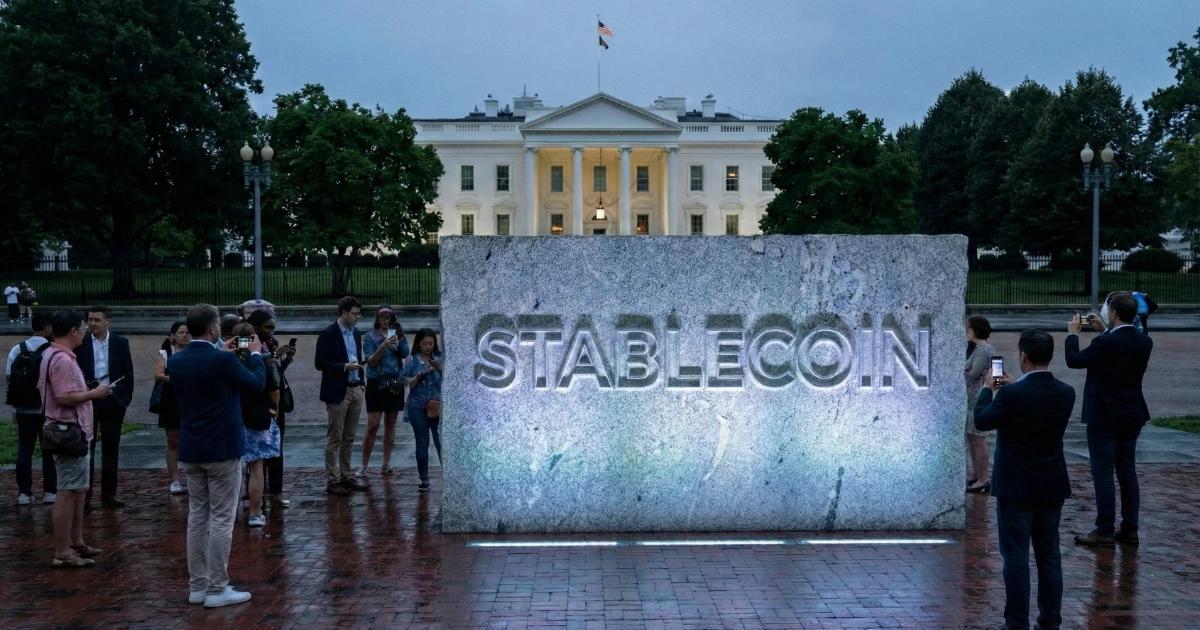
White House urgently convenes banks and crypto industry for negotiations on the "CLARITY Act," with stablecoin yields and ethical controversies becoming key issues, aiming for a decision by the end of February.
High-level Confrontation at the White House Diplomatic Reception Hall and Legislative Deadline
On the third day of a partial government shutdown caused by budget issues, White House officials under the Trump administration convened heavyweight representatives from the cryptocurrency and banking sectors on February 2, 2026, at the White House Diplomatic Reception Hall for over two hours of in-depth negotiations. Led by President’s Crypto Advisor Patrick Witt, the core goal of this meeting was to clear obstacles delaying the long-stalled "CLARITY Act."
The lineup of participants was highly symbolic, with crypto industry leaders including Coinbase, Circle, Ripple, and Crypto.com, while traditional financial forces such as the U.S. Bank Policy Institute (BPI), American Bankers Association (ABA), and Financial Services Forum attended. The White House issued clear instructions during the meeting, requiring both sides to reach consensus on technical details and submit specific amendments to the bill by the end of February. Witt described the dialogue as "constructive, fact-based, and solution-oriented," expressing confidence in reaching an agreement in the short term.
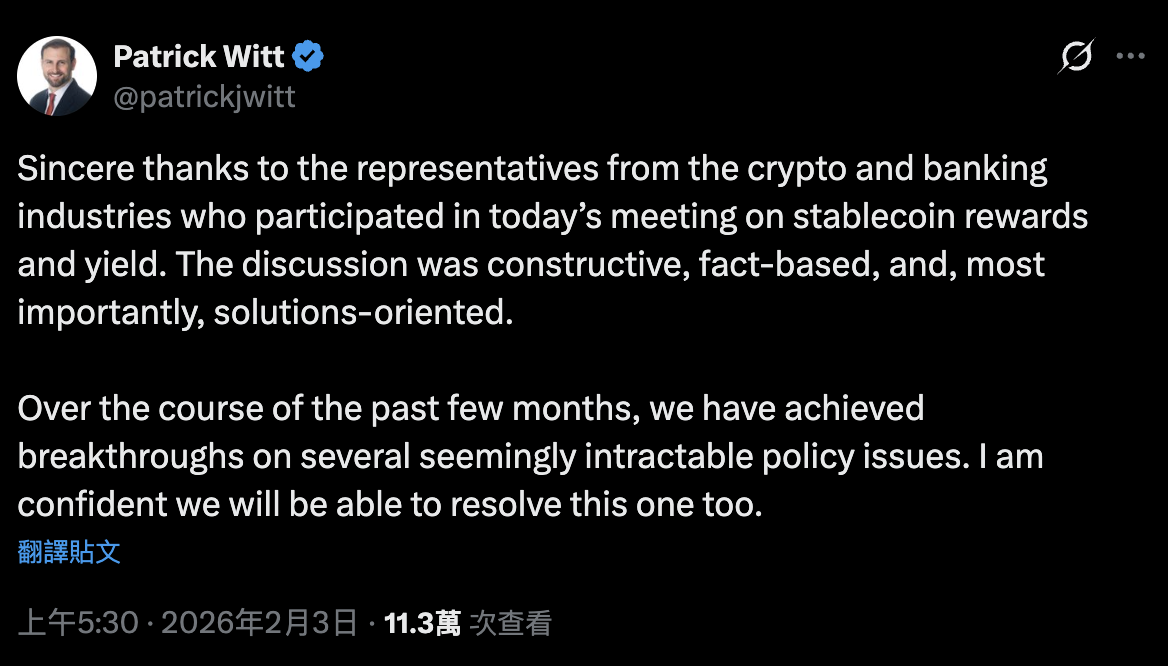
Image source: X/@patrickjwitt Crypto Advisor Patrick Witt describes the meeting as "constructive, fact-based"
Stablecoin Yield Mechanisms Become the Banking Sector’s Survival Line
The core controversy centers on how stablecoin rewards and incentives are handled, directly related to the "GENIUS Act" passed last summer. While the law prohibits stablecoin issuers from paying interest directly to holders, it allows third-party platforms like Coinbase to offer stablecoin yields.
The banking industry has taken a very hard stance on this, fearing it could lead to a large-scale outflow of customer deposits to crypto exchanges. According to the latest estimates from Standard Chartered, as stablecoins become more widespread, the U.S. banking system could face a risk of $500 billion in deposit outflows. U.S. Bank CEO Brian Moynihan also stated, "If laws require stablecoin issuers to pay interest, it could lead to up to $6 trillion in deposits leaving traditional banks."
Representatives from the banking sector emphasized during the meeting that any legislation must support local communities’ lending to families and small businesses, and maintain the safety and stability of the financial system. For banks, this is not just a technical regulatory issue but a fight to defend their core deposit business, making them relatively conservative and inflexible at the negotiation table.
Further Reading
Standard Chartered warns: Stablecoins could drain $500 billion in deposits! Is the U.S. banking sector facing capital outflow concerns?
U.S. Bank CEO warns: Stablecoins may siphon off $6 trillion in deposits, impacting bank lending capacity
Shifts in Power and Negotiation Deadlock Between Crypto and Traditional Finance
Although Cody Carbone, CEO of The Digital Chamber, expressed optimism about the meeting’s progress, calling it a "necessary step" toward resolving legislative barriers to market structure, sources familiar with the negotiations revealed that crypto representatives significantly outnumbered banking representatives, creating an atmosphere of crypto forces exerting full pressure. Summer Mersinger, Executive Director of the Blockchain Association, also praised the White House’s leadership in narrowing differences.

Image source: X/@DigitalChamber Digital Chamber CEO Cody Carbone optimistic about the meeting’s progress
However, the negotiation authority of banking representatives was strictly limited by their member banks, preventing them from making immediate commitments when faced with proposals from the crypto industry, such as storing stablecoin reserves proportionally in community banks. This "rigid" negotiation style has become the current deadlock. To break the impasse, the White House has requested future meetings to reduce the number of participants and require representatives to bring decision-making amendments to the table.
Democratic Party’s Ethical Red Lines and Trump Family Business Controversies
Beyond industry conflicts, political and ethical issues are another major variable in the legislative process. Last week, the Senate Agriculture Committee passed its version of the bill with only Republican support, while Democrats strongly opposed public officials holding digital assets.
Adding to the complexity, according to The Wall Street Journal, a member of the UAE royal family purchased a 49% stake in the Trump family-related virtual currency company "World Liberty Financial" (WLFI) for $500 million before Trump’s inauguration. This raised serious concerns about conflicts of interest, especially after the U.S. government approved the export of advanced AI chips to the UAE, prompting Democrats to demand strict ethical and anti-corruption provisions in the bill.
Additionally, Democrats are calling for the Commodity Futures Trading Commission (CFTC) to have bipartisan commissioners and for stricter measures to prevent illegal financial activities, aiming to prevent cryptocurrencies from being used for crime.
Further Reading
Senate Agriculture Committee narrowly passes crypto bill! But missing are provisions on Trump’s interests and ethics, sparking bipartisan debate
Foreign media: UAE controls 49% stake in Trump WLFI, revealing intertwined relationships with stablecoins and Binance
Final Decision by End of February and Market Indicators
As the February deadline approaches, market attention is focused on the Senate Banking Committee’s deliberations. Coinbase previously withdrew support due to dissatisfaction with how stablecoin yields were handled, which directly led to a postponement of the committee vote, demonstrating the industry giants’ strong influence on policy direction.
Currently, the market is experiencing intense volatility, with Bitcoin recently falling below the $80,000 mark and even hitting its lowest point since the start of the year. Major investment firms like MicroStrategy continue to accumulate Bitcoin despite facing over $135 billion in paper losses, adding 855 BTC during the price decline, reflecting industry commitment to long-term digital asset development.
Whether the White House can reconcile the conflicts between the banking and crypto sectors by the end of February, and reach consensus with Democrats amid the government shutdown, will be crucial in determining whether the U.S. cryptocurrency regulation bill can proceed to a full chamber vote. This will also directly impact America’s competitive edge in the global virtual asset market.


