Anyone looking to join qubic mining or evaluate its design should first understand how UPoW connects to QUBIC tokenomics: each epoch (7 days) the network emits a fixed 1 trillion QUBIC, and everything miners earn comes from that emission curve, while the burn rate, Computor allocations, and buybacks funded by external mining surplus all shape the net rewards that actually arrive. The two participation paths — AI training mining on CPU/GPU and Doge-Connect mining on Scrypt ASICs — differ structurally in access, hardware, and settlement.
Qubic's mainnet launched fairly in 2022 with no premine and no VC allocation, so the entire circulating supply comes from weekly emissions; Epoch 175 (August 2025) delivered the first halving, raising the weekly burn rate from 15% to 55% and compressing the net emission available to miners accordingly (Source: Qubic official blog).
Key Takeaways
- Under UPoW, qubic mining directs compute toward Aigarth's AI training: miners produce Solutions (training datasets) rather than solving purposeless hash puzzles as in Bitcoin PoW.
- Top-ranked miners by performance are elected as Computors, which validate transactions and execute contracts; the theoretical per-Computor reward cap is 1,479,289,940 QUBIC per epoch, with actual payouts averaging 90–98% of that cap.
- An epoch is a 7-day cycle settling every Wednesday at 12:00 UTC; regular miners are scored on Solution performance through pools such as Qubic.li, which pay out under a PPS+ model at the end of each epoch.
- Doge-Connect is a parallel Scrypt ASIC path: mined Dogecoin (DOGE) is sold to buy back QUBIC, complementing rather than replacing CPU/GPU AI training; mining carries hardware, electricity, ranking-competition, and market risks, and returns are never guaranteed.
What Is Qubic Mining?
At its core, qubic mining converts "energy spent on mining" into "output for AI training": under Useful Proof of Work (UPoW), miners do not crunch arbitrary hashes such as SHA-256 — they generate and evaluate artificial neural networks (ANNs), submitting Solutions (training datasets) that meet difficulty requirements to Aigarth, Qubic's decentralized AI project. Within the protocol, QUBIC functions as a unit of "computational energy," and miner rewards come from network emissions rather than user fees.
The difference between UPoW and Bitcoin PoW is structural: traditional PoW puzzles are deliberately designed to be "hard to solve but useless," with no value beyond securing the ledger, whereas UPoW requires every computation to advance Aigarth's training progress, with hundreds of thousands of AI Miners jointly producing billions of neural network iterations and security deriving from the cost of replicating that compute, as the Qubic official FAQ lays out in its Mining & Useful Proof of Work section. Qubic mining has two further traits that set it apart from mainstream PoW: first, there is no fixed "difficulty threshold" — competition is a relative performance ranking within each epoch, and the more Solutions a miner produces, the higher the rank; second, hardware access spans consumer-grade CPUs and GPUs, so no specialized ASIC is needed for AI training mining (the Doge-Connect path excepted).
How Do Computors and AI Miners Divide the Work?
The Qubic network splits participants into two roles — AI Miners handle training, Computors handle validation — and the two rotate weekly based on performance rankings. As defined on the Qubic Mining official page, Computors are the fixed set of validators that execute smart contracts, communicate with oracles, process transactions, and keep the network secure; AI Miners dig up Solutions for Aigarth, and the best performers are promoted to Computor status.
The selection process from regular miner to Computor works as follows:
- New participants join as Candidates and first contribute AI training to Aigarth, earning no direct rewards at this stage.
- Candidates keep submitting Solutions throughout the epoch, and the network builds a performance ranking based on Solution output.
- If a Candidate ID enters the top performance ranks, it qualifies as a Computor and starts earning QUBIC from the next epoch.
- Computor seats are reshuffled every epoch by ranking; underperformers are replaced by new miners, and no validator seat is permanent.
At the consensus layer, a two-thirds-plus-one supermajority of Computors must agree before a transaction or contract execution reaches finality (Source: qubic.org/mining) — a threshold (a two-thirds supermajority plus one) that draws on Byzantine fault tolerance principles, so a single malicious Computor or small minority cannot sway network outcomes. This design, where training output determines validation eligibility, ties mining performance directly to governance participation; Qubic vs Bitcoin vs Ethereum sets this design against Bitcoin's hashrate competition and Ethereum's staking admission side by side.
How Do Epochs and Reward Settlement Work?
Qubic settles mining rewards by epoch: each epoch spans 7 days, running from Wednesday 12:00 UTC to the following Wednesday 12:00 UTC, with reward distribution and the Computor seat handover completed when it ends. Each epoch emits a fixed 1 trillion QUBIC, allocated to Computors, the CCF (roughly 8%), and QEarn (roughly 12.25%), while the remainder is burned by the Supply Watcher contract according to the burn rate.
Computor rewards scale with performance: the theoretical cap for a single Computor is 1,479,289,940 QUBIC per epoch, and actual receipts typically land in the 90–98% range of that cap depending on efficiency (Source: qubic.org/mining). Miners outside the top performance ranks receive no direct protocol emission; their income comes from the pool's secondary distribution — mainstream pools score miners on submitted Solution performance and pay out at the end of each epoch, including the first epoch of participation. The Qubic.li pool defaults to PPS+ (pay-per-share plus), and miners can switch to Solo mode, which pays full proceeds only when they find a valid Solution themselves.
The settlement rhythm has one practical implication for participants: both pool payouts and protocol emissions anchor to the Wednesday epoch handover, so earnings are confirmed weekly rather than arriving per block; performance competition resets and re-ranks each epoch, meaning a single week's output swing directly affects the next week's eligibility and allocation.
How to Join Aigarth Training Mining with a CPU or GPU?
Ordinary consumer CPUs and GPUs are enough to join Aigarth training mining: CPU access is a deliberate design choice by Qubic, and while GPUs produce more Solutions thanks to stronger parallel compute, both feed into the same training workflow. The most common tool is the official qli-Client from Qubic.li, which supports Windows, Linux, HiveOS, RaveOS, and Android, with the pool dashboard hosted at platform.qubic.li.
The participation process can be summed up in five steps:
- Prepare the hardware: an x64 CPU (AVX2/AVX512 instruction sets run more efficiently) or an NVIDIA GPU (CUDA); the platform's live statistics track miner hashrate separately by type — AVX2, AVX512, CUDA, ARM64, and others (Source: platform.qubic.li).
- Download the qli-Client: get the build for your system from the GitHub qubic-li/client releases page or dl.qubic.li.
- Choose a connection mode: registered mode uses an accessToken from the qubic.li dashboard and manages multiple machines under one account; anonymous mode needs no registration — simply enter a Qubic wallet address (qubicAddress) in the config as the payout ID.
- Configure the payout method: setting
"pps": true enables PPS+ pay-per-share (the default), which smooths variance for small setups; setting it to false runs Solo training, settling only when a valid Solution is found.
- Run the client and verify performance: once connected to the pool endpoint (wss://wps.qubic.li/ws), training begins, Solutions and shares accrue to the account, and payment follows performance at epoch close.
Anonymous and registered modes follow identical output rules; the difference lies in management features — registered accounts can view detailed stats for multiple machines on the dashboard, while anonymous mode receives payouts to a wallet address only.
What Is Doge-Connect? How Does the Scrypt ASIC Path Differ?
Doge-Connect is Qubic's Dogecoin mining integration: Scrypt ASIC miners contribute Dogecoin hashpower through the Qubic protocol, and the mined DOGE is aggregated via Dispatcher infrastructure, sold, and used to buy back QUBIC on the open market — part of it tops up Computor rewards and the surplus is burned; the full supply-and-demand logic of this "external mining revenue" channel is broken down in QUBIC tokenomics. The feature switched on after Epoch 210 and went fully live on mainnet on April 1, 2026, replacing the earlier external mining model in which CPUs alternated between AI training and Monero (XMR) RandomX hashing — a transition documented in the Qubic official FAQ's Qubic x Dogecoin Mining section.
Compared with the CPU/GPU path, Doge-Connect differs structurally on three levels. On hardware, it accepts only Scrypt ASICs (such as the Antminer L7 and L9, plus older models like the L3+ that are no longer economical on standard Dogecoin pools); consumer CPUs and GPUs cannot participate. On validation, machines connect to the Pool Server over the Stratum protocol, and shares are translated by the Dispatcher and routed to Oracle Machines, where independent Computors running Oracle nodes confirm validity share by share — replacing off-chain confirmation by a single pool operator. On rewards, income is denominated in DOGE and converted into QUBIC distribution through the buyback leg rather than coming directly from weekly AI training emissions. Because the two paths use entirely different hardware classes, they run in parallel without crowding each other out: the ASIC layer is purely additive and does not reduce existing rewards for CPU and GPU miners.
| Dimension |
CPU/GPU AI Training Mining |
Doge-Connect Scrypt ASIC Mining |
| Hardware requirement |
Consumer CPU (AVX2/AVX512) or NVIDIA GPU |
Scrypt ASIC (Antminer L7/L9/L3+, etc.) |
| Computation content |
Generates Aigarth neural network training datasets (Solutions) |
Dogecoin Scrypt hash shares |
| Access method |
Download qli-Client and connect to a pool, registered or anonymous |
ASIC connects via Stratum to the Pool Server and Dispatcher |
| Validation and scoring |
Scored by Solution performance ranking within each epoch |
Shares verified on-chain via Oracle Machines before counting |
| Reward source |
Computor share of the weekly 1 trillion QUBIC emission plus pool distribution |
DOGE sold to buy back QUBIC; part distributed, surplus burned |
| Relationship to Aigarth |
Training is mining — directly advances AI training |
Runs parallel to AI training; funds flow back to the protocol without joining training |
As the table shows, the two paths are not either/or: the same miner can run AI training on GPUs and Doge-Connect on ASICs at the same time, with hardware and settlement fully independent. The core difference lies in the division between "training output" and "external revenue" — the former determines Computor eligibility and protocol emission allocation, while the latter imports value from outside the ecosystem.
What Costs and Risks Does Qubic Mining Involve?
Returns from qubic mining depend on performance rankings, pool rules, and market conditions, and no path comes with any promise of profit. Four categories of cost and risk are worth assessing before participating:
- Hardware and electricity costs: CPU/GPU training mining means absorbing equipment depreciation and ongoing power bills; Doge-Connect requires purpose-bought Scrypt ASICs, and while older models can be reused, their efficiency per unit of hashrate is low.
- Performance ranking competition: Computor seats re-rank weekly by Solution output, and competition intensifies as more miners join; falling out of the top performance ranks means losing direct access to protocol emission, and weekly income can swing significantly.
- Pool rules and fees: Pool fee rates and the payout differences between PPS+ and Solo are set by each operator and should be checked against their published terms; anonymous mode skips registration but lacks account-level data management, making troubleshooting more dependent on the miner's own records.
- Market and mechanism volatility: Both QUBIC and Dogecoin prices are highly volatile, and the scale of buybacks and surplus burns rises and falls with external mining revenue; after Epoch 175 the weekly burn rate climbed to 55%, adjusting net emission and the miners' distributable share, and any future halving still requires a Quorum vote, so the rules can change.
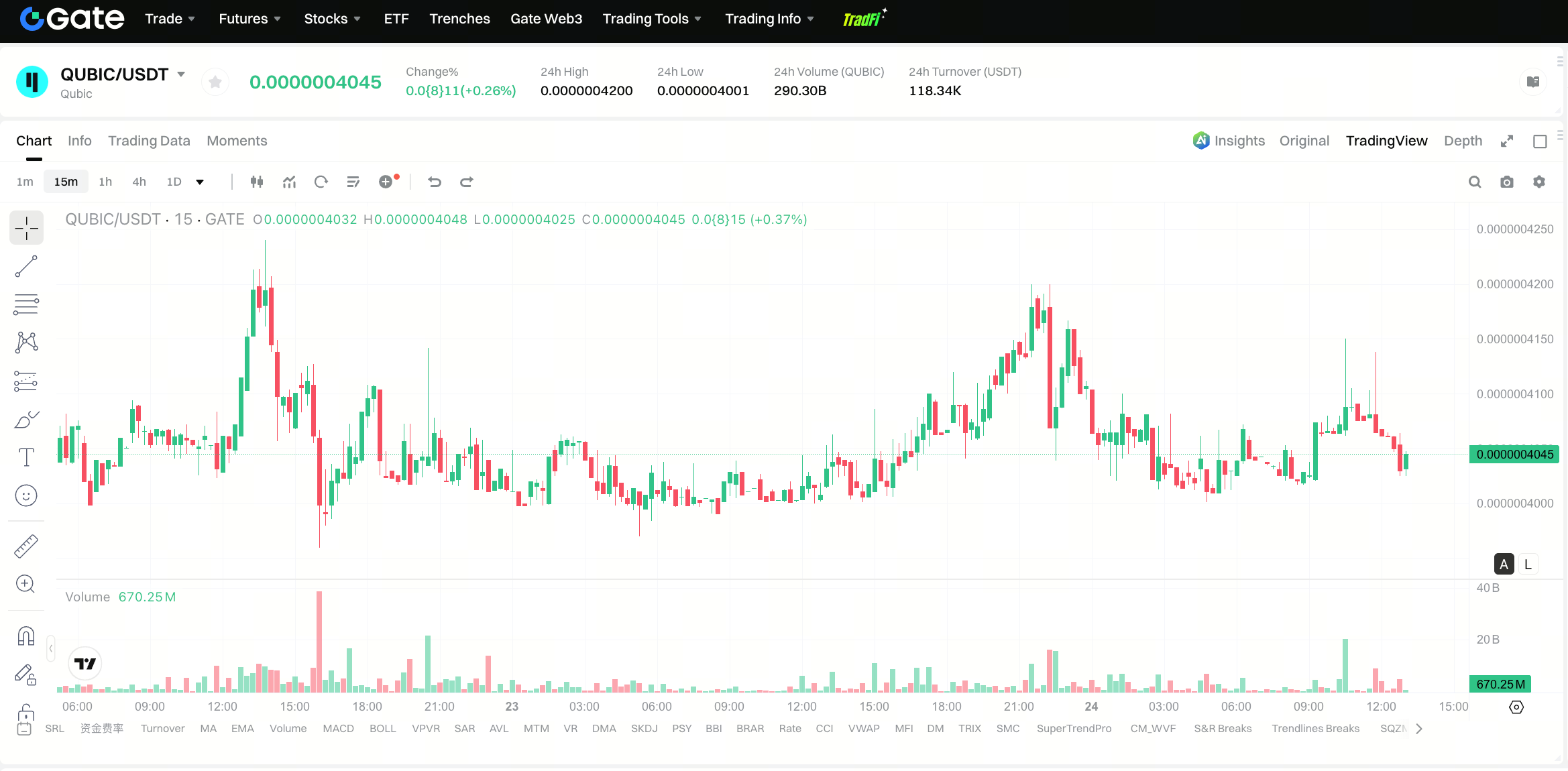
If mined QUBIC needs to be sold or topped up, the spot route follows the process for buying QUBIC on Gate; mining and buying are two independent risk exposures — the former ties to hardware operations, the latter to market prices.
Summary
Under UPoW, qubic mining turns compute into Aigarth AI training output: miners submit Solutions from CPUs and GPUs to compete in a weekly performance ranking, the top-ranked miners are elected Computors and share in protocol emissions, and regular miners settle through pools such as Qubic.li under a PPS+ model at each Wednesday epoch handover; Doge-Connect, meanwhile, mines Dogecoin on Scrypt ASICs and feeds value back into QUBIC through buybacks, running in parallel with AI training. Calculate hardware, electricity, and ranking-competition costs before joining — returns are never guaranteed.
FAQ
What is Useful Proof of Work (UPoW)?
Useful Proof of Work (UPoW) is Qubic's consensus mechanism: miner compute is used to generate and evaluate artificial neural network training data for Aigarth, instead of solving Bitcoin-style arbitrary hash puzzles. Network security is still guaranteed by computational cost, but every computation simultaneously advances decentralized AI training, and miners earn QUBIC rewards based on their training output.
How do you mine QUBIC?
The mainstream route is running the Qubic.li qli-Client on a CPU or GPU: after downloading the build for your system, connect to the pool either with a registered account's accessToken or anonymously with a wallet address, and by default you are scored on submitted Solutions under the PPS+ model, with the pool paying out at the end of each epoch (7 days, handed over on Wednesdays). Miners holding Scrypt ASICs can additionally take the Doge-Connect path to mine Dogecoin.
What is a Computor in Qubic?
A Computor is one of Qubic's fixed validators, responsible for validating transactions, executing smart contracts, and communicating with oracles. Miners join Aigarth training as Candidates, and the top-ranked miners by each epoch's Solution performance ranking serve as Computors from the following epoch; any protocol decision takes effect only when Computors reach a two-thirds-plus-one supermajority.
How are Qubic mining rewards settled?
At the protocol layer, each epoch (Wednesday 12:00 UTC to the following Wednesday 12:00 UTC) emits 1 trillion QUBIC; the theoretical reward cap per Computor is 1,479,289,940 QUBIC, with actual payouts averaging 90–98% of the cap. Miners outside the top performance ranks receive a secondary distribution from pools based on Solution performance, and mainstream pools pay immediately at the end of each epoch, including the first epoch of participation.
Can you mine QUBIC with a regular computer?
Yes. Qubic's AI training mining explicitly supports consumer-grade CPUs and GPUs: CPU participation is an intentional access design, while GPUs deliver higher output. Miners can join through the Qubic.li pool without buying specialized ASICs; only the Doge-Connect Dogecoin mining path mandates Scrypt ASIC hardware.