Qubic is a Layer 1 network founded by Sergey Ivancheglo (Come-from-Beyond, CfB), the founder who earlier co-founded Nxt and IOTA, and fair-launched in 2022. Its consensus, Useful Proof of Work (UPoW), directs miner compute toward training Aigarth, the network's decentralized AI project, with the goal of building decentralized intelligence on-chain; the base architecture of QUBIC underpins everything the token model does.
Within Qubic's design, QUBIC tokenomics ranks alongside consensus as a core layer: emissions stay constant while consumption keeps widening through burns, producing a long-term deflationary trajectory.
Key Takeaways
- QUBIC functions as "computing energy" rather than money: tokens consumed by smart contract execution and oracle calls are permanently burned, while plain transfers are completely free.
- Emissions stay constant: each epoch (7 days) mints 1 trillion QUBIC for Computors, the CCF, and QEarn, with the burn share adjusted by the Supply Watcher contract.
- Four independent burn channels — execution fees, protocol-level emissions (halving-driven), smart contract IPO Dutch auctions, and external mining surpluses — have removed over 41.5 trillion QUBIC cumulatively.
- Halvings leave the 1 trillion weekly emission untouched and only raise the burn share: Epoch 175 (August 2025) lifted the burn rate from 15% to 55%, and Epoch 227 (around August 2026) targets roughly 78.75%.
What Role Does the QUBIC Token Play in the Qubic Network?
QUBIC is the native token of the Qubic network, yet its design role is an energy unit rather than a circulating currency. Executing smart contracts and calling oracles on Qubic consumes QUBIC, which is sent to the NULL_ID zero address and burned forever; ordinary transfers cost nothing at all.
That zero-fee transfer design makes QUBIC practical for fast settlement: users can move tokens between wallets or exchanges without paying network fees, and transfers confirm quickly because no fee auction slows inclusion. On chains with congested mempools, even simple transfers can take minutes; Qubic's fast, feeless transfers are a direct consequence of treating QUBIC as energy for computation rather than as a fee market commodity. This "forget fees and delays" approach removes a common friction point found on chains where every transaction competes for block space through gas bidding.
That model differs structurally from the gas-fee design of mainstream chains: on Ethereum, gas goes to validators (with a portion burned after EIP-1559), whereas on Qubic, 100% of usage fees are burned and no party earns income from them. The Qubic whitepaper defines QUBIC as an "energy" unit of account, and Qubic vs Bitcoin vs Ethereum maps the differences across the three networks.
How Does QUBIC's Supply and Emission Mechanism Work in Practice?
QUBIC's maximum supply is 200 trillion tokens, reduced from an original 1,000 trillion cap by a 2024 Project X community vote. The network issues a fixed 1 trillion QUBIC per epoch (7 days); gross emission never changes with halvings, and epoch handover settles every Wednesday, as the Qubic official FAQ explains.
Emission distribution revolves around the Computor set. At each epoch's end, the top-ranked miners by AI training solutions become the next epoch's Computors — validating transactions, executing contracts, and earning emission rewards that typically land at 90–98% of the theoretical maximum. Emissions also flow to the CCF (about 8%) and QEarn (about 12.25%), with the remainder burned by the Supply Watcher contract; Qubic mining details how hashpower converts into seats and rewards. This emission framework works in tandem with the burn channels described below, so the network's monetary policy operates as a single closed loop rather than as separate levers.
Because the Q2 2022 fair launch involved no premine and no VC allocation, the entire circulating supply comes from weekly emissions: emissions stay flat while burns ratchet up, and total supply should peak near 196.8 trillion before declining. That peak has not yet been reached, meaning the network remains in a net expansion phase until burn volume overtakes emission volume.
What Are QUBIC's Burn Channels?
QUBIC's burn comes from four mutually independent mechanisms stacked together, all ending at the same destination: tokens sent to the NULL_ID zero address exit circulation permanently.
| Burn Channel |
Trigger |
Scale Characteristic |
Frequency |
| Execution-fee burn |
Smart contract execution and oracle calls |
Grows with network usage |
Continuous |
| Protocol-level emission burn |
Supply Watcher deducts from weekly emission at the burn rate |
550 billion QUBIC per week after Epoch 175 |
Every epoch |
| Smart contract IPO burn |
All bids in a new contract's Dutch auction |
QBridge IPO burned 547 billion QUBIC in a single event |
Each contract launch |
| External mining revenue surplus burn |
Surplus after buybacks and distributions from mining revenue |
Fluctuates with external mining income |
Settled each epoch |
Execution-fee burns are ecosystem-internal consumption: more contract execution and oracle calls mean more burns. Protocol-level emission burns are parametric: the burn rate is set by Quorum vote and stair-stepped upward by halvings. IPO and external mining surplus burns convert "new application launches" and "external income" into supply exits, pushing cumulative burns past 41.5 trillion QUBIC (Source: Qubic official blog).
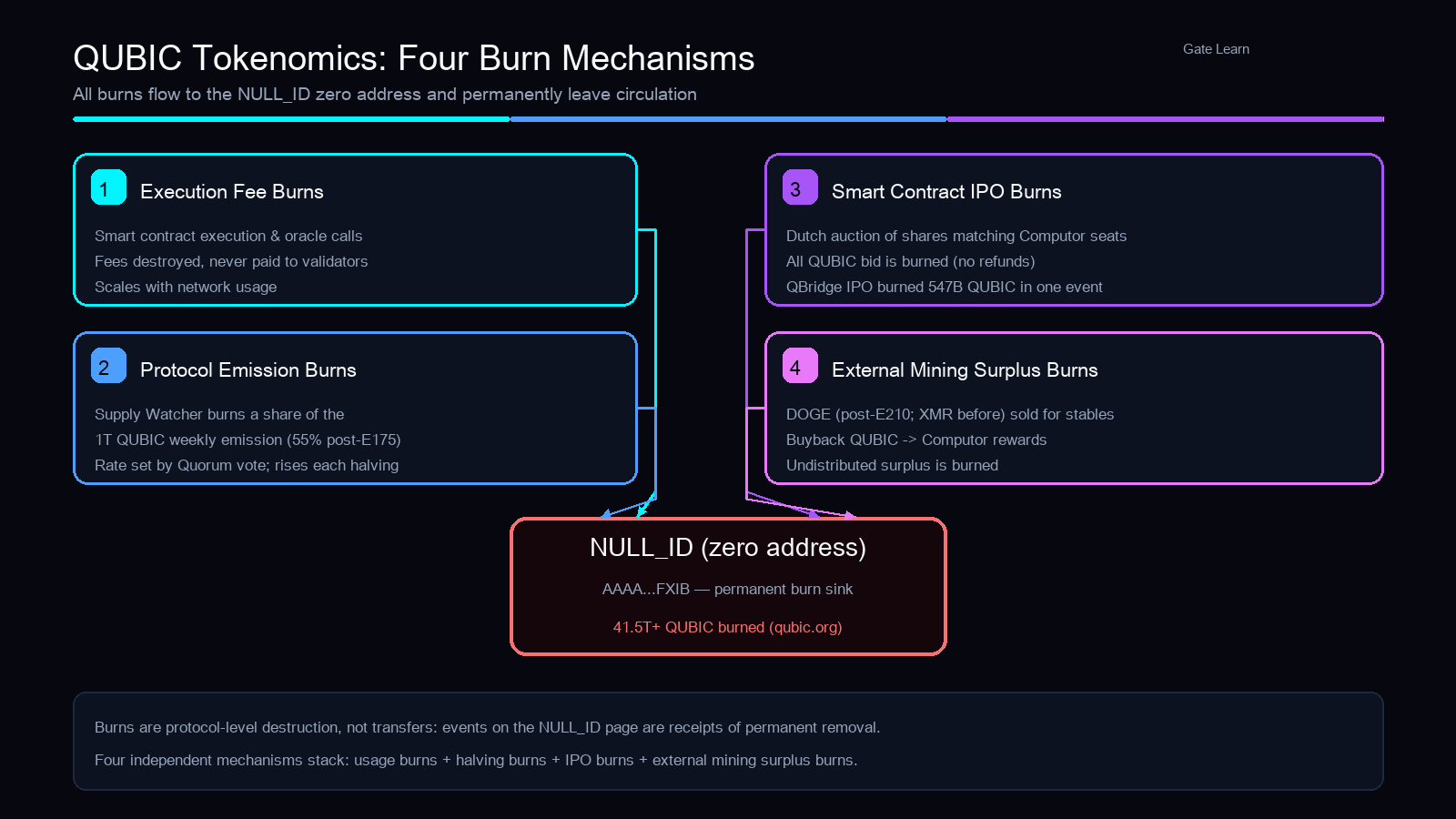
Figure 1. QUBIC's four burn channels — execution fees, protocol-level emissions, smart contract IPOs, and external mining surpluses — all flow into the NULL_ID zero address for permanent burning.
What Is the QUBIC Halving? How Does the Burn Rate Change?
A Qubic halving is a protocol event that lowers net emissions by raising the burned share of weekly emissions, unlike Bitcoin's block-reward cut: gross emission stays at 1 trillion QUBIC, the burned portion steps up, and the net supply reaching the market is halved accordingly. Halvings are scheduled at intervals of roughly 52 epochs and require a Quorum vote.
This design makes halvings a controlled supply reduction rather than a production shock. Miners still receive the same gross allocation, but the protocol burns a larger slice before rewards are distributed, which reduces sell pressure over time without abruptly cutting miner income.
The first halving took effect at Epoch 175 (August 20, 2025), lifting the burn rate from 15% to 55%: 550 billion QUBIC now burns at the protocol level every week, and net effective emissions fell from about 850 billion to about 450 billion (Source: Qubic official blog — Epoch 175 halving explainer). A second halving is planned for Epoch 227 (around August 2026), raising the burn rate to roughly 78.75% and leaving weekly net emissions near 212.5 billion.
| Time |
Epoch |
Weekly Burn Rate |
Weekly Burn Amount |
Weekly Net Emission |
| Before August 2025 |
< 175 |
15% |
150 billion QUBIC |
~850 billion QUBIC |
| August 20, 2025 |
175 |
55% |
550 billion QUBIC |
~450 billion QUBIC |
| ~August 2026 (planned) |
227 |
~78.75% |
~787.5 billion QUBIC |
~212.5 billion QUBIC |
The burn rate is not a hard-coded constant but a policy variable set by successive Quorum votes. The Epoch 175 halving proposal passed with 567 votes in favor and 56 against (Source: Qubican voting records), and the pace of future halvings depends on the Computors in office at the time. The Supply Watcher contract then enforces whatever burn rate the Quorum has accepted, automatically deducting the burned share from each epoch's emission before Computor rewards are paid.
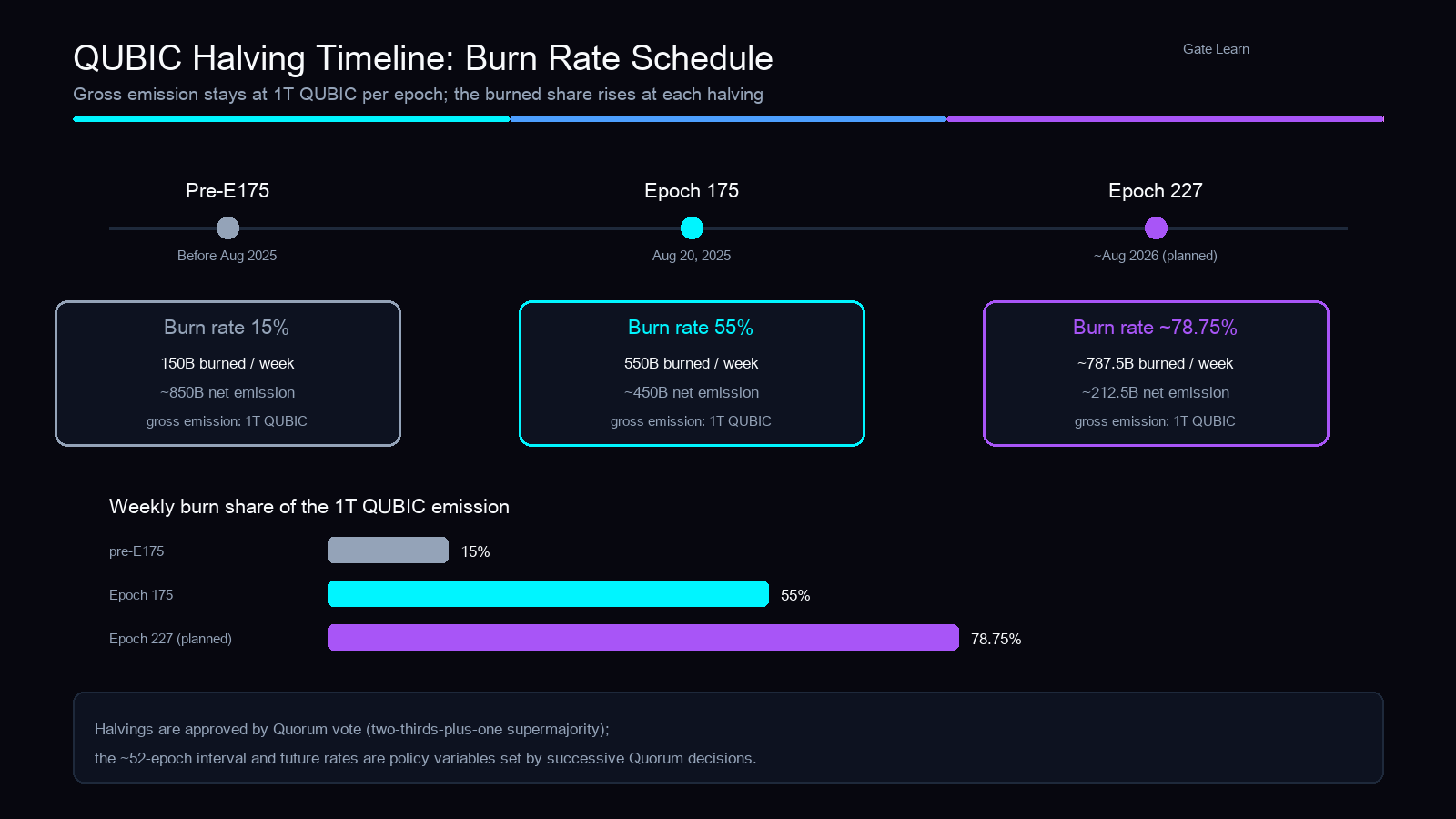 Figure 2. QUBIC's halving timeline: the burn rate rose from 15% to 55% at Epoch 175 (August 2025) and is planned to reach roughly 78.75% at Epoch 227 (around August 2026), while gross weekly emission stays fixed at 1 trillion.
What Is a Smart Contract IPO? How Does the Dutch Auction Burn QUBIC?
A smart contract IPO is the only way a new contract goes live on Qubic: the contract must first win a Quorum proposal vote — winning a two-thirds-plus-one supermajority — after which a fixed number of shares matching Computor seats are sold in a Dutch auction and every QUBIC paid is burned forever. Launching a contract thus converts directly into supply exiting circulation.
This IPO-gated launch path makes Qubic's contract ecosystem deliberately selective: only proposals that Computors believe will generate real usage are accepted, because a failed contract wastes the QUBIC burned in its auction. Developers therefore have strong incentive to build applications with genuine demand for execution and oracle calls.
A typical smart contract IPO runs as follows:
- The developer writes the contract in C++ and validates it on the testnet.
- The contract is submitted as a Quorum proposal and enters the auction schedule after receiving a two-thirds-plus-one supermajority.
- The Dutch auction opens: a fixed number of shares matching Computor seats sell at descending prices as participants bid in QUBIC.
- When the auction ends, all bids are sent to NULL_ID and burned, and shareholders earn a pro-rata split of the contract's fees.
- The contract launches on mainnet, and the QUBIC consumed by its ongoing execution keeps feeding the execution-fee burn.
Shareholders' passive income comes from contract fee splits, but joining an auction carries a certain cost: a filled bid is burned with no refund path, and if the contract sees too little usage, share income may not cover the bid. The first case, the QBridge IPO, burned 547 billion QUBIC in a single event (Source: qubic.org official blog).
How Does External Mining Revenue Affect QUBIC Supply and Demand?
External mining revenue is the only one of the four burn channels that imports value from outside the ecosystem: Qubic points its own hashpower at other PoW networks, sells the proceeds to buy back QUBIC on the open market for Computor rewards, and burns the entire surplus. Unlike execution or IPO burns, which circulate within the ecosystem, this channel's funding originates outside the Qubic system.
The exact path has evolved with the mining target. Before Epoch 210, external income came from Monero (XMR) mining, switching idle CPU cycles between AI training and RandomX hashing; after Epoch 210, it switched to Dogecoin (DOGE), mined by dedicated Scrypt ASICs running in parallel with Aigarth training. The mined DOGE is sold for stablecoins on external exchanges, which then buy QUBIC on the open market — part supplements Computor rewards, and the surplus is burned outright.
The supply-demand implications run in two layers: the buyback itself creates open-market buying pressure, and the surplus burn permanently converts external income into supply contraction, tying burn scale to external mining profitability. The purchase side is covered in buying QUBIC on Gate.
What Are the Strengths and Risks of QUBIC Tokenomics?
QUBIC's model carries structural strengths at the mechanism level, alongside limitations and risks bound to governance and adoption.
Strengths: burns are directly tied to usage, so growth in network activity converts into supply contraction; the four burn channels operate independently of one another; and the fair launch plus a fully public emission schedule makes the supply rules verifiable. In practice, this framework works best when ecosystem adoption grows, because every new contract and oracle feed adds to the burn base.
Limitations: the burn rate is a policy variable set by Quorum vote, so the timing and size of future halvings rest with the Computors in office; the deflationary effect also depends heavily on network adoption — if contract execution and IPO volume fall short, those two channels contribute far less.
Risks: QUBIC is highly volatile, and the burn mechanism is not a price-support commitment; smart contract IPO bids are burned on the spot, so participants can lose their entire bid if contract income falls short; and external mining revenue moves with DOGE prices and mining difficulty, meaning surplus burns can swing sharply with market conditions.
Summary
QUBIC tokenomics rests on a core structure of constant emissions plus escalating burns: the weekly 1 trillion emission never changes, while execution fees, protocol-level halvings, smart contract IPOs, and external mining surpluses send a growing share to NULL_ID for permanent burning, with two halvings pushing the weekly burn rate to 55% and roughly 78.75% respectively. Burning is therefore an endogenous outcome of network usage, and its long-term effect depends on Quorum governance, ecosystem adoption, and external mining income.
For readers who want to track QUBIC markets or acquire the token, it is listed on several centralized exchanges; buying QUBIC on Gate explains the steps involved. This article focuses on mechanism design rather than price action, and no content here constitutes investment advice.
FAQ
What is QUBIC tokenomics?
QUBIC tokenomics is the supply-and-consumption rulebook of the Qubic network: each epoch issues a fixed 1 trillion QUBIC distributed to Computors, the CCF, and QEarn, while execution burns, IPO burns, protocol-level emission burns, and external mining surplus burns continuously remove tokens from circulation, all under a 200 trillion supply cap. The framework works alongside Qubic's UPoW consensus and its AI training pipeline, so the same compute that secures the network also helps build Aigarth's decentralized intelligence. The model was designed by Qubic's founder Sergey Ivancheglo (Come-from-Beyond), who earlier co-created Nxt and IOTA, and the founder built token burns into consensus-level mechanics rather than adding them later.
Why is QUBIC burned?
QUBIC functions as computing energy within the Qubic network: tokens consumed by smart contract execution and oracle calls are sent to the NULL_ID zero address and permanently burned, replacing the gas fees that other chains pay to validators. Burning also serves supply management by ratcheting down net emissions so circulating supply contracts over the long term. Because plain transfers carry no fee, only productive on-chain work — running contracts and querying oracles — reduces supply.
How does Qubic burn tokens?
Qubic burns QUBIC through four channels: fee burns from contract execution and oracle calls; protocol-level burns where the Supply Watcher deducts a share of weekly emissions (55% after Epoch 175); burns of all bids in new-contract IPO Dutch auctions; and surplus burns after buybacks and distributions from external mining revenue. All burns flow into the NULL_ID zero address.
What is a Qubic smart contract IPO?
A Qubic smart contract IPO is the only path for a new contract to launch: after Quorum approval, a fixed number of shares matching Computor seats are sold in a Dutch auction where participants bid in QUBIC, all bids are permanently burned, and shareholders receive a split of the contract's fees. The QBridge IPO burned 547 billion QUBIC in a single event.
When is the next Qubic halving?
The second Qubic halving is planned for Epoch 227, around August 2026, raising the weekly burn rate from 55% to roughly 78.75%. The first halving was completed at Epoch 175 (August 2025), when the burn rate rose from 15% to 55%; further halvings require Quorum confirmation. Once the burn rate reached 55%, weekly net emissions fell by nearly half; reaching 78.75% would leave net emissions at roughly one-fifth of gross emission.