Qubic (QUBIC), Bitcoin, and Ethereum represent three generations of Layer 1 design: Bitcoin pioneered Proof of Work (PoW) in 2009, Ethereum introduced Turing-complete smart contracts in 2015 and moved to Proof of Stake (PoS) in 2022, Qubic fair-launched in 2022 with Useful Proof of Work (UPoW) plus Quorum consensus.
Their fee models follow directly from how each token is positioned: Bitcoin and Ethereum pay usage fees to miners or validators, while Qubic burns every QUBIC consumed by contract execution, a structure that sits at the core of QUBIC tokenomics. This four-dimension comparison is written for readers who already understand blockchain basics and are weighing the architectural trade-offs of different networks.
Qubic vs Bitcoin vs Ethereum: Key Takeaways
-
Consensus: Bitcoin relies on PoW miners racing to solve arbitrary hashes, Ethereum relies on PoS validators staking ETH, and Qubic directs UPoW compute toward AI training while Computors settle results via Quorum.
-
Fees: Ordinary Qubic transfers are free, and all QUBIC consumed by execution is burned; Bitcoin and Ethereum fees go to miners and validators (Ethereum burns the base fee).
-
Finality: Qubic reaches sub-second finality within a tick; Bitcoin offers probabilistic finality (6 confirmations ≈ 60 minutes); Ethereum checkpoint finality takes ~15 minutes.
-
Smart contracts: Qubic contracts are written in C++, run on bare metal, and must pass a contract IPO; Ethereum contracts run on the EVM; Bitcoin Script is non-Turing-complete.
What Is Qubic in Blockchain Technology?
Qubic is a Layer 1 network founded by Sergey Ivancheglo (Come-from-Beyond), fair-launched in 2022. Its consensus uses Useful Proof of Work (UPoW), where miner compute trains Aigarth, a decentralized AI; Computors validate transactions and execute contracts, and transfers are free. The base architecture and positioning of QUBIC are covered in the network explainer.
What Are Bitcoin and Ethereum?
Bitcoin was proposed in Satoshi Nakamoto's 2008 whitepaper and launched in 2009 as peer-to-peer electronic cash. PoW and the longest-chain rule maintain its ledger, its security model makes attacks costly through computing power, and the 21 million supply cap underpins its store-of-value role. Ethereum launched in 2015 with Turing-complete smart contracts; post-Merge in 2022 it switched to PoS, validators proposing and voting by staking ETH — security from bonded capital, not compute. Each validator stakes 32 ETH.
Qubic vs Bitcoin vs Ethereum: Core Differences at a Glance
The table below condenses the key information across consensus, fees, contracts, and energy.
| Dimension |
Qubic |
Bitcoin |
Ethereum |
| Consensus |
UPoW + Quorum BFT |
PoW arbitrary hashing + longest chain |
PoS staked validators (Gasper) |
| Ordinary transfer fee |
Zero fees |
Paid to miners, floats with block-space bidding |
Base fee burned + tip to validators |
| Finality |
Sub-second instant finality (Quorum decision within a tick) |
Probabilistic finality; 6 confirmations ≈ 60 minutes |
Checkpoint finality, usually ~15 minutes |
| Smart contracts |
C++ on bare metal, no virtual machine; contract IPO required |
Non-Turing-complete script, deliberately limited |
EVM Turing-complete contracts, deploy by paying gas |
| Compute/energy use |
UPoW trains Aigarth AI, i.e. "useful computation" |
Hashing serves network security only |
PoS needs no mining, extremely low energy |
| Where usage fees go |
All consumed QUBIC is burned |
100% to miners |
Base fee burned, tips to validators |
| These structural differences shape cost, confirmation speed, and scalability. |
|
|
|
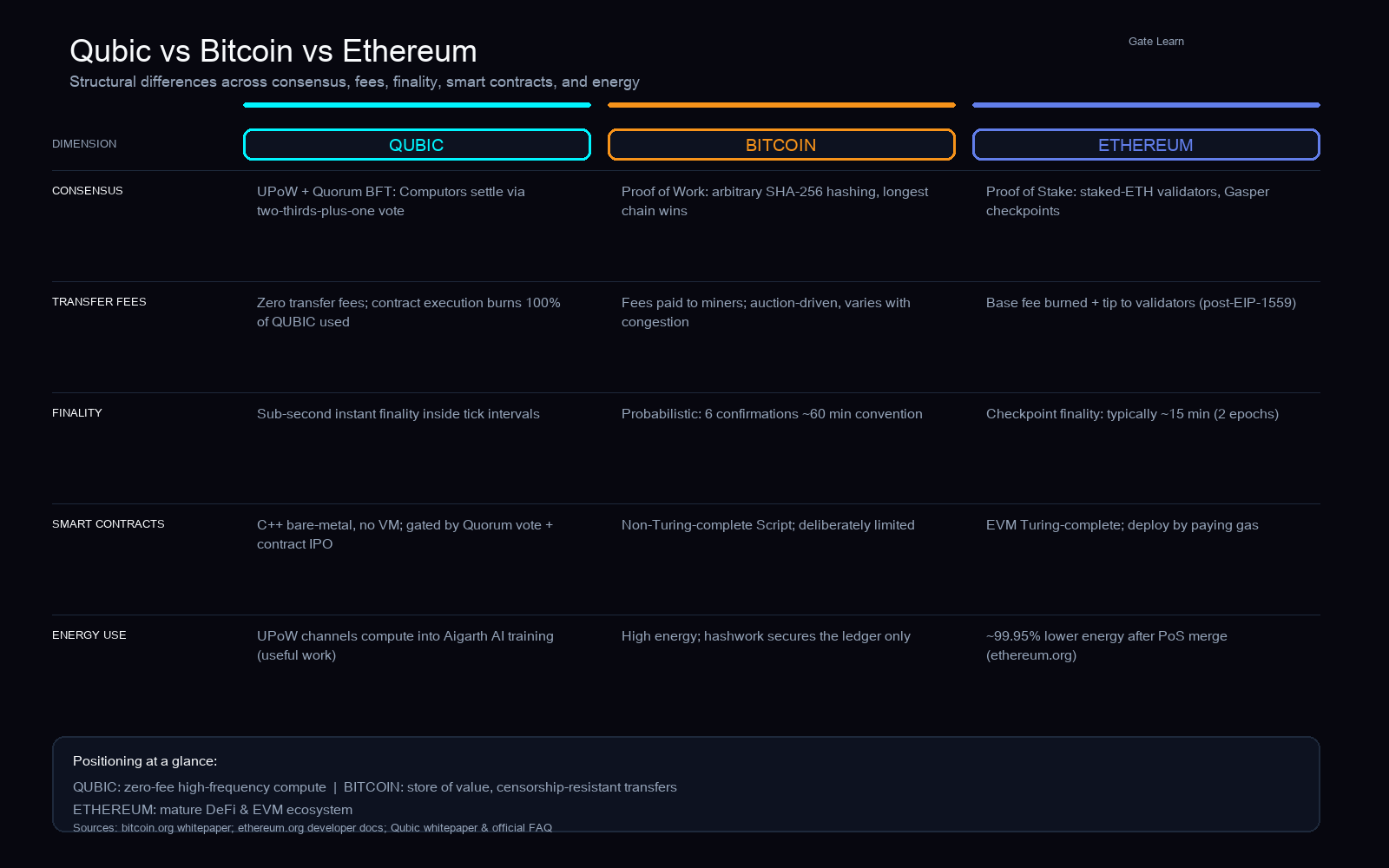
Figure 1. Structural differences among Qubic, Bitcoin, and Ethereum.
How Do Their Consensus Mechanisms Differ?
The three networks use different consensus mechanism designs, so each makes different security assumptions; official documentation gives background information.
Bitcoin's PoW requires miners to compute SHA-256 hashes until a block header meets the difficulty target; the first to find one writes the block, and the chain with the most accumulated work is canonical. The Bitcoin whitepaper explains how that work secures the chain against 51% attacks: security rises with confirmation depth, more hash power makes majority control harder (Source: Bitcoin whitepaper). Most miners join a pool to smooth rewards.
Ethereum's PoS divides time into 12-second slots grouped into 32-slot epochs. Once validators representing two-thirds of total stake link a checkpoint, the block is justified, then finalized. Slashing keeps validator incentives aligned: reverting a finalized block requires destroying one-third of staked ETH. Holders without 32 ETH can join a staking pool; PoS is based on bonded stake, not energy, and slashing adds risk when offline.
Qubic's consensus has two layers. At the UPoW layer, miners direct compute toward training Aigarth neural networks instead of arbitrary hash puzzles. At the decision layer, Computors elected each Epoch run Quorum consensus: any transaction or contract result must receive a two-thirds-plus-one supermajority — a Byzantine fault tolerant threshold (Source: Qubic FAQ). Unlike a mining pool, Computor seats are re-earned every Epoch, and Qubic mining explains how compute converts into seats and emission rewards; each Computor acts as a validator, a role called Qubic's validator set.
How Do Transaction Fees and Finality Differ?
Ordinary Qubic transfers are completely free and finalize instantly within a tick; Bitcoin and Ethereum transfers cost fees, with "probabilistic convergence" versus "~15-minute checkpoint" finality.
On fees, Bitcoin pays all transaction fees to the miner who includes the transaction, at rates set by the block-space market. Since EIP-1559, Ethereum splits fees into a burned base fee and a priority fee paid to validators, and costs rise under congestion. Qubic sets ordinary transfers at zero cost: only contract execution and oracle calls consume QUBIC, all sent to the NULL_ID zero address and burned — a fee model based on burning, "usage as burn" replacing "usage as payment". This makes transfers free.
On finality, Bitcoin has no absolute finality: rollback probability falls exponentially with each confirmation, and convention treats six blocks (~60 minutes) as the safety line. Ethereum takes ~two epochs (~15 minutes) to finalize. Qubic's Quorum consensus settles within a tick — once a two-thirds-plus-one supermajority agrees, state is final, with no "waiting for confirmations".
How Do Smart Contracts Differ?
Qubic smart contracts are written in C++ and execute on bare-metal hardware with no virtual machine; Ethereum contracts run inside the EVM sandbox; Bitcoin Script is deliberately non-Turing-complete.
Ethereum contracts are written in languages such as Solidity and compiled to EVM bytecode; any account can deploy one by paying gas — maximum openness, which is why the largest DeFi and NFT ecosystems settled there. Qubic contracts run on Computor bare-metal hardware with no VM overhead, delivering higher execution efficiency; but the launch bar differs — a contract must pass a Quorum vote, then raise funds via a Dutch-auction IPO of a fixed share count matching Computor seats, all raised QUBIC burned. Ethereum is "pay to deploy," Qubic "governance approval plus burn-based fundraising"; docs add more information.
Bitcoin Script is an intentionally non-Turing-complete stack-based language supporting limited logic such as multisig and timelocks, designed to minimize attack surface. The trade-offs: Bitcoin puts security above programmability, Ethereum puts openness first, Qubic prioritizes performance and contract screening.
How Do Energy Use and Sustainability Differ?
Each network's energy profile follows from its consensus: Bitcoin PoW consumes large amounts of electricity on hashing, Ethereum PoS uses extremely little, and Qubic tries to make similar compute yield AI value.
Bitcoin PoW's energy consumption expresses its security budget: miners spend electricity competing for block rewards, and the hash output serves no purpose beyond protecting the ledger — a "pure security expense" criticized on sustainability grounds. Post-Merge, staked ETH replaced compute races, cutting energy use ~99.95% (Source: Ethereum PoS documentation).
Qubic's UPoW keeps the "compute mining" form, with the task swapped from arbitrary hashing to Aigarth AI training: submitted solutions serve as both block-production eligibility proof and training output, so the same electricity secures the network and trains AI. UPoW does not lower energy use; it changes what that energy produces (Source: Qubic whitepaper).
Which Should You Choose?
The three networks serve different scenarios, so the choice depends on use case: Bitcoin for store of value, Ethereum for ecosystem and developers, Qubic for zero-fee high-frequency interaction.
-
Choose Qubic if… you need zero transfer fees and sub-second final confirmation, or your application demands extreme contract performance (high-frequency computation or AI inference) — accepting the IPO bar and an early-stage ecosystem with limited tooling and information.
-
Choose Bitcoin if… you prioritize store of value, large transfers, and censorship resistance — accepting ~60-minute waits and floating fees for the longest security record.
-
Choose Ethereum if… you need mature DeFi, NFT, and stablecoin ecosystems and depend on EVM tooling, communities, and audits — accepting gas costs and ~15-minute finality.
The three can be combined across these roles. QUBIC can be acquired by buying it on Gate. This is an architectural comparison, not investment advice; verify information against docs.
Summary
The differences among Qubic, Bitcoin, and Ethereum are differences in design philosophy: Bitcoin trades PoW for maximum censorship resistance and minimal functionality, Ethereum trades PoS for low energy use and the richest contract ecosystem, Qubic trades UPoW plus Quorum consensus for zero fees, sub-second finality, and bare-metal contracts. Consensus determines finality, token positioning determines fee flows, contract architecture shapes the ecosystem.
FAQ
How does Qubic's consensus differ from Bitcoin's and Ethereum's?
Bitcoin uses PoW arbitrary-hash races with the longest chain as canonical, its security depending on miners supplying computing power, not stake; Ethereum uses PoS, with staked validators proposing and voting while Gasper finalizes checkpoints; Qubic uses UPoW to direct compute toward Aigarth AI training, then has Computors settle transactions and contract results via Quorum consensus (two-thirds-plus-one supermajority), satisfying Byzantine fault tolerance. Qubic's miner incentives tie to AI training output, not hash rate, and Computors secure the ledger via quorum voting.
Are Qubic transfers really free of fees?
Yes. Ordinary Qubic transfers carry no fee. Only smart contract execution and oracle calls consume QUBIC, all sent to the NULL_ID zero address and burned — unlike "pay-to-use" models where Bitcoin fees go to miners and Ethereum tips go to validators (with the base fee burned).
What is Useful Proof of Work (UPoW)?
Useful Proof of Work (UPoW) is Qubic's modification of PoW: instead of solving arbitrary hash puzzles, miners train the Aigarth decentralized AI, and submitted solutions serve as both block-production eligibility proof and training output. UPoW keeps the mining form but lets compute generate value beyond security.
What is a Qubic Computor?
Computors are the specialized Qubic nodes that validate transactions and contract results, execute smart contracts, and vote in the Quorum — a role sometimes called the validator layer. Each Epoch re-elects the top-ranked miners by AI training output; any transaction or decision needs a two-thirds-plus-one Computor supermajority, so each acts as a validator for one Epoch.
What scenarios suit Qubic, Bitcoin, and Ethereum, and what are the trade-offs?
Qubic suits zero-fee, high-frequency, performance-intensive contract interactions, at the cost of a high launch bar and an early-stage ecosystem; Bitcoin suits store of value and censorship-resistant transfers, at the cost of slow confirmation and limited functionality; Ethereum suits development depending on mature DeFi and EVM ecosystems, at the cost of gas fees and ~15-minute finality. Neither model eliminates smart-contract exploits or bridge attacks; these are architectural comparisons, not investment advice.







