The biggest risk sits at withdrawal: QUBIC is a native Layer 1 token on the Qubic network, not an ERC-20 token. Its addresses carry a qubic_ prefix and derive from a 55-character seed, so sending QUBIC to an Ethereum wallet such as MetaMask means permanent loss. QUBIC tokenomics covers the token's role and burn mechanism, while Gate Learn's QUBIC explainer lays out the basics of the Qubic network and the token's functions.
The walkthrough below follows the order: preparation, deposit, order placement, withdrawal, troubleshooting, and a safety self-check. On-chain transfers cannot be reversed, so every step involving an address or network defaults to "verify first, then test with a small amount."
Key Takeaways
- Buying QUBIC on Gate takes four steps: create an account and complete KYC, deposit USDT, buy QUBIC/USDT on the spot market, and withdraw to a native Qubic wallet as needed.
- QUBIC is a native Layer 1 token on the Qubic network, not an ERC-20 token; withdrawals must use a native Qubic address (qubic_ prefix) and cannot be received by MetaMask.
- Before withdrawing, create the official Qubic Web Wallet (wallet.qubic.org) or official Mobile Wallet, send a small test transfer, confirm it arrives, then move the full amount.
- When depositing USDT and withdrawing QUBIC, check the network and address character by character; a wrong network or address is usually irreversible.
What Do You Need Before Buying QUBIC?
You need four things: a Gate account with KYC verification, USDT to fund the purchase, two-factor authentication (2FA), and, if you plan to self-custody, a native Qubic wallet.
| Preparation |
Details |
| Gate account |
Create an account with an email or phone number and set a strong password |
| KYC verification |
Spot trading and withdrawals usually require the corresponding tier; exact requirements vary by region |
| USDT |
QUBIC trades mainly against the QUBIC/USDT pair on the spot market, so you need USDT first |
| Two-factor authentication (2FA) |
Bind an authenticator such as Google Authenticator; used to confirm withdrawals |
| Native Qubic wallet (optional) |
If you plan to withdraw into self-custody, create and back up a seed in an official wallet beforehand |
A native Qubic wallet works nothing like an Ethereum wallet: according to the Qubic documentation, it is generated from a 55-character lowercase seed, and the public address (Qubic ID) is the 60-character string derived from it. The seed is the private key; losing or leaking it means losing the assets, so write it down and store it offline. Use the official Qubic Web Wallet (wallet.qubic.org) on the web or the official Qubic app on mobile.
Step 1: How to Deposit USDT?
To deposit USDT, the sender and Gate must select exactly the same network:
- Log in to Gate, go to Assets → Deposit, and select USDT.
- Choose a network (such as TRC-20 or ERC-20); each has its own deposit address, fee, and confirmation speed.
- Copy the Gate deposit address for that network.
- Withdraw USDT from the external side on exactly the same network, paste the address, and check the first and last several characters.
- Wait for network confirmations; the USDT then appears in your spot account.
Gate charges no deposit fee, but the sending network charges an on-chain fee; TRC-20 is usually cheaper and faster than ERC-20.
Step 2: How to Buy QUBIC on the Spot Market?
Buying QUBIC on spot means finding the QUBIC/USDT pair and choosing an order type; once filled, the QUBIC goes into your spot account:
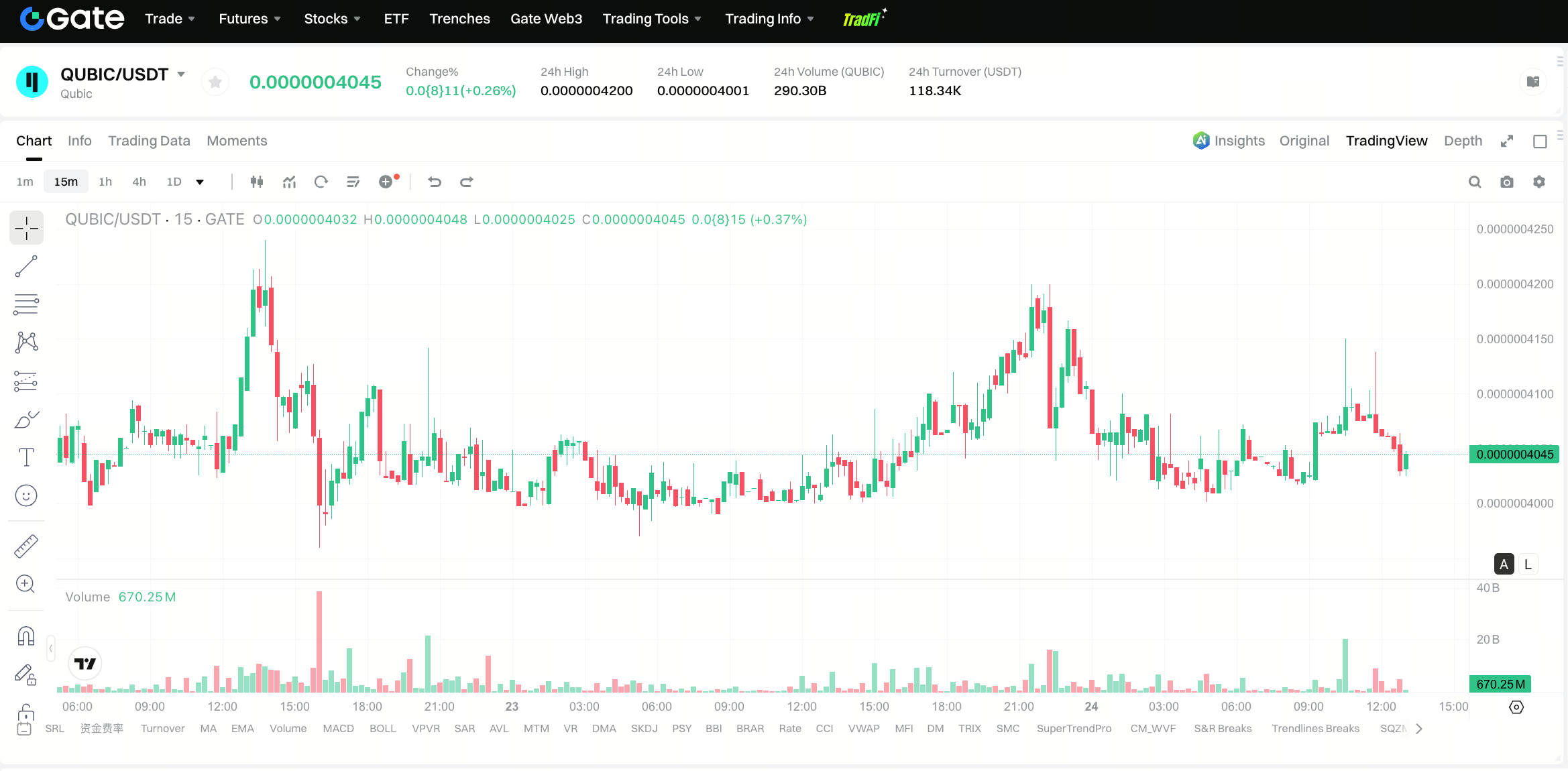
- On Gate's spot trading page, search QUBIC and select the QUBIC/USDT pair.
- Check the order book and last traded price, then choose between a market order and a limit order.
- Market order: enter the QUBIC amount to buy or the USDT amount to spend; the order fills immediately at the best available price.
- Limit order: enter your target price and quantity; the order fills when the market reaches it.
- After the fill, confirm the QUBIC balance in your spot account.
Market orders suit small purchases needing immediate execution, but the fill price depends on live order-book depth; limit orders lock in a price but execute only when the market touches it. A large market order on Gate can slip when depth is thin, so splitting the purchase into smaller orders reduces price impact. QUBIC's emission and burn background maps to the issuance-model differences in Qubic vs Bitcoin vs Ethereum, while part of its demand side comes from the output distribution of Qubic mining.
Step 3: How to Withdraw QUBIC to a Native Qubic Wallet?
Withdrawing moves QUBIC from Gate's custodial account into a self-held native Qubic wallet, and it demands the most care. QUBIC exists only on the Qubic network, so the receiving address must be a native Qubic address (60 characters, qubic_ prefix, derived from a 55-character seed); no Ethereum, BSC, or other chain address can receive it.
- Open the official Qubic Web Wallet (wallet.qubic.org) or official Mobile Wallet, log in with the 55-character seed, and copy the public address (Qubic ID).
- Check the address character by character: confirm the qubic_ prefix and that it comes from the official wallet interface, not a chat log or third-party page.
- In Gate, go to Assets → Withdraw, select QUBIC, and paste the native Qubic address.
- Confirm the withdrawal network is the Qubic mainnet (Gate shows the single supported network), and review the fee and minimum amount on the page.
- Submit a small test withdrawal first, complete the 2FA verification, and wait for it to arrive.
- Once the test amount arrives in the official Qubic wallet, withdraw the remaining balance.
Per the Qubic FAQ, the Qubic network charges no protocol-level fee for wallet-to-wallet transfers, so the withdrawal cost is mainly Gate's fixed fee, shown in real time on the withdrawal page. Withdrawing QUBIC usually requires no Memo or Tag; if the field appears, follow the on-page prompt. The network runs in 7-day Epochs, and confirmations can be briefly delayed around an Epoch transition; once the transfer lands, the balance can be checked in the official wallet.
Common Errors and How to Fix Them
Most errors happen at the "network and address matching" stage, and on-chain transfers generally cannot be reversed. Four common errors:
| Error |
Cause |
Fix |
| Withdrawing QUBIC to an ERC-20 address such as MetaMask |
Mistaking QUBIC for an Ethereum token |
No fix exists; on-chain transfers are irreversible, so confirm the qubic_ prefix before withdrawing |
| Selecting the wrong network when depositing USDT |
Sender and Gate networks differ (e.g., TRC-20 on one side, ERC-20 on the other) |
Contact Gate support immediately with the transaction hash (TxID); recovery is slow, uncertain, and may incur a fee, so match both networks exactly |
| Incomplete address copy or extra whitespace |
Missing characters or stray spaces mixed in during copying |
Check the start and end character by character before submitting; a sent transfer cannot be reversed |
| Sending a large amount without a small test first |
Skipping the test step |
If the address or network is wrong, the entire amount is lost; start every first withdrawal to a new address with a small test |
All four withdrawal errors share one trait: prevention costs far less than recovery. Wrong-address or wrong-network transfers have no undo mechanism, and recovery assistance applies only in limited scenarios with no guarantee of success. Making "verify the network, verify the address, test small first" a fixed habit avoids most irreversible losses.
Is Buying QUBIC on Gate Safe?
Safety depends on two layers: platform mechanisms and user operations. Gate offers two-factor authentication, withdrawal address management, and risk-control review, with spot account assets held in platform custody. On the user side, the main risk when buying QUBIC on Gate is not the purchase but the withdrawal and self-custody stages.
Users can run through the following checklist:
- 2FA is bound to the account, and the login password is not reused on any other platform.
- The withdrawal address comes from the official Qubic wallet interface, has been checked character by character, and has been validated by a successful small test transfer.
- The Qubic wallet's 55-character seed is written down and stored offline, never saved as a screenshot, email, or cloud note, and never imported into any multi-chain general-purpose wallet.
- All actions are performed only on Gate's official site and official apps; watch out for impersonation pages in search engine ad slots.
Custody and self-custody are different security models: keeping QUBIC in a Gate spot account means the platform safeguards the private keys, suiting ongoing trading needs; withdrawing to a native Qubic wallet means taking personal responsibility for seed storage, suiting long-term holding or Qubic ecosystem interaction. Neither is universally better; match the custody method to your usage plan and security capability.
Summary
The complete path: create an account and complete KYC → deposit USDT → buy QUBIC/USDT on the spot market → withdraw to a native Qubic wallet as needed. The purchase stage only requires understanding market vs limit orders; the real risk concentrates at withdrawal, because QUBIC is a native Layer 1 token on the Qubic network, not an ERC-20 token, and must be received at a qubic_-prefixed native address verified first with a small test transfer. For custody, Gate custodial accounts and official-wallet self-custody map to trading needs and long-term holding respectively.
FAQ
How to buy QUBIC?
Buying QUBIC on Gate takes four steps: create an account and complete KYC; deposit USDT; select the QUBIC/USDT pair on the spot market and buy with a market or limit order; and, if you want self-custody, withdraw to a native address in the official Qubic Web Wallet (wallet.qubic.org) or official Mobile Wallet.
How to store QUBIC?
QUBIC can be stored in two ways: in a Gate spot account under platform custody, suiting ongoing trading needs, or in a native Qubic wallet for self-custody. The official Qubic Web Wallet and official Mobile Wallet are generated from a 55-character lowercase seed, and the public address is a 60-character string. Self-custody requires an offline seed backup; never import a Qubic seed into a multi-chain general-purpose wallet.
Is QUBIC an ERC-20 token?
No. QUBIC is a native Layer 1 token on the Qubic network and exists only on its mainnet; its receiving addresses start with the qubic_ prefix. QUBIC has no ERC-20 contract, Ethereum wallets such as MetaMask cannot receive it, and withdrawing QUBIC to an ERC-20 address results in permanent loss.
No. MetaMask only supports Ethereum and EVM-compatible addresses, while QUBIC's native address scheme is incompatible with EVM. Sending QUBIC to a MetaMask address is irreversible; receiving QUBIC requires a native address from an official Qubic wallet.
What should I pay attention to when withdrawing to a Qubic wallet?
Four things matter: the address must come from an official Qubic wallet and start with the qubic_ prefix; check the start and end character by character after copying; send a small test transfer first and confirm arrival before moving a larger amount; and Gate withdrawals of QUBIC usually need no Memo, though confirmation may be briefly delayed around an Epoch transition.