Proof of Transfer (PoX) is a mechanism that uses Bitcoin assets to participate in network consensus. It supports the operation and security of the Stacks network. Through the transfer of value between BTC and STX, it enables block production, reward distribution, and a network incentive cycle, allowing Bitcoin to provide economic security support for a smart contract ecosystem.
As the Bitcoin Layer and Bitcoin DeFi ecosystems develop, the market has paid increasing attention to how Bitcoin’s functionality can be expanded without changing its protocol. PoX offers a new path for Bitcoin expansion. Unlike blockchains that depend on additional hash power or staking models, PoX brings BTC itself into the network operation process, enabling Stacks to build a smart contract and application layer ecosystem while inheriting Bitcoin’s security.
What Is the Core Concept of PoX?
PoX stands for Proof of Transfer. Its core idea is to use value assets from an existing blockchain to support the operation of a new network, rather than building a separate security system from scratch.
In the Stacks network, miners do not compete for block production rights by consuming large amounts of computing power. Instead, they participate in block competition by sending BTC. Once a miner successfully obtains the right to produce a block, they can receive STX rewards. At the same time, STX holders who participate in Stacking can receive the BTC sent by miners.
This mechanism creates a value cycle between BTC and STX, making Bitcoin an important part of the economic security of the Stacks network.
Why Did Stacks Choose PoX?
Bitcoin has one of the most mature security systems and the broadest decentralized network in the blockchain industry, but it does not support complex smart contracts by itself.
Stacks does not aim to rebuild a new PoW network. Instead, it seeks to expand Bitcoin’s application capabilities while preserving BTC security. For this reason, PoX was designed as a consensus mechanism that inherits Bitcoin’s security.
By allowing miners to send BTC to participate in consensus, Stacks connects network security with Bitcoin’s value system. This model avoids the need to build a new high energy PoW network, and it also differs from PoS models that rely entirely on token staking.
Within the Bitcoin Layer ecosystem, PoX has also become an important feature that differentiates Stacks from other smart contract platforms.
How Does PoX Work?
PoX’s operating mechanism revolves around two types of participants: miners and Stackers.
Miners need to send BTC to participate in block competition. The protocol selects the miner who receives the right to produce a block according to its rules, and that miner is then allowed to generate a new block. After successfully producing a block, the miner receives STX rewards.
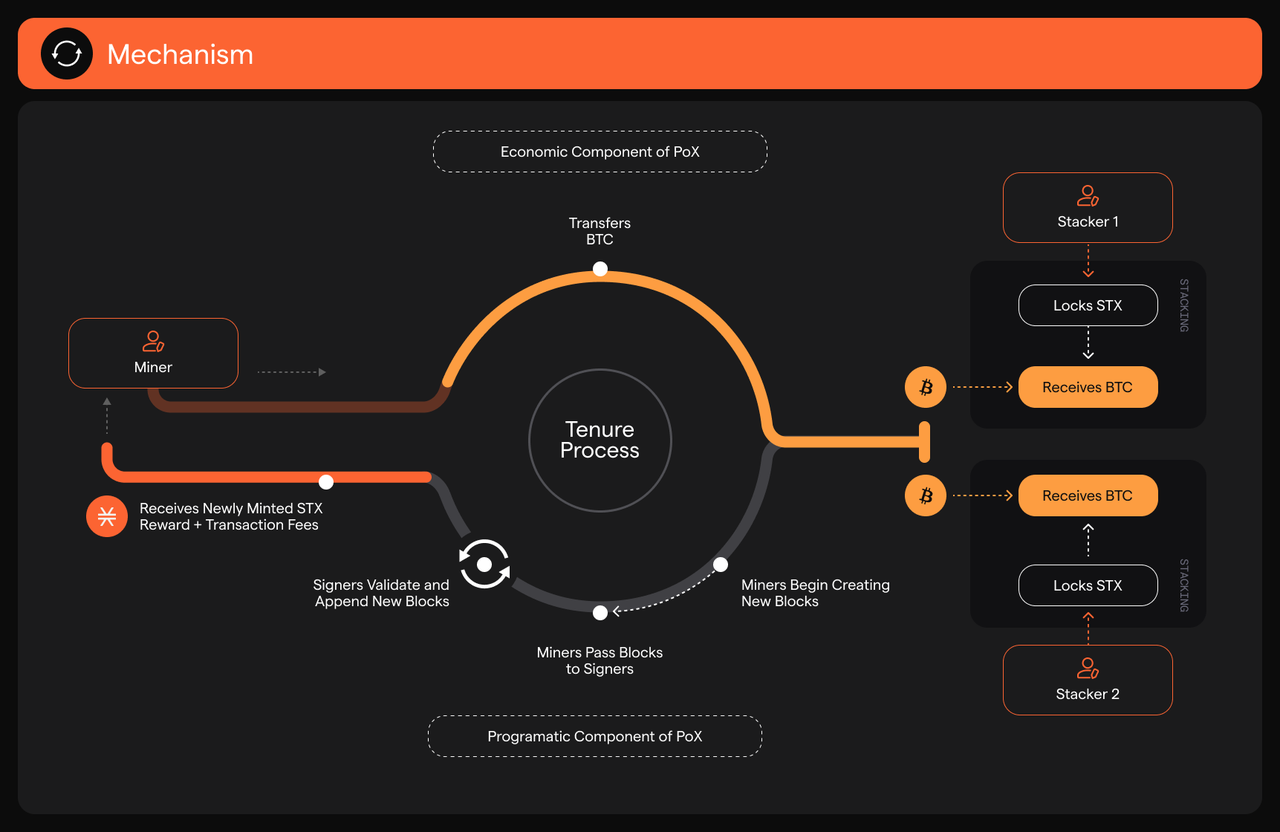
At the same time, users who hold STX can choose to participate in Stacking. Participants need to lock a certain amount of STX to support the network consensus process. In return, they receive the BTC sent by miners according to protocol rules.
The overall process can be understood as follows:
-
Miners spend BTC to obtain STX
-
Stackers lock STX to receive BTC
-
The network remains operational through the cycle between BTC and STX
This mechanism not only establishes an economic incentive system, but also further strengthens the connection between Stacks and Bitcoin.
What Role Do Miners Play in PoX?
In the PoX model, miners are responsible for producing new blocks and maintaining network operations.
Unlike traditional PoW, Stacks miners do not need to continuously consume large amounts of computing power for hash based competition. Instead, they participate in block elections by sending BTC. The protocol then selects block producers according to its rules.
Miners are willing to send BTC because they can receive STX block rewards. If miners believe that the network value and ecosystem demand for STX have long term significance, they have an incentive to continue participating in network operations.
This mechanism makes PoX more of an economic competition than a pure computing power competition.
What Is Stacking?
Stacking is a participation mechanism in the Stacks network. It has some similarities with staking in traditional PoS networks, but its reward asset is usually BTC.
When users participate in Stacking, they need to lock STX for a certain period of time. During the lockup period, participants can receive BTC distributions according to network rules.
The core role of Stacking is not only to earn rewards, but also to participate in network security and the consensus process. Since Stackers receive the BTC sent by miners, they are also an important part of the PoX incentive cycle.
Unlike traditional PoS, Stacking does not directly give users block production rights. It focuses more on network participation and reward distribution.
How Is PoX Different From PoW and PoS?
PoX, PoW, and PoS are all blockchain consensus mechanisms, but the resources they rely on and the way they operate are clearly different.
PoW depends on computing power competition. Miners need to consume energy for hash calculations in order to compete for block production rights. Bitcoin uses this model.
PoS relies on token staking. After participants lock tokens, they receive validation rights and rewards based on their holdings and the protocol rules.
PoX, by contrast, achieves consensus through value transfer. Stacks miners participate in competition by sending BTC, while Stackers lock STX to receive BTC rewards. Its core is not the consumption of new resources, but the use of an existing asset system to build network security and an incentive model.
| Consensus Mechanism |
Core Resource |
Incentive Method |
Source of Security |
| PoW |
Computing power and energy |
Block rewards |
Hash power |
| PoS |
Token staking |
Staking yield |
Locked assets |
| PoX |
BTC transfer |
BTC and STX cycle |
Bitcoin’s economic value |
How Does PoX Connect With the Bitcoin Main Chain?
One of PoX’s key features is its direct connection with the Bitcoin network.
Stacks blocks are anchored to the Bitcoin main chain through Anchor Blocks. This means that state confirmation on Stacks can use the BTC network for final settlement.
At the same time, the BTC sent by miners when they participate in PoX further strengthens the economic link between the network and Bitcoin.
This structure means Stacks is not simply a smart contract platform that is compatible with BTC. It is an application layer network deeply tied to Bitcoin’s value system.
Advantages and Limitations of PoX
The biggest advantage of PoX is that it can use Bitcoin’s existing security and economic value without rebuilding an independent PoW network. Compared with high energy hash power competition, PoX places greater emphasis on value circulation and economic incentives.
In addition, PoX strengthens the relationship between Stacks and the Bitcoin ecosystem, allowing BTC to participate in more complex on chain application scenarios.
However, PoX also has certain limitations. For example, its operating efficiency is still affected by Bitcoin’s block confirmation rhythm. At the same time, network incentives are closely linked to BTC market conditions.
For developers and users, PoX is better suited to scenarios that emphasize security and the Bitcoin native ecosystem, rather than extremely high throughput applications.
Conclusion
Proof of Transfer (PoX) is the core consensus mechanism of the Stacks network. It builds network security and an incentive system through the transfer of value between BTC and STX. Unlike traditional PoW or PoS, PoX does not rely on additional computing power or simple token staking. Instead, it uses Bitcoin’s existing economic foundation to support the operation of a smart contract ecosystem.
Through miners sending BTC, Stackers locking STX, and blocks anchoring to the Bitcoin main chain, PoX creates a deeper connection between Bitcoin and an application layer network. As Bitcoin DeFi and the Bitcoin Layer ecosystem continue to expand, PoX has also become an important mechanism for exploring Bitcoin programmability.
FAQs
How Is PoX Different From PoS?
PoS mainly relies on token staking, while PoX builds an incentive cycle through BTC transfers and STX locking.
Why Do Miners Need to Send BTC?
Miners send BTC to participate in block competition and receive STX rewards after successfully producing blocks.
Is Stacking the Same as Staking?
They are similar in some ways, but Stacking focuses more on receiving BTC distributions by locking STX, rather than directly obtaining block validation rights.
Will PoX Change the Bitcoin Protocol?
No. PoX achieves security anchoring by working together with the BTC network, without modifying Bitcoin’s underlying rules.
What Is the Main Advantage of PoX?
Its core advantage is that it uses Bitcoin’s existing security and value system to support the operation of a smart contract network.







