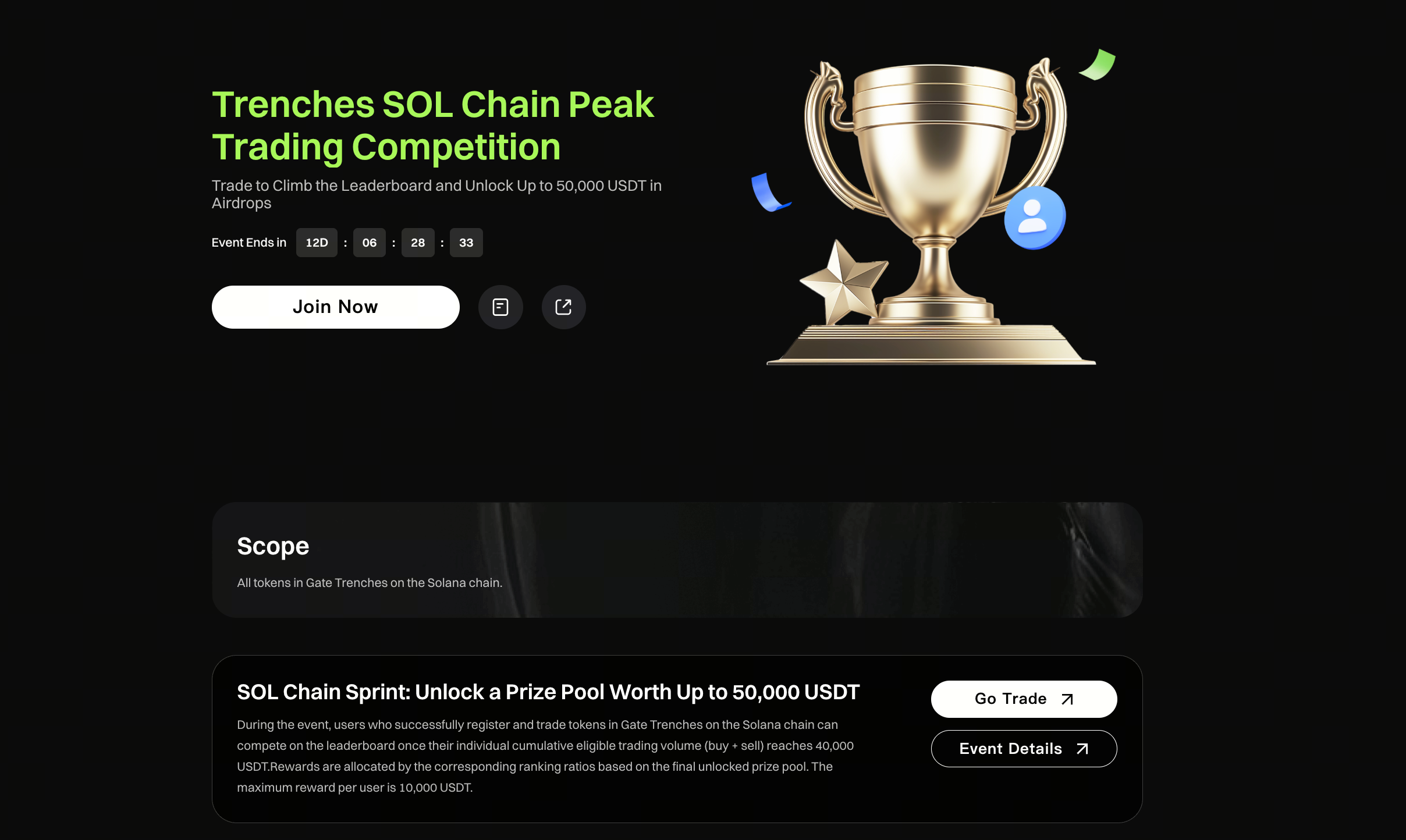
The official name is the Peak Trading Competition, and the series runs in repeating cycles, so thresholds change while the underlying arithmetic does not. In the Solana cycle that ran from 19 October to 2 November 2026, the pool was valued at up to 50,000 USDT, personal eligible volume of 40,000 USDT opened the board, and only trades placed after registration counted. The Trenches trading workflow itself is a short search-and-submit sequence; the competition sits on top of it as a rules layer. Readers who already trade onchain will find most of the mechanics familiar, and the parts that decide payouts are easy to misread.
Four numbers determine the result: the counting window, the pool tier that actually unlocks, the rank band a trader lands in, and the fee charged on both buys and sells. Each one is handled below, with dated announcements as worked examples rather than as permanent terms.
Key Takeaways
- A Trenches competition counts eligible volume, buys plus sells, only after registration and only inside the named chain's Trenches zone.
- The pool unlocks collectively from total eligible volume; only the highest tier reached is paid, and tiers do not stack.
- Individual rewards follow the final unlocked pool and the winning rank, not a user's share of total volume.
- The 0.5% trading fee applies to both buys and sells, which puts fee drag at roughly 0.5% of every unit of eligible volume.
What Is a Gate Trenches Trading Competition?
A Trenches competition is a campaign layered on the Gate Trenches product, which is an onchain trading interface where users search tokens by name or contract address and execute against Gate account balances. The campaign does not change how orders are routed. It adds three things: a measurement rule, a collective pool, and a distribution ladder.
The measurement rule decides which fills enter the score. The pool converts the combined volume of all registered participants into a payout ceiling. The distribution ladder converts rank into a percentage of that ceiling. Trenches competitions are therefore closer to a rules engine than to a lottery, because every payout traces back to a published threshold.
The same product has already carried three documented shapes, and each rewards different behaviour:
| Campaign shape |
What is measured |
How the pool forms |
How rewards are split |
Practical trade-off |
| Ranked leaderboard (Solana chain cycle) |
Buy + sell volume, single chain |
Collective tier unlock, up to a ceiling |
Fixed percentage by final rank, top 100 |
Highest volume requirement, highest upside |
| Parallel pools (Robinhood Chain cycle) |
Buy + sell volume, single chain |
Check-in, volume, leaderboard and rebate-voucher pools run side by side |
Each pool has its own rule; the volume pool is pro rata with a per-user cap |
Low entry bar, several pools can be joined at once |
| Check-in streak (BSC cycle) |
Daily volume above a small floor |
Fixed pool, first-come |
Fixed tiers for basic check-ins plus a weighted-volume pool for advanced ones |
Small rewards, minimal capital at risk |
The same product therefore supports a ranked sprint, parallel pools, and a check-in streak. Which one is running matters more than the brand name, because a check-in event and a ranked leaderboard demand very different position sizes. The Trenches vs DEX comparison covers the execution layer; the rest of this section covers the scoring layer.
How Is Trading Volume Counted — and Which Trades Don't Count?
Eligible volume counts only fills that pass four filters at once: the user registered first, the trade happened inside the event window, the token sits in the Trenches zone on the specified chain, and the fill is a buy or a sell. Anything outside that intersection contributes nothing, even if the same account traded heavily during the same period.
| Counts toward eligible volume |
Does not count |
| Buys and sells of in-zone tokens |
Deposits, withdrawals, and transfers |
| Buys and sells added together |
Cross-chain transfers |
| Fills after successful registration |
Fills placed before the "Join Now" click |
| Trades on the named chain |
Trades on other chains or other product zones |
Two implications follow. First, a round trip costs twice in fees but counts once in each direction, so the same capital can inflate eligible volume by repeated cycling; the fee arithmetic in a later section shows why that is not free. Second, arriving early is worthless without registering: volume from before the click is discarded, and it cannot be reconstructed afterwards.
The Solana cycle also required first-time Trenches users to complete a trading disclaimer quiz and sign the user agreement before the first order. That step sits ahead of registration in practice, and it is easy to lose a day to it if a trader starts during a fast market.
Page data updates hourly, while the displayed board can lag by one to two hours, and all figures are recalculated after the event closes. A ranking screenshot taken mid-cycle is an estimate, not a settlement.
Do limit orders that never fill count?
No. Volume follows executed notional, so an unfilled or partially filled order contributes only the executed portion. Resting orders that sit outside the market have no effect on the score.
How Do Prize Pool Tiers Unlock?
The pool is a staircase, not an accumulator. Total registered eligible volume is compared against a threshold table, only the highest tier reached is paid, and tiers do not stack; the announcement for each cycle carries the binding thresholds. The Solana cycle used eight steps from 750,000 USDT to 18,750,000 USDT:
| Total event volume (buy + sell) |
Unlocked pool value |
| 750,000 USDT |
2,500 USDT |
| 2,250,000 USDT |
5,000 USDT |
| 3,750,000 USDT |
7,500 USDT |
| 4,875,000 USDT |
10,000 USDT |
| 6,000,000 USDT |
12,500 USDT |
| 7,500,000 USDT |
15,000 USDT |
| 9,000,000 USDT |
20,000 USDT |
| 18,750,000 USDT |
50,000 USDT |
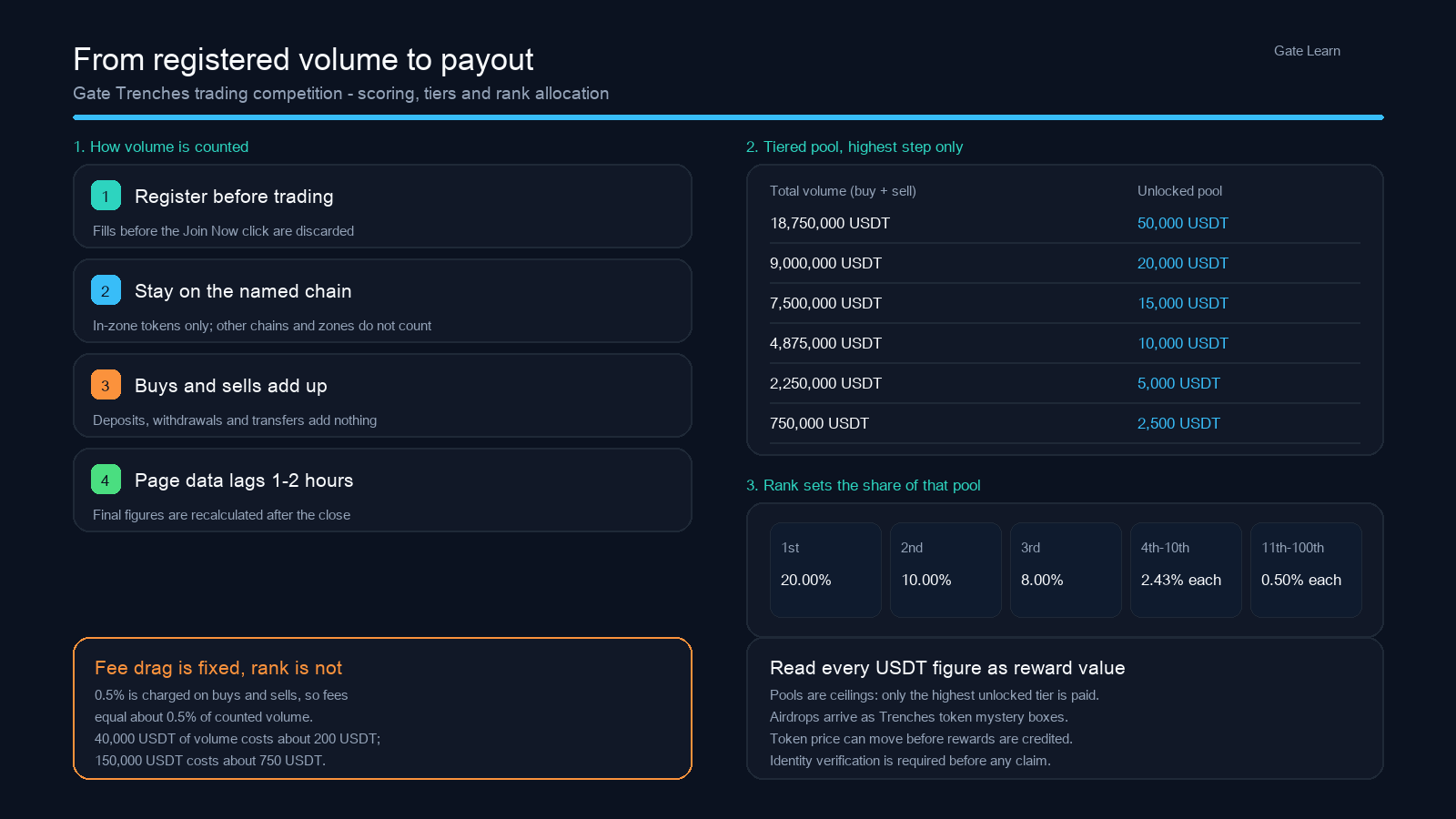
Figure 1. Registered volume passes through chain and zone filters, unlocks only the highest pool tier, and is then divided by rank band.
Read as a ratio, the staircase is not proportional. The first tier pays 2,500 USDT on 750,000 USDT of volume, or about 0.33%. The top tier pays 50,000 USDT on 18,750,000 USDT, or about 0.27%. The pool grows more slowly than the volume that unlocks it, which is why the headline ceiling says nothing about the average payout rate.
Worked example: if total volume settled at 4,000,000 USDT, the unlocked tier is the 3,750,000 USDT step, so the pool is 7,500 USDT and the 4,875,000 step never applies. A first-place finish would then be worth 1,500 USDT at the 20% allocation, and an 11th-to-100th finish 37.50 USDT.
How Does the Individual Leaderboard Work?
Rank replaces volume share in this format. A trader qualifies for the board at a personal eligible volume threshold, then receives a fixed percentage of the unlocked pool based on final position. In the Solana cycle the board opened at 40,000 USDT of personal eligible volume for the top 100, while anyone finishing in the top three also needed 150,000 USDT to claim. Clearing the threshold does not guarantee a reward: the final rank and the applicable claim conditions still apply.
| Final rank |
Share of unlocked pool per winner |
| 1st |
20.00% |
| 2nd |
10.00% |
| 3rd |
8.00% |
| 4th–10th (each) |
2.43% |
| 11th–100th (each) |
0.50% |
The percentages add up to about 100% of the unlocked pool: 20% plus 10% plus 8% plus seven payments of 2.43% plus ninety payments of 0.50%. That structure has a direct consequence. Once the board fills, extra volume near the bottom of a rank band buys almost nothing, because the band pays the same percentage whether a trader sits 11th or 100th. Moving from 11th to 10th multiplies the payout by nearly five, which is the only jump that rewards marginal volume.
Why are rewards quoted in USDT but paid in tokens?
USDT amounts describe reward value, not a stablecoin transfer. Airdrops are distributed as Trenches token mystery boxes, token prices move between settlement and credit, and rewards land within seven business days after the event ends. A quoted 1,500 USDT prize is therefore a valuation at settlement, not a guaranteed balance.
What happens when a ranked user never claims?
Claiming requires identity verification and the applicable conditions. Users who miss those conditions or are disqualified are not paid, and the slot passes to the next eligible user in rank order of eligible volume; a reassigned top-three slot still requires 150,000 USDT of personal eligible volume. The board can therefore move after the event closes, which is another reason mid-cycle screenshots are unreliable.
How Do You Join a Trenches Competition and Track Your Position?
Joining is a sequence rather than a single click, and skipping a step usually costs volume rather than producing an error message.
- Open the campaign page for the specific cycle and chain, since parallel events do not share registration.
- Complete the Trenches disclaimer quiz and sign the user agreement if the account has never traded in the zone.
- Click "Join Now" and confirm registration before placing any order; registration also completes the event's pre-trade risk screening.
- Trade in-zone tokens on the named chain, using the scanning new Trenches listings check for contract address and network on each order.
- Review the board periodically, remembering that displayed data can trail by one to two hours.
- Complete identity verification before the claim window, then claim within the stated period.
Tracking position is mostly arithmetic. Divide personal volume by the current entry threshold to see whether the board is reachable, then compare the resulting rank band against the pool tier that seems likely to unlock. Both numbers can change until settlement.
What Is the Real Cost of Competing?
Cost is predictable even when rank is not. The Trenches trading fee is 0.5% on both buys and sells, so fees equal 0.5% of eligible volume regardless of how many round trips produced that volume; the launch announcement states the unified rate. Slippage and token price movement sit on top, and the 0.5% Trenches trading fee breakdown explains why the confirmation screen can differ from the headline rate.
| Eligible volume |
Trading fees at 0.5% |
11th–100th share (50,000 pool) |
4th–10th share (50,000 pool) |
| 40,000 USDT |
about 200 USDT |
250 USDT |
1,215 USDT |
| 75,000 USDT |
about 375 USDT |
250 USDT |
1,215 USDT |
| 150,000 USDT |
about 750 USDT |
250 USDT |
1,215 USDT |
| 300,000 USDT |
about 1,500 USDT |
250 USDT |
1,215 USDT |
The table makes the trade-off explicit. At the 40,000 USDT entry threshold, fees of about 200 USDT sit close to the 250 USDT paid to the 11th-to-100th band at full pool, leaving almost no room for slippage or a softer token price. A 4th-to-10th finish at the same volume pays 1,215 USDT and widens the margin. Above 150,000 USDT, fee drag exceeds the low band entirely, so volume only makes sense when it is defended by a high rank.
Three costs sit outside the fee column. Gas or network fees vary by chain and congestion; slippage on thin tokens can exceed the trading fee, and a large exit may need to be split; and the mystery box carries token price risk between settlement and credit. Liquidity checks belong in the same review as the fee check.
How Do Trenches Competitions Compare With WCTC?
The two campaign families measure different things. A Trenches competition scores raw onchain notional on one chain. WCTC scores weighted trading volume across spot, futures, stocks, event contracts, options, and CFDs, then routes participants into solo, team, and head-to-head boards.
| Dimension |
Trenches competition |
WCTC |
| Instruments |
Onchain tokens in the Trenches zone |
Spot, futures, stocks, event contracts, options, CFDs |
| Measurement |
Raw buy + sell notional, chain-scoped |
Weighted volume, with different multipliers per product |
| Pool formation |
Collective tier unlock against a threshold table |
Dynamic competition pools plus fixed activity pools |
| Distribution |
Fixed percentage by rank band |
Board-specific rules, including team and head-to-head structures |
| Capital profile |
Small, fast, repeated exposure to volatile tokens |
Broader market access, larger notional, leverage available |
Neither structure is universally better. A trader who already holds onchain tokens and checks liquidity before entering fits the Trenches format; a trader who wants cross-market exposure and team mechanics fits WCTC. Reading the measurement rule first prevents the common mismatch of optimising volume in a format that weights it differently.
What Mistakes and Risks Should You Check Before Joining?
Most failures come from rule mismatch rather than from trading losses. The five below account for a large share of forfeited volume.
| Mistake |
Cause |
Fix |
| Volume recorded as zero |
Traded before clicking "Join Now" |
Register first, then trade |
| Only part of the volume counts |
Mixed chains or traded outside the zone |
Confirm chain and zone on each order |
| Volume lost at settlement |
Assumed a mid-cycle rank was final |
Recheck after the close, before claiming |
| Reward smaller than expected |
Read the pool ceiling as a guaranteed payout |
Calculate the unlocked tier and the rank band |
| Rewards withheld |
Wash trading, self-matching, coordinated trading, or bulk account registration |
Multiple accounts under one verified user count as one |
Beyond the rules, the assets themselves carry risk. Trenches zone tokens include newly issued and low-liquidity markets, where price can move sharply, exit liquidity can thin out, and imitation contracts can share a name and ticker with a real project. Chain-level conditions and regional restrictions apply as well, and users in the UK and other restricted regions may be unable to take part; identity verification is required before any claim. Campaign terms can also be revised between cycles, so each event page governs its own settlement.
Summary
A Gate Trenches trading competition converts registered onchain volume into a collective pool, then distributes that pool by leaderboard rank. The counting rule is narrow, the pool unlocks in non-cumulative tiers, and the payout follows rank percentages rather than volume share.
Three checks make the format legible before any capital moves. Confirm that registration precedes trading and that every order sits on the named chain and zone; calculate the tier that current volume would unlock instead of reading the ceiling as a payout; and compare the 0.5% fee on eligible volume against the rank band a realistic position can reach. The same review applies to whether the cycle is a ranked sprint, a parallel-pool event, or a check-in streak, since each shape rewards different behaviour.
FAQ
How much trading volume do I need to rank in a Gate Trenches competition?
A ranked cycle sets two separate numbers. The Solana cycle opened the top-100 board at 40,000 USDT of personal eligible volume, and required 150,000 USDT from anyone finishing in the top three. Both figures are campaign terms that change between cycles, so each event page should be read before sizing a position.
Is the prize paid in USDT?
No. USDT amounts describe the value of the reward, and airdrops are distributed as Trenches token mystery boxes within seven business days after the event ends. Because token prices move, the credited value can differ from the quoted figure at settlement.
Does trading before registering count toward the competition?
No. Only fills made after successful registration, inside the event window, on the specified chain and zone, are counted. Volume from before the click is discarded and cannot be added later.
How much does it cost in fees to reach the entry threshold?
At the 0.5% fee charged on both buys and sells, fees equal about 0.5% of eligible volume. Reaching 40,000 USDT of eligible volume therefore costs roughly 200 USDT in trading fees before slippage and token price movement, and 150,000 USDT costs roughly 750 USDT.
Are Trenches competitions the same as WCTC?
No. A Trenches competition scores raw onchain notional on a single chain and distributes a threshold-based pool by rank. WCTC scores weighted volume across spot, futures, stocks, options, and CFDs, and runs separate solo, team, and head-to-head boards with their own pools.