For traders using Gate Trenches to access emerging digital assets, those distinctions matter. The trading fee is relatively predictable. Network demand and liquidity aren't. Knowing what each cost represents can help smaller investors and active traders estimate whether a transaction still makes sense after fees are included.
Key Takeaways
-
Gate Trenches currently applies a 0.5% trading fee to buy and sell transactions under the new fee structure announced on September 7, 2026.
-
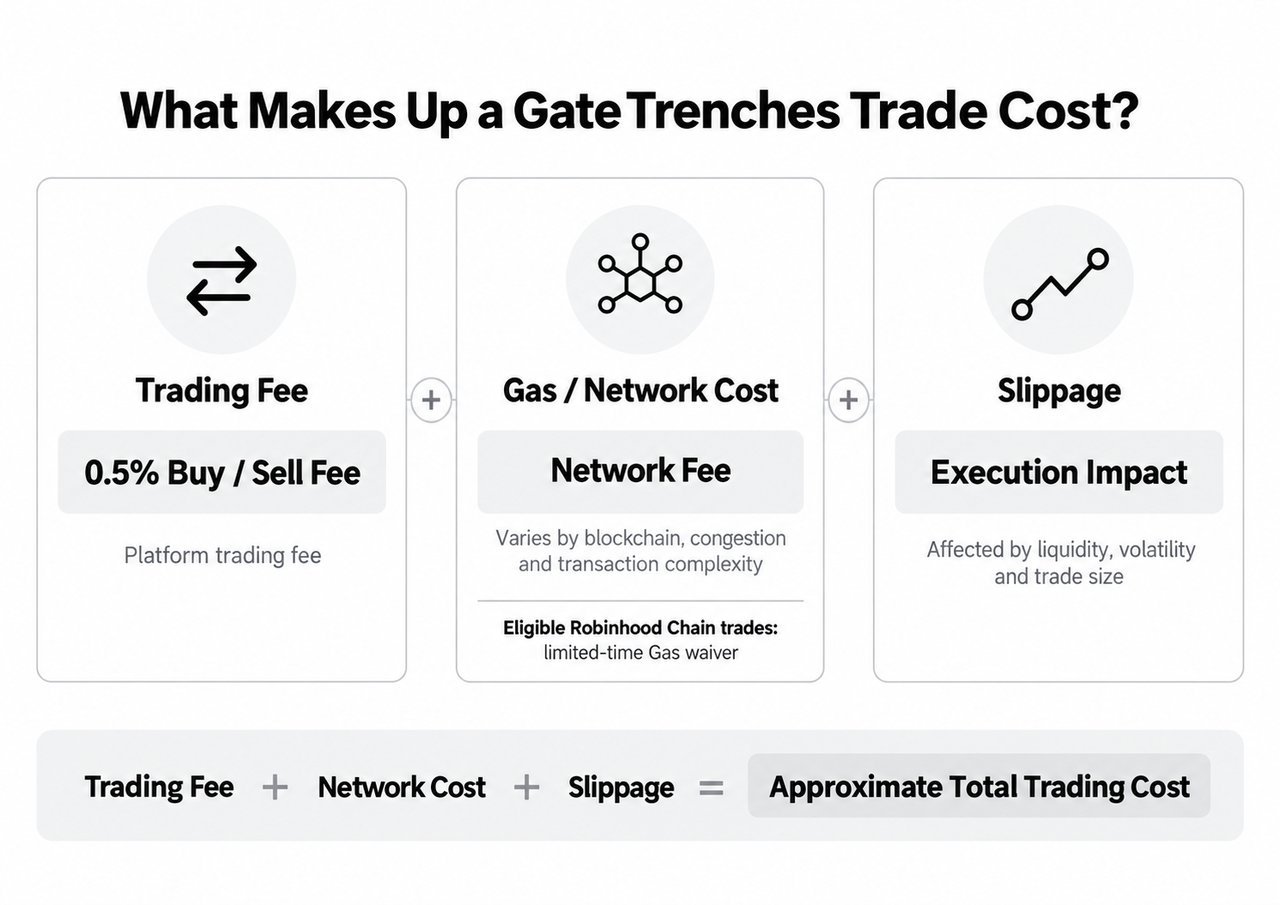
Trading fees, Gas fees and slippage are different components of the actual cost of an onchain transaction.
-
Gas fees fluctuate based on network demand, congestion and the computational effort required to process a transaction.
-
Gate currently applies a limited-time Gas fee waiver to eligible Robinhood Chain transactions through Trenches.
-
Trading directly from a Gate account can remove some external-wallet transfers, but it doesn't eliminate every possible trading or network cost.
Gate Trenches Fees Explained: Trading Fees and the New Fee Structure
Gate introduced the current Trenches fee structure on September 7, 2026. Buy and sell trades are charged at a rate of 0.5%, with the rate applying across the Web interface and Gate App. Older App versions below 8.36.0 may still display the previous 0.8% figure, although Gate states that settlement is calculated based on the 0.5% rate.
A simple example shows how the percentage works. If the transaction value is 1,000 USDT and the entire trade is subject to a 0.5% fee:
1,000 USDT × 0.5% = 5 USDT
A later sale is another transaction and can incur another trading fee.
Unlike some traditional financial services, this percentage model doesn't operate like a broker charging a fixed commission or minimum fee for each trade. In conventional stocks and other financial assets, brokers may use commissions, transaction-based charges, account expenses or other fee arrangements. Investor.gov notes that transaction and ongoing fees can reduce investment returns over time, which is especially relevant for long-term investors repeatedly paying costs across a portfolio.
That comparison shouldn't be confused with Gate Stocks, which belongs to a different product category. Gate Trenches is designed around supported onchain assets, so the cost structure and execution mechanics differ from those associated with traditional stocks, brokers or securities-related regulatory fees.
How Gas Fees and Network Costs Work
Gas is the unit used to measure computational effort on networks such as Ethereum. Users pay Gas because validators and the network need resources to process transactions and execute smart-contract operations.
On the Ethereum blockchain, Gas prices are commonly expressed in gwei, a fraction of ETH. One gwei represents one-billionth of ETH, making it a convenient smallest denomination-style unit for quoting Ethereum Gas prices.
Ethereum's fee system combines a base fee with a priority fee. The actual cost is determined by the amount of Gas consumed and the applicable fee per unit of Gas. Ethereum's official documentation explains that a priority fee can be used to signal urgency, while the base fee changes according to block demand.
For Ethereum network transactions, the simplified relationship is:
Transaction fee = Gas used × applicable Gas price
The Gas limit sets the maximum amount of Gas a transaction is allowed to consume. A simple payment requires less work than complex operations involving smart contracts and the Ethereum Virtual Machine. Ethereum documents a standard ETH transfer as requiring a 21,000-unit Gas limit, while more complicated smart-contract transactions can require substantially more computational work.
Why Ethereum Gas Fees Fluctuate Based on Network Congestion
Ethereum Gas fees aren't permanently fixed. They respond to demand for block space.
When network congestion increases, more users are competing to have transactions processed. Ethereum adjusts its base fee according to how full previous blocks were relative to the target size. When demand falls, the base fee can decrease.
Timing transactions can therefore matter. A user executing a non-urgent Ethereum transaction when demand is lower may encounter a lower cost than someone submitting the same type of operation during a period of heavy activity.
Complex operations also require more Gas. A transaction that interacts with several smart contracts or performs multiple calculations through the Ethereum Virtual Machine uses more computational resources than sending an asset from one address to another.
The catch is that Gate Trenches supports more than the Ethereum network. Gate lists networks including Solana, BNB Chain, Base, Arbitrum, Polygon, Sui, Avalanche and others, so Gas terminology and fee calculation can differ between blockchain networks.
Can Gate Trenches Reduce Gas Costs?
Gate Trenches can reduce some of the friction created by moving assets between an exchange account, an external wallet and an onchain application.
For example, a trader can use supported assets from a Gate account when executing trades through Trenches rather than first withdrawing USDT to a separate wallet. Fewer transfers can mean fewer blockchain transactions, fewer approval steps and fewer opportunities to incur additional network fees.
Gate's onchain token trading workflow similarly centers token discovery, market information and execution within the account-based workflow.
That advantage doesn't mean every Trenches trade is Gas-free.
Gate currently applies a limited-time Gas fee waiver for eligible Robinhood Chain assets traded through Trenches. Gate said the end date would be announced separately, so traders shouldn't treat the waiver as a permanent part of the fee structure.
On other networks, applicable blockchain costs can still depend on transaction type and network conditions.
Trading Fees vs. Actual Trading Costs
The stated trading fee is only one part of the amount a trader can ultimately incur.
| Cost component |
What affects it? |
| Gate Trenches trading fee |
Current platform fee structure |
| Gas or network fee |
Blockchain, congestion and computational work |
| Slippage |
Liquidity, transaction value and volatility |
| Additional transfers |
Whether funds need to move between addresses or services |
Slippage is particularly important when trading small or volatile tokens. Suppose a token displays a market price of 1 USDT. If there isn't enough liquidity available at that price, a larger buy may consume several price levels and execute at an average price above 1 USDT.
In that situation, the trader may pay more through execution impact than through the formal 0.5% trading fee.
This is one reason the top meme coin trading platforms can't be compared only by headline fees. Liquidity, supported networks, execution mechanics and available market information also affect practical trading costs.
How Traders Can Reduce Costs When Executing Trades
There isn't one strategy that guarantees the lowest cost, because different parts of the transaction respond to different conditions.
On networks where Gas changes with demand, traders can sometimes reduce costs by taking advantage of periods with less congestion. Ethereum's official Gas documentation shows that its base fee increases or decreases according to network utilization. Ethereum gas and fee documentation
Order size also matters. A large transaction in a thin market may create significant slippage. Smaller transactions can sometimes reduce price impact, although splitting a trade may result in paying trading or network fees multiple times.
Investors should therefore compare the expected total amount received or spent rather than focusing only on one percentage.
The same principle exists outside crypto. Investor.gov explains that investors should examine the total fees associated with buying and selling investments rather than concentrating on a single commission. Investor.gov explanation of investment fees FINRA also explains how commissions and other costs can affect brokerage transactions. FINRA fees and commissions overview
Costs Aren't the Only Risk
Lower fees don't make an onchain asset safer.
Before executing trades, users still need to verify the network and contract address, especially when tokens with similar names exist. Liquidity, holder concentration and smart-contract risk can matter far more than saving a fraction of a percentage point in fees.
The process described in how to check if a meme coin is legit includes checking contract details and other warning signs before putting money at risk.
Social signals deserve the same caution. Crypto callouts and KOL signals may help traders identify narratives or unusual attention, but they don't determine whether the token has enough liquidity for efficient execution.
Conclusion
Gate Trenches fees currently begin with a 0.5% trading fee on buys and sells, but the total cost of a trade can include more than that percentage. Applicable Gas or network costs depend on the blockchain and transaction, while slippage depends heavily on liquidity, volatility and transaction value.
Trading directly from a Gate account can reduce some multi-wallet friction and unnecessary transfers. Eligible Robinhood Chain transactions also currently benefit from a limited-time Gas waiver. Still, the most useful cost calculation is:
Trading fee + applicable network cost + slippage = approximate total trading cost
For traders comparing strategies, that complete figure matters more than any single advertised fee.
FAQs
What are the current Gate Trenches trading fees?
Gate Trenches currently applies a 0.5% fee to buy and sell transactions under the fee structure announced on September 7, 2026. Older Gate App versions may display the previous 0.8% rate, but Gate says actual settlement uses the 0.5% standard.
Are Gas fees included in the Gate Trenches trading fee?
Not necessarily. The platform trading fee and blockchain network costs are separate components. Users may incur applicable Gas or network fees depending on the blockchain and transaction being processed.
Does Gate Trenches have zero Gas fees?
Not across every network. Gate currently provides a limited-time Gas fee waiver for eligible Robinhood Chain assets traded through Trenches, and the company has said the end date will be announced separately.
Why do Ethereum Gas fees fluctuate?
Ethereum Gas fees fluctuate based largely on network demand. When blocks are more heavily used, Ethereum's base-fee mechanism can raise the price of computation; when usage falls, the base fee can decrease.
What is the Gas limit?
The Gas limit is the maximum amount of computational work allocated to a transaction. Complex operations involving smart contracts generally require more Gas than simple payments because the Ethereum Virtual Machine has more instructions to execute.
Can timing transactions reduce Gas costs?
Sometimes. On networks where fees respond to congestion, submitting a non-urgent transaction during periods of lower demand may reduce costs. The saving isn't guaranteed because demand can change quickly.
Do minimum fees or regulatory fees apply to Gate Trenches?
Gate's September 7 Trenches announcement specifies the 0.5% buy-and-sell trading fee and the temporary Robinhood Chain Gas waiver; it doesn't describe Trenches using the traditional brokerage concepts of minimum commissions or securities regulatory fees. Those terms are more commonly associated with brokers and conventional financial-asset transactions.
Is the 0.5% fee the total cost of a Gate Trenches transaction?
No. Actual costs can also include network charges and slippage. For thinly traded tokens, price impact can sometimes be larger than the formal trading fee, so the expected execution price should be checked before confirming the transaction.
Disclaimer: This content is for educational purposes only and does not constitute financial or investment advice. Onchain assets can involve substantial price, liquidity, smart-contract, execution and network risks.