Gate Idle Earn is Gate’s idle-stablecoin yield product: after a one-time enable, the system takes a daily average snapshot of eligible USDT, USDC, and other supported stablecoin balances in Spot and Futures trading accounts, then calculates and credits yield on a T+1 schedule. Funds stay in the original accounts and remain tradable; live APR and rules appear on the Idle Earn product page.
Idle Earn sits in Gate’s Earn menu as a snapshot service for capital that already lives in trading workflows, not as a separate locked vault subscription. It differs from Simple Earn—which uses active subscribe/hold paths for idle tokens—and from GUSD on-demand Treasury-style products that require an active GUSD subscription. Soft Staking may appear nearby as a separate flexible-staking neighbor, not as an alias for Simple Earn.
For a side-by-side map, see Idle Earn vs Simple Earn and GUSD. For enable steps and balance checks, see how to enable Idle Earn. Product labels, supported coins, and displayed APR change on the live Idle Earn page; do not treat a promotional rate in any article as fixed.
Key Takeaways
Gate Idle Earn accrues yield from daily average snapshots of eligible available stablecoins in Spot and Futures trading accounts after a one-time enable; no fund transfer is required for the base path.
Borrowed assets, open-order frozen amounts, margin-occupied balances, and lending-pool borrowed (non-owned) funds do not count; Corporate/Institution accounts are not eligible.
Qualifying snapshot amounts are mapped one-to-one in the backend to asset certificates linked to compliant real-world U.S. Treasury asset yields; everyday accrual does not require minting and holding GUSD.
Assets stay labeled as trading-account stablecoins and remain usable for trading; interest is based on the previous day’s valid snapshot balance and any trading-volume bonuses.
What is Gate Idle Earn?
Gate Idle Earn is a Gate Earn-line feature that pays yield on idle stablecoins such as USDT and USDC held in trading accounts through daily average balance snapshots, without requiring a classic lock-and-stake subscription for each accrual day. The product targets capital that regularly sits as available stablecoin inventory between trades, while still allowing those same balances to support spot or derivatives activity under Gate’s account rules.
Mechanically, Idle Earn is closer to a balance-based accrual service than to a dual-currency structured note or a hard lock staking product. Users who have completed individual KYC enable the feature once on the product page or in-app Earn surface; Gate then measures eligible available balances, maps qualifying amounts to backend yield accounting, and credits interest automatically. UI wording can differ across Web and App, so readers should match the live Idle Earn surface rather than a single marketing phrase.
Idle Earn sits next to Simple Earn, Soft Staking, Dual Investment, and GUSD-linked Treasury style products inside Gate’s broader earn and wealth menu. Each product answers a different job: Idle Earn answers “stablecoins sitting in Spot and Futures trading accounts,” Simple Earn answers “subscribe/hold idle tokens under Simple Earn rules,” Soft Staking answers “selected holdings with flexible staking-style rewards,” and GUSD on-demand Treasury style products answer “subscribe into a GUSD voucher that tracks disclosed Treasury and related yield sources.” Choosing by workflow first—tradable idle funds versus subscribed earn—avoids mixing products that share a “low-risk style” narrative but use different participation UX.
How does Gate Idle Earn work?
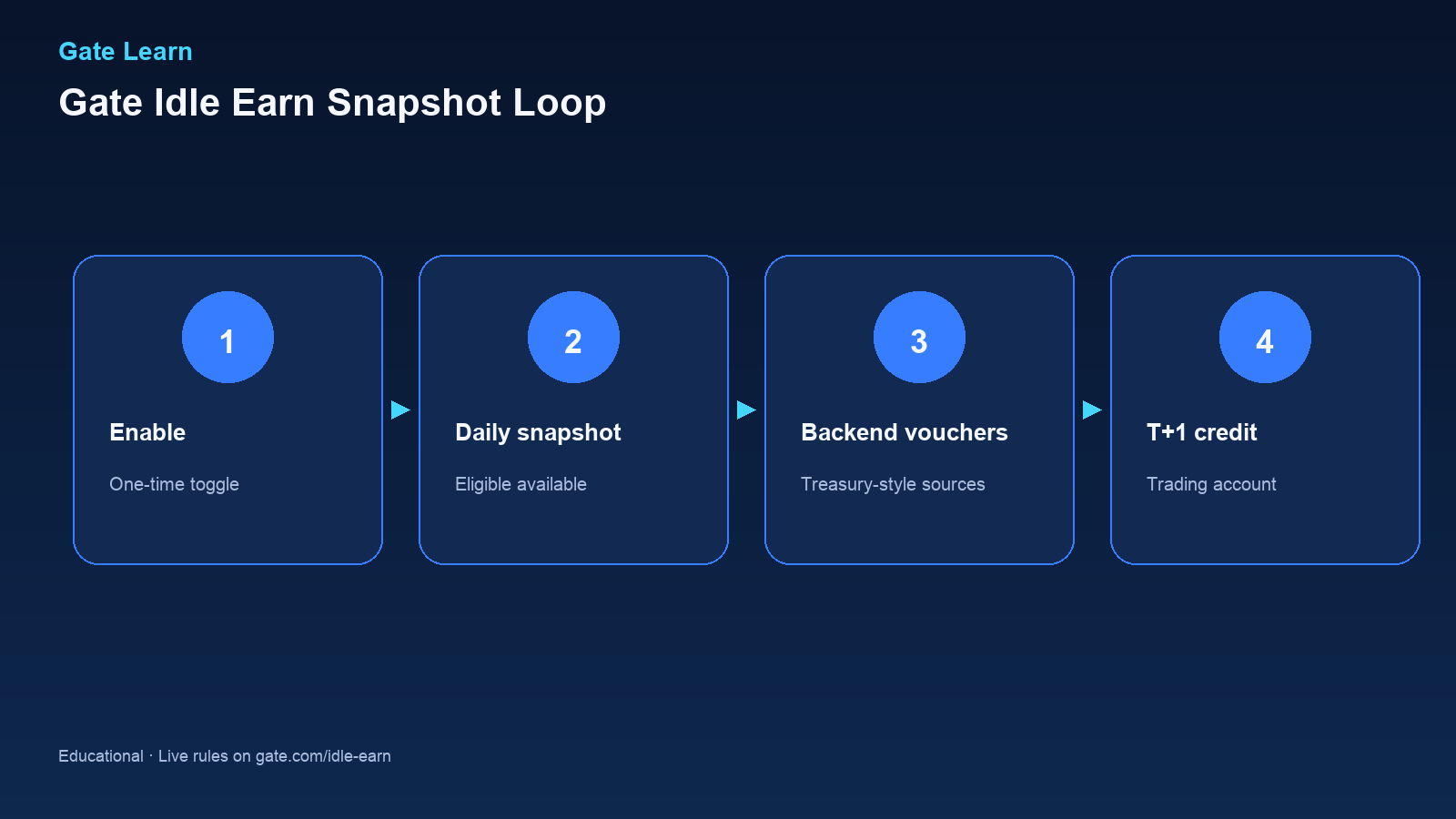
The Idle Earn loop has four educational steps. First, the user enables Idle Earn once under Earn → Idle Earn on the Idle Earn page or the matching App entry. Second, Gate takes a scheduled daily automatic snapshot of available stablecoin balances across Spot and Futures trading accounts; funds do not need to move. Third, eligible snapshot assets are mapped one-to-one in the backend to asset certificates linked to compliant real-world U.S. Treasury asset yields. Fourth, interest is calculated from the prior day’s valid snapshot balance and any trading-volume bonuses, then credited automatically on a T+1 path—typically to the Spot Account, per the live product FAQ.
“Funds stay in place” means the user does not need to move coins into a separate locked vault for each accrual day. It does not mean every unit of equity always qualifies. Open orders, futures margin, and borrowed liquidity can shrink the effective snapshot even when the UI still shows a large total balance. Exact T-day snapshot windows and T+1 credit cutoffs follow the live product FAQ, not a fixed article clock.
Gate has also outlined a possible future path: consolidating daily snapshots and displaying them as GUSD certificates for Launchpool and related on-platform activities, without requiring users to convert trading balances into held GUSD. Treat that as a plan that may change, not a feature already live in the wallet. Neighboring Simple Earn or Soft Staking offers may sit near Idle Earn in the menu; those products still use different participation mechanics even when marketing language mentions idle assets.
Which balances count toward the effective snapshot?
Effective snapshot balance is the subset of stablecoin inventory that Gate’s risk and product rules treat as eligible idle capital—typically above any minimum effective balance threshold disclosed on the live page. Supported coins usually include USDT, USDC, and other stablecoins listed on the Idle Earn surface. Snapshot scope covers available balances in Spot and Futures trading accounts under those rules.
Balances that do not count include:
Borrowed assets
Assets frozen by open orders
Assets occupied as margin
Funds borrowed through lending pools (non-owned liquidity)
Corporate/Institution verified accounts are not eligible for Idle Earn. Users who see “available snapshot funds” much lower than total equity should review each exclusion row before assuming a display error.
Because futures and spot often share the same user’s capital stack on Gate account setups, a large open position can reduce Idle Earn accrual even when Spot still shows idle USDT. That interaction is central: trading availability and yield eligibility are linked through the same balance, not through two disconnected wallets. The same exclusion list and T-day snapshot / T+1 credit pattern appear in the Idle Earn announcement.
How is Idle Earn different from Simple Earn and GUSD on-demand Treasuries?
Simple Earn focuses on subscribe/hold paths for idle tokens under Simple Earn product rules. It is not primarily a trading-account daily average snapshot of idle USDT and USDC. Soft Staking may appear as a separate neighbor for flexible staking-style rewards on selected holdings; Simple Earn must not be treated as Soft Staking.
GUSD on-demand U.S. Treasury style products typically require an active subscription that converts supported stablecoins into GUSD vouchers at a one-to-one style rate, then accrues disclosed yield while GUSD is held under product rules. Idle Earn does not require that conversion for everyday trading balances: the user keeps USDT or USDC labels in the trading account while backend certificates handle yield accounting.
Dimension
Gate Idle Earn
Simple Earn
GUSD on-demand Treasuries
Primary inventory
Eligible available stablecoins in Spot / Futures trading accounts
Idle tokens under Simple Earn subscribe/hold rules
Subscribed GUSD voucher balance
How users join
One-time enable; daily average snapshot
Active subscribe / hold under Simple Earn
Active subscription / conversion into GUSD
Locking for accrual
No classic lock vault for each accrual day on the base path
Both Idle Earn and GUSD-linked Treasury style products may point to low-risk style asset sources such as Treasuries and RWA-linked structures, but participation UX differs. Same yield-source family does not mean identical eligibility, redemption, or activity stacking rules. Region-specific availability, English versus localized labels, and account-type gates can change which offer appears first in the earn area.
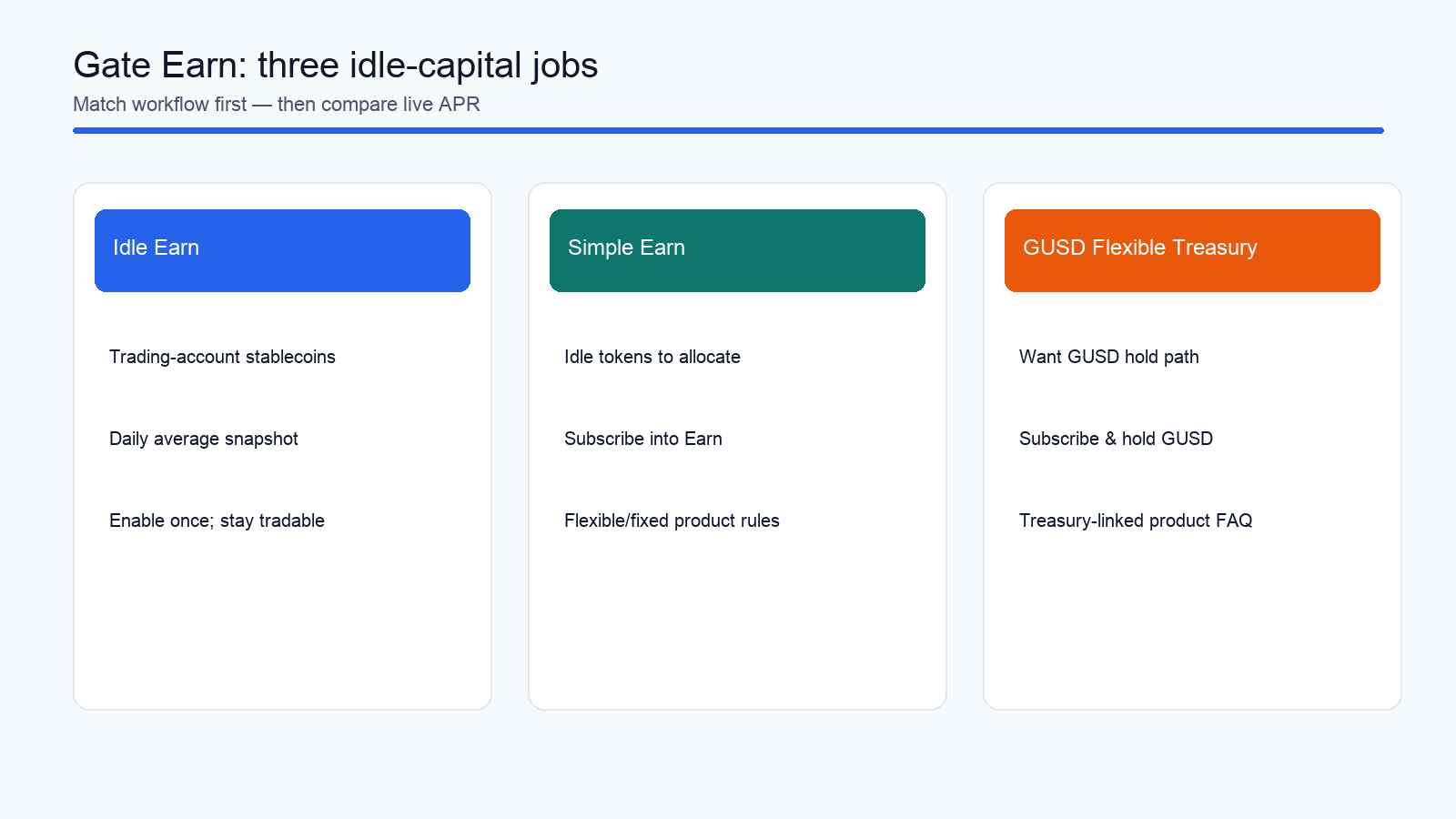
Figure 2. Participation comparison of Gate Idle Earn, Simple Earn, and GUSD on-demand Treasury-style products.
What should users check before enabling Idle Earn?
Before enabling, users should confirm individual KYC completion, account-type eligibility, supported stablecoins, how “available snapshot funds” is calculated, and where interest is credited. They should also read that Corporate/Institution accounts are blocked and how borrowed or margin capital is excluded. Live APR figures on the Idle Earn page can change; always check the page itself rather than freezing a campaign rate from elsewhere.
Opening Idle Earn after reviewing Simple Earn and GUSD on-demand Treasury style offers helps select the right job for idle capital. Soft Staking can be checked separately if the inventory is selected flexible-staking holdings rather than trading-account stablecoins. Check specific supported coins, specific exclusion rows, and the time window used for daily average snapshots. Users who actively trade futures should model how margin occupancy reduces snapshot size on high-utilization days. Users who keep large open spot orders should model order freezes the same way. Idle Earn is most coherent for capital that regularly sits as available stablecoin inventory between trades.
According to the product page, yield sources include U.S. Treasuries, money market funds, on-chain staking, and RWA, and Idle Earn does not participate in high-risk quantitative strategies, high-risk on-chain products, or algorithmic stablecoins. Language that Gate assumes principal-protection risk and publishes transparency reports is product-term wording—not a guarantee of principal, and not a bank-deposit guarantee. For broader context on how proof-of-stake network rewards work as one of several yield-source families, readers can review how Proof of Stake works on Ethereum’s developer docs; that background is conceptual and does not describe Idle Earn’s own payout engine. For a complementary overview of short-term U.S. government securities as a reference asset class, see the U.S. Treasury’s Treasury bills overview.
What are the advantages, risks, and limits of Gate Idle Earn?
Advantages include low operational friction after a one-time enable, continued trading access to the same balances, and a product story tied to disclosed low-risk style yield sources rather than a dual-currency conversion bet. Daily automatic credit reduces the need to claim rewards manually when rules say auto-payout. Backend one-to-one certificate mapping keeps everyday UX labeled as trading-account USDT or USDC while connecting qualifying amounts to disclosed Treasury / RWA-style sources.
Limits include strict effective-balance filters, Corporate/Institution exclusion, dependence on Gate’s product and risk engines, and APR displays that can move with market and program parameters. Trading-volume bonus components, if any appear on the live page, add another variable to a comprehensive APR label and should be treated as rules parameters, not guaranteed returns.
Risks include platform and counterparty structure risk common to centralized earn products, stablecoin issuer and peg risk on the underlying coins, rule changes for eligibility and payout timing, and opportunity cost when capital is used for trading instead of remaining in the snapshot. Principal-protection style wording on product pages is subject to live terms—not a bank deposit guarantee. Idle Earn is not a bank deposit and is not investment advice. Displayed APR labels can change; borrowed, frozen, and margin-occupied balances can be excluded; Corporate/Institution accounts are blocked. Simple Earn, Soft Staking, and Idle Earn remain different pieces of the Gate Earn menu. Pick the product by workflow first—trading liquidity versus subscribed earn—then compare live APR information on each product page.
Summary
Gate Idle Earn is a snapshot-based idle stablecoin yield product for Spot and Futures trading-account balances. Users enable once; Gate snapshots eligible available USDT, USDC, and other supported coins; qualifying amounts are mapped to backend certificates linked to disclosed Treasury style sources; and yield credits on a T+1 schedule while funds remain tradable. Simple Earn and GUSD on-demand Treasury products remain adjacent but distinct paths; Soft Staking is a separate neighbor. Effective balance exclusions and live page APR rules determine what actually earns.
FAQ
What is Gate Idle Earn?
Gate Idle Earn is an idle-stablecoin yield feature that accrues interest from daily average snapshots of eligible available balances in Spot and Futures trading accounts after the user enables the product once. Funds stay labeled as trading-account stablecoins and do not need a separate locked vault for each accrual day.
Can Idle Earn funds still be used for trading?
Yes under product design: balances stay in trading accounts and can be used for spot or derivatives activity. Orders, margin, and borrowing can reduce the effective snapshot that earns yield even when total equity still looks large on the account overview.
Where does Idle Earn yield come from?
According to the product page, sources include U.S. Treasuries, money market funds, on-chain staking, and RWA, with backend one-to-one certificate mapping for qualifying snapshot amounts; Idle Earn does not participate in high-risk quantitative strategies, high-risk on-chain products, or algorithmic stablecoins. Read live product disclosures rather than treating any article figure as a fixed rate.
Which balances are excluded from Idle Earn snapshots?
Borrowed assets, open-order frozen amounts, margin-occupied balances, and lending-pool borrowed (non-owned) funds do not count toward the effective snapshot. Corporate/Institution accounts are not eligible. Always confirm on the live Idle Earn rules.
When is Idle Earn interest credited?
Under product rules, the system takes a T-day average snapshot and calculates and credits interest on T+1, typically to the Spot Account. Exact cutoff times follow the live Idle Earn FAQ.
Author: Jayne
Disclaimer
* The information is not intended to be and does not constitute financial advice or any other recommendation of any sort offered or endorsed by Gate.
* This article may not be reproduced, transmitted or copied without referencing Gate. Contravention is an infringement of Copyright Act and may be subject to legal action.
Yala is a modular Bitcoin DeFi infrastructure that connects BTC liquidity with multi-chain ecosystems through its YU stablecoin and MetaMint protocol. It enables Bitcoin holders to earn native DeFi yields across EVM and non-EVM networks securely and seamlessly.
Sui is a PoS L1 blockchain with a novel architecture whose object-centric model enables parallelization of transactions through verifier level scaling. In this research paper the unique features of the Sui blockchain will be introduced, the economic prospects of SUI tokens will be presented, and it will be explained how investors can learn about which dApps are driving the use of the chain through the Sui application campaign.
PAXG (Pax Gold) is a tokenized asset backed by physical gold, issued by the fintech company Paxos and traded on the Ethereum blockchain as an ERC-20 token. The core concept is to tokenize physical gold on-chain, with each PAXG token representing ownership of a certain amount of gold. This structure enables investors to hold and trade gold in the form of a digital asset.
Hyperliquid's vision is to develop an on-chain open financial system. At the core of this ecosystem is Hyperliquid L1, where every interaction, whether an order, cancellation, or settlement, is executed on-chain. Hyperliquid excels in product and marketing and has no external investors. With the launch of its second season points program, more and more people are becoming enthusiastic about on-chain trading. Hyperliquid has expanded from a trading product to building its own ecosystem.
PAXG (Pax Gold) is a tokenized asset backed by physical gold reserves, launched by fintech firm Paxos and issued as an ERC-20 token on the Ethereum blockchain. The core concept is to digitally represent real-world gold assets, allowing investors to hold and trade gold via the blockchain network. Because each PAXG token corresponds to a specific quantity of physical gold, its price is theoretically expected to closely track the global gold market.