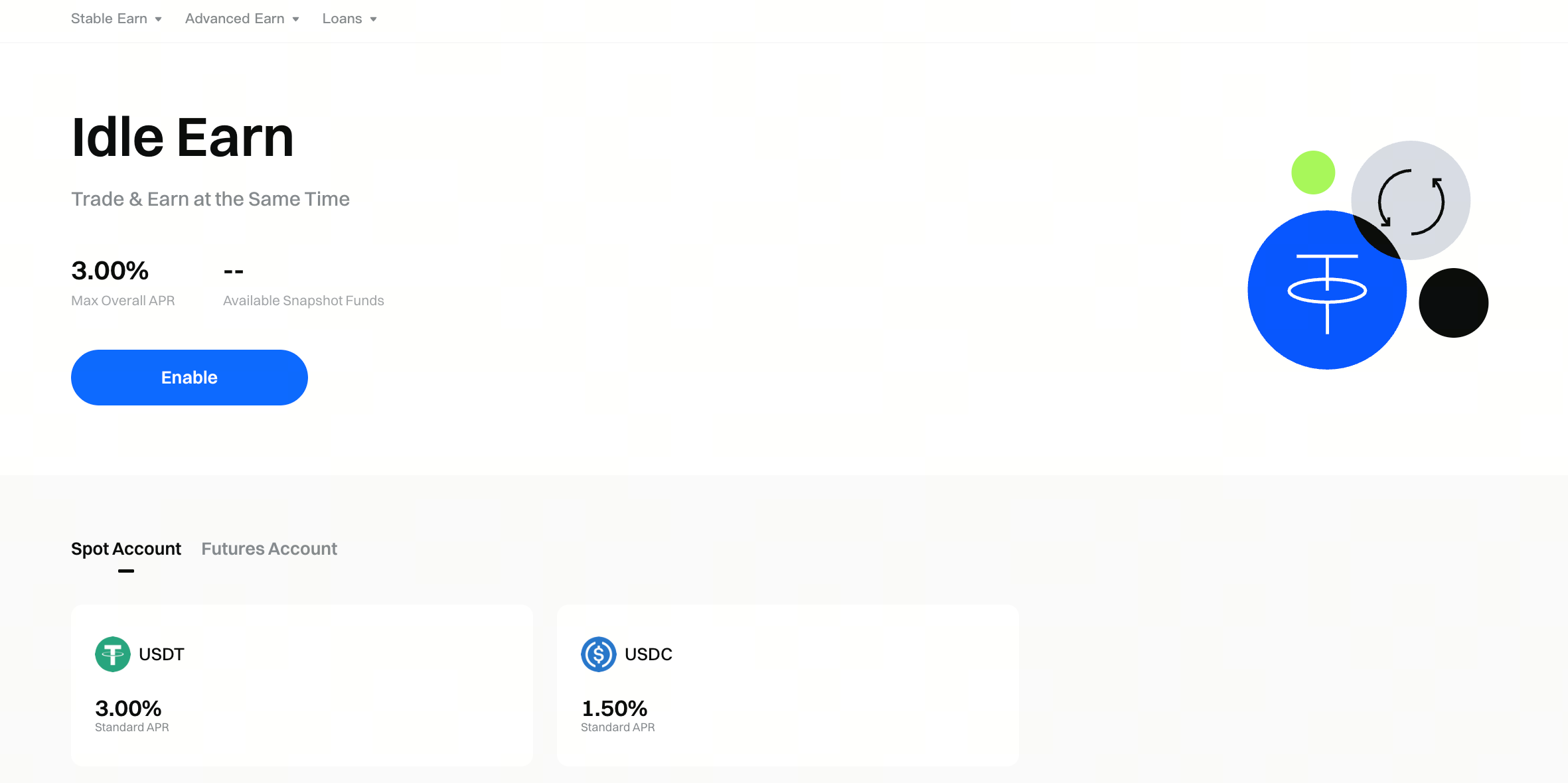
Gate Idle Earn fits idle USDT or USDC that stays in Spot and Futures trading accounts and earns via daily average snapshots after one enable; Simple Earn—English menu often framed as “Earn interest with idle tokens”—fits capital allocated into flexible or fixed Earn subscription paths; GUSD Flexible US Treasury fits users who actively subscribe and hold GUSD for disclosed Treasury-linked yield. Shared earn-menu language does not make participation UX, asset labels, or accrual bases identical.
What Is Gate Idle Earn covers the snapshot model and eligibility filters; this comparison keeps Simple Earn and GUSD Flexible US Treasury in short definitions and focuses on participation, liquidity, and accrual differences. For enable steps and effective-balance checks, use how to enable Gate Idle Earn. Live APR, caps, and stacking rules always override educational tables—confirm on each product page, including the Idle Earn surface and the related Gate announcement. Soft Staking is a separate neighbor product and is not the same as Simple Earn.
Key Takeaways
Idle Earn: enable once; daily average snapshots of eligible available stablecoins in Spot and Futures trading accounts; funds need not move for the base path.
Simple Earn: idle-token yield via flexible or fixed subscription into an Earn path—allocation into Earn, not a trading-account snapshot-in-place.
GUSD Flexible US Treasury: active subscribe and hold GUSD to earn; Idle Earn does not require subscribe or convert for everyday balances.
Choose by workflow first (snapshot-in-place vs allocate into Earn vs hold GUSD), then compare live APR labels on each product page.
What Is Gate Idle Earn?
Gate Idle Earn is Gate’s idle-stablecoin yield product built around a daily average snapshot of eligible available balances in Spot and Futures trading accounts. After a one-time enable, qualifying USDT, USDC, and other supported stablecoins can accrue yield without recurring subscribe or lock steps for the base path, and the same balances remain usable for trading subject to effective-balance exclusions.
Eligible assets captured in snapshots are mapped one-to-one to backend asset certificates linked to yields from compliant real-world U.S. Treasury assets. Interest is automatically distributed based on the prior day’s valid snapshot balance plus any trading-volume bonuses under live rules. Returns sources disclosed for Idle Earn include U.S. Treasuries, money market funds, on-chain staking, and RWA; Idle Earn does not involve high-risk quant strategies, high-risk on-chain products, or algorithmic stablecoins. Language that Gate assumes principal-protection risk and publishes transparency reports is product-term wording, not a bank guarantee or investment advice.
What Is Simple Earn?
Simple Earn on Gate—often framed as earning interest with idle tokens—is the Earn-family path where users allocate tokens into flexible or fixed style subscription products. Capital moves into an Earn subscription path under Simple Earn rules; yield follows the chosen flexible or fixed product parameters rather than a daily average snapshot of untouched trading-account stablecoins.
Simple Earn is not Soft Staking. Soft Staking is a separate holding-based neighbor for selected spot tokens under Soft Staking listings. Confirm the live English product name on Gate before treating neighboring Earn menu items as interchangeable.
What Is GUSD Flexible US Treasury?
GUSD Flexible US Treasury requires users to actively subscribe and hold GUSD to earn under that product’s disclosed Treasury-linked yield rules. Participation is subscribe-and-hold: the held asset label becomes GUSD (or related voucher presentation under product rules), and accrual follows eligible GUSD balances rather than an Idle Earn trading-account snapshot.
In short: GUSD Flexible US Treasury needs active subscription and holding; Idle Earn needs no subscription or conversion for everyday eligible stablecoin balances, while original assets remain in the account for trading. Gate has also outlined a future plan that may display Idle Earn daily snapshots as GUSD certificates for activities such as Launchpool, without users actually converting to or holding GUSD—treat that as a roadmap that may change, not a completed merge of the two products.
Feature Comparison: Participation, Liquidity, and Accrual
Feature
Idle Earn
Simple Earn
GUSD Flexible US Treasury
Primary job
Idle stablecoins in Spot & Futures trading accounts
Idle tokens allocated into Earn (flexible/fixed)
Subscribe & hold GUSD for Treasury-linked yield
How to start
One-time enable; no recurring subscribe/lock for base path
Subscribe into Simple Earn flexible or fixed paths
Active subscribe and hold GUSD
Asset label while earning
Keep USDT/USDC (etc.) in trading accounts; 1:1 backend certificates
Tokens allocated into the Earn product path
Hold GUSD
Liquidity for trading
Balances stay tradable; snapshot shrinks with exclusions
Depends on flexible vs fixed Simple Earn terms
Follows GUSD Flexible US Treasury redeem/hold rules
Accrual basis
Prior-day valid snapshot + any volume bonuses; auto distribute
Product-specific caps, terms, and eligibility on Simple Earn pages
Non-eligible GUSD locations per GUSD product FAQ
Credit path (Idle Earn)
T-day snapshot; T+1 calculate & auto credit (typically Spot Account)
Per Simple Earn product FAQ
Per GUSD Flexible US Treasury FAQ
The table is educational. Live APR, caps, stacking rules, and account-type gates override any article snapshot—open each product page before treating a row as operational fact. Idle Earn APR must be read from the live product page display; do not freeze a promotional figure such as “3%” as a permanent rate.
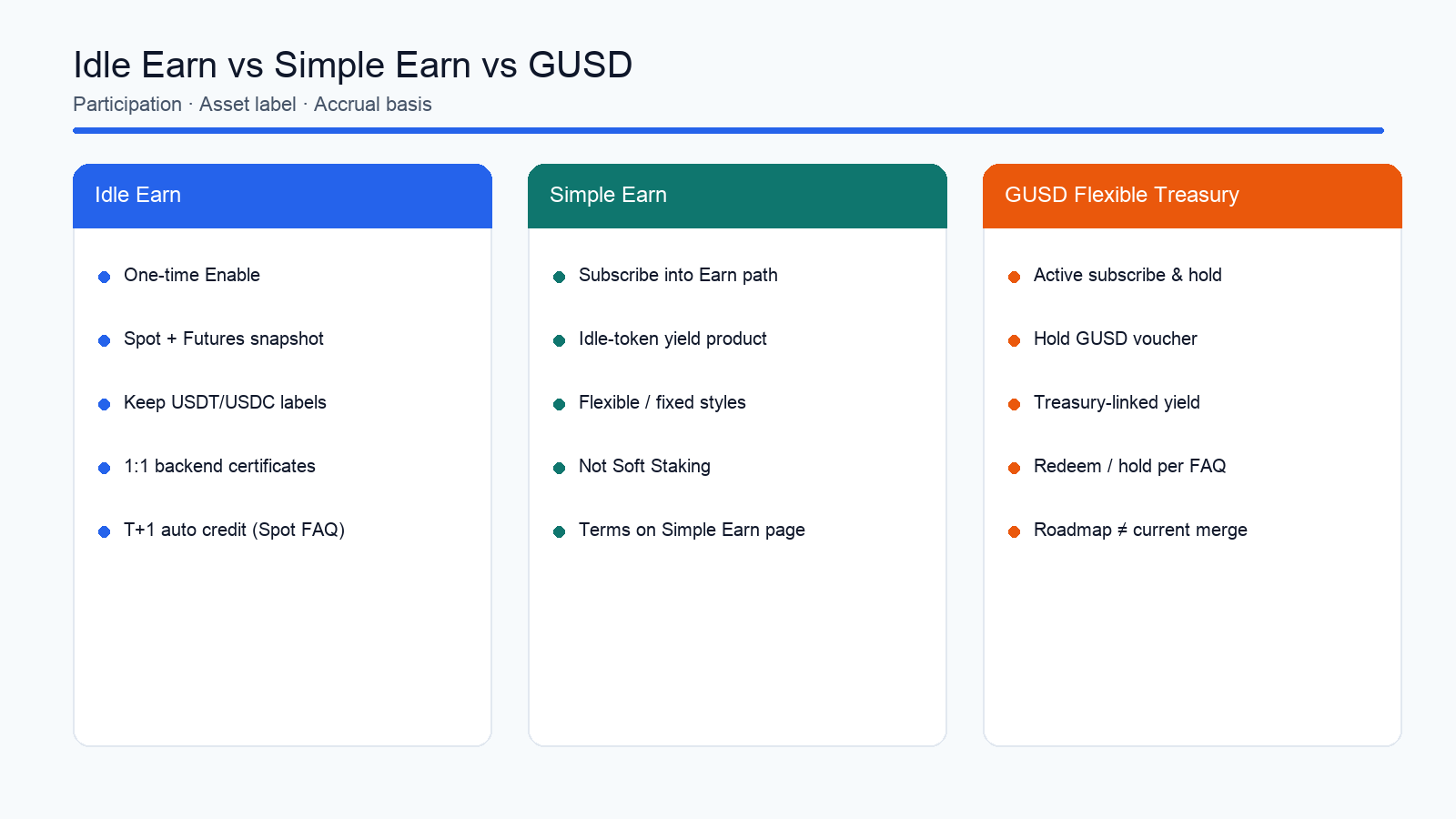
Figure 1. Side-by-side comparison of Idle Earn, Simple Earn, and GUSD Flexible US Treasury by participation, asset label, and accrual basis.
Participation and UX: Enable Snapshot vs Allocate into Earn vs Hold GUSD
Idle Earn minimizes repeated earn subscriptions: enable once on the Idle Earn page, then let daily average snapshots run on eligible available stablecoins in Spot and Futures trading accounts. Funds do not need to move for the base path. Participation is limited to individual KYC users who enable the feature; corporate and institutional accounts are not eligible.
Simple Earn focuses on allocating idle tokens into an Earn subscription path—flexible or fixed style—under Simple Earn product family rules. That is the core UX contrast with Idle Earn: allocate into Earn versus snapshot-in-place on trading balances. Soft Staking remains a separate neighbor and should not be substituted for Simple Earn.
GUSD Flexible US Treasury requires an explicit subscribe-and-hold step into GUSD. Users who want trading inventory to remain labeled USDT or USDC without converting into GUSD typically evaluate Idle Earn first; users who accept GUSD as the held voucher for disclosed Treasury-linked yield evaluate GUSD Flexible US Treasury on its own product page.
Liquidity and Capital Efficiency
Idle Earn’s liquidity story is trade without leaving the earn path: assets remain in trading accounts and can open positions or trade spot, while yield only attaches to the effective snapshot after exclusions. Using balances as margin, freezing them in open orders, or holding borrowed liquidity can shrink or remove yield even when the feature stays enabled.
Simple Earn’s liquidity story depends on whether the chosen path is flexible or fixed. Flexible-style products generally emphasize redeemability under Simple Earn rules; fixed-style products trade higher or more predictable term structure for reduced early-exit flexibility. Capital efficiency comparisons should stay qualitative: a higher displayed APR is meaningful only if capital can stay eligible for that product’s accrual basis.
GUSD Flexible US Treasury’s liquidity story is subscribe, hold GUSD, and redeem under GUSD product rules. Moving USDT into GUSD changes both the asset label and the ruleset that governs yield—different jobs from Idle Earn’s snapshot-in-place model and from Simple Earn’s allocate-into-Earn model.
Accrual Basis and Exclusions
Idle Earn accrues on the prior day’s valid snapshot of eligible available stablecoins, with automatic distribution that can include trading-volume bonuses under live rules. Snapshot timing is T-day; calculation and auto credit occur on T+1, typically to the Spot Account. Borrowed assets, open-order frozen assets, and margin-occupied assets are excluded; lending-pool borrowed funds are also excluded, and Corporate/Institution accounts are unavailable. Simple Earn settles under flexible or fixed product terms; GUSD accrues on eligible GUSD holdings under its own rules. When “almost no yield” appears, match the exclusion rows for the product you actually enabled.
Announcement exclusions for valid balances include borrowed assets, assets frozen by open orders, and assets used as margin. The Idle Earn product page also excludes funds borrowed through lending pools and states that Corporate/Institution-verified users are currently unavailable. Simple Earn accrues under flexible or fixed Simple Earn settlement rules after allocation. GUSD Flexible US Treasury accrues on eligible GUSD holdings under that product’s disclosures.
Comparing “why didn’t I earn today?” therefore starts with the correct product’s exclusion or eligibility row, not with a shared earn-menu narrative.
Which Should You Choose?
Idle Earn: idle capital is mostly available USDT or USDC in Spot or Futures trading accounts, one enable is preferred over allocating into Earn or converting to GUSD, and margin or open orders reducing the snapshot is an acceptable trade-off for keeping balances tradable.
Simple Earn: the goal is to put idle tokens into flexible or fixed Earn subscription paths under the Simple Earn product family, and the inventory problem is “allocate into Earn,” not “snapshot trading-account stablecoins in place.” Do not choose Soft Staking when the intended product is Simple Earn—confirm the live English menu label.
GUSD Flexible US Treasury: an active subscribe-and-hold into GUSD is acceptable, voucher-based Treasury-linked yield accounting is desired, and published stacking or redeem rules for GUSD may matter more than keeping USDT/USDC tickers untouched in trading accounts.
None of these options is bank cash. Compare live terms, eligibility, and risk disclosures on each product page. Choose by workflow and the English product name first, then compare displayed APR labels side by side. Idle Earn APR is never a frozen article figure; use the live product page.
Summary
Gate Idle Earn, Simple Earn, and GUSD Flexible US Treasury share a broad “earn on crypto balances” menu but differ in participation UX, asset labels, and accrual bases. Idle Earn snapshots Spot and Futures trading-account stablecoins after one enable, maps eligible amounts one-to-one to backend certificates linked to compliant U.S. Treasury yields, and auto-credits from the prior-day valid snapshot plus any volume bonuses. Simple Earn allocates idle tokens into flexible or fixed Earn paths and must not be equated with Soft Staking. GUSD Flexible US Treasury requires active subscribe and hold of GUSD; roadmap ideas about displaying Idle Earn snapshots as GUSD certificates remain platform plans subject to change. Match the product to the workflow first, then read live APR and exclusion rules on each product page.
FAQ
How is Gate Idle Earn different from Simple Earn?
Idle Earn enables once, then takes daily average snapshots of eligible available stablecoins in Spot and Futures trading accounts without moving funds for the base path. Simple Earn earns on idle tokens by allocating them into flexible or fixed Earn subscription paths. Soft Staking is a separate neighbor product and is not the same as Simple Earn.
How is Idle Earn different from GUSD Flexible US Treasury?
GUSD Flexible US Treasury requires users to actively subscribe and hold GUSD to earn under that product’s rules. Idle Earn does not require subscribe or convert for everyday eligible stablecoin balances; original assets stay in trading accounts and remain usable for trading. Accrual, redemption, and any activity stacking follow separate rule sets on the live pages.
Can Idle Earn show GUSD certificates without holding GUSD?
The Idle Earn announcement describes a possible future plan to consolidate daily Idle Earn snapshots and display them as GUSD certificates for activities such as Launchpool, without users actually converting to or holding GUSD. That is a platform roadmap subject to change, not a guarantee that the two products have merged.
Which balances count for Idle Earn snapshots?
Idle Earn snapshots eligible available stablecoin balances in Spot and Futures trading accounts. Exclusions include borrowed assets, open-order frozen assets, margin-occupied assets, and lending-pool borrowed funds; Corporate/Institution accounts are not eligible. T-day snapshot and T+1 auto credit follow live FAQ rules, with interest typically credited to the Spot Account.
Is Idle Earn APR fixed at a set percentage?
No. Idle Earn APR is not fixed. Actual APR, supported assets, and calculation rules may change with market conditions; always use the live product page display rather than freezing any promotional figure.
Author: Jayne
Disclaimer
* The information is not intended to be and does not constitute financial advice or any other recommendation of any sort offered or endorsed by Gate.
* This article may not be reproduced, transmitted or copied without referencing Gate. Contravention is an infringement of Copyright Act and may be subject to legal action.
Yala is a modular Bitcoin DeFi infrastructure that connects BTC liquidity with multi-chain ecosystems through its YU stablecoin and MetaMint protocol. It enables Bitcoin holders to earn native DeFi yields across EVM and non-EVM networks securely and seamlessly.
PAXG (Pax Gold) is a tokenized asset backed by physical gold, issued by the fintech company Paxos and traded on the Ethereum blockchain as an ERC-20 token. The core concept is to tokenize physical gold on-chain, with each PAXG token representing ownership of a certain amount of gold. This structure enables investors to hold and trade gold in the form of a digital asset.
PAXG (Pax Gold) is a tokenized asset backed by physical gold reserves, launched by fintech firm Paxos and issued as an ERC-20 token on the Ethereum blockchain. The core concept is to digitally represent real-world gold assets, allowing investors to hold and trade gold via the blockchain network. Because each PAXG token corresponds to a specific quantity of physical gold, its price is theoretically expected to closely track the global gold market.
Espresso Network serves as a blockchain infrastructure purpose-built for multi-chain ecosystems. Utilizing fast finality, the HotShot consensus mechanism, and decentralized sequencing services, it empowers various blockchains to realize real-time cross-chain interactions. This article summarizes the core architecture, technical highlights, application scenarios, and ESP Token utilities of Espresso Network, offering a concise introduction to its role in the Web3 multi-chain landscape.
This report provides a comprehensive analysis of the past year's market performance and future development trends from four key perspectives: market overview, popular ecosystems, trending sectors, and future trend predictions. In 2024, the total cryptocurrency market capitalization reached an all-time high, with Bitcoin surpassing $100,000 for the first time. On-chain Real World Assets (RWA) and the artificial intelligence sector experienced rapid growth, becoming major drivers of market expansion. Additionally, the global regulatory landscape has gradually become clearer, laying a solid foundation for market development in 2025.
A stablecoin is a cryptocurrency with a stable price, which is often pegged to a legal tender in the real world. Take USDT, currently the most commonly used stablecoin, for example, USDT is pegged to the US dollar, with 1 USDT = 1 USD.