As the blockchain ecosystem continues to expand, networks such as Bitcoin, Ethereum, and Solana have gradually developed their own independent asset systems, trading environments, and application ecosystems. Although assets on different chains can all participate in the crypto market, they are not inherently interoperable. Users who want to exchange an asset on one chain for an asset on another typically need to use a combination of cross-chain bridges, wrapped assets, centralized exchanges, or multiple DeFi protocols.
This multi-step approach to asset transfers increases usage costs and introduces additional security and liquidity concerns. Cross-chain bridges need to manage message transmission and asset mapping between different networks, while centralized exchanges require users to deposit assets into platform accounts. For users seeking to exchange assets directly between different blockchains, reducing intermediaries, improving the trading experience, and maintaining sufficient security and liquidity have become important challenges for multichain infrastructure to address.
Chainflip is a cross-chain exchange protocol that emerged in this context. Rather than simply locking an asset and minting a corresponding token on another chain, it coordinates asset deposits, swaps, and withdrawals across different blockchains through an independent State Chain, cross-chain Vaults, a validator network, and an automated market-making mechanism. Understanding these components helps clarify Chainflip's technical positioning and its role in the multichain financial ecosystem.
Key Takeaways
-
Chainflip is a decentralized cross-chain exchange protocol for the multichain ecosystem, focused on enabling users to directly exchange native assets across different blockchains
-
The protocol consists of components including the State Chain, cross-chain Vaults, and a validator network, which record transactions, verify external-chain events, and control asset transfers
-
Chainflip uses a Just-In-Time automated market maker mechanism (Just-In-Time AMM, JIT AMM) to process swaps, with liquidity providers quoting prices for upcoming transactions
-
FLIP is Chainflip's native token and supports network security, validator staking, and protocol economic mechanisms
-
Cross-chain swaps are not risk-free. Validator security, Vault management, liquidity, network confirmation times, and transaction prices all require consideration
What Problem Does Chainflip Aim to Solve?
Asset movement between different blockchains has long faced structural barriers. The Bitcoin and Ethereum networks use different account models, transaction validation methods, and asset management mechanisms, while other networks such as Solana have their own execution environments. Native assets held on one chain cannot be used directly as the same native assets on another chain. Even when certain assets can enter other networks in wrapped or mapped forms, their circulation depends on additional custody, contracts, or cross-chain verification mechanisms.
Traditional cross-chain methods usually involve multiple steps. For example, a user may first convert BTC into a wrapped asset, transfer it to an EVM network through a cross-chain bridge, and then swap it for ETH or other tokens on a decentralized exchange. Each step may involve separate fees, confirmation times, liquidity conditions, and security assumptions. If any step experiences congestion, insufficient liquidity, or a contract failure, the entire transaction path may be affected.
Chainflip's approach is to integrate cross-chain asset transfers and swaps into a single protocol architecture. After a user initiates a transaction, the protocol monitors deposits on external chains through its validator network, records and processes the transaction on its internal State Chain, and then sends the swapped assets to the destination address through a Vault on the corresponding chain. For users, this approach can reduce the need to manually switch between multiple protocols. However, it does not mean that cross-chain processes no longer require network confirmations, nor does it mean that every asset pair receives the same liquidity and execution price.
What Are the Core Components of Chainflip's Architecture?
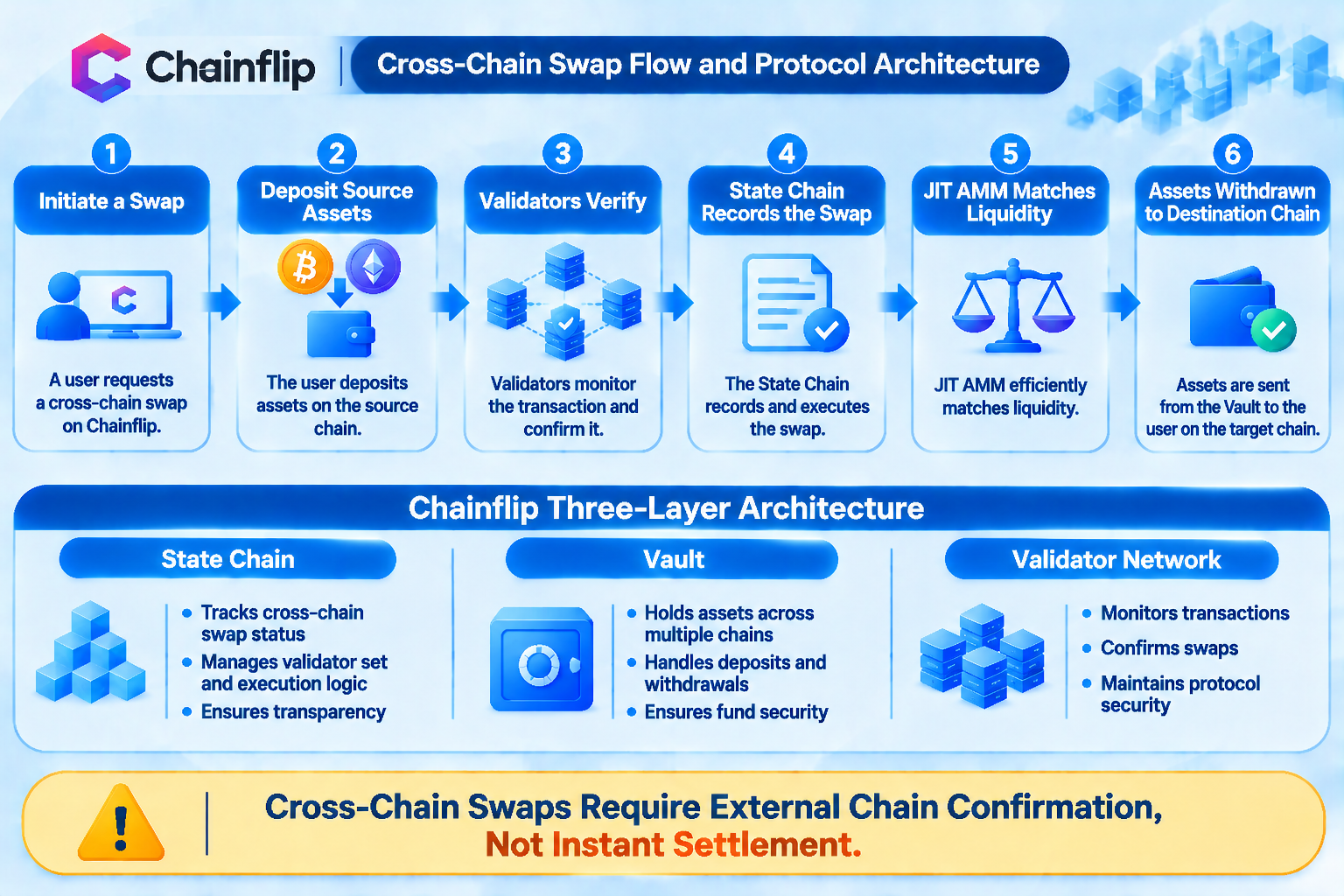
Chainflip's protocol architecture can be understood across three layers: the State Chain manages internal state and transaction coordination, Vaults store and transfer assets on external blockchains, and the validator network collectively maintains protocol operations and control over cross-chain assets. These three components are not independent products but infrastructure that supports the complete cross-chain swap process.
The State Chain is an application chain specifically designed by Chainflip. It is built on the Substrate framework but does not operate on the Polkadot relay chain. It records user deposits, updates account balances, processes transaction instructions, and coordinates swaps within the protocol. Since transaction events from different blockchains must be recognized and processed consistently, the State Chain functions as the protocol's internal ledger and coordination layer.
Vaults are deployed or operated on different external blockchains to receive and send assets. Depending on the technical characteristics of the destination chain, a Vault may take different forms, such as a smart contract or a native wallet. Validators collectively control the relevant assets through threshold signatures, so no single node needs to hold the complete private key. Chainflip's official documentation describes an Authority Set consisting of 150 validators and a design in which Vault transactions are jointly authorized through threshold signatures. Specific signature thresholds and network parameters should be based on the current version of the protocol.
In addition to monitoring and confirming external-chain transactions, the validator network participates in State Chain block production, transaction processing, staking, and network upgrades. Therefore, Chainflip's cross-chain security does not depend solely on smart contracts on a particular chain. It is also closely related to the honesty of the validator set, economic incentives, and Vault control mechanisms.
How Does a Chainflip Cross-Chain Swap Work?
Users can usually initiate a transaction through Chainflip's swap interface or an application integrated with the protocol. Before the transaction begins, users need to specify the input asset, destination asset, destination chain, and receiving address. The protocol creates a corresponding deposit channel for the user or registers the swap intent through a supported Vault call method. Users must send assets to the specified address or contract according to the transaction instructions. Not every transfer can be treated as a successfully registered swap request.
After a deposit is made, the validator network monitors the relevant blockchain and submits the event to the State Chain once the transaction meets the protocol's confirmation requirements. Block times, finality mechanisms, and congestion levels vary across networks, so deposit confirmation times may differ significantly. A transaction enters the subsequent swap process only after the protocol recognizes and records the deposit event.
Next, the State Chain uses the protocol's JIT AMM mechanism to process the swap. After the transaction is completed, the protocol initiates an asset withdrawal through a Vault on the destination chain and sends the swapped assets to the address specified by the user. The overall process can be summarized as "register transaction—deposit assets—verify confirmation—internal swap—destination-chain withdrawal." Although users do not need to manually complete every intermediate step as they might with certain multi-step cross-chain solutions, they still need to monitor transaction status, destination-chain confirmations, and final receipt of assets.
Chainflip Liquidity and the Just-In-Time Automated Market Maker Mechanism
A cross-chain swap must not only transfer assets but also address transaction pricing and liquidity between different assets. Even if a protocol can securely receive source-chain assets, users may still encounter significant slippage or unfavorable execution prices if the destination asset lacks sufficient trading depth. Therefore, the liquidity mechanism is an important component of whether Chainflip can provide effective cross-chain swap services.
Chainflip uses a Just-In-Time AMM, also known as a Just-In-Time automated market maker mechanism. Unlike traditional AMMs, where liquidity is deployed in price ranges for extended periods, Chainflip's JIT AMM allows liquidity providers to submit quotes around transactions that are about to be executed. When the protocol recognizes a deposit and prepares to execute a swap, it incorporates transaction information into its internal processing flow. Liquidity providers can adjust their quotes based on the transaction direction and size, competing for the opportunity to fill the transaction.
This design aims to align liquidity with actual transaction demand and improve execution prices and capital efficiency through competition among market makers. However, a JIT AMM does not automatically eliminate slippage or insufficient liquidity. When transaction sizes are large, market volatility is substantial, or liquidity providers are insufficient in a particular direction, actual execution prices may still deviate from user expectations. Transaction paths that need to pass through multiple liquidity pools are also jointly affected by the quotes and depth at each stage.
The Role of the FLIP Token in the Chainflip Ecosystem
FLIP is the native token of the Chainflip protocol. Its core functions relate to network security and the protocol's economic mechanisms. Validators need to stake FLIP to participate in network operations, taking responsibility for maintaining the State Chain, validating transactions, and jointly controlling cross-chain Vaults through staking and related economic incentives. As a result, FLIP is not only a market-traded asset but is also connected to the protocol's security model and participant incentives.
In addition to validator staking, Chainflip's tokenomics also involve protocol fees and token burning. According to the official tokenomics documentation, the protocol uses a portion of network fees to purchase FLIP on an internal market and burn it, creating a link between protocol trading activity and changes in FLIP supply. The actual impact depends on protocol trading volume, fee rules, token price, emission arrangements, and how the mechanism is implemented. Fee burning should not be simply equated with an inevitable increase in token price.
For general users, it is important to distinguish between FLIP's protocol functions and its market trading function. Holding or trading FLIP on an exchange does not automatically mean that a user is using Chainflip for cross-chain swaps, nor does it mean that token holders can directly receive all protocol revenue. Users who want to participate in validator staking or delegation should further understand the applicable rules, lockup conditions, reward sources, and potential penalty risks.
How Do You Trade FLIP on Gate?
After understanding Chainflip's protocol mechanisms and the FLIP token, readers can also view this asset from the perspective of a centralized exchange. Gate offers a FLIP/USDT spot market, where users can buy or sell FLIP through this trading pair and manage related assets based on their own assessment of the project and market. Compared with directly using the Chainflip protocol for cross-chain swaps, spot trading follows a more familiar digital asset trading process: users submit buy or sell orders through Gate's trading interface, and the platform matches the trades.
It is important to note that buying or selling FLIP through Gate does not mean that users are using Chainflip's cross-chain swap functionality. The former is token spot trading on a centralized exchange, where the traded asset is FLIP itself. The latter involves exchanging native assets between different blockchains through components such as Chainflip's validator network, State Chain, and Vaults. These two methods involve different systems, operational processes, and sources of risk. Users who want to learn about FLIP market trading can visit Gate's FLIP/USDT spot trading page. Users who want to participate in protocol-level cross-chain swaps or liquidity activities need to further understand Chainflip's protocol rules and relevant operational requirements.
What Risks Should You Consider When Using Chainflip?
The first concern is validator and Vault security risk. Chainflip uses threshold signatures and a validator set to jointly control cross-chain Vaults, reducing the risks associated with single private-key control. However, the protocol still depends on a sufficient number of validators remaining honest and performing operations correctly. If the validator set is subject to a coordinated attack, or if vulnerabilities arise in the threshold signature mechanism or related infrastructure, cross-chain assets may face risks. Chainflip's official security documentation also clearly states that the protocol is designed to minimize trust rather than function as a completely trustless system.
The second concern is liquidity and price risk. Cross-chain transactions need to satisfy conditions including source-chain deposit confirmation, internal swaps, and destination-chain withdrawals. Transaction prices may be affected by market volatility, transaction size, liquidity depth, and execution delays. Before initiating a transaction, users should review the quote validity period, estimated amount to be received, slippage settings, and related fees, rather than relying solely on the estimated price displayed in the interface to determine the final outcome.
In addition, external blockchains can introduce confirmation delays, network congestion, and fee changes. Smart contracts, wallet management, protocol upgrades, and cross-chain transaction registration errors may also affect asset security. Liquidity providers and validators also need to consider issues such as impermanent loss, capital efficiency, changes in staked asset prices, node operations, and potential penalty mechanisms. Understanding the protocol's technical structure does not eliminate these risks.
Conclusion
The development of the multichain ecosystem requires not only more blockchains and applications, but also infrastructure that can connect assets across different networks. Through its State Chain, cross-chain Vaults, validator network, and JIT AMM, Chainflip integrates asset validation, transaction coordination, and liquidity execution into one protocol, providing another approach for exchanging native assets across different blockchains.
Understanding Chainflip's value requires more than assessing whether it supports cross-chain transactions. It also requires attention to validator security, liquidity competition, transaction confirmations, and tokenomics. For users, cross-chain convenience and protocol risks always coexist. When choosing a transaction path, users should continue to assess asset types, network conditions, and their own risk tolerance.
FAQ
Is Chainflip a cross-chain bridge?
Chainflip's primary use is cross-chain asset swaps, but its design should not be simply equated with a traditional lock-and-mint cross-chain bridge. The protocol coordinates asset deposits, swaps, and withdrawals across different chains through its State Chain, cross-chain Vaults, and validator network. Its core objective is to provide cross-chain swap services. Specific transaction paths and asset handling methods should still be assessed based on the chains and assets supported by the protocol.
Which blockchains does Chainflip support?
Chainflip's supported networks and asset range may change as the protocol version and integrations evolve. Users should refer to the current supported asset list in Chainflip's official application and documentation rather than assuming that a particular chain or asset is available for swaps based solely on project descriptions.
Is FLIP used to pay for cross-chain swaps?
FLIP is Chainflip's native token and supports network security, validator staking, and protocol economic mechanisms. Fees for cross-chain swaps may be denominated and processed in other assets. Therefore, FLIP should not be simply understood as the fee asset that users must directly pay for every cross-chain transaction.
Does buying FLIP on Gate mean participating in the Chainflip protocol?
No. FLIP/USDT spot trading on Gate is token trading on a centralized exchange. It differs from directly using the Chainflip protocol for cross-chain swaps, participating in validator operations, or providing liquidity through protocol mechanisms.