In the crypto market, the trading experience is typically determined by liquidity depth, quote quality, trading fees, and execution speed. For single-chain decentralized exchanges, users mainly focus on whether the trading pool has sufficient assets and whether the trade size will have a noticeable impact on the price. Cross-chain swaps, however, must also handle source-chain deposit confirmation, internal trade execution, and asset transfers to the destination chain. As a result, the trading mechanism must account for both on-chain settlement processes and market liquidity.
Chainflip combines cross-chain swaps with a Just-In-Time Automated Market Maker (JIT AMM) mechanism, aiming to allow liquidity providers to compete with quotes based on trading demand that actually enters the protocol. Unlike traditional AMMs, which deploy liquidity over extended periods, JIT AMMs place greater emphasis on matching liquidity as a trade is about to be executed. This design provides a different market-making model for cross-chain trading, but trading outcomes may still be affected by quote competition, trade size, market volatility, and liquidity provider behavior.
At the same time, Chainflip's native token, FLIP, is connected to protocol operations and economic incentives. Validators stake FLIP to support network security, while the protocol fee mechanism links part of the trading activity to the purchase and burning of FLIP. For traders, understanding how JIT AMM execution works and how the FLIP token mechanism operates can provide more insight into its market structure than simply observing short-term changes in FLIP's price.
Key Takeaways
-
Chainflip uses JIT AMM to process cross-chain swaps, with liquidity providers submitting quotes for trades that are about to be executed
-
Liquidity providers participate in market making through price ranges, limit orders, and other methods. Trade size and quote competition can affect execution results
-
Cross-chain transactions also require consideration of source-chain confirmations, destination-chain transfers, network fees, and possible multi-pool swap routes
-
FLIP is associated with validator staking, network security, and the protocol fee-burning mechanism, but protocol usage does not necessarily mean the token price will rise
-
Gate FLIP/USDT spot trading is token market trading and differs from cross-chain swaps and staking activities within the Chainflip protocol
How Does Chainflip's Just-In-Time Automated Market Maker Process Trades?
Traditional AMMs typically deploy liquidity in trading pools, where users complete swaps based on the asset ratio and pricing curve within the pool. Liquidity providers can choose the asset allocation or price range for their funds and earn income through trading fees. The larger a trade is relative to the pool's liquidity, the more noticeable its impact on the execution price will typically be.
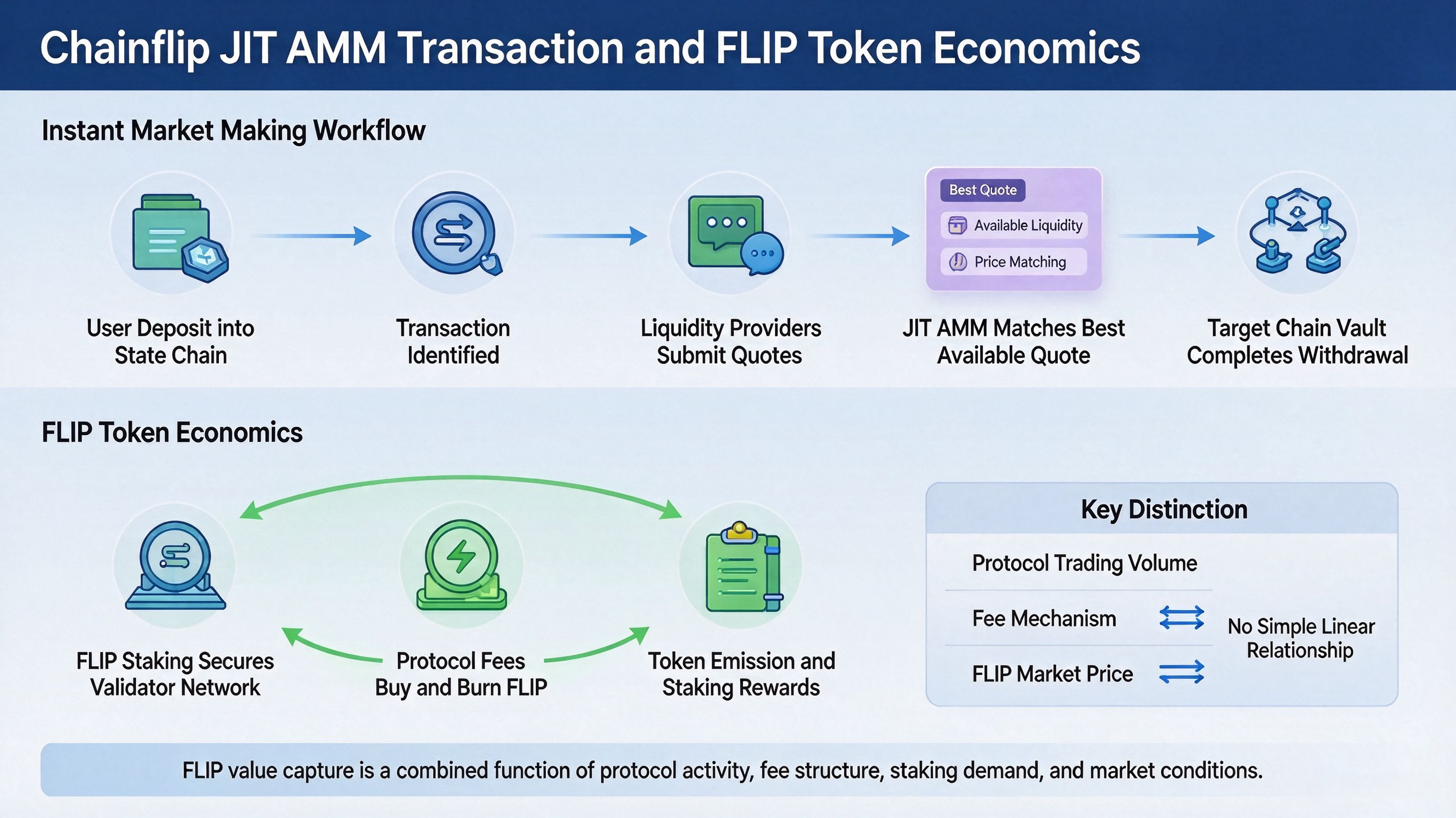
Chainflip's Just-In-Time Automated Market Maker organizes liquidity around trades that are about to be executed. After a user's deposit is identified by the validator network and submitted to the State Chain, the related swap enters the protocol's internal processing flow. Liquidity providers can observe pending trades and submit quotes suitable for those trades. During execution, the protocol matches liquidity based on available quotes and trading rules, allowing market makers to compete for specific trades.
According to the official documentation, Chainflip's Just-In-Time Automated Market Maker operates on the State Chain and adds features such as limit orders to its existing range order mechanism. Different types of liquidity orders can participate in trades based on price competitiveness. Trades are processed in batches according to the protocol's block execution process, and liquidity providers can adjust their quotes for upcoming trades. The mechanism aims to improve users' execution prices through competition, but the final outcome still depends on the amount of liquidity participating in market making and market conditions.
How Do Liquidity Providers Participate in Chainflip?
Liquidity providers are an important part of Chainflip's trading mechanism. They provide assets to liquidity pools supported by the protocol and participate in cross-chain swaps through quotes. Unlike simply holding tokens, providing liquidity means that users need to bear risks related to asset price volatility, capital efficiency, and trade execution structure. Whether liquidity providers can earn reasonable returns depends on actual trading volume, fee income, quote competition, and capital deployment strategies.
In JIT AMM, liquidity providers can participate in market making through price ranges, limit orders, and other methods. A price range determines the price levels at which funds provide liquidity, while a limit order indicates a willingness to buy or sell under specific price conditions. When processing trades, the protocol compares available orders and consumes the corresponding liquidity according to its execution rules. Competition among different quotes may improve users' execution prices, but it also presents liquidity providers with more complex strategic decisions.
Liquidity providers need to consider more than fee income. When market prices change rapidly, quotes may become uncompetitive before a trade is executed. When trade flows are imbalanced, funds may become concentrated on one side. If liquidity depth is insufficient, large trades may also cause price deviations. Cross-chain trading also requires consideration of external-chain confirmation times and fund routing processes, so capital management practices for single-chain AMMs cannot be applied directly.
What Determines Cross-Chain Trading Fees and Execution Prices?
Chainflip's trading costs are not limited to a single protocol fee. They consist of multiple components. Users must first pay the network fee incurred when transferring assets on the source chain. During the swap, the protocol may charge liquidity fees and network fees. If the trade involves a transfer to the destination chain, the destination chain's broadcast fee must also be considered. Fee structures may vary across networks, assets, and trading routes, so users should refer to the actual amounts displayed in the trading interface.
Chainflip's official trading documentation breaks down protocol fees, including liquidity fees collected by liquidity providers, network fees used by the protocol to buy and burn FLIP, and fees related to transfers to the destination chain. Some trades may also involve optional Boost fees or refund fees. Fee rules may change with protocol updates, and the mechanism described in this article should not be considered a fixed quote for every current trade.
Execution prices are also affected by multiple factors. Larger trades typically require greater available liquidity depth. If a trade needs to pass through multiple liquidity pools, the final price will be affected by the quotes for each swap. Source-chain confirmation times, market volatility, and changes in liquidity provider quotes may also cause the estimated price initially shown to users to differ from the final execution result. Therefore, before making a cross-chain swap, users should compare the estimated amount received, slippage, all applicable fees, and destination-chain confirmation requirements rather than focusing on only one fee amount.
How Is the FLIP Token Connected to Protocol Activity?
FLIP is Chainflip's native token and primarily serves network security and validator economic incentive functions. Validators must stake FLIP to participate in network operations and help maintain protocol operations by maintaining the State Chain, monitoring external-chain events, and jointly controlling Vaults. The staking mechanism links validators' economic interests to network security, but it also means participants need to bear risks related to token price volatility, node operations, and protocol penalties.
Chainflip's protocol fee mechanism also seeks to link trading activity with changes in FLIP supply. According to the official documentation, the protocol uses a portion of network fees to purchase FLIP from the internal USDC-FLIP liquidity pool and burn it. This mechanism means that protocol trading activity can affect FLIP's circulating supply through the fee flow, but the actual impact depends on factors such as trading volume, fee ratios, purchase execution, and token market liquidity.
It is important to note that token burning does not necessarily mean that the price will rise. Market prices are also affected by the overall crypto market environment, investor expectations, liquidity, token emissions, unlock schedules, and trading demand. Even if protocol fees are continuously used to purchase and burn FLIP, this alone cannot determine the token's market performance. When analyzing FLIP, users should consider the protocol revenue mechanism alongside market supply and demand, circulating supply, and risk factors rather than inferring price trends based only on the burn narrative.
How Can Traders Distinguish Protocol Participation From FLIP Spot Trading?
There is more than one way to participate in the Chainflip ecosystem. Regular users can conduct cross-chain swaps through the protocol, liquidity providers can supply assets to the protocol and participate in quoting, and validators can contribute to network security through staking and node operations. Different participation methods involve different sources of returns, uses of funds, and risk structures, and should not simply be viewed as the same type of "holding FLIP."
FLIP spot trading is another form of market participation. Users buy or sell FLIP on trading platforms and are primarily exposed to changes in the token's market price. Traders need to consider trading depth, bid-ask spreads, market volatility, and asset allocation risks. Holding FLIP does not automatically mean that a user has provided liquidity to Chainflip, is operating a validator node, or is directly participating in protocol cross-chain swaps.
Gate offers FLIP/USDT spot trading, allowing users to buy and sell FLIP through this trading pair. Users who want to understand the Chainflip ecosystem can view protocol usage, liquidity provision, validator staking, and spot trading as different levels of participation, then make decisions based on their own objectives and risk tolerance. Do not directly equate FLIP price changes on centralized trading platforms with changes in protocol usage or network security.
What Risks Does Chainflip's Trading Mechanism Face?
Quote competition in JIT AMM cannot guarantee an ideal price for every trade. If there are few liquidity providers on one side of a trade, or if the trade size significantly exceeds available depth, users may still face increased slippage and execution price deviations. Liquidity providers may also adjust their quotes because of market volatility, capital costs, and competitive strategies, causing trades submitted at different times to receive different results.
Cross-chain trading also involves external-chain confirmation and execution risks. Source-chain congestion may delay deposit confirmations, destination-chain congestion may affect asset transfers, and issues may occur in the protocol's internal state processing and Vault operations. Even if the trading interface displays an estimated price, users still need to confirm whether the trade has been identified by the protocol, whether it has entered the swap stage, and whether the destination-chain transfer has been completed.
FLIP itself faces token market risks and protocol economic risks. Validator staking rewards, token emissions, fee burning, and actual protocol usage jointly affect the token's economic structure, but no single mechanism can guarantee price performance. Liquidity providers and validators must also consider asset price changes, locked funds, operating costs, and potential penalty mechanisms. For traders, understanding these risks is more important than focusing only on a specific return or token burn figure.
Conclusion
Chainflip's trading mechanism combines cross-chain asset settlement with JIT AMM and processes asset swaps between different chains through quote competition among liquidity providers. Its trading experience depends not only on the protocol's market-making design, but also on factors such as external-chain confirmations, liquidity depth, trade size, and network fees.
FLIP connects protocol security with token economic mechanisms. Staking, fee-funded purchases and burning, and token emissions together form its economic structure. Understanding these mechanisms requires distinguishing between protocol usage, liquidity provision, validator participation, and token spot trading. Only by clearly understanding the sources of returns and risk boundaries of different participation methods can users more accurately understand Chainflip's role in the multichain trading ecosystem.
FAQ
What Is the Difference Between JIT AMM and Traditional AMM?
Traditional AMMs typically rely on liquidity that is deployed in trading pools in advance, with users completing swaps based on the assets and pricing rules within the pool. Chainflip's JIT AMM instead emphasizes liquidity providers submitting quotes for trades that are about to be executed and matching trading demand through quote competition. The two differ in how liquidity is deployed and trades are executed.
Are Chainflip Liquidity Providers Guaranteed to Earn Fee Income?
No. Liquidity providers' returns depend on actual trading volume, fee distribution, quote competition, and capital efficiency. They must also bear risks related to price volatility, capital deployment, and insufficient liquidity. Providing liquidity does not represent a fixed or guaranteed return.
Will FLIP's Burning Mechanism Increase the Token Price?
No definite conclusion can be drawn from this alone. Buying and burning FLIP with fees affects token supply, but market price also depends on factors such as trading demand, circulating supply, token emissions, market liquidity, and overall market conditions. The burning mechanism is part of the token's economics, not a price guarantee.
Do I Need to Use the Chainflip Protocol to Trade FLIP on Gate?
No. Gate FLIP/USDT spot trading involves buying and selling tokens on a centralized trading platform, and users do not need to initiate cross-chain swaps through the Chainflip protocol. However, spot trading itself does not constitute participation in protocol liquidity provision or validator staking.