Blockchain interoperability is not just about enabling different networks to send messages to one another. More importantly, it enables assets to move securely across different execution environments. Networks such as Bitcoin, Ethereum, and Solana use different consensus mechanisms, account structures, and transaction formats, so one chain cannot natively verify the complete state of another chain. Even when users can transfer assets between multiple networks, the process still requires a mechanism to confirm the source-chain transaction, record asset changes, and ensure that the transfer on the destination chain corresponds to the original transaction.
Common cross-chain methods currently include lock-and-mint, burn-and-release, liquidity networks, and transfers through centralized trading platforms. These approaches differ in their security assumptions, capital efficiency, asset formats, and user experience. Lock-and-mint models rely on custodial contracts or verification mechanisms to maintain the relationship between underlying assets and mapped tokens. Liquidity networks, meanwhile, require asset pools on different chains to facilitate swaps and settlement.
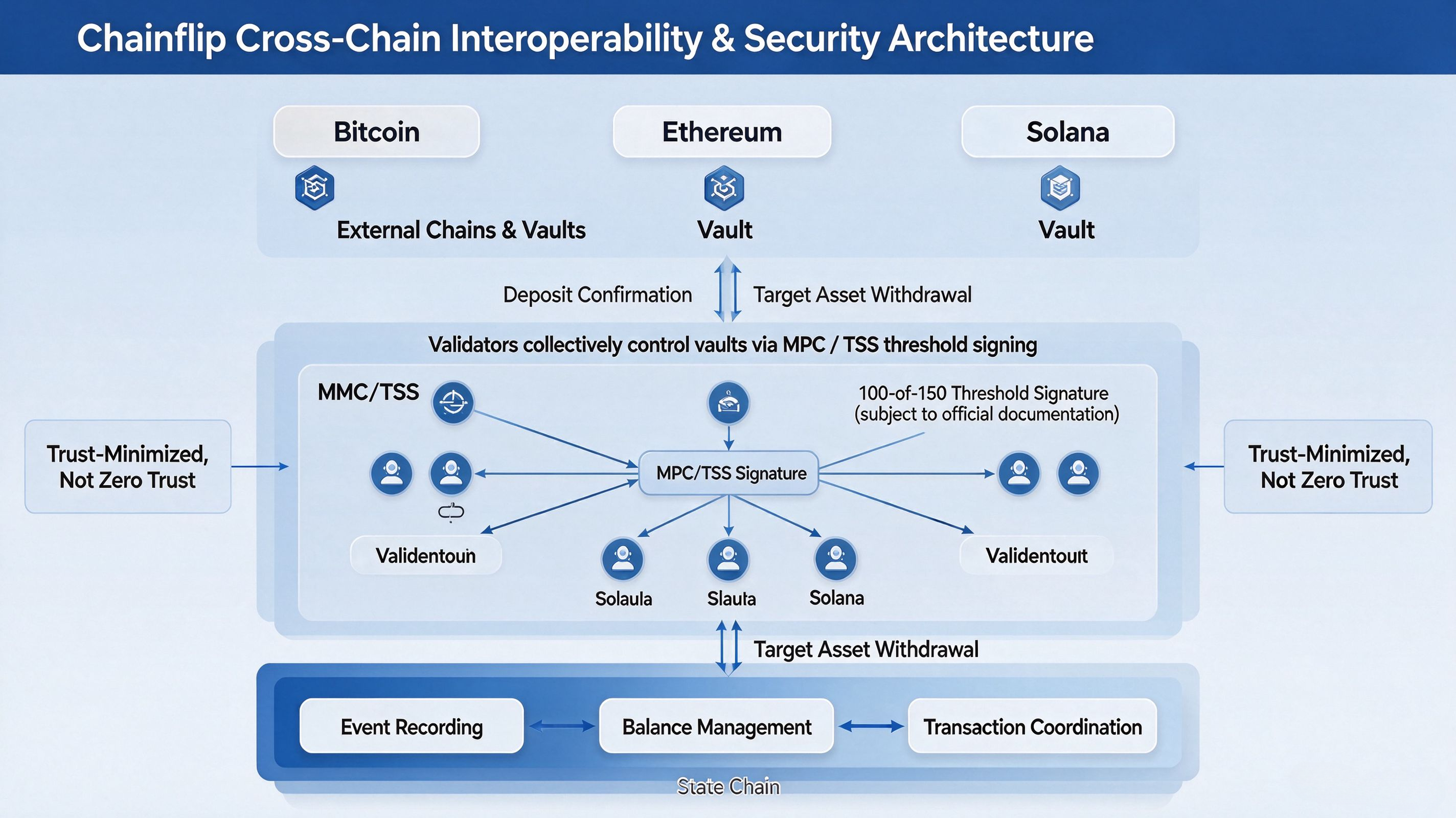
Chainflip takes a different architectural approach. It uses the State Chain to maintain the protocol's internal state, Vaults deployed on external chains to manage assets, and a validator network to jointly control related operations. Understanding this design requires starting with the fundamental challenges of cross-chain interoperability and then examining the relationship between the State Chain, threshold signatures, and the cross-chain transaction process.
Key Takeaways
- Blockchain interoperability must address transaction identification, state verification, asset control, and settlement across different networks
- Chainflip uses an independent State Chain as its internal coordination layer and uses external Vaults to receive and send assets
- MPC and TSS threshold-signature mechanisms allow multiple validators to jointly control cross-chain assets without any single node holding the complete private key
- The validator network monitors events on external chains, maintains the State Chain, and participates in executing cross-chain transactions
- Chainflip uses a trust-minimized design. This does not mean that validator or cross-chain risks are eliminated entirely
Why Is It Difficult for Different Blockchains to Interoperate Directly?
Each blockchain has its own method for recording state and its own transaction-verification rules. Bitcoin uses the UTXO model, Ethereum uses an account model, and Solana has a different account and program-execution structure. These differences mean that nodes on one chain generally cannot directly understand the complete state of another chain or confirm, solely through their own consensus mechanism, whether assets have arrived on an external network.
For example, suppose a user wants to exchange BTC for ETH. The Bitcoin network can confirm whether BTC has been sent from the user's address, but it cannot directly verify whether ETH has been sent to the target address on Ethereum. To establish a trusted connection between the two chains, an additional system is needed to monitor the source-chain transaction, confirm that it has met the required conditions, and coordinate the transfer of assets on the destination chain. This system may consist of smart contracts, validators, light clients, or other cross-chain verification mechanisms.
Cross-chain interoperability also involves asset liquidity. Even if a protocol can verify a source-chain transaction, this does not mean that the destination chain necessarily has sufficient assets available for the exchange. If a user wants to exchange BTC for ETH, the protocol still needs ETH liquidity and must account for the effects of price, fees, and transaction size on the execution result. Therefore, a cross-chain system is both verification and settlement infrastructure and a mechanism for coordinating liquidity across different markets.
How Does Chainflip Coordinate Different Networks Through the State Chain?
Chainflip's State Chain is an application chain for the protocol's internal operations. It maintains user balances, processes transaction events, records instructions, and coordinates protocol operations. It is not a scaling layer for Bitcoin or Ethereum, nor does it mean that all external-chain assets have been migrated to the State Chain. Its role is closer to that of an internal coordination and accounting system designed specifically for cross-chain swaps.
When a user initiates a deposit on the source chain, Chainflip validators monitor the relevant network and identify transactions associated with registered swap requests. Once the required confirmation conditions have been met, the validators submit the external-chain event to the State Chain. The State Chain updates its internal state based on the transaction registration details and passes the transaction to the protocol's swap mechanism. After the swap is completed, the State Chain coordinates the destination-chain Vault to transfer the assets.
This architecture maps transaction events from different networks into a unified internal state process, allowing the protocol to coordinate multiple external blockchains. However, the State Chain itself cannot replace the consensus mechanisms of the source and destination chains. Source-chain transactions must still be confirmed according to the rules of the original network, and transfers on the destination chain must still be included in blocks and confirmed on that network. The cross-chain system coordinates these steps; it does not turn different blockchains into a single chain.
How Do Vaults and Threshold Signatures Manage Cross-Chain Assets?
Vaults are key components that Chainflip uses to manage assets on external blockchains. Depending on the technical characteristics of the destination chain, a Vault may take the form of a smart contract or a native wallet. Vaults receive assets deposited by users and execute transfers after the protocol confirms that the swap conditions have been met. Vault implementations may differ across chains, but their core function is to manage cross-chain assets according to protocol rules.
To avoid having a single entity hold the complete private key, Chainflip uses multiparty computation (MPC) and threshold-signature schemes (TSS) to coordinate joint transaction authorization by validators. Validators each hold a share of the key. Only when the required threshold of participants jointly completes a signature can the Vault execute the corresponding asset transfer. The official Chainflip protocol overview describes a validator cluster (Authority Set) consisting of 150 validators and a 100-of-150 threshold-signature design. These parameters are specific configurations described in the protocol documentation, and the actual operating rules should be based on the current version.
How Does Chainflip Differ From Other Cross-Chain Solutions?
Traditional lock-and-mint bridges typically lock or custody assets on the source chain and issue mapped tokens on the destination chain. The assets users receive on the destination chain are not the native assets of the original chain. Instead, they are tokens whose value relationship depends on underlying reserves or bridging mechanisms. This model allows assets to enter new application ecosystems, but its security is closely tied to custodial contracts, validators, or message-verification mechanisms.
Transfers through centralized exchanges use user deposits, internal platform trading, and withdrawals to convert assets across chains. Users do not need to handle cross-chain contracts or liquidity pools themselves, but they must entrust their assets to the platform and follow its account, risk-control, and withdrawal rules. This approach may be simpler operationally, but its asset-control model differs from that of decentralized protocols.
Chainflip is positioned as a cross-chain swap protocol rather than a simple asset-mapping system. It uses a validator network to jointly manage Vaults, records transaction states through the State Chain, and uses a Just-In-Time automated market maker (JIT AMM) mechanism to process asset swaps. It aims to integrate cross-chain verification, swapping, and transfers into a single process, but this does not mean it is superior to other solutions for all assets, networks, or transaction sizes. Users should still compare supported networks, liquidity depth, fees, confirmation times, and security models to determine which option best suits their trading needs.
How Do Chainflip Cross-Chain Swaps Differ From Gate Spot Trading?
Understanding Chainflip's cross-chain interoperability also requires distinguishing the roles of on-chain protocols and centralized trading platforms. Chainflip coordinates asset deposits, transaction processing, and transfers across different blockchains through components such as the validator network, State Chain, and Vaults. Its goal is to enable native-asset swaps across different networks. When using this mechanism, users need to consider how the source-chain assets are identified by the protocol, how validators coordinate the state, and how the destination-chain assets are transferred based on the transaction result.
Spot trading of FLIP/USDT on Gate is a different way to participate. Users can buy and sell FLIP with USDT in Gate's spot market, with transactions completed through the centralized platform's order-matching mechanism. Users do not need to deposit assets into Chainflip's Vaults or involve the Chainflip validator network in processing cross-chain transactions. Therefore, Gate's spot market provides a trading venue for the FLIP token, not an entry point to Chainflip's cross-chain swap protocol.
This distinction also means that the two approaches involve different risks. When using Chainflip for cross-chain swaps, users need to consider risks related to protocol operations, the validator mechanism, smart contracts, and the relevant blockchain networks. When trading FLIP/USDT on Gate, users need to consider token price volatility, market liquidity, order execution, and risks associated with centralized trading platforms. Users can learn more about the trading pair through Gate's FLIP/USDT spot trading page, but should not confuse spot trading with participating in Chainflip protocol functions.
What Limitations Does Cross-Chain Interoperability Still Face?
First, different blockchains have different confirmation times and finality mechanisms. Bitcoin transactions require block confirmations, while Ethereum and other networks may also be affected by congestion, fees, and changes in on-chain conditions. Cross-chain protocols must balance security and speed. Stricter confirmation requirements may result in longer transaction wait times, while overly lenient requirements may increase the risks associated with chain reorganizations or abnormal transactions.
Second, cross-chain systems must manage both internal protocol state and external-chain state. Validators must correctly identify deposits, process transaction instructions, and execute transfers on the destination chain. An error at any stage may result in transaction delays, refunds, or asset losses. Even if the State Chain's internal state is operating normally, external-chain outages, Vault contract vulnerabilities, or issues with the signing infrastructure may affect the final result.
Finally, liquidity and market conditions determine whether a cross-chain swap can be completed at a reasonable price. Cross-chain protocols do not automatically create trading depth for destination assets. For large transactions, low-liquidity assets, or periods of significant market volatility, quoted prices and actual execution results may differ. Therefore, the maturity of cross-chain interoperability depends not only on the number of connected chains but also on security, liquidity, execution quality, and fault-handling capabilities.
Conclusion
The core challenge of cross-chain interoperability is establishing reliable verification, coordination, and settlement mechanisms across the independent consensus and asset systems of different blockchains. Chainflip connects external-chain transactions with internal swap processes through the State Chain, Vaults, and validator network, while using threshold signatures to jointly manage cross-chain assets.
This design provides a cross-chain swap path that differs from traditional lock-and-mint bridges, but it still faces challenges related to validator security, external-chain confirmations, liquidity, and transaction execution. Understanding its architecture means more than learning about one cross-chain product. It also helps explain how multichain financial infrastructure seeks to balance interoperability and security.
FAQ
What Is Chainflip's State Chain?
The State Chain is an application chain designed specifically for Chainflip. It records internal protocol balances, processes external-chain events, and coordinates cross-chain swaps. It is based on the Substrate framework but does not operate as a parachain of the Polkadot Relay Chain.
Is Chainflip's Vault Controlled by a Single Private Key?
No. Chainflip uses multiparty computation and threshold-signature mechanisms. Multiple validators jointly hold key shares and jointly authorize transactions after the required threshold is reached. This mechanism reduces the risk of single-point private-key control but still depends on the security of the validator set and signing system.
Is Chainflip Completely Trustless?
No. Chainflip is designed to reduce reliance on a single intermediary, but the protocol still depends on the validator network operating correctly. It also relies on the security of its threshold-signature mechanism, software implementation, and external-chain monitoring process. A more accurate description is trust-minimized rather than completely trustless.
Do Users Need to Hold FLIP to Use Chainflip?
Whether users need to hold FLIP depends on the specific function and participation method they use. Ordinary cross-chain swaps differ from network participation activities such as validator staking and token delegation. Users should refer to the protocol's current application interface and official documentation.