As blockchain applications move beyond general financial use cases into gaming, social platforms, enterprise adoption, RWA, and other areas, traditional single-chain structures are increasingly facing network congestion, volatile Gas costs, and competition for resources.
Unlike traditional public blockchains, where all applications share the same execution environment, Avalanche uses Subnets to let developers build independently operated blockchain networks. They can customize validation rules, Gas models, and permission structures based on their needs. This architecture gives Avalanche a distinct competitive path in application-specific chains and institutional-grade blockchain solutions.
What Is an Avalanche Subnet
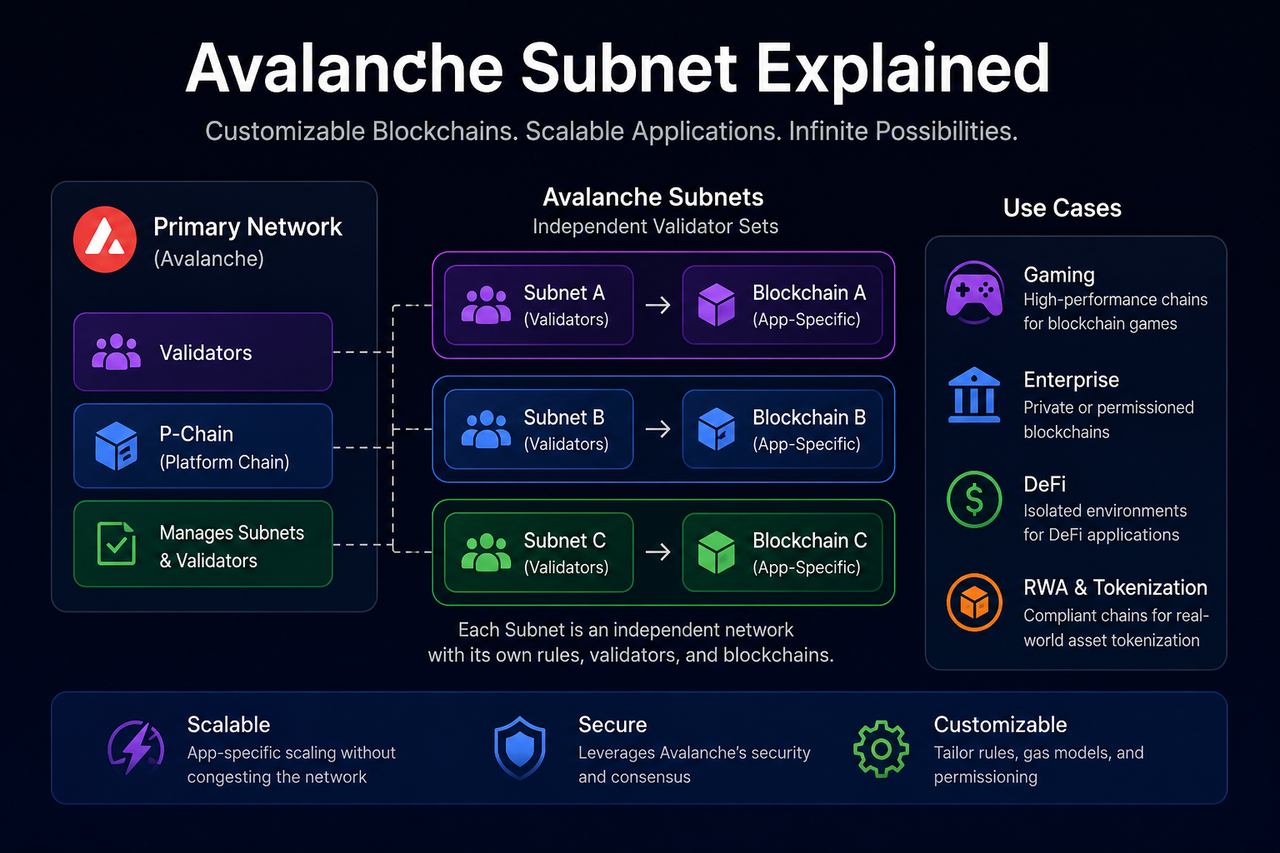
An Avalanche Subnet is a group of validators within the Avalanche network that is responsible for validating one or more blockchains. Each Subnet can have its own rules, nodes, and operating logic.
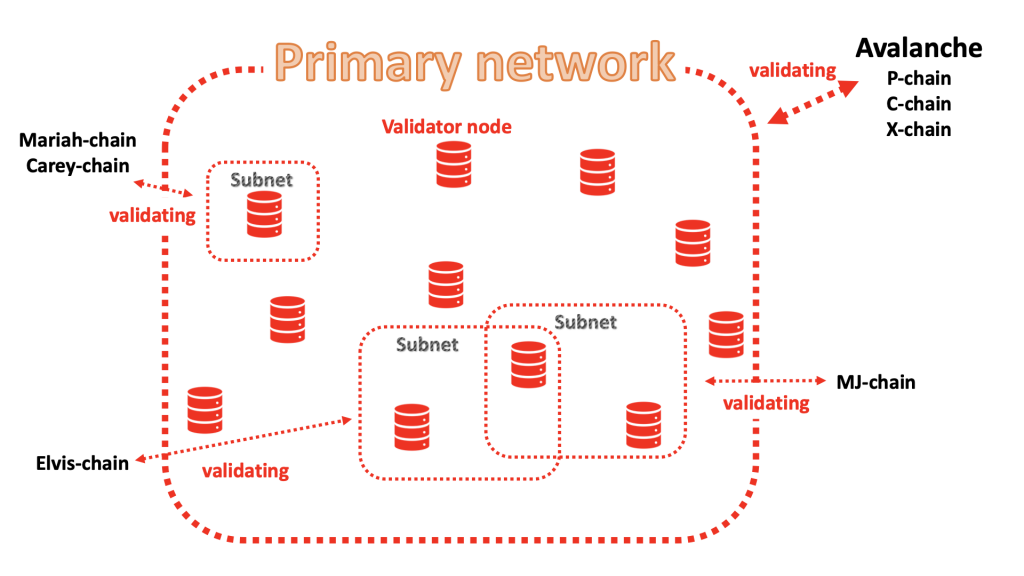
In the Avalanche network, all validators are required by default to validate the Primary Network. A Subnet functions as an additional validation layer built on top of the main network. By creating a Subnet, developers can build dedicated blockchains and set different operating parameters according to real needs.
How Avalanche Subnets Work
Subnet operations rely on Avalanche’s P-Chain, also known as the Platform Chain. The P-Chain records the relationships among validators, Subnets, and blockchains.
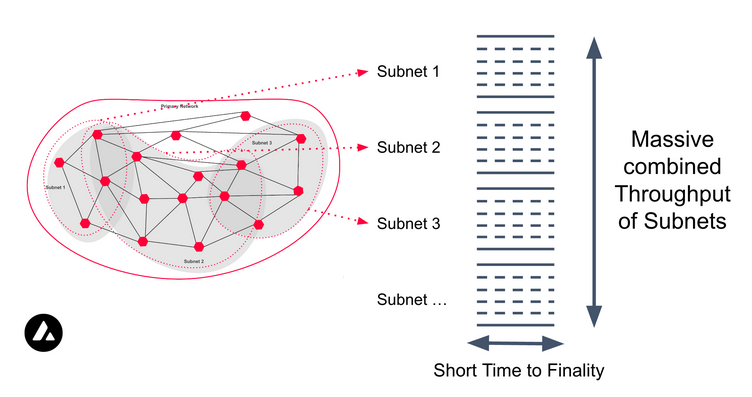
When developers create a new Subnet, they first need to register the Subnet on the network and configure its validation rules. After that, they can deploy blockchains within the Subnet and allow selected validators to join the network.
Each Subnet can run one or more blockchains, which means different Subnets can support multiple types of application logic at the same time. For example, a blockchain gaming project can deploy a dedicated game chain, while an enterprise institution can deploy a private chain environment with permission controls.
How Avalanche Subnets Differ from Traditional Public Blockchains
Avalanche Subnets differ significantly from traditional single-chain public blockchains in resource allocation and network structure.
| Comparison |
Avalanche Subnet |
Traditional Single-Chain Public Blockchain |
| Validation structure |
Independent validator set |
Shared validation across the entire network |
| Network congestion |
Isolated from one another |
Shared across the entire network |
| Gas model |
Customizable |
Usually unified |
| Chain rules |
Customizable |
Usually fixed |
| Scaling method |
Application-specific chains |
Main chain scaling |
Traditional public blockchains usually require all applications to share the same network resources. When on-chain activity increases, Gas costs and confirmation times may rise at the same time. Avalanche Subnets reduce competition for resources between different projects through application isolation. For example, peak gaming transaction activity will not directly affect the operation of DeFi protocols.
Why Avalanche Needs Subnets
One of the core goals behind Avalanche Subnets is to improve blockchain scalability and flexibility.
As the number of Web3 applications grows, single-chain structures are becoming less capable of meeting the needs of every use case. Different applications have different requirements for performance, permissions, and compliance. Blockchain games need high-frequency transaction processing, enterprise chains need permission controls, financial applications need a stable execution environment, and some institutions require independent validation rules.
Subnets allow developers to build dedicated chain environments based on actual needs, preventing all applications from competing for the same execution space. In addition, Subnets can support custom token models and Gas mechanisms, giving different business models greater flexibility.
Avalanche Subnet Validator Mechanism
Avalanche uses a PoS, or proof-of-stake, model to operate Subnets.
Validators must first become validators of the Avalanche Primary Network before they can join other Subnets. Different Subnets can set different validation thresholds and participation rules.
Some Subnets allow open validation, while certain enterprise or institutional Subnets may adopt permissioned validation. This design allows Avalanche to support both open public blockchains and customized chain environments.
In addition, the validation process within a Subnet is still based on Avalanche Consensus and the Snowman protocol, helping maintain fast transaction confirmation speeds.
Use Cases for Avalanche Subnets
Blockchain gaming is one of the most typical use cases for Avalanche Subnets. Gaming applications usually need to process large volumes of high-frequency transactions. If they are deployed directly on a shared public blockchain, they may face Gas volatility and network congestion. By building a dedicated Subnet, blockchain gaming projects can gain a more stable performance environment.
In enterprise blockchain use cases, some companies want to use blockchain technology while also requiring permission controls and compliance management. Subnets allow developers to build chain structures with access restrictions, meeting the needs of enterprises.
Some DeFi protocols also prefer using independent execution environments to reduce the impact of external network activity on transaction efficiency. As real-world asset, or RWA, tokenization continues to develop, some institutions have begun exploring Avalanche Subnets as a way to build asset networks that can meet regulatory requirements.
The Relationship Between Avalanche L1 and Subnets
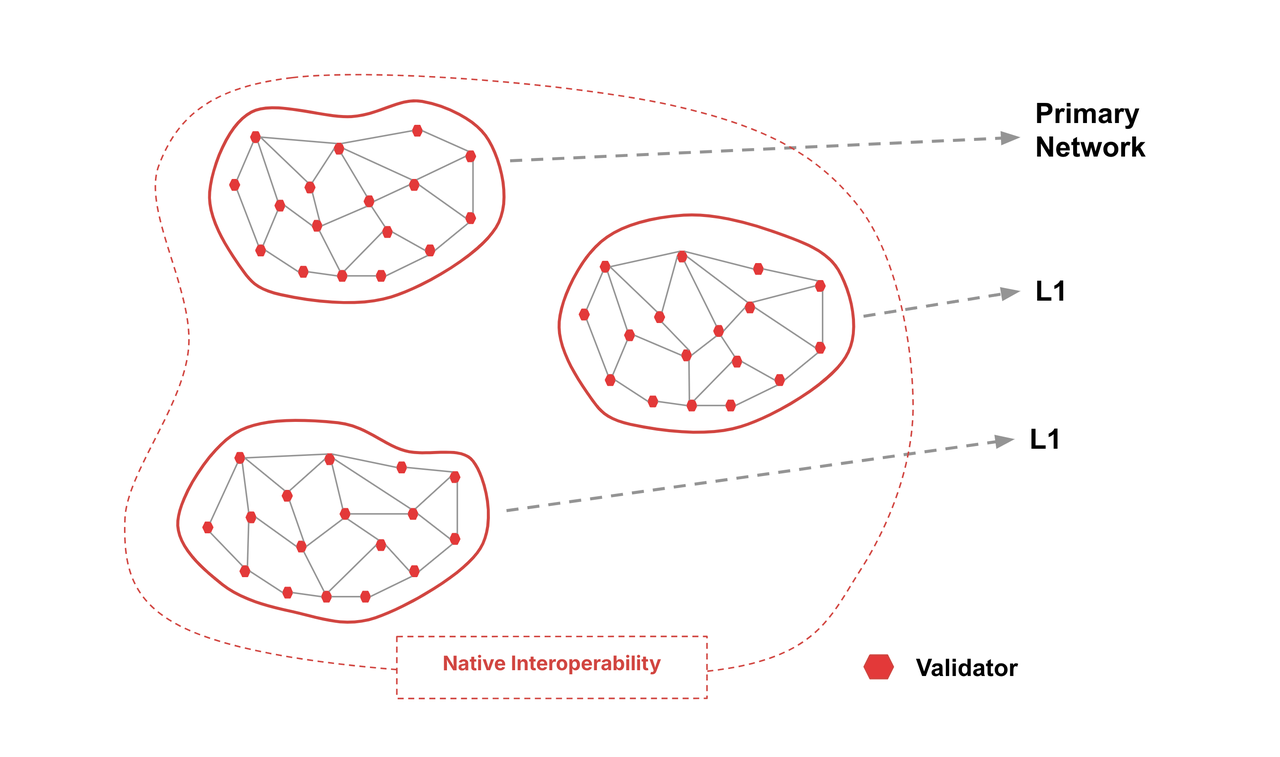
Avalanche later introduced the Avalanche L1 concept to further simplify the deployment process for dedicated chains.
Traditional Subnets still involve a certain level of complexity in deployment and validator management, while Avalanche L1 places greater emphasis on chain-level independence and standardized deployment. From a development perspective, Avalanche is gradually moving its ecosystem from a “Subnet network” toward a “customizable Avalanche L1 cluster.”
Challenges Facing Avalanche Subnets
Although Avalanche Subnets offer strong scalability, they still face several challenges.
Because different Subnets operate independently, assets and users may become dispersed across multiple chain environments. At the same time, as the number of Subnets increases, data and asset interactions between different chains may become more complex.
In addition, some smaller projects may struggle to maintain an independent validator network. As Layer2, Rollup, and modular blockchain ecosystems continue to develop, Avalanche also needs to keep expanding the scale of its developer and application ecosystem.
Conclusion
As a core scaling mechanism within the Avalanche network, Avalanche Subnets provide blockchain applications with higher performance and stronger customization through independent validator sets and application isolation.
Compared with traditional single-chain structures, Subnets allow developers to deploy dedicated blockchain environments and customize validation rules, Gas models, and permission structures based on actual needs. This design enables Avalanche to cover a wide range of scenarios, including DeFi, GameFi, enterprise blockchains, and RWA.
FAQs
How is an Avalanche Subnet different from a regular public blockchain?
A Subnet supports application isolation, custom validation rules, and an independent Gas model, while traditional public blockchains usually require all applications to share the same network resources.
What is needed to create an Avalanche Subnet?
Developers need to create a Subnet, deploy a blockchain, configure validation rules, and have validators join the corresponding network.
Are Avalanche Subnets compatible with EVM?
Yes. Developers can deploy EVM-compatible blockchain environments within Avalanche Subnets.
What are the main use cases for Avalanche Subnets?
The main use cases include blockchain gaming, DeFi, enterprise blockchains, NFTs, and real-world assets, or RWA.
What is the relationship between Avalanche L1 and Subnets?
Avalanche L1 is a further evolution of Avalanche’s dedicated chain architecture. Its goal is to reduce deployment complexity and improve chain-level independence.







