As artificial intelligence (AI) models, large language models (LLMs), and AI Agents rapidly advance, high-quality data is emerging as a critical resource shaping model capabilities. In traditional data systems, data contributors typically do not receive value in return, while developers face challenges such as opaque data sources and complex authorization structures. The DATA economic model aims to address these issues by introducing decentralized incentive mechanisms to improve the relationship between data production and usage.
In the context of the convergence between Web3 and AI, DATA serves not merely as a payment tool but as a coordination mechanism linking data providers and AI application users. By implementing data contribution incentives, ecosystem governance, and value distribution frameworks, DATA seeks to build a more open data network—enabling data to become a verifiable, authorizable, and transferable digital asset in the AI era.
It is important to note that Data Network (DATA) is not a project built from scratch; its predecessor was Internet Protocol (IP). As the project’s strategic focus shifted toward AI-era data infrastructure, trusted data networks, and data value circulation, both the ecosystem brand and token name were updated to DATA, emphasizing its role in the AI data economy.
Core Functions and Use Cases of the DATA Token
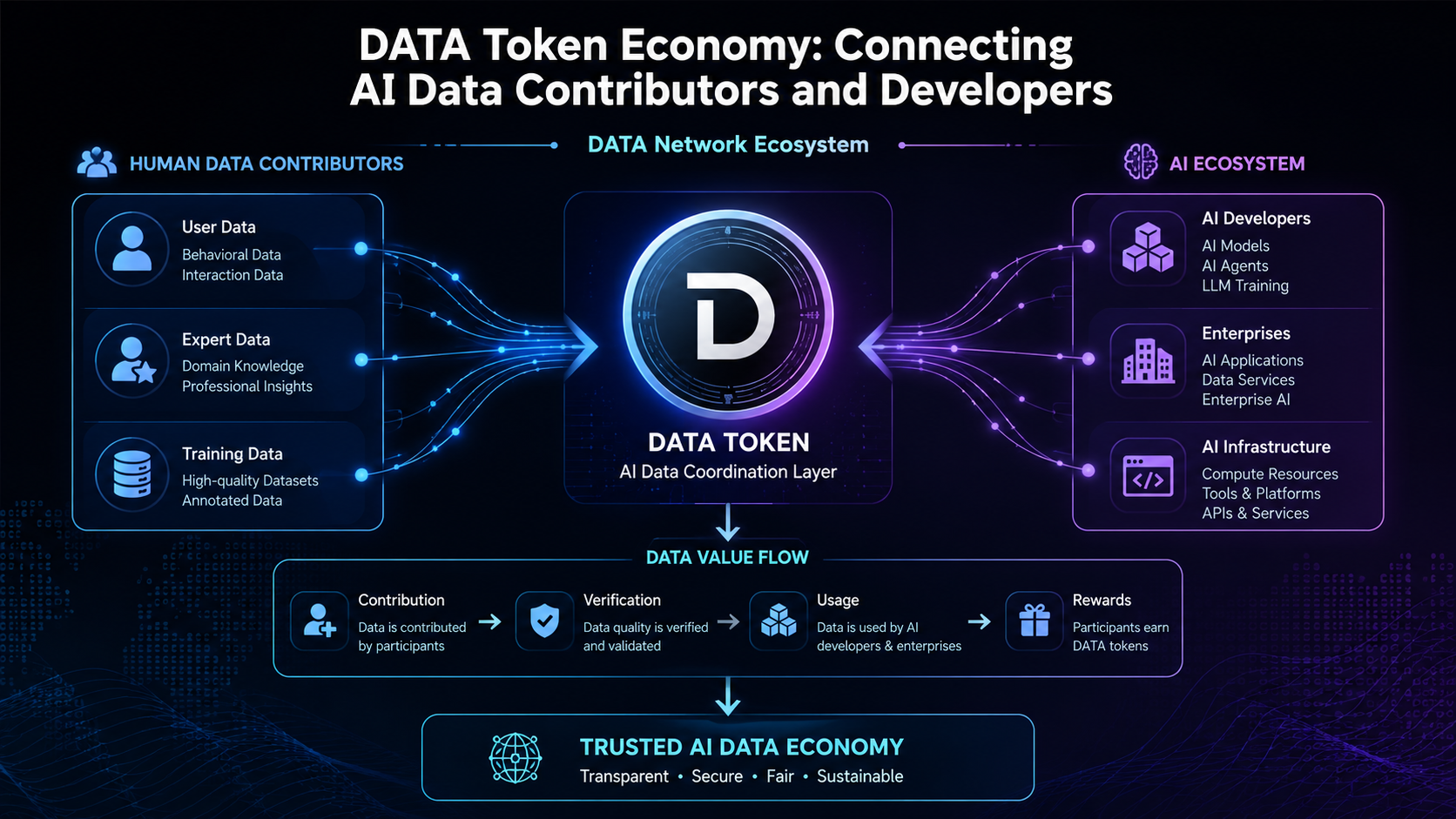
The DATA token is the core value carrier of the Data Network ecosystem, evolving from the former Internet Protocol (IP) ecosystem token. As the project pivoted from a general data protocol to a focus on AI data infrastructure, the IP brand transitioned to Data Network (DATA), placing greater emphasis on data contribution, verification, and the connection between AI applications.
Data Network is designed to reshape relationships, creating more direct economic connections among data contributors, developers, and enterprise users.
The DATA token fulfills several core functions:
Ecosystem incentive tool. Training AI models requires large volumes of high-quality data, and producing and organizing such data demands significant time and resources. The token reward mechanism incentivizes more users to contribute valuable data assets.
Linking data demand and supply. AI developers need access to data suitable for model training, while data contributors seek fair compensation for their resources. The token mechanism enables both parties to participate in an open data exchange system.
Supporting network governance and ecosystem growth. As Data Network expands, community members may participate in adjusting protocol parameters, setting ecosystem direction, and optimizing incentive mechanisms, with the token serving as a key governance tool.
Unlike traditional data platforms—which rely on transaction fees—DATA is designed as a foundational coordination mechanism connecting all participants in the AI data economy.
How DATA Incentivizes AI Training Data Contributions
A major challenge in the AI era is ensuring a steady supply of high-quality data. While the internet contains vast public information, data suitable for AI model training typically requires filtering, validation, and structuring. Examples include domain-specific knowledge, manually labeled datasets, and industry experience data—all of which are highly valuable.
The DATA economic model plays a crucial role by incentivizing users to contribute these high-value resources. Within the Data Network ecosystem, contributors can provide various types of data, including user-generated content, professional knowledge, multimedia, enterprise business data, and AI training annotations.
In contrast to traditional platforms that collect user data for free, the token incentive mechanism is designed to establish a fairer data value cycle. Contributors provide resources, the network verifies and records the data, AI developers create commercial value from it, and contributors receive feedback based on ecosystem rules.
This approach transforms data production into an economic activity open to all participants. However, data incentives do not mean all data is equally valuable. Future reward mechanisms in the DATA ecosystem will need to consider factors such as data quality, scarcity, usage frequency, and the contribution to AI models.
Sustainable growth requires a continual supply of high-value data.
How Data Contributors Participate in the Network Ecosystem
A key feature of Data Network is enabling both individuals and institutions to participate in the AI data ecosystem. Traditionally, large enterprises have dominated data collection and management in AI, while individuals, despite generating significant data, have remained outside the data economy.
Data Network seeks to change this dynamic. Data contributors can participate in several ways:
- Directly providing data resources—users can contribute authorized data, such as knowledge materials, professional information, or other data valuable for AI training.
- Participating in data verification—ensuring data quality and authenticity is vital. Ecosystem participants can help validate data, enhancing overall network quality.
- Joining data management—some contributors may engage in data classification, labeling, and optimization, making raw data more suitable for AI models.
This open mechanism democratizes data production. As AI Agents and personalized AI applications evolve, personal data’s value may increase further. Users will not only consume AI services but also become resource providers in the AI data ecosystem.
How Data Authorization and Revenue Distribution Work
Data authorization is a central issue in the AI data economy. Traditionally, internet data has been governed by one-time authorization: users upload content, platforms obtain usage rights, but users lack transparency regarding the subsequent value generated from their data.
Data Network is exploring a more dynamic data authorization model. Contributors can manage—via network mechanisms—whether their data may be used, for which AI scenarios, the time frame and scope of use, and whether they require revenue feedback. For example, a researcher with domain-specific data may wish to help train AI models but restrict unlimited use. The data authorization mechanism allows contributors to set such conditions.
Regarding revenue distribution, the DATA ecosystem aims to establish a value feedback system. When AI companies generate value from contributed data, relevant contributors receive rewards according to defined rules. The core innovation is that data becomes a resource for ongoing value creation, not a one-off sale. Of course, the actual distribution mechanism depends on network design, market demand, and ecosystem scale. Accurately measuring individual data contributions remains a challenge across all AI data markets.
DATA’s Role in Network Governance
Beyond incentivizing data contributions, the DATA token also supports ecosystem governance. Decentralized networks require ongoing rule adjustments, such as optimizing incentives, setting data verification standards, allocating ecosystem funds, and upgrading protocol features. Traditional internet platforms are company-managed, while Web3 projects favor community governance.
DATA holders can participate in governance, shaping the network’s development. Governance mechanisms improve transparency and empower stakeholders to drive network progress. For AI data networks, governance is especially important, as data involves privacy, copyright, commercial interests, and technical standards.
However, token-based governance faces challenges. Effectiveness depends on community engagement, participant diversity, and sound governance design.
Developers and AI Enterprises in the DATA Ecosystem
AI developers and enterprises are the primary demand drivers in the Data Network ecosystem. Without data usage demand, incentives for data contribution cannot generate lasting value.
For developers, Data Network offers more transparent data acquisition. Compared to traditional approaches, developers gain access to data with clear provenance, validation, and transparent authorization.
This is critical for building AI models, AI Agents, and industry applications. For example, healthcare companies require authorized professional data to train diagnostic models; financial institutions need high-quality market data for analytics systems; enterprises need internal knowledge bases for AI assistants. All these scenarios depend on trusted data infrastructure. For enterprises, Data Network’s value lies not only in data access but also in reduced compliance risk. As AI regulations evolve, organizations must increasingly demonstrate that model data is legal, authorized, and traceable.
A trusted data network may become essential infrastructure for enterprise AI applications.
Factors Influencing DATA Token Value
The long-term value of the DATA token is shaped by multiple factors:
- Ecosystem adoption: Increased participation by contributors, developers, and enterprises drives demand for DATA.
- AI data market growth: As the AI industry expands, so does the need for trusted data infrastructure. Ongoing development of the AI data economy draws attention to supporting infrastructure.
- Technical competitiveness: Data Network faces competition from traditional platforms, AI firms, and other Web3 data projects. Technical strength, data quality, and ecosystem scale will determine its long-term position.
- Tokenomics: Well-designed supply mechanisms, incentives, and demand scenarios are essential for DATA’s value. Tokenomics must attract participants while avoiding excessive issuance and value dilution.
Risks to Consider When Investing in DATA
Despite the growth potential of AI data infrastructure, investing in DATA involves several risks:
- Ecosystem adoption risk: The network’s value depends on real-world usage. Without sufficient demand and developer participation, the token economy may not achieve a sustainable cycle.
- Market competition risk: The AI data sector is rapidly evolving, with new solutions—both centralized and decentralized—emerging.
- Data quality risk: The network’s competitiveness relies on data quality. Inadequate filtering of low-value data could hinder ecosystem growth.
- Regulatory risk: Data involves privacy, copyright, and cross-border issues. Regulatory changes could impact the AI data market’s development.
- Crypto asset market risk: As a digital asset, DATA’s price is influenced by broader market conditions, liquidity, and investor sentiment.
Evaluating DATA’s value requires attention to both project development and broader AI infrastructure market trends.
Summary
The DATA token economic model is designed to connect AI data contributors, developers, and enterprise users through decentralized incentives, promoting the growth of trusted data infrastructure. In the AI era, high-quality data is a decisive resource for model competition, while traditional data systems fall short on source verification, authorization management, and value allocation.
Data Network leverages the DATA token to establish incentives for data contribution, ecosystem governance, and value exchange—inviting broader participation in the AI data economy. DATA’s future potential depends on factors such as ecosystem scale, enterprise adoption, technical capability, and AI data market growth.
As AI shifts from model-centric to data-centric competition, infrastructure that bridges data resources and AI applications will likely become a cornerstone of the next phase of the artificial intelligence industry.