Stacks and Lightning are both used to expand Bitcoin’s capabilities, so they are often discussed together. However, they solve different problems. Lightning’s core goal is to improve BTC payment efficiency, while Stacks focuses on adding smart contracts and application layer capabilities to Bitcoin. Although both are related to the Bitcoin Layer ecosystem, their underlying architecture, operating logic, and use cases differ significantly.
As the Bitcoin ecosystem expands from simple value transfer into DeFi, NFTs, and on chain applications, different types of scaling solutions have emerged. Some projects focus on payments and throughput, while others try to make BTC more programmable. Lightning and Stacks represent these two directions respectively, making them two of the most representative scaling networks in today’s Bitcoin ecosystem.
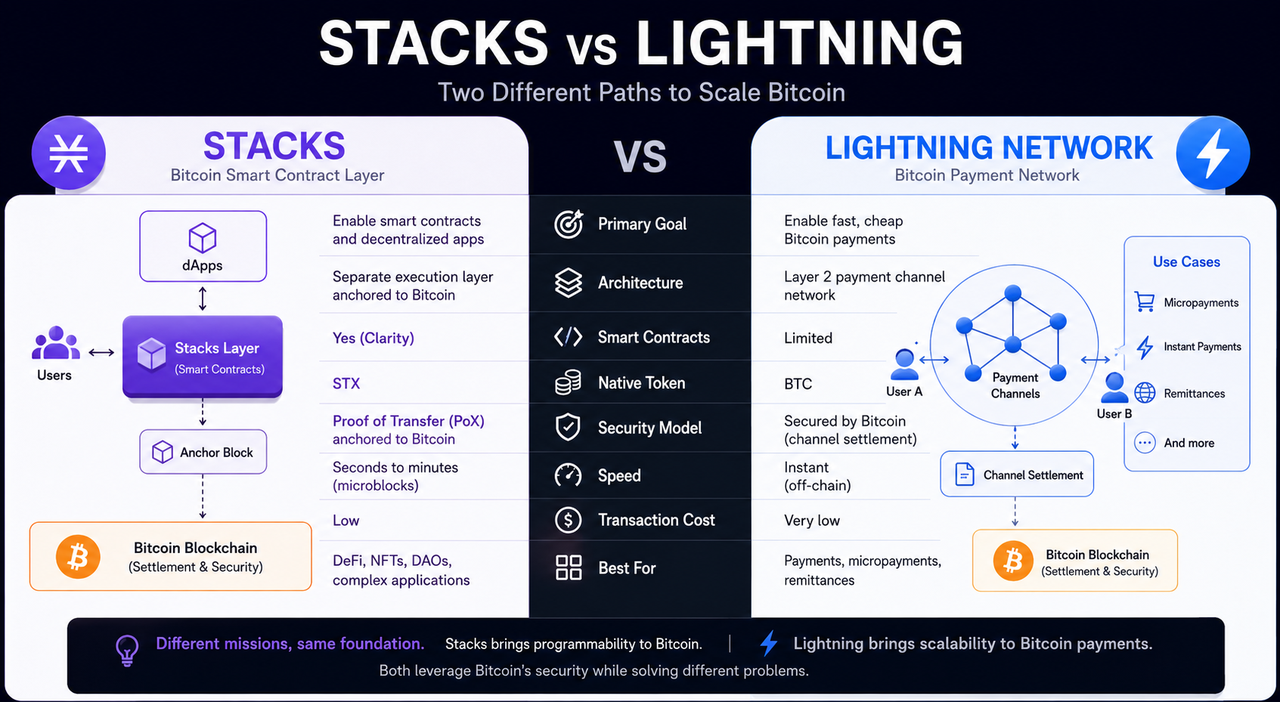
What Is Stacks’ Core Positioning?
Stacks is a smart contract layer built on top of Bitcoin. Its goal is to bring programmability to Bitcoin without modifying the BTC protocol.
Stacks uses a structure that combines an independent execution layer with Bitcoin’s settlement layer, allowing developers to deploy dApps, DeFi protocols, NFT applications, and on chain governance systems. Its core consensus mechanism, PoX, or Proof of Transfer, maintains network operations through a value cycle between BTC and STX.
Unlike the traditional idea of “scaling,” Stacks is more focused on making it possible for BTC to run applications. For this reason, it is often viewed as an important part of the Bitcoin application layer or Bitcoin Layer ecosystem.
What Is Lightning Network’s Core Positioning?
Lightning Network is a payment scaling network built on top of Bitcoin. Its main goal is to improve the efficiency of small BTC payments.
Because Bitcoin main chain confirmations are relatively slow and transaction fees can fluctuate, Lightning uses off chain payment channels to let users complete instant transfers without frequently writing transactions to the main chain.
In practice, most Lightning transactions are not immediately written to the BTC main chain. Instead, they are settled together when a payment channel is closed. This model can significantly reduce fees and improve transaction speed.
Lightning is better suited for everyday payments, cross border transfers, and high frequency small transactions, rather than complex smart contracts or on chain applications.
How Do Stacks and Lightning Differ in Technical Architecture?
One of the biggest differences between Stacks and Lightning lies in their underlying technical structure.
Stacks has an independent execution layer that can run smart contracts and application logic, while anchoring state to the Bitcoin main chain through Anchor Blocks. The network has its own STX token and uses the PoX consensus mechanism to operate.
Lightning uses a payment channel structure. Users establish off chain channels with one another, and most transactions are completed inside those channels. The Bitcoin main chain is only involved when channels are opened or closed.
Put simply, Stacks is more like an application platform based on BTC, while Lightning is more like a payment network based on BTC.
How Do the Use Cases of Stacks and Lightning Differ?
The clearest difference between the two appears in their application directions.
Stacks is better suited for scenarios that require smart contract support. Applications such as Bitcoin DeFi, NFTs, DAOs, digital asset protocols, and on chain governance all need a programmable execution environment, which is exactly where Stacks is strongest.
Lightning is mainly used for payments. Its advantages are low fees and fast settlement, making it more suitable for coffee payments, cross border transfers, small transactions, and high frequency payment networks.
If the Bitcoin ecosystem is compared to internet infrastructure, Lightning is more like a payment channel, while Stacks is more like an application layer operating system.
How Do Stacks and Lightning Inherit Bitcoin Security?
Stacks and Lightning both rely on the security of the Bitcoin main chain, but they do so in different ways.
Stacks anchors key block states to the BTC main chain and uses the PoX consensus mechanism to establish an economic connection with Bitcoin. Its final state confirmation can inherit security from the BTC network.
Lightning uses the Bitcoin main chain as the final settlement layer for payment channels. When users close a payment channel, the final balance is written to the BTC main chain.
Although both remain connected to Bitcoin, Stacks emphasizes “Bitcoin security plus application execution,” while Lightning emphasizes “Bitcoin security plus payment scaling.”
How Is the Relationship Between STX and BTC Different?
Lightning mainly operates around BTC. Users usually make payments and settlements directly in BTC, and its ecosystem does not have a separate native token.
Stacks has its own native asset, STX. STX is used to pay gas fees, participate in PoX consensus, and perform Stacking. There is also a value cycle between STX and BTC. For example, Stackers can receive BTC rewards.
As a result, Lightning is closer to a BTC payment scaling solution, while Stacks has formed an independent application layer economy.
Why Are They Often Discussed Together?
Stacks and Lightning both belong to the Bitcoin Layer ecosystem, so they are often viewed as Bitcoin scaling solutions.
However, they expand different capabilities. Lightning mainly addresses BTC payment efficiency, while Stacks mainly addresses Bitcoin’s lack of smart contract capability.
As Bitcoin DeFi and the Bitcoin application ecosystem develop, the market has become more interested in whether Bitcoin can run applications like Ethereum. This has brought more attention to Stacks. In the payments field, Lightning remains one of the most representative BTC scaling solutions.
Over the long term, the two are not necessarily competitors. They are better understood as different functional layers built around BTC.
Stacks vs Lightning Comparison Table
| Comparison Dimension |
Stacks |
Lightning |
| Core Goal |
Smart contracts and application layer |
Bitcoin payment scaling |
| Main Use Cases |
DeFi, NFTs, dApps |
Small, fast payments |
| Technical Structure |
Execution layer + BTC settlement layer |
Payment channel network |
| Smart Contract Support |
Supported |
Limited |
| Native Asset |
STX |
BTC |
| Security Source |
BTC main chain anchoring |
BTC main chain settlement |
| Transaction Features |
Programmable application interaction |
Fast, low cost payments |
Which Solution Is Better Suited to the Future of the Bitcoin Ecosystem?
The Bitcoin ecosystem is gradually expanding from a single store of value into multiple directions, including payments, finance, and on chain applications. As a result, different scaling solutions may continue to coexist over the long term.
Lightning is better suited to scenarios that emphasize payment efficiency, while Stacks is better suited to scenarios that emphasize applications and programmability. They represent two technical paths: payment scaling and application scaling.
As the Bitcoin Layer ecosystem continues to develop, infrastructure around BTC may gradually form a multi layer structure, and both Stacks and Lightning may play important roles within it.
Conclusion
Stacks and Lightning are both important scaling solutions built around Bitcoin, but they solve different problems. Lightning focuses on improving BTC payment efficiency, while Stacks aims to add smart contracts and application layer capabilities to Bitcoin.
From a technical perspective, Lightning is closer to an off chain payment network, while Stacks is more like Bitcoin application layer infrastructure. As Bitcoin DeFi, Ordinals, and the BTC native asset ecosystem develop, the two solutions are also pushing the Bitcoin ecosystem in different directions.
FAQs
Are Stacks and Lightning Both Layer2s?
Both are often classified as part of the Bitcoin Layer ecosystem, but their technical structures do not fully match the traditional definition of Layer2.
Does Lightning Support Smart Contracts?
Lightning is mainly used for payment scaling. It supports only limited scripting functions and is not well suited for complex smart contract applications.
Why Does Stacks Need the STX Token?
STX is used to pay network gas fees, participate in PoX consensus, and perform Stacking.
Which Solution Is Better for DeFi?
Stacks is better suited for DeFi, NFTs, dApps, and other application scenarios that require smart contract support.
Do Lightning and Stacks Compete With Each Other?
They expand Bitcoin in different directions. One focuses on payments, while the other focuses on applications, so in most cases they are complementary rather than directly competitive.







