With DeFi, on-chain analytics platforms, blockchain explorers, and AI Agents driving ever-increasing demand for on-chain data, data indexing networks have become a cornerstone of Web3 infrastructure. Understanding the differences between SQD and The Graph provides clearer insight into the current direction of the Web3 data layer and the distinct characteristics of different technical approaches.
What Is SQD
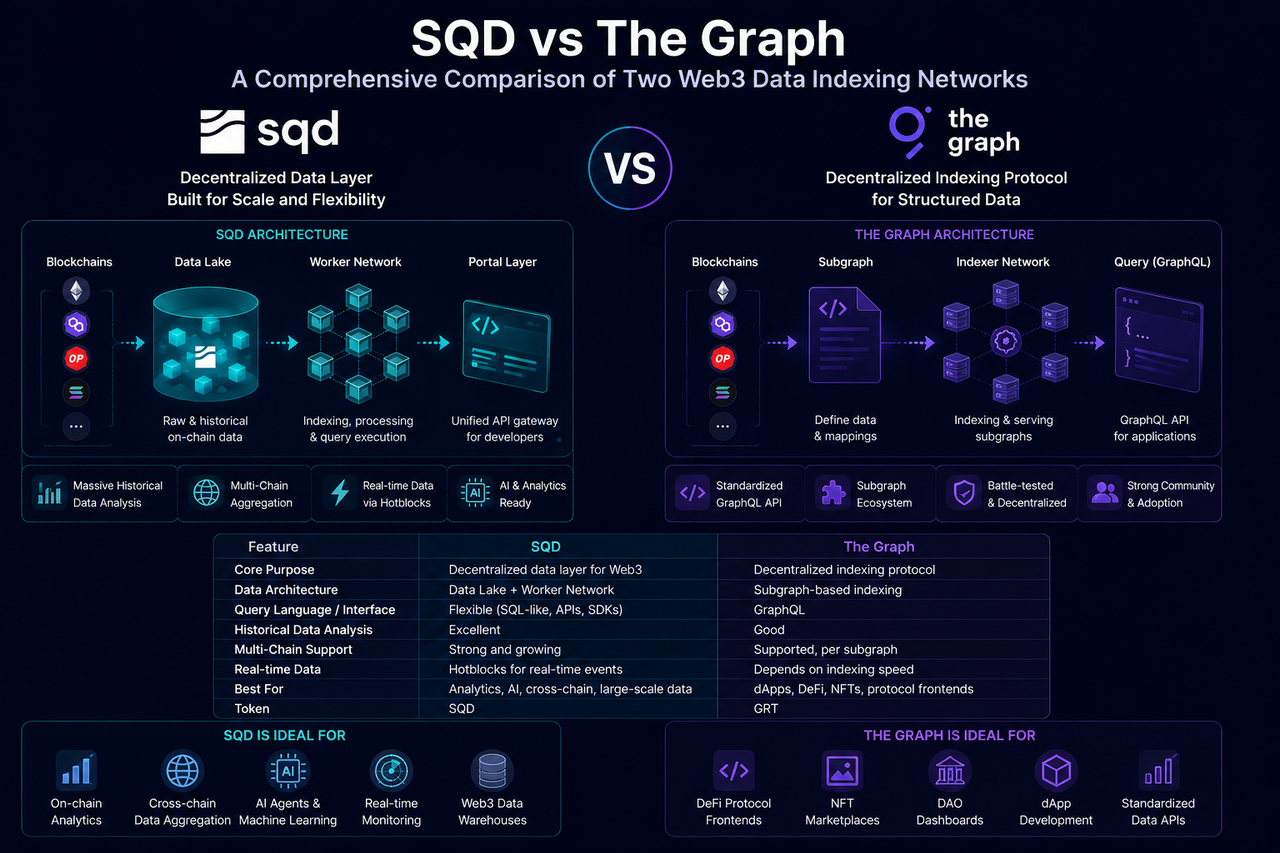
SQD (Subsquid) is a decentralized blockchain data network that establishes an open data access framework through a Data Lake, Worker Nodes, and a Portal query layer. Its core objective is to enable developers to rapidly access and analyze multi-chain data without maintaining complex indexing systems.
Unlike traditional indexing approaches, SQD proactively collects and stores vast amounts of on-chain historical data, indexing and executing queries via Worker Nodes. When an application sends a request, the Portal layer schedules network resources and returns structured results. This architecture positions SQD more as a decentralized data platform tailored for Web3.
What Is The Graph
The Graph is one of the earliest data indexing protocols to achieve large-scale adoption in Web3. Its core mechanism uses Subgraphs to define and index data for specific protocols or applications, offering developers GraphQL query interfaces.
Developers must predefine the data structure and event types to be indexed. Indexer nodes synchronize and process on-chain data per the Subgraph configuration, ultimately generating queryable datasets.
The Graph's philosophy gives each application its own dedicated indexing solution, driving widespread use across DeFi, NFT, and DAO ecosystems.
How Do Data Architectures Differ?
Data architecture is one of the most fundamental differences.
The Graph uses a Subgraph-driven model. Developers define a data model first, then the network builds indexes accordingly—similar to predefining a database schema before storing data.
SQD adopts a Data Lake architecture. Large volumes of on-chain data are uniformly ingested and stored in a distributed Data Lake, with Worker Nodes processing data dynamically based on query needs.
In essence, The Graph builds indexes for specific applications, while SQD creates a data warehouse covering the entire blockchain ecosystem.
How Do Query Methods Differ?
Query patterns directly affect developer experience and application capabilities.
The Graph relies primarily on GraphQL interfaces. Developers can quickly fetch predefined data results using standardized syntax. This model works well for applications with clear structures and relatively fixed query logic.
SQD emphasizes flexible query capabilities. Developers can access preprocessed data and also perform complex historical data analysis and multi-chain aggregate queries.
For large-scale data analysis, SQD generally offers higher flexibility. For building standardized application interfaces, The Graph has a mature ecosystem advantage.
How Does Multi-Chain Support Differ?
As Web3 enters the multi-chain era, cross-chain data access becomes increasingly critical.
The Graph initially developed around the Ethereum ecosystem and later expanded to multiple Layer 1 and Layer 2 networks, usually requiring corresponding Subgraph configurations for each chain.
SQD was designed from the start with multi-chain data integration in mind. Its unified Data Lake structure allows data from different blockchains to be processed and queried within a single framework.
For applications requiring cross-chain analysis, cross-chain asset tracking, and unified data access, SQD's architecture makes multi-chain aggregation significantly easier.
How Does Real-Time Data Processing Differ?
On-chain monitoring systems and AI Agents demand high real-time performance.
The Graph is built primarily around event indexing and querying; its real-time capability depends on indexing sync speed and network conditions.
SQD adds a Hotblocks real-time data layer alongside its Data Lake to handle new blocks and live events. This allows it to cover both historical analysis and real-time monitoring.
For transaction monitoring, automated strategy execution, and real-time data streaming, SQD's real-time architecture design offers clear advantages.
How Does Developer Experience Differ?
Both solutions aim to lower the barrier to on-chain data access, but they take different paths.
The Graph's strength is its mature GraphQL query system. For teams with web development experience, the GraphQL learning curve is relatively low.
SQD focuses more on data analysis capabilities and flexibility. Developers can directly use existing Data Lake resources without building a complete indexing system for each application.
If needs are primarily standardized data interfaces, The Graph is often easier to start with. If complex analysis and multi-chain data processing are involved, SQD provides richer data access.
How Do Node Networks and Incentive Mechanisms Differ?
Both use token incentives to sustain network operations.
The Graph network consists of Indexers, Curators, and Delegators. Indexers handle indexing and query services; other participants maintain the ecosystem through economic incentives.
SQD's network revolves around Worker Nodes, Portal Service Providers, and Delegators. Worker Nodes are responsible for data processing and query execution, forming the core execution layer.
Although both are decentralized data networks, their node role division and resource coordination mechanisms differ.
Which Scenarios Are Better for SQD?
SQD is better suited for:
- Multi-chain data analytics platforms
- On-chain behavior analysis systems
- AI Agent data layers
- Blockchain data warehouses
- Real-time monitoring systems
- Large-scale historical data analysis
These scenarios typically require access to large amounts of historical data and involve complex computations and aggregation tasks.
Which Scenarios Are Better for The Graph?
The Graph is better suited for:
- DeFi protocol frontends
- NFT platform data interfaces
- DAO data displays
- Standardized Web3 APIs
- Specific protocol data services
These applications usually have fixed data structures and well-defined query needs.
SQD vs The Graph: Core Comparison
| Dimension |
SQD |
The Graph |
| Core Positioning |
Decentralized data layer |
Decentralized indexing protocol |
| Data Architecture |
Data Lake |
Subgraph |
| Query Model |
Flexible query |
GraphQL query |
| Historical Data Analysis |
Strong |
Moderate |
| Multi-Chain Aggregation |
Strong |
Moderate |
| Real-Time Data Capability |
Hotblocks support |
Relies on index sync |
| Node Roles |
Worker Network |
Indexer Network |
| AI Agent Compatibility |
Relatively strong |
Average |
| Application Interface Building |
Strong |
Strong |
| Learning Barrier |
Moderate |
Relatively low |
Summary
SQD and The Graph are both key representatives of Web3 data infrastructure, but they follow different technical paths. The Graph provides standardized indexing services for specific applications through Subgraphs, with a mature base in DeFi and NFT ecosystems. SQD builds a general-purpose decentralized data platform using a Data Lake, Worker Network, and real-time data layer, prioritizing historical data analysis, multi-chain aggregation, and complex query capabilities.
From an industry development perspective, these two models are not purely competitive. As Web3 data continues to grow, both standardized query services and general-purpose data layers will become important components of blockchain infrastructure.
FAQs
What is the biggest difference between SQD and The Graph?
The biggest difference lies in data architecture. The Graph builds application-level indexes based on Subgraphs, while SQD constructs a general-purpose data layer using a distributed Data Lake and Worker Network. This leads to clear differences in data organization and query methods.
Can SQD replace The Graph?
The problems they solve partially overlap, but their design goals differ. The Graph is better for building standardized data interfaces, while SQD excels at complex analysis and multi-chain data access. Therefore, there is no direct replacement relationship.
Why are AI Agents more interested in SQD?
AI Agents typically need access to extensive historical data and multi-chain information. SQD's Data Lake architecture and flexible query capabilities can provide richer data sources for AI systems.
Does The Graph support multi-chain data?
Yes. The Graph has expanded to multiple blockchain networks, but it usually requires corresponding Subgraph configurations for different networks.
Why does SQD use a Data Lake architecture?
A Data Lake can uniformly store large-scale on-chain historical data and support flexible analysis later. This architecture is more suited for complex queries and cross-chain data aggregation scenarios.
Should developers choose SQD or The Graph?
The choice depends on specific needs. If the priority is standardized protocol data interfaces, The Graph is a mature solution. If complex analysis, multi-chain data integration, or AI data layer support is needed, SQD has the advantage.