As Web3 applications such as DeFi, NFTs, and DAOs develop rapidly, the amount of data on blockchains continues to grow. Smart contract transactions, on-chain asset states, and user interaction records generate massive volumes of data every day. Yet this data is usually stored on blockchains as low-level transaction logs, which are inefficient to read. Developers often struggle to retrieve the information they need quickly and directly. As a result, on-chain data access has become an important factor limiting the expansion of Web3 applications.
The Graph was created to solve this problem. As a decentralized data indexing protocol in the Web3 ecosystem, The Graph organizes complex on-chain data into structured information that can be queried quickly, giving developers a data access experience similar to traditional APIs.
How Does The Graph Work?
The core goal of The Graph is to turn raw blockchain data, which is often complex and difficult to read, into data interfaces that can be accessed quickly. It mainly does this through the coordinated work of three core components: Subgraphs, Indexers, and GraphQL, which together form a complete data indexing process.
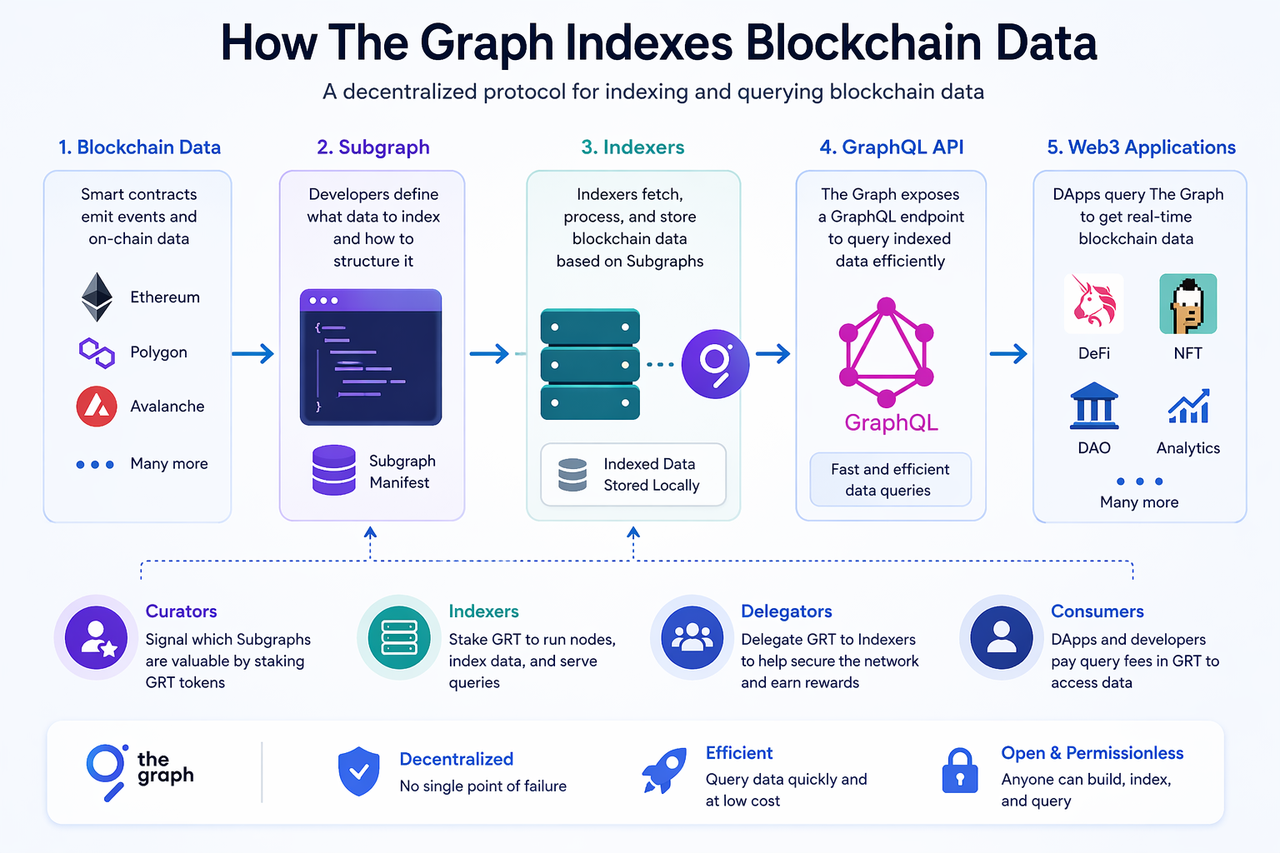
In simple terms, developers first use a Subgraph to define the data they want indexed. Indexer nodes then collect and process on-chain data according to those rules. Finally, data services are provided to applications through the GraphQL query interface. This mechanism allows The Graph to deliver efficient data retrieval in a decentralized environment.
Subgraph: The Core of The Graph’s Data Indexing Rules
A Subgraph is a foundational component of The Graph network. It can be understood as a set of rules for indexing on-chain data. By creating a Subgraph, developers define which smart contract events should be monitored, which fields should be extracted, and how the data should be organized and stored.
For example, a decentralized exchange may need to display trading records and liquidity data. Developers can use a Subgraph to specify that events such as Swap, Mint, and Burn in a trading contract should be indexed. The Graph network then automatically collects and organizes the relevant data according to those rules, allowing the application to call it quickly.
Subgraphs spare developers from manually parsing low-level blockchain logs, greatly reducing the complexity of data processing. This is also why The Graph can support the data needs of a large number of DApps.
Indexer: The Node That Carries Out Data Indexing Tasks
Indexers are node operators in The Graph network. They are responsible for performing data indexing and responding to query requests. They run Graph Node software, collect blockchain data according to Subgraph rules, and build indexes.
When a developer or DApp sends a query request, an Indexer returns the corresponding data results and earns query fee rewards. To help maintain network security and service quality, Indexers must stake GRT before they can participate in network operations.
This mechanism not only incentivizes nodes to keep providing services, but also helps ensure decentralized data indexing. As more applications use The Graph, the role of Indexers will become even more important, and their earning potential will also be influenced by network usage.
GraphQL: The Data Interface for Efficient Queries
GraphQL is the data query language provided by The Graph. It helps developers quickly retrieve the specific on-chain data they need. Unlike traditional blockchain query methods, GraphQL allows developers to request precise fields without scanning large amounts of irrelevant data.
For example, a developer can query only the transaction history of a particular address or the liquidity information of a specific trading pool, without downloading the entire blockchain dataset. This greatly improves query efficiency and reduces the cost of developing and running applications.
The introduction of GraphQL gives The Graph a development experience close to Web2 APIs, which is one of the main reasons it has gained broad adoption.
The Complete Data Indexing Process of The Graph
The Graph’s data indexing process can be divided into the following steps:
First, developers create and deploy a Subgraph to define the data indexing rules. Next, Indexers monitor on-chain events according to the Subgraph and collect the relevant data. That data is then processed and stored in a queryable format. Finally, developers retrieve the data they need through the GraphQL query interface and display it in their applications.
This entire process automatically converts raw blockchain data into application-ready data, greatly improving the efficiency of data access for Web3 applications.
What Roles Do Curators and Delegators Play in The Graph?
In addition to Indexers, The Graph network also includes two other important types of participants: Curators and Delegators.
Curators evaluate which Subgraphs are more valuable and signal this to the network by staking GRT, helping Indexers prioritize high-quality data sources. This mechanism improves the efficiency of resource allocation.
Delegators are users who delegate GRT to Indexers. They do not need to run nodes themselves, but they can still earn rewards by supporting Indexers. This lowers the barrier to participation while strengthening network security.
Through the collaboration of Indexers, Curators, and Delegators, The Graph has built a complete decentralized indexing ecosystem.
Why Is The Graph’s Data Indexing Mechanism Important?
In the traditional internet, search engines and database indexes are essential infrastructure for data access. In Web3, The Graph plays a similar role by indexing blockchain data so developers can quickly obtain the information they need.
Without a data indexing mechanism, DApp developers would need to run their own nodes and process complex on-chain data themselves, which would be extremely costly. The Graph lowers the barrier to development through standardized data query services and helps accelerate Web3 application development.
As the number of blockchain applications grows, demand for on-chain data queries continues to expand. This makes The Graph’s data indexing mechanism an important part of Web3 infrastructure.
How Does The Graph’s Operating Mechanism Support the Value of GRT?
The way The Graph works directly determines demand for GRT. Developers and applications need to use GRT to pay query fees, while Indexers, Curators, and Delegators need to stake GRT to participate in network operations.
As more applications are deployed on The Graph network, increased query demand may drive higher GRT usage. At the same time, staking demand from network participants reduces circulating supply in the market, creating support for its value.
Therefore, The Graph’s data indexing mechanism is not only the foundation of the protocol’s operations, but also an important source of value for the GRT token.
Conclusion
The Graph builds a complete decentralized data indexing system through Subgraphs, Indexers, and GraphQL, allowing developers to access blockchain data quickly. Subgraphs define indexing rules, Indexers perform data processing, and GraphQL provides an efficient query interface. Together, they form the core operating mechanism of The Graph. As Web3 applications continue to expand, the importance of this data indexing capability will keep growing, bringing long-term value support to GRT.
FAQs
What Role Does a Subgraph Play in The Graph?
A Subgraph is The Graph’s data indexing rule template. It defines which on-chain data should be monitored and how that data should be organized, making it the core foundation of the data indexing process.
How Do Indexers Earn Rewards in The Graph?
Indexers earn query fees paid by developers and protocol rewards by running nodes, processing data indexing tasks, and responding to query requests. However, they must stake GRT before they can participate in network operations.
Why Does The Graph Use GraphQL?
GraphQL allows developers to query exactly the data they need, improving the efficiency of on-chain data access and reducing application operating costs. It is an important tool that helps The Graph provide efficient data services.
How Does The Graph’s Operating Mechanism Affect the Value of GRT?
Developer query fee payments and GRT staking by network participants together form the demand sources for GRT. As a result, growth in The Graph’s network usage generally strengthens the value support for GRT.







