With the growing data demands of DeFi, on-chain analytics platforms, blockchain explorers, and AI Agent, the importance of data infrastructure continues to rise. Unlike traditional centralized data services, SQD aims to build an open data layer through a decentralized Worker network, enabling data processing to be provided jointly by multiple independent nodes, thus improving system scalability and reliability.
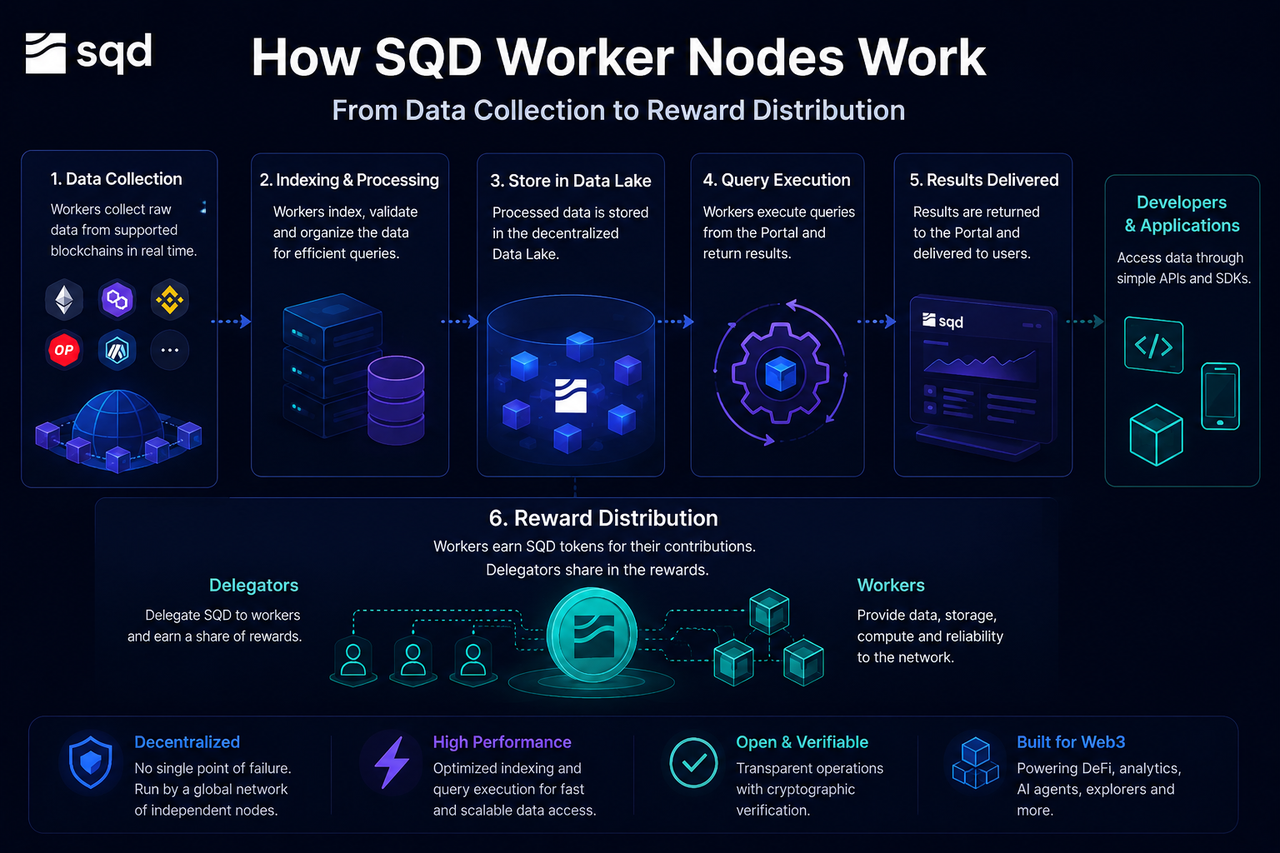
What Is an SQD Worker Node?
The SQD Worker node serves as the computation and execution layer in the SQD data network, primarily responsible for on-chain data processing and query services.
Think of the SQD Network as a large data factory: the Data Lake stores raw materials, the Portal receives orders, and Worker nodes handle actual processing and production. Most of the data results developers ultimately get come from the computation and processing of Worker nodes.
Unlike traditional blockchain validator nodes, Worker nodes do not participate in transaction consensus or produce blocks. Their core job is to make blockchain data easier to access and use.
The Role of SQD Worker Nodes in the Network
The SQD Network mainly consists of a Data Lake, a Worker Network, and a Portal Layer.
The Data Lake stores massive historical data from different blockchains. The Portal layer receives developer requests and coordinates network resources. Worker nodes take on data processing, index building, and query execution — making them one of the most critical execution modules in the entire network.
When developers call the API to fetch on-chain data, Worker nodes typically perform the actual query work. Consequently, the performance of Worker nodes directly impacts the overall data service quality of the network.
How Worker Nodes Collect On-Chain Data
Data collection is the first step in on-chain data processing.
As supported blockchains generate new blocks, the SQD Network continuously syncs relevant data, including transaction records, event logs, account state changes, and smart contract interaction logs. Worker nodes participate in receiving and processing this data.
Since different blockchains use different data formats, raw data must undergo standardized transformation after entering the network. Worker nodes organize this data into a uniform format for subsequent indexing and querying.
This process is like translating documents from different countries into one common language, enabling the entire system to process data using a consistent data structure.
How Worker Nodes Build Data Indexes
Data indexing is one of the most important tasks for Worker nodes.
Without an indexing system, every query would need to scan all historical block data, severely hurting efficiency. Worker nodes build index structures based on transaction addresses, block heights, smart contract events, and time dimensions.
Once an index is in place, the query system can quickly locate target data without scanning the whole database. For applications analyzing millions of transactions, the indexing mechanism dramatically improves response speed.
As the data scale grows, the indexing system gets continuously updated and optimized to maintain query efficiency.
How Worker Nodes Execute Query Tasks
When a developer sends a query request through the SQD Portal, the request is routed to an appropriate Worker node.
The Worker node first parses the query, then locates the relevant data using the index. Next, the node performs filtering, aggregation, statistics, and computation, generating the final result.
For example, a DeFi analytics platform might need to aggregate transaction data from the past three months, while an AI Agent might analyze fund flows across multiple wallet addresses. These complex operations are all handled by Worker nodes.
Compared with traditional RPC nodes that scan data block by block, SQD Worker nodes can quickly return results using pre-built indexes.
How Worker Nodes Ensure Data Availability
A decentralized data network must guarantee the reliability and consistency of query results.
SQD enhances data availability by having multiple Worker nodes work together. Even if some nodes go offline, others continue to provide services, reducing the risk of a single point of failure.
At the same time, nodes share data state and index information to ensure consistency across results returned by different nodes. As the network scales, the overall fault tolerance of the system also increases.
This distributed architecture gives SQD higher sustainability compared to a single centralized service.
How Are Worker Nodes Different from Traditional RPC Nodes?
Many users confuse Worker nodes with RPC nodes, but they serve different purposes.
RPC nodes primarily read the blockchain state and return raw data to applications. Worker nodes process and index that raw data to provide developers with structured query results.
| Dimension of Comparison |
SQD Worker Node |
RPC Node |
| Main Responsibility |
Data indexing and query |
State reading |
| Data Processing |
Supported |
Mostly none |
| Historical Analysis |
Strong |
Weak |
| Multi-Chain Aggregation |
Supported |
Requires additional configuration |
| Query Efficiency |
High |
Medium |
| Application Scenario |
Data service network |
Blockchain access interface |
In essence, an RPC node is like a database interface, while a Worker node is more like a data analysis engine.
How the SQD Reward Mechanism Works
The SQD Network uses a token incentive mechanism to encourage nodes to provide services.
When Worker nodes consistently deliver data processing, query execution, and network maintenance, they earn SQD Token rewards. The reward amount usually depends on node contribution, service quality, and resource investment.
This mechanism attracts more participants to contribute computing and storage resources, creating a sustainably scalable data infrastructure.
Economic incentives are a key foundation for the long-term operation of decentralized networks, and they are also a major feature that sets the SQD Network apart from traditional centralized services.
How Delegators Participate in the Worker Node Ecosystem
Not all SQD holders need to run their own nodes.
The network allows token holders to support Worker node operations through a delegation mechanism. By delegating SQD to specific nodes, they help those nodes increase network participation and resource scale.
In return, some of the rewards earned by the nodes may be shared with delegators according to protocol rules. This way, more users can participate in the SQD Network without having to maintain nodes themselves.
The delegation mechanism also boosts the network’s decentralization and economic participation.
Summary
SQD Worker nodes, as the core execution layer of the SQD Network, handle key tasks such as data collection, index building, query processing, and data distribution. Through a distributed collaboration architecture, they transform raw blockchain data into structured information developers can use directly — improving data access efficiency and lowering application development costs.
From on-chain data sync to query execution, and from reward distribution to delegation participation, Worker nodes form the essential backbone of the SQD data network. As multi-chain ecosystems, on-chain analytics platforms, and AI Agents demand more data, the role of the Worker network in Web3 data infrastructure will only grow.
FAQs
What are the main responsibilities of an SQD Worker node?
SQD Worker nodes are primarily responsible for on-chain data collection, index building, query execution, and data processing. They convert raw blockchain data into structured data that developers can directly use.
Do Worker nodes participate in blockchain consensus?
No. SQD Worker nodes do not validate transactions or generate blocks. Their duties focus on data processing and query services.
How do Worker nodes improve query efficiency?
Worker nodes pre-build data indexes and optimize storage structures. When an application initiates a query, the node can quickly locate target data without scanning all historical block records.
What is the difference between a Worker node and an RPC node?
RPC nodes mainly provide access to blockchain state, while Worker nodes deliver indexed and processed data. Worker nodes are ideal for complex analysis and historical data queries.
How does the SQD Token incentivize Worker nodes?
Worker nodes earn SQD Token rewards by providing data services. This reward mechanism incentivizes them to contribute compute and storage resources, ensuring the network runs long-term.
Can ordinary users participate in the Worker node ecosystem?
Yes. The SQD network supports a delegation mechanism. Token holders can participate by delegating to nodes and share in network rewards according to protocol rules.