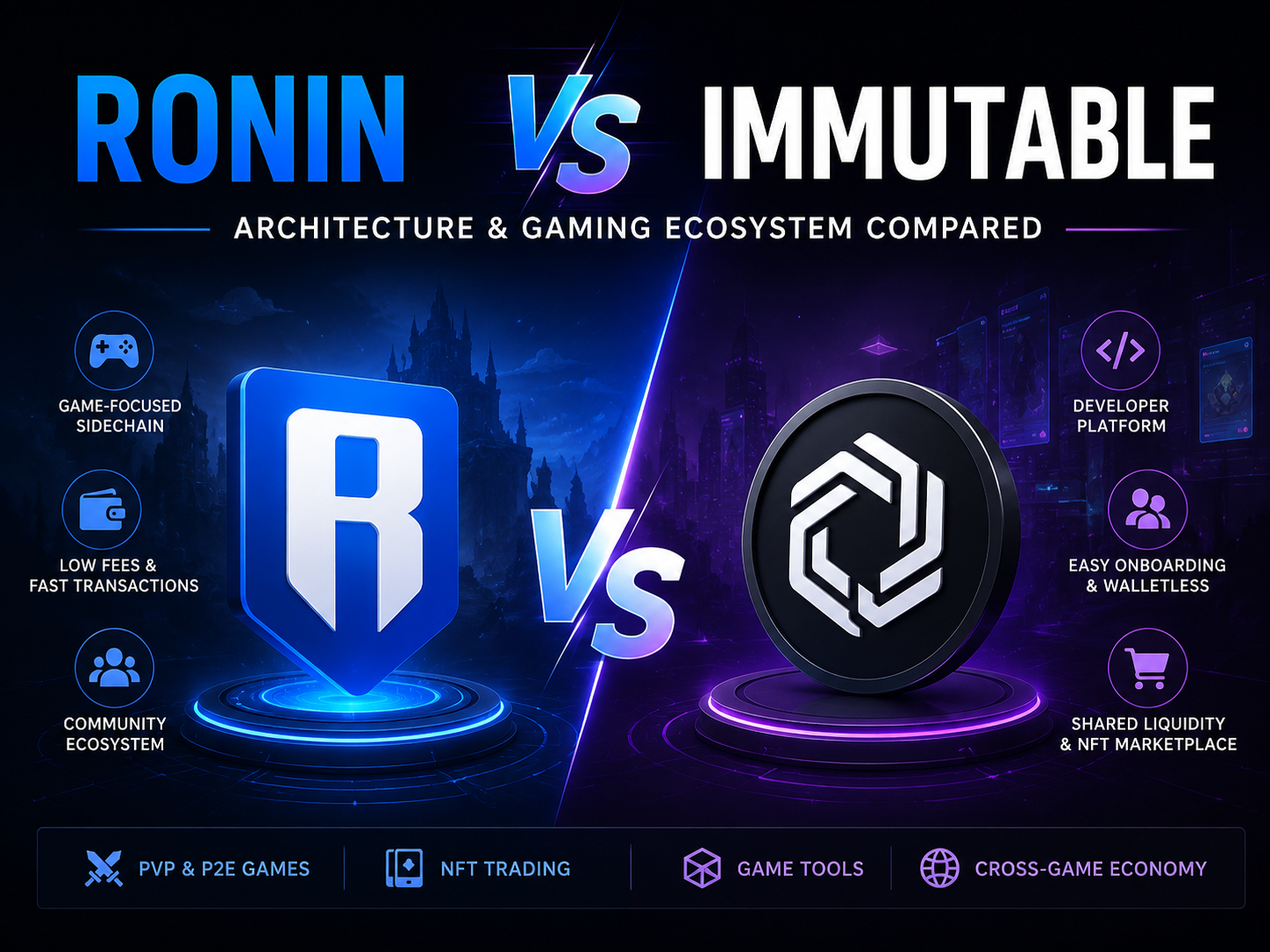
Users who search for the difference between Ronin and Immutable are usually trying to determine how different blockchain gaming infrastructure supports game assets, NFT trading, player accounts, and developer tools. For Web3 game projects, the choice of underlying chain affects transaction costs, asset liquidity, user onboarding, and the way an ecosystem can expand.
This topic usually involves several layers, including architecture design, on-chain transactions, ecosystem incentives, data control, and application scenarios. Understanding these differences helps clarify which types of game projects and blockchain gaming economies are better suited to Ronin or Immutable.
What Is Ronin
Ronin’s core positioning is centered on transaction efficiency for blockchain games. It was originally built by Sky Mavis for the Axie Infinity ecosystem to support game assets, NFTs, and on-chain interactions. Ronin can be understood as an Ethereum-compatible sidechain optimized for gaming scenarios, with a focus on lowering on-chain operating costs and improving the player experience when game assets move between users and applications.
Structurally, Ronin uses a Delegated Proof of Stake mechanism. Users can delegate RON to validator nodes to support network security and receive related rewards. Official documentation refers to this process as delegation, where token holders support validator operations by delegating their tokens.
First, users enter the blockchain gaming ecosystem through Ronin Wallet. Game assets are then transferred, traded, or brought on-chain within the Ronin network. Next, validator nodes process transactions and maintain the network state. Finally, through lower fees and faster confirmation speeds, Ronin provides the infrastructure needed for blockchain game asset circulation.
The impact of this structure is that Ronin is better suited to high-frequency game interactions and NFT trading scenarios, although its ecosystem focus is also relatively concentrated, mainly around games and related asset applications.
What Is Immutable
Immutable is designed to provide a full set of infrastructure for Web3 games, rather than serving only as a single on-chain transaction network. It can be understood as a blockchain gaming platform for game developers, offering a suite of tools around player login, wallet creation, NFT issuance, asset trading, and ecosystem liquidity.
Immutable’s official documentation emphasizes that its platform includes player growth tools, cross-game discovery, player analytics, frictionless login, automatic wallet creation, and game asset ownership. Players can log in through Google, Apple, or email, with the system automatically creating a wallet to lower the entry barrier for blockchain games.
Structurally, Immutable is more like a combination of developer tools and on-chain infrastructure. First, developers connect games through Immutable’s SDKs, Passport, Orderbook, and other tools. Players then enter games through a simplified account system. Next, NFTs and game assets can move across different marketplaces. Finally, Immutable uses platform-level tools to improve the efficiency of asset issuance, trading, and user retention.
This mechanism means Immutable’s core advantage lies not only in the chain itself, but also in the complete tool system it has built around game development, user onboarding, and asset liquidity.
What Are the Differences in Their Underlying Architecture
The architectural differences between Ronin and Immutable mainly reflect the distinction between a sidechain network and a platform-based scaling solution. Ronin places more emphasis on the operating efficiency of an independent blockchain gaming network, while Immutable focuses more on a gaming infrastructure stack based on the Ethereum ecosystem.
In architectural terms, Ronin uses an Ethereum-compatible sidechain to handle blockchain gaming transactions and relies on a DPoS mechanism to coordinate validator nodes. Its core purpose is to keep game transactions within a dedicated network as much as possible, reducing mainnet costs and interaction complexity. Ronin’s architecture is closer to a dedicated execution environment for a gaming ecosystem.
Immutable is closer to a developer platform combined with a scaling network. Its product system includes modules such as Passport, Orderbook, and Checkout, and it is combined with zkEVM solutions to provide games with smart contract compatibility, account abstraction, asset liquidity, and player onboarding tools. Polygon has stated that Immutable zkEVM is designed to provide scalability, Ethereum security, and smart contract compatibility, while working with the Immutable platform to deliver the user onboarding and asset liquidity capabilities that games need.
| Comparison Dimension |
Ronin |
Immutable |
| Architectural positioning |
Gaming-focused sidechain |
Gaming platform and scaling network |
| Core focus |
Transaction efficiency and low cost |
Developer tools and asset liquidity |
| User entry point |
Ronin Wallet |
Immutable Passport |
| Transaction foundation |
Internal transactions on the Ronin network |
Orderbook and platform-based markets |
| Ecosystem direction |
Expands around blockchain gaming applications |
Expands around game developers |
This difference shows that Ronin is better suited to building deep asset circulation around one or multiple game ecosystems, while Immutable is better suited to providing standardized blockchain tools for different game projects.
Why Blockchain Game Asset Trading Has Taken Different Paths
The difference in blockchain game asset trading models comes from the two platforms’ different understandings of NFT liquidity. Ronin places more emphasis on completing game asset transactions within its own ecosystem, while Immutable focuses more on shared orders across marketplaces and platform-level asset liquidity.
Ronin’s trading model mainly revolves around the movement of game assets within a dedicated network. First, players hold game NFTs or tokens. These assets are then transferred or traded through Ronin Wallet and ecosystem marketplaces. Next, the on-chain state is confirmed by the Ronin network. Finally, in-game assets can go through repeated interactions at relatively low cost.
Immutable’s asset trading mechanism is more platform-based. Its official documentation shows that Immutable Orderbook is a decentralized trading protocol where orders created on any marketplace can be viewed and filled across the ecosystem. This means Immutable is more focused on shared liquidity between different marketplaces, rather than keeping assets only inside a single game or single market.
In practice, Ronin’s advantage lies in its direct transaction path, which suits high-frequency game asset operations. Immutable’s advantage lies in stronger market connectivity, making it more suitable for projects that need multi-market exposure and cross-game asset circulation. Both serve NFTs and game assets, but they do not solve exactly the same problem.
How Ronin and Immutable Build Ecosystem Incentive Mechanisms
Incentive mechanisms for blockchain gaming networks usually need to serve players, developers, validator nodes, and asset traders at the same time. The difference between Ronin and Immutable is that Ronin relies more on its network token and validator node structure, while Immutable relies more on platform tools, asset liquidity, and its developer ecosystem.
Ronin’s incentive core revolves around RON. Users can delegate RON to support validator nodes. Validators are responsible for confirming transactions and maintaining network security, while staking participants receive rewards according to the mechanism. Official documentation clearly states that RON delegation is used to help secure the network and earn staking rewards.
Immutable’s ecosystem incentives place more emphasis on developer and player growth tools. Its documentation notes that the platform provides cross-game discovery, player analytics, automatic wallet creation, and asset ownership capabilities. These mechanisms mainly support game integration, user conversion, and asset trading efficiency.
First, Ronin maintains network security through token staking and validator incentives. Game asset trading then drives on-chain usage demand. Next, ecosystem applications build user activity around the Ronin network. Finally, RON and blockchain game transactions form an economic cycle.
Immutable’s process is different. First, developers integrate platform tools. Players then enter games through a simplified account system. Next, assets gain a broader trading range through mechanisms such as Orderbook. Finally, platform capabilities help games improve asset liquidity and user retention.
How Game Data and Asset Control Are Distributed
Game data and asset control are key issues when comparing blockchain gaming infrastructure. Both Ronin and Immutable support player ownership of on-chain assets, but they differ in account systems, asset circulation, and ecosystem control methods.
Ronin’s asset control is more concentrated within the Ronin network and Ronin Wallet system. Players use the wallet to manage NFTs, tokens, and game assets, while asset trading mainly takes place around the Ronin ecosystem. The advantage of this approach is that the on-chain interaction path is clear, and user assets are closely tied to the game environment.
Immutable’s asset control leans more toward a platform-based account and cross-market trading system. Immutable Passport allows players to enter games through social accounts or email and automatically creates a wallet. Official documentation shows that Passport allows players to obtain wallet addresses, check balances, send transactions, and sign messages.
Structurally, Ronin is more like a wallet-centered game chain asset system, while Immutable is more like a game asset platform centered on account abstraction and developer tools. The former emphasizes asset management efficiency within the ecosystem, while the latter emphasizes lowering the barrier for players to interact with wallets and on-chain operations.
This difference can affect game design. Projects that emphasize native on-chain asset management may pay more attention to Ronin’s wallet and network experience. Projects that emphasize seamless onboarding for ordinary players may pay more attention to Immutable’s account and platform tools.
How the Two Blockchain Gaming Ecosystems Are Developing Differently
The difference in ecosystem direction between Ronin and Immutable comes mainly from how each defines blockchain gaming infrastructure. Ronin is more like an application ecosystem built around a blockchain gaming network, while Immutable is more like a platform ecosystem built around developer and player tools.
Ronin’s ecosystem expansion usually revolves around games, NFTs, wallets, and trading. Its infrastructure focuses on supporting high-frequency movement of blockchain game assets within the same network, allowing game economies to operate at lower cost. Ronin’s ecosystem is more likely to form deep loops around specific game assets and player communities.
Immutable’s ecosystem expansion places more emphasis on standardized tools. Its documentation provides TypeScript SDK, Unity SDK, Unreal SDK, Passport, asset issuance modules, and trading-related modules, giving different types of game developers the ability to integrate with the platform.
In practice, Ronin is better suited to building gaming ecosystems with strong communities and deep asset circulation, while Immutable is better suited to serving multiple game projects by lowering the developer integration barrier through unified tools. Ronin’s core lies in its on-chain economic system, while Immutable’s core lies in platform-level distribution and asset liquidity.
This difference does not mean the two are only competitors. More accurately, they represent two routes for blockchain gaming infrastructure: one is the dedicated gaming-chain route, and the other is the game development platform route.
Which Types of Web3 Games Are Better Suited to Ronin or Immutable
Choosing Ronin or Immutable mainly depends on whether a game project needs a dedicated on-chain environment or platform-level tools and cross-market asset liquidity. Ronin is better suited to high-frequency transactions, strong communities, and deep in-game economies, while Immutable is better suited to games that need fast integration, seamless player login, and multi-market NFT liquidity.
Projects suited to Ronin usually involve frequent game asset operations, such as character upgrades, NFT transfers, in-game token settlement, and player-to-player trading. First, players enter the Ronin ecosystem and manage their wallets. Game assets then continue circulating on-chain. Next, RON pays network fees and supports transaction confirmation. Finally, the game economy forms a closed loop within a dedicated network.
Projects suited to Immutable usually place more emphasis on player onboarding and development efficiency. First, developers integrate Immutable tools. Players then log in through email or social accounts. Next, the system automatically handles wallet and asset interactions. Finally, the game can use Orderbook, Passport, and SDKs to improve the asset issuance and trading experience.
Therefore, Ronin is better suited to projects that want to build a closed-loop on-chain game economy, while Immutable is better suited to projects that want to reduce development and user onboarding costs. Their use cases differ, and the key question is not which one completely replaces the other, but what type of infrastructure the project needs.
Conclusion
The core differences between Ronin and Immutable lie in their architectural paths, asset trading mechanisms, ecosystem incentives, and user onboarding methods. Ronin leans more toward a gaming-focused sidechain, serving high-frequency blockchain game asset circulation and internal ecosystem trading. Immutable leans more toward a Web3 gaming platform, serving developer tools, player login, NFT liquidity, and cross-market trading.
From the perspective of blockchain game projects, Ronin is better suited to games that emphasize a dedicated economic system, player communities, and on-chain asset circulation. Immutable is better suited to games that need fast integration, lower player entry barriers, and broader asset trading reach. Together, they show that Web3 gaming infrastructure is developing along different technical paths.
FAQs
What Is the Biggest Difference Between Ronin and Immutable
Ronin is more like a dedicated sidechain for a gaming ecosystem, while Immutable is more like a Web3 gaming platform for developers and players. Both serve blockchain games, but their architectural focus and asset trading models are different.
What Types of Games Is Ronin Suitable For
Ronin is better suited to game projects with high-frequency transactions, strong communities, and clear on-chain asset circulation, especially scenarios that require low-cost NFT trading and in-game token interactions.
What Types of Games Is Immutable Suitable For
Immutable is better suited to game projects that need fast blockchain integration, lower wallet barriers for players, and improved asset liquidity through shared orders and platform tools.
Do Ronin and Immutable Both Support NFTs
Both Ronin and Immutable support NFT-related applications, but Ronin places more emphasis on NFT circulation within its own ecosystem, while Immutable places more emphasis on cross-market order sharing and platform-based asset trading.
How Should Projects Choose Between Ronin and Immutable
The choice depends on the needs of the game project. Projects that need a dedicated closed-loop blockchain gaming economy are better suited to Ronin, while projects that need developer tools, seamless player login, and cross-market liquidity are better suited to Immutable.