Over the past few years, many Web3 gaming projects have relied on token incentives to attract users. Yet a large number of these products have struggled to build long-term retention and stable revenue structures. Once market attention fades, models driven purely by high returns often become difficult to sustain.
At the same time, the growth of Telegram Mini Apps, WeChat Mini Games, and LINE social gaming platforms has shown that lightweight mini-games and social distribution offer a more stable logic for user growth. Compared with heavy blockchain games, Mini-Games are easier for ordinary users to access and can build sustained traffic channels through Super Apps.
What Is the Core of PlaysOut’s Business Model?
The business model of PlaysOut is mainly built around three layers: developer services, the mini-game ecosystem, and the on-chain economy.
The platform does not depend on a single revenue stream. Instead, it creates a complete business loop through SDKs, traffic distribution, payment systems, and ecosystem incentives. Its overall logic can be understood as:
Developer integration → mini-game growth → user activity → on-chain interaction → platform revenue growth
This model is closer to an internet platform economy than a traditional blockchain game model.

How Does PlaysOut Generate Revenue Through Its SDK?
The Mini-Game SDK is one of PlaysOut’s most important products.
Through the PlaysOut SDK, developers can quickly connect with Super Apps such as Telegram, LINE, and WeChat, while gaining access to account systems, payment capabilities, and on-chain incentive modules.
The platform’s revenue sources may include developer tools, API services, cloud capabilities, and user growth tools. As the number of developers increases, the SDK itself can gradually become a stable infrastructure-based revenue source.
This model is relatively close to a traditional SaaS platform. Its core value lies in lowering the barrier for developers to enter Web3.
How Does PlaysOut Monetize Through the Mini-Game Ecosystem?
Beyond developer tools, PlaysOut can also generate revenue through the mini-game ecosystem itself.
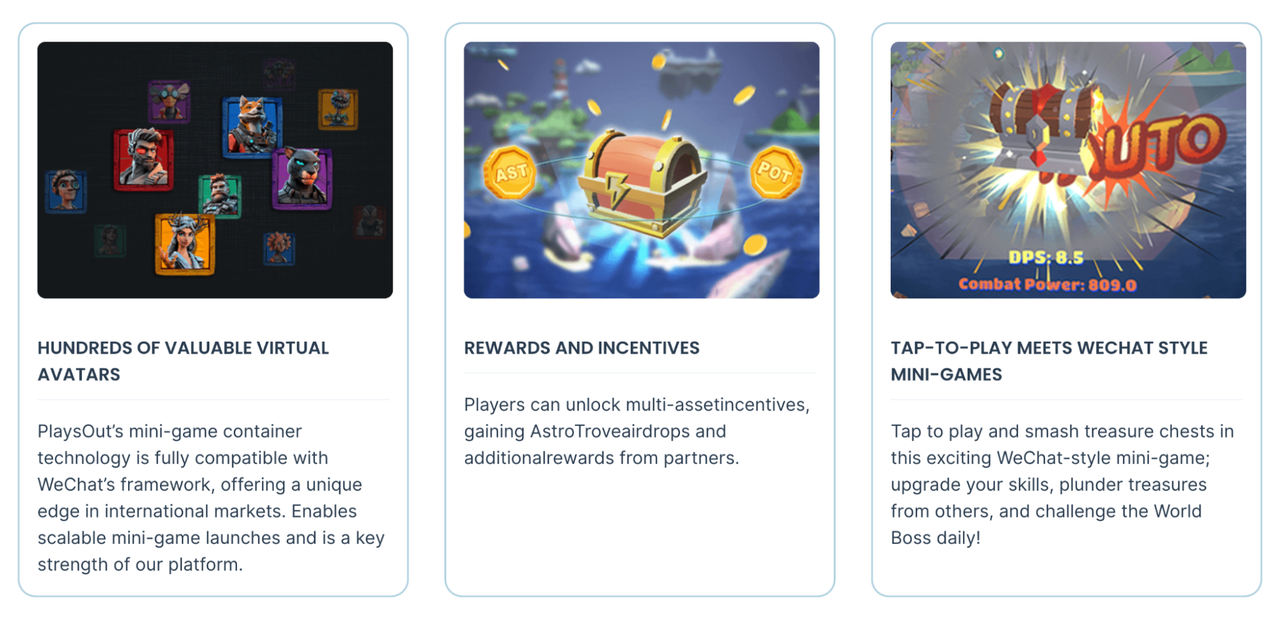
Mini-games typically have high engagement and strong social sharing potential, which allows the platform to monetize through in-game advertising, virtual item sales, game payments, and brand partnerships.
Compared with traditional blockchain games that rely on NFT speculation, PlaysOut is closer to the logic of Web2 mini-game platforms, using a large base of lightweight users to generate sustained cash flow.
This also means the platform places more emphasis on long-term user retention rather than short-term token hype.
Why Does PlaysOut Emphasize Super App Traffic?
The greatest value of a Super App lies in its built-in traffic and social graph.
Traditional blockchain games often need to spend heavily on user acquisition, while Telegram, LINE, and WeChat already have large user bases. By integrating with these platforms, PlaysOut can significantly reduce user acquisition costs.
At the same time, mini-games are designed for instant play. Users can enter a game directly without downloading an app. This low-barrier experience makes social sharing and viral growth easier to achieve.
For PlaysOut, Super Apps are not just distribution channels. They are the traffic foundation of the entire business model.
What Role Does PLAY Token Play in the Business Model?
PLAY Token is an important part of the PlaysOut ecosystem, but it is not the platform’s only source of revenue.
PLAY Token functions more like a value circulation tool within the ecosystem. Its uses include game payments, user rewards, community governance, developer incentives, and staking mechanisms.
Compared with traditional GameFi tokens, PLAY is more of a platform token. Its value depends more on ecosystem activity and growth in the number of mini-games.
This means PlaysOut’s long-term goal is not short-term token speculation, but the creation of a platform network effect that can continue expanding over time.
How Does PlaysOut Drive User Growth and Retention?
User growth is at the center of the business model for any mini-game platform.
PlaysOut’s growth logic mainly comes from Super App traffic, lightweight mini-game experiences, and Web3 incentive mechanisms. The platform can improve user activity through check-ins, leaderboards, referral systems, and task systems, while using on-chain rewards to strengthen long-term participation.
Compared with traditional blockchain games that emphasize high yields, PlaysOut focuses more on frequent interaction and social distribution.
This model better matches user behavior in the mobile internet era.
How Is PlaysOut Different from Traditional GameFi Business Models?
Traditional GameFi usually relies on NFT sales, token speculation, and high-yield models, while PlaysOut places more emphasis on platform-based revenue and long-term ecosystem expansion.
The core differences are:
| Traditional GameFi |
PlaysOut |
| High-yield driven |
User-growth driven |
| Single game |
Platform ecosystem |
| NFT speculation |
Mini-game distribution |
| Heavily financialized |
Lightweight entertainment |
| Short-term hype cycles |
Long-term network effects |
PlaysOut is closer to an internet gaming platform than simply an on-chain financial product.
Why Does PlaysOut Emphasize the Developer Ecosystem?
For platform-based products, the number of developers determines the scale of the ecosystem.
If more mini-games are released through PlaysOut, the platform can gradually accumulate user traffic, game content, on-chain accounts, and payment scenarios, creating a clear network effect.
Platform models such as Shopify, Steam, and Unity all depend, in essence, on the continued expansion of their developer ecosystems.
For this reason, PlaysOut’s long-term value comes not only from user numbers, but also from the growth of its developer ecosystem.
Where Does PlaysOut’s Long-Term Business Potential Lie?
PlaysOut’s long-term potential mainly comes from three trends.
First, Super Apps are becoming new internet entry points. Second, Mini-Games are becoming tools for Web3 user growth. Third, the Web3 gaming industry is shifting from heavy financialization toward lightweight entertainment.
If PlaysOut can continue building its mini-game ecosystem and developer network, it may become more than a gaming platform in the future. It could evolve into infrastructure for Web3 social entertainment.
This platform-based structure also gives it room for long-term commercial expansion.
Conclusion
PlaysOut’s business model is built on its Mini-Game SDK, Super App traffic, on-chain incentives, and developer ecosystem. The platform not only generates revenue through developer tools and the mini-game ecosystem, but also aims to build a long-term network effect through PLAY Token and social traffic.
Compared with traditional GameFi, which relies more heavily on short-term financial returns, PlaysOut places greater emphasis on platformization, lightweight experiences, and sustained user growth.
FAQs
What Are PlaysOut’s Main Revenue Sources?
They mainly include SDK services, mini-game ecosystem revenue, advertising, in-game payments, and revenue related to Web3 incentives.
Why Does PlaysOut Emphasize Super App Traffic?
Because platforms such as Telegram and LINE already have built-in user bases, which can significantly lower user acquisition costs for mini-games.
What Role Does PLAY Token Play in the Business Model?
PLAY Token is used for payments, rewards, governance, and developer incentives. It is an important value circulation tool within the ecosystem.
What Is the Biggest Difference Between PlaysOut and Traditional GameFi?
Traditional GameFi relies more on NFTs and high-yield models, while PlaysOut emphasizes platform ecosystems and long-term user growth.
Why Does PlaysOut Care About the Developer Ecosystem?
Because platform-based products need a steady expansion of mini-game content, and the number of developers determines the overall scale and long-term value of the ecosystem.