That distinction matters to an amateur investor preparing to start day trading as much as it does to experienced individual investors refining an existing trading system designed around intraday trading. A clear trading plan can reduce impulsive decisions, but making money day trading is difficult. Traders shouldn't expect to immediately start cashing in on countless money-making opportunities simply because a chart setup looks convincing.
Key Takeaways
-
Effective day trading combines technical setups with position sizing, stop-loss rules, and disciplined execution.
-
Momentum trading strategies, breakouts, VWAP setups, scalping, and mean reversion work under different market conditions.
-
High liquidity can reduce spread and slippage, making fast entry and exit easier.
-
Day traders commonly use scanners, candlestick charts, chart patterns, volume, and short-term technical indicators to find setups.
-
A trader's psychology, physical readiness, trading profile, and weekly performance review can matter as much as the entry signal.
-
U.S. margin requirements changed in 2026, while some brokerages can continue using the previous Pattern Day Trader framework during a transition period.
How Does Day Trading Work?
A day trader usually targets short-term price movements and closes positions before the relevant trading session ends, reducing overnight risk. A swing trader may keep a position for several days, while a position trader can hold much longer.
Real-world trading scenarios also differ by market. Forex trading runs across global sessions, stock markets have defined opening and closing periods, and crypto trading operates continuously. In foreign exchange, activity comes from several categories of participants rather than one type of trader. Forex market descriptions commonly include commercial and investment banks, central banks, institutional asset managers, multinational corporations, brokers or liquidity providers, and individual traders among the major players involved.
Multinational corporations may buy or sell currencies to hedge commercial exposures rather than speculate. That differs from a retail currency trading strategy built around short-term technical analysis.
There isn't a standardized trader profile test that reliably assigns everyone to five trading profiles or any other fixed number. Still, thinking about a trader profile can be useful. A mechanical trader may prefer fixed rules, while a discretionary day trader may rely more heavily on market structure. Others naturally fit swing trading or longer-term positioning.
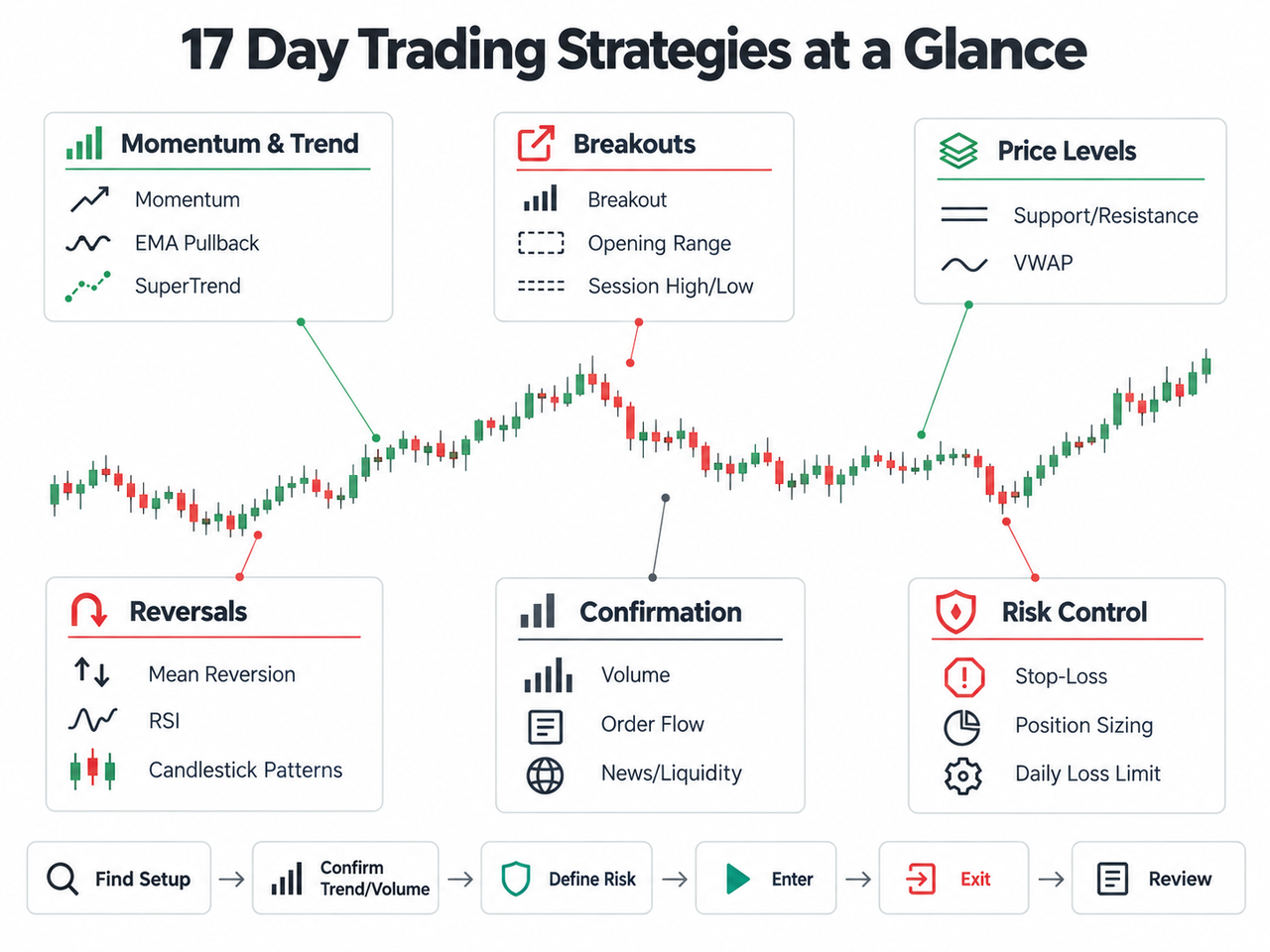
The following 17 strategies provide step-by-step guidance and practical insights without assuming one natural trading style suits everyone.
17 Most Effective Strategies for Day Traders
1. Momentum Trading
Momentum trading involves entering securities or crypto assets that are already moving strongly in one direction. Day traders often use stock scanners to identify momentum stocks with unusual price movement or volume.
A trader could pair EMA 9 for short-term momentum with volume and price structure instead of buying simply because a stock or token has risen sharply.
Quick decision-making can be valuable here, but speed shouldn't replace confirmation.
2. Breakout Trading
Breakout traders look for price to move beyond an established range, previous high, resistance level, or support zone.
High-volume breakouts generally carry more information than a single candle briefly crossing a level. The risk is a false breakout, where price quickly returns inside the range.
3. VWAP Trend Trading
VWAP represents the volume-weighted average price during an intraday session. Traders often treat price above a rising VWAP as evidence of stronger intraday demand and price below a declining VWAP as evidence of weakness.
VWAP versus EMA shows why the two aren't interchangeable: VWAP incorporates price and volume, while EMA emphasizes recent price changes.
4. EMA Pullback Trading
Instead of chasing price, traders can wait for a pullback toward a fast moving average.
A rising EMA followed by a higher low and renewed momentum provides more information than an EMA touch alone. Comparing EMA 9, EMA 20, and EMA 50 can give a clearer picture of short-term and broader intraday direction.
5. Support and Resistance Trading
Support and resistance strategies use areas where price has previously attracted buyers or sellers.
Previous daily extremes are common references. Daily high and low levels can act as breakout levels, rejection zones, or targets during same-day trading.
6. Session High/Low Trading
Session highs and lows focus on the current trading period rather than the full historical chart.
A trader can monitor whether price breaks, rejects, or retests a session high or session low. Activity often increases around high-volume windows such as major market openings, session overlaps, and in some markets the closing period.
7. Scalping
Scalping tries to capture small price movements over seconds or minutes. Most traders using this method rely on very short timeframes such as 1-minute or 5-minute candlestick charts.
Execution costs matter because profit targets can be small. High liquidity helps traders enter and exit with less potential slippage, although it doesn't guarantee the displayed price.
8. Opening-Range Breakout
An opening-range strategy records the early session's high and low and waits for price to leave that range.
The approach is especially relevant to markets with formal opening hours. Volume expansion, VWAP alignment, or a successful retest can help filter weak breaks.
9. Mean-Reversion Trading
Mean-reversion strategies assume that an unusually extended price may eventually move back toward an average.
VWAP, Bollinger Bands, RSI, or moving averages can serve as reference points. The catch is that strongly trending markets can stay overextended for much longer than expected.
10. RSI Reversal Trading
RSI tracks momentum on a 0-100 scale. Traders often examine extreme readings, divergence, and momentum shifts.
RSI versus Stochastic RSI illustrates why different momentum indicators can respond at different speeds. Neither confirms a reversal on its own.
11. MACD Momentum Trading
MACD uses moving averages to evaluate trend and momentum.
Day traders may monitor signal-line crosses, histogram changes, and zero-line movement. A signal aligned with market structure usually has more context than an isolated technical indicator crossover.
12. Candlestick and Chart Pattern Trading
Candlestick charts show open, high, low, and close information in a compact format. Chart patterns add broader structure.
An engulfing candle, rejection wick, flag, triangle, or range breakout becomes more meaningful near VWAP, support, resistance, or a prior session level. Taking every visible pattern can encourage overtrading, so confirmation matters.
13. Volume and Order-Flow Confirmation
Price shows where the market moved; volume helps show how much participation accompanied the move.
In derivatives, open interest versus volume separates outstanding positioning from trading activity. Net volume versus volume delta can provide another view of directional buying and selling pressure.
14. SuperTrend Trend-Following
SuperTrend combines price with volatility to create a directional trading line.
Combining SuperTrend and VWAP can separate trend confirmation from intraday value. It usually fits directional markets better than choppy price action where signals flip repeatedly.
15. News and Economic-Release Trading
News traders watch scheduled events that can trigger short-term volatility in stocks, futures, forex, and sometimes crypto.
The U.S. Bureau of Labor Statistics publishes an official economic release calendar, while the Federal Reserve publishes its FOMC meeting calendar. CPI, employment reports, and interest-rate decisions can cause spreads and volatility to expand quickly.
Successful execution around these events requires a high degree of risk awareness, not merely faster trading.
16. High-Liquidity Market Trading
Liquidity is important because traders need to enter and exit without excessive price impact.
For example, a crypto trader testing a VWAP or momentum setup can observe a liquid BTC/USDT perpetual market on Gate.com, where price, volume, order-book activity, funding, and open interest can be compared with the chart setup.
Trading with leverage can increase both profit and loss. Futures positions can also be liquidated, so security selection, leverage, position size, and stop placement have to work together.
17. Rule-Based Risk Management
Risk management turns a chart setup into a complete trading process.
Position size should reflect account equity, volatility, and stop distance rather than emotion. Hard stop-loss orders can reduce hesitation, while a predefined maximum daily loss can stop a poor session from turning into a much larger drawdown.
Some traders use daily loss caps around 3% to 5% of account equity, but that is a trading convention rather than a universal standard. A trader should custom tailor limits to capital, volatility, instrument, and strategy rather than treating 3% or 5% as inherently safe.
Stock Scanners, Brokers, and Execution Speed
A day trading setup also depends on infrastructure. Stock scanners can identify securities displaying unusual volume, volatility, price gaps, or momentum before the trader studies the chart.
Day Trade Dash, for example, currently combines scanners, charts, and breaking-news tools in one trading interface. Its own website describes scanners and news as core features, so it can illustrate the type of workflow active traders may use rather than representing a required tool.
Execution deserves similar attention. Direct-access systems can let active traders route orders toward particular markets or market makers instead of relying entirely on preset broker routing. The SEC has noted that direct-access systems can allow orders to reach market execution systems rapidly, though execution speed and price still aren't guaranteed. SEC information on trade execution explains why routing can affect execution quality.
Commission-free trading has become common among retail brokerage platforms, making explicit commissions less of a barrier than they once were. Cost still includes spreads, execution quality, financing charges, and other fees, however, so "$0 commission" isn't the same thing as cost-free trading.
Build a Trading Plan Before You Start Day Trading
A useful trading plan defines the market, trading schedule, setup, entry criteria, stop level, position size, profit-taking rules, and conditions that require no trade.
For example, a trading system designed for long entries could require price above VWAP, a rising 20 EMA, a higher low, and increasing volume. That gives the trader specific rules instead of simply buying when a market "looks strong."
Psychological discipline matters too. Successful day trading requires patience, high emotional awareness, and enough physical preparation to stay attentive during fast markets. Fatigue can reduce reaction quality just as easily as fear or overconfidence can distort a decision.
A trading journal should record entries, exits, setups, position sizes, mistakes, and emotional state. Profitable traders commonly review performance data regularly because weekly review can reveal which setups work, which habits lose money, and whether losses came from strategy or execution.
Is Day Trading Illegal? Margin Accounts and Cash Accounts
Day trading itself isn't illegal. Rules depend on the jurisdiction, security, broker, and account type.
The familiar U.S. Pattern Day Trader Rule applied to margin accounts, not ordinary cash accounts. Under the previous framework, a person classified as a pattern day trader generally had to maintain $25,000 of equity to continue qualifying day-trading activity.
That framework changed in 2026. FINRA's new intraday-margin rules became effective on June 4, 2026 and replace the trade-count-based PDT designation and $25,000 day-trading minimum. Brokerage firms are permitted a transition period through October 20, 2027, so a firm can temporarily continue operating under the old rules.
Under the new framework, leveraged margin trading generally requires at least $2,000 in equity, while accounts must maintain adequate intraday margin relative to their positions. Repeated intraday margin deficits can lead to restrictions. Individual firms may impose stricter requirements.
Cash accounts do not use the former PDT classification, but settlement requirements, available cash, and broker rules still affect trading activity.
How Difficult Is It to Make Money Day Trading?
Claims that traders can reliably earn high returns, a fixed amount of money per day, or a standard annual salary should be treated cautiously. There is no dependable industry-wide figure showing that a successful day trader averages $400 per day or that self-employed day traders earn $94,266 a year.
Academic evidence paints a harder picture. A 2014 study of Taiwanese day traders covering 1992-2006 found that less than 1% of the day-trader population predictably and reliably earned positive abnormal returns after fees.
A later study using Taiwanese trading data found that predictably profitable traders represented less than 3% of active day traders on an average day. That is likely the source behind the often-repeated "3%" claim, but it shouldn't be described as a finding from the 2014 study or generalized directly to today's global stock, forex, futures, or crypto markets.
The practical lesson is simpler: technical skill, execution, risk limits, psychological discipline, and adaptation all matter, but none guarantees consistently profitable results.
Conclusion
The 17 most effective strategies for day traders solve different problems. Momentum and breakout approaches target continuation; VWAP and moving averages help establish direction; mean reversion looks for overstretched moves; volume, chart patterns, and candlesticks add confirmation.
A trader doesn't need every strategy. A clearer approach is to identify a suitable trader profile, choose a small number of setups, test them across real-world trading scenarios, and define risk before placing the order.
Day trading can create short-term opportunities, but it isn't a shortcut to high returns. The advantage comes from applying a structured trading plan repeatedly, controlling losses, reviewing performance, and knowing when not to trade.
FAQ
What strategy do most day traders use?
There is no single strategy used by most traders. Momentum, breakout, VWAP, moving-average, scalping, and support-resistance setups are all common, with the choice depending on market structure and the trader's style.
Do day traders use stock scanners?
Yes. Stock scanners can help day traders locate securities showing unusual volume, gaps, volatility, or price momentum. A scanner identifies candidates; it doesn't determine whether a trade is worth taking.
When are the most active periods for day trading?
In markets with fixed sessions, trading volume can be particularly high around the opening and closing periods. Forex activity can increase during major session overlaps, while crypto trades continuously and may develop different liquidity patterns.
Does the Pattern Day Trader Rule apply to cash accounts?
The traditional U.S. Pattern Day Trader designation applied to margin accounts rather than cash accounts. FINRA began replacing that framework with risk-based intraday-margin requirements on June 4, 2026, with a brokerage transition period through October 20, 2027.
Is a direct-access broker better for day trading?
Direct access can give an active trader more control over order routing and potentially faster interaction with market execution systems. That doesn't guarantee a better fill because execution quality also depends on liquidity, order type, market conditions, and routing.
Can day traders consistently earn high returns?
A small minority may develop sustained profitability, but high returns aren't assured. Historical academic research has found that predictably profitable day traders represented only a small proportion of the studied populations, and those historical findings shouldn't be treated as a forecast for an individual trader.
Disclaimer
This content is for educational purposes only and does not constitute financial, investment, legal, or tax advice. Day trading, margin, forex, futures, and crypto trading can involve significant losses. Rules differ by jurisdiction, account type, market, and platform. Historical performance, technical indicators, trading systems, and chart patterns do not guarantee future results.