This is the core issue for exchanges, custodians, portfolio managers, and other existing CASPs or financial services firms operating in Monaco. This discussion focuses on what the current 2022 law still governs, how a proposed replacement framework sometimes identified as Bill No. 1131 could shift licensing and supervision toward a more MiCA aligned framework, and what that means in practice for transitional compliance, AML/CFT upgrades, asset safeguarding, multi-agency oversight, foreign providers, and the cost and business-model impact of staying active in the Principality.
Key Takeaways
-
Monaco’s July 2022 framework remains part of the current legal basis for crypto and digital-asset activities.
-
A transition to stricter crypto regulations would likely require existing providers to reassess authorization scope rather than assume that an old registration or approval automatically carries forward.
-
Governance, AML/CFT controls, safeguarding, cybersecurity and operational resilience are likely to become major transition workstreams under a MiCA-influenced model.
-
Monaco has been under FATF increased monitoring since June 2024, adding regulatory pressure to strengthen AML/CFT effectiveness. Monaco remained listed under increased monitoring in June 2026.
-
No verified final Monaco grandfathering deadline should be assumed until the replacement legislation and implementing measures are officially published.
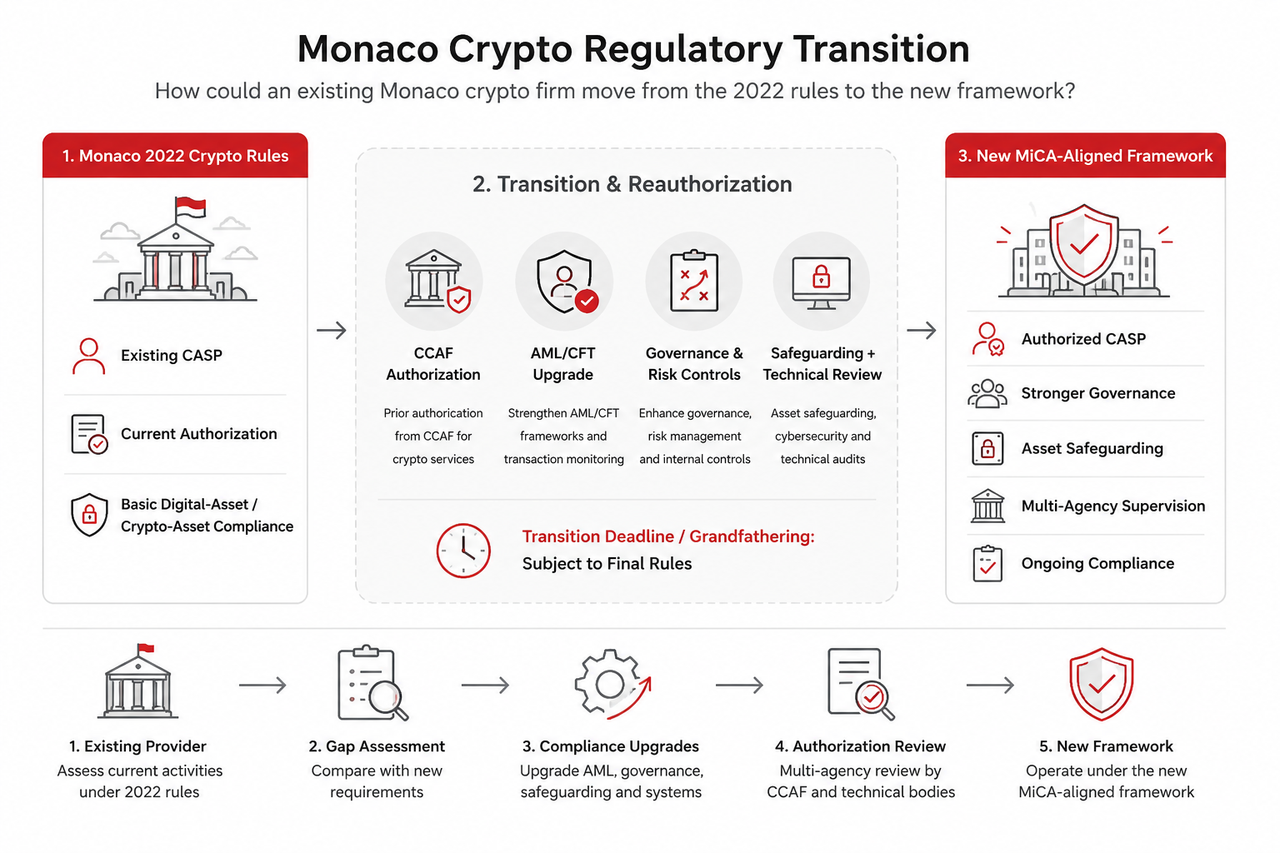
How Could Existing Crypto Firms Transition From Monaco’s 2022 Rules to the New Framework?
For an existing provider, the safest way to think about a Monaco crypto regulatory transition is as a re-permissioning exercise.
The firm would first map every activity it currently performs against the service categories recognized by the replacement framework. It would then identify which of those services require prior authorization, which authority supervises them, and whether the existing legal entity, management structure and compliance systems meet the new standard.
That sounds administrative. In practice, it can affect the whole operating model.
A company may currently describe itself broadly as a digital-asset platform but actually perform several distinct services: custody, exchange, order execution, portfolio management, transfer services or reception and transmission of client orders. Under a more granular framework, each activity may need to appear expressly within the firm's authorization.
The underlying principle already exists elsewhere in European crypto regulation. Under MiCA, authorization is linked to particular crypto-asset services rather than giving a company an unrestricted permission to conduct any crypto activity. ESMA's implementation of MiCA illustrates how Europe has moved toward service-specific licensing, governance and ongoing supervision.
Monaco appears to be moving in a similar regulatory direction, as the proposed framework in Bill No. 1131 aims to align digital asset regulation with MiCA and FATF standards, even though it is not an EU member state and its final rules must still be assessed under Monegasque law rather than assuming that MiCA applies directly.
The broader relationship between those systems matters because Monaco's alignment with MiCA and FATF standards sits within a wider regulatory landscape and concerns both market regulation and financial-crime controls, not simply terminology.
Crypto Assets and Digital Assets Under the Monaco 2022 Crypto Law
Law No. 1.528 introduced and revised several definitions within Monaco's digital legislation. Among other things, it defines a digital asset as a digital representation of value, property or a patrimonial right and defines a crypto-asset more broadly to include digital assets and financial tokens.
Those definitions matter during a transition because a firm's existing product catalogue may no longer fit neatly into the same regulatory category after new legislation takes effect.
For example, a provider might support token custody, crypto-to-crypto exchange and managed investment strategies through one customer interface while also providing covered services across multiple functions. Regulators may view those as separate activities with separate legal and control requirements.
An internal transition review should therefore start with products, not licenses.
For every service, the business can ask:
-
What asset is involved?
-
What covered services or certain operational services does the company actually perform for the customer under the new perimeter?
-
Does it hold or control client assets?
-
Does it transmit, execute or arrange orders?
-
Does it exercise investment discretion?
-
Does the activity fall within the new authorization perimeter?
That exercise also helps distinguish the transition question from the broader issue of how Monaco crypto licensing works, especially for companies involved in digital asset service lines. An existing firm starts with legacy permissions and operating systems, while a new applicant starts without them.
Prior Authorization Could Replace Assumptions About Grandfathering
The largest mistake an existing provider could make would be to assume that being lawful under the old crypto rules automatically creates a permanent right to operate under the new ones.
Transitional arrangements can work in several ways. A government may recognize old permissions temporarily, require firms to reapply before a deadline, convert certain licenses automatically if conditions are met, or allow continued operations only while a new application is being assessed.
Until Monaco publishes final transitional provisions, none of those outcomes should be treated as confirmed.
A useful European comparison is MiCA's grandfathering system. Providers legally operating before December 30, 2024 could, where national law allowed it, continue during a temporary transition period, but ESMA made clear that they weren't considered MiCA-authorized merely because they could continue operating, and those transitional arrangements could not extend beyond July 1, 2026.
That distinction is highly relevant to Monaco: temporary permission to keep operating isn't the same thing as authorization under the replacement framework.
Existing firms should therefore prepare an authorization package before they know whether grandfathering will be generous, limited or unavailable, because companies seeking to continue operating may still need formal approval rather than relying on legacy status.
A MiCA Aligned Framework Could Require a Governance Overhaul
The proposed legislation under Monaco's Bill No. 1131 would likely replace basic corporate registration and activity notification with a stricter MiCA aligned framework and tougher licensing requirements.
MiCA-style authorization emphasizes who controls the business, whether management is suitable, how risks are governed, and whether firms can show sound corporate governance, professional conduct, client protection, and prudential safeguards. European CASPs must operate within defined authorization scopes and governance obligations.
For a Monaco firm, transition preparation could consequently involve reviewing:
-
board and senior-management responsibilities;
-
compliance independence;
-
risk-management policies;
-
conflicts-of-interest controls;
-
recordkeeping;
-
outsourcing arrangements;
-
incident escalation;
-
business continuity;
-
client complaints;
-
safeguarding of client assets and financial safeguards;
-
cybersecurity governance and operational controls.
Existing firms often have many of these controls already. The difficulty is demonstrating that they meet the new regulatory standard and are properly documented.
The difference between broad regulation and the specific transition problem is also clearer when viewed against Monaco's overall crypto regulatory framework: transition compliance asks whether an existing provider's actual procedures can survive the change in law, including any detailed technical requirements later set through secondary regulations.
Compliance Requirements Could Become a Multi-Agency Process
A new authorization model could also involve more than one supervisory body.
The CCAF is Monaco's independent authority supervising financial activities in the Principality, broadly comparable to a markets authority in frameworks where MiCA shapes supervision of European securities and crypto-asset activity. It already requires authorization for regulated financial activities and stresses that material changes to an authorization file, including capital, corporate purpose and management arrangements, may need prior approval.
If crypto authorization is placed more directly within the CCAF's remit under future legislation, firms should expect regulators to examine the complete operating structure rather than only the crypto technology.
Technical reviews may also involve agencies responsible for financial security, digital security or AML supervision and, if the final statutory design makes it relevant, coordination points with banking regulators or other regulated institutions. That could turn a once relatively narrow approval exercise into a multi-agency assessment covering both financial controls and technology, similar to how supervision became more formalized after MiCA, with 300 firms added to ESMA's register by July 2025.
In practical terms, the firm should be able to produce the same answer to different regulators asking different versions of the same question: How does this service work, who controls it, what can go wrong, and what proves ongoing regulatory compliance to prevent customer or financial-system harm?
AML/CFT May Be the Most Important Transition Workstream
Monaco's regulatory reform can't be separated from its anti-money laundering and AML/CFT position, especially as authorities tighten expectations around preventing money laundering.
The Financial Action Task Force placed Monaco under increased monitoring in June 2024. The FATF emphasized areas including sanctions for AML/CFT breaches, suspicious transaction reporting, judicial effectiveness and asset seizure.
Progress has since been recorded, but Monaco remained among jurisdictions under increased monitoring in the FATF's June 19, 2026 update, and the overhaul is meant to address identified strategic deficiencies, improve Monaco's classification, and support an exit from the FATF grey list.
For crypto firms, that means they must enhance Anti-Money Laundering controls and their counter terrorist financing framework rather than treat compliance as a supporting function.
An existing CASP may need to revisit:
-
customer identification and verification;
-
beneficial-owner checks;
-
enhanced due diligence, including when dealing with high risk jurisdictions;
-
transaction monitoring;
-
wallet screening;
-
sanctions controls;
-
customer risk scoring;
-
suspicious transaction reporting;
-
source-of-funds procedures;
-
record retention;
-
compliance staffing.
The transition may be particularly demanding for firms that grew under lighter processes and later added controls as volume increased, especially as the european commission and other bodies expect stronger safeguards for dealings involving high risk third countries.
A mature licensing regime generally expects the controls to be designed around the business before authorization, not retrofitted after problems appear, particularly where past strategic deficiencies drew scrutiny.
Asset Safeguarding Could Change Daily Operations
Custody is another area where the gap between old and new compliance models can become visible, especially where crypto custody is treated as an authorization-sensitive function.
A firm safeguarding customer crypto assets may need to demonstrate asset segregation, private-key controls, reconciliation procedures, withdrawal authorization, incident response, procedures for dealing with insolvency or operational disruption, and oversight of third-party service providers where custody or wallet infrastructure is outsourced.
Those aren't simply policy-document questions about virtual assets.
Suppose an exchange holds customer BTC while operating its own treasury wallets. A regulator may want evidence that customer assets can be distinguished from company assets, that withdrawal permissions aren't concentrated in one individual and that records can be reconciled reliably.
For a practical view of how a regulated exchange service can be separated into specific activities, Gate Technology Ltd's European authorization shows how crypto-asset service providers are authorized under MiCA for functions including custody, trading-platform operation, crypto-to-fiat exchange, crypto-to-crypto exchange, execution and transfers.
A user can see how an exchange activity works at the product level through the BTC/USDT spot market on Gate.com, but the regulatory question sits behind the interface: which legal entity performs the service, under what permission, and with what controls?
Existing CASP Monaco: A Practical Transition Sequence
An existing CASP in Monaco doesn't need to wait for a final deadline to begin preparation, and crypto companies should treat this as transition planning for market participants already operating under supervision.
A workable sequence would be:
-
**Inventory current services.**Map every product and customer journey to the regulated activity actually being performed.
-
**Compare legacy permissions with the proposed scope.**Identify which activities performed by digital asset service providers or other asset service providers could require new or expanded authorization.
-
**Run a governance gap assessment.**Review board oversight, management suitability, compliance ownership, conflicts and outsourcing.
-
**Rebuild AML/CFT controls where necessary.**Test KYC, sanctions screening, transaction monitoring and suspicious-activity escalation against the likely higher standard.
-
**Document safeguarding and technology controls.**Custody processes, wallet architecture, cybersecurity, access management and incident response should be capable of regulatory review.
-
**Prepare an authorization-ready evidence pack.**Policies alone aren't enough. Firms need procedures, responsible personnel, system descriptions, risk assessments and evidence that controls actually operate, especially where the new regime requires prior CCAF authorization.
-
**Track the final Monaco crypto compliance deadline.**Only the enacted law, secondary measures, and National Council-approved text can confirm whether a firm receives grandfathering, how long it lasts and when continued operation without new authorization becomes unlawful.
This approach costs more upfront, but it reduces the risk of trying to redesign the business while an authorization clock is already running.
Foreign Providers May Face a Different Transition Problem
Foreign companies shouldn't assume that a locally focused transitional regime will override local presence requirements for foreign providers or give them the same protection as firms already established and authorized in Monaco.
Even under Monaco's existing financial-services framework, the CCAF says firms that aren't authorized in the Principality generally cannot market financial services, instruments or products to private Monaco residents and may need to satisfy established local presence requirements before offering covered services, subject to limited exceptions. Unsolicited distance marketing is also restricted in circumstances defined by the rules.
A future crypto framework could apply similarly strict territorial and marketing controls.
That matters for overseas exchanges using websites, apps, affiliates or targeted advertising. A firm may not have a physical Monaco office yet still create regulatory exposure through remote crypto services, because local presence requirements may still apply based on how it approaches Monaco-based customers.
What If Monaco Doesn't Provide Grandfathering?
The most difficult scenario is a short transition period with no broad automatic recognition of existing permissions.
In that case, firms could face three choices: obtain authorization before the deadline, limit the services that fall outside their permission, or stop providing regulated activities until authorization is granted.
Operational planning should account for that possibility now.
Customer communications, new-client onboarding, pending orders, custody arrangements and withdrawal access all need contingency plans. Simply shutting off a regulated service on the final day could create its own conduct and operational risks.
This is why a Monaco crypto compliance deadline, once officially published, will matter far beyond the legal department.
Compliance Costs Will Probably Rise
Stricter authorization generally brings higher fixed costs.
Existing providers may need additional compliance personnel, external legal review, cybersecurity testing, governance changes, audit support and more formal internal reporting. Smaller firms feel those costs more heavily because much of the infrastructure is required regardless of customer count.
Europe's MiCA rollout gives some sense of that regulatory filtering. Before full MiCA implementation, thousands of crypto businesses operated under national registration systems, while only 194 crypto firms had secured MiCA authorization by May 2026. Gate's European regulatory coverage, for example, moved from legacy authorization structures to a defined MiCA CASP scope before the EU transition ended, reflecting how the [markets in crypto assets] regime set a tighter benchmark within the broader [eu framework].
Monaco won't necessarily reproduce the EU experience. Still, the direction is relevant: tighter licensing tends to shift compliance from a registration exercise toward an ongoing operating requirement.
Conclusion
The likely path from Monaco's 2022 regime to a replacement crypto framework is not simply “old license becomes new license.”
Existing firms should expect to map their services against a new authorization perimeter, strengthen governance, upgrade AML/CFT controls, document custody and cybersecurity processes, and prepare for deeper supervisory review. A final framework could provide grandfathering or a reauthorization window, but no specific Monaco transition deadline should be treated as established until official legislation confirms it.
For companies already operating in the Principality, the sensible transition strategy is therefore to become authorization-ready before the legal clock starts.
Monaco's regulatory direction is increasingly shaped by the same concerns driving European MiCA implementation and FATF supervision: clear responsibility, stronger controls, transparent service boundaries and greater accountability for firms handling digital assets. The transition may raise operating costs, but it also makes one question unavoidable for every existing provider: can the business prove that its current operations meet the standards expected under the next regulatory framework?
FAQ
Does Monaco's 2022 crypto law still apply?
Yes. Law No. 1.528 of July 7, 2022 remains listed by Legimonaco as in force as of July 26, 2026. Future proposed rules may amend or replace parts of that framework.
Will existing Monaco crypto firms automatically receive a new license?
That shouldn't be assumed. Automatic conversion, grandfathering and reauthorization depend on the final transitional provisions adopted by Monaco, if and when the National Council approves them.
Has Monaco announced a final crypto compliance deadline?
A definitive replacement-framework deadline could not be verified from the official legislation available as of August 18, 2026. Firms should avoid treating unofficial dates as binding until the enacted law and any implementing or secondary regulations, following review by the National Council, confirm them.
Why is FATF relevant to Monaco crypto regulation?
Monaco entered FATF increased monitoring in June 2024 and remained listed in June 2026. FATF's action plan has focused on strengthening the effectiveness of Monaco's AML/CFT system, making financial-crime controls particularly relevant to crypto regulatory reform.
Could existing firms need CCAF authorization?
That depends on the final legislation and the services performed. The CCAF already supervises regulated financial activities in Monaco, and within its current remit it requires prior approval for activities and certain material changes, may authorize investment services and other covered digital-asset activities, can supervise providers on an ongoing basis rather than only at initial approval, and also has enforcement powers.
Is Monaco required to copy MiCA exactly?
No. Monaco is not an EU member state, so its domestic framework is established through Monegasque law. The European Union's Markets in Crypto-Assets model can nevertheless provide an important reference point for authorization, governance, safeguarding and compliance standards across the broader european union's markets, although Monaco could align digital asset service providers and non bank entities with that model only through domestic law rather than direct EU application.
Disclaimer: This content is for educational purposes only and does not constitute legal, regulatory, investment or compliance advice. Crypto regulation can change quickly, and firms should verify current requirements with Monaco's official authorities and qualified legal advisers before taking regulatory action.







