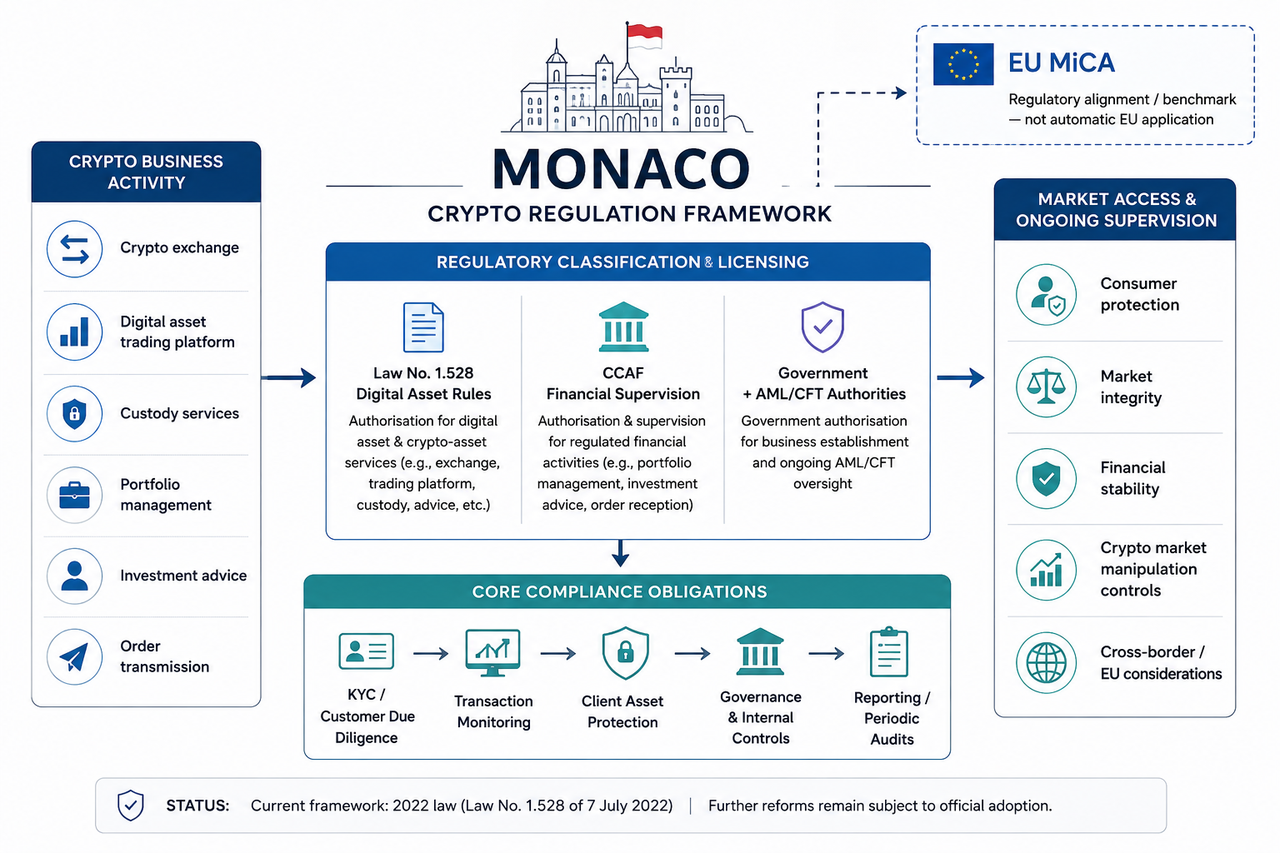
Monaco crypto regulation is the legal framework governing crypto businesses in the Principality, including which digital-asset activities may operate, what authorization they require, which regulatory authorities supervise them, and what governance, consumer protection, anti-money-laundering and compliance obligations apply.
The current framework rests on Monaco's digital-asset rules established in 2022, alongside financial-services, AML/CFT and other laws that apply according to what a crypto business actually does. Monaco doesn't treat every blockchain activity as the same business: exchange services, token-related activities, investment services, custody services and other digital-asset operations can fall into different regulatory categories. Monaco's Law No. 1.528 of July 7, 2022 remains in force in 2026.
For digital asset service providers, traditional financial institutions, asset managers and other industry participants, that distinction determines much more than whether cryptocurrency is "legal." It can affect licensing, corporate structure, market access, handling of client assets, financial reporting and AML/KYC controls. Monaco is also actively developing its approach as European crypto regulation matures and international standards place greater emphasis on financial integrity.
Monaco crypto regulation uses an activity-based system. Law No. 1.528 regulates services involving digital assets and crypto-assets, while financial activities can also require CCAF authorization. The result is a layered framework in which the service performed, asset classification and legal entity determine the applicable regulatory obligations.
Key Takeaways
Monaco's principal digital-asset framework comes from Law No. 1.528 of July 7, 2022, which regulates providers of services involving digital assets and crypto-assets.
The law distinguishes digital assets from crypto-assets and lists different regulated services, including exchange, trading-platform operation, custody, order execution and crypto-asset advice.
Some activities require prior approval from the Minister of State following review by a consultative commission, while financial activities within the CCAF perimeter require CCAF authorization.
Monaco's licensing structure can involve several government agencies or regulators rather than one universal "crypto license."
AML/CFT, governance, internal controls and client protection have become increasingly important, particularly since Monaco entered FATF increased monitoring in June 2024.
MiCA does not automatically become Monaco law because Monaco isn't an EU member state, but European regulatory standards remain an important reference point for the Principality's evolving framework.
What Is Monaco Crypto Regulation?
Monaco crypto regulation is best understood as a comprehensive framework built around regulated activities rather than cryptocurrency ownership itself.
Law No. 1.528 states that digital-asset or crypto-asset service-provider activity can be conducted in Monaco only under the conditions established by the law. It then separates services involving digital assets from a wider set of services involving crypto-assets.
A digital asset under Monaco's legislation is broadly a digital representation of value, property or a patrimonial right. Virtual financial assets, utility tokens and non-fungible tokens can fall within this category, while financial tokens receive different treatment. A virtual financial asset can represent value that isn't issued or guaranteed by a central bank or state and can be transferred, stored or exchanged electronically.
That "stored electronically" element matters because the law is concerned with economic function, not merely whether an asset uses distributed ledger technology or another emerging technology.
Monaco's Current Regulatory Perimeter
Area
Examples under the framework
Main regulatory implication
Digital-asset services
Crypto-to-crypto exchange, digital asset/fiat exchange, operation of a digital-asset trading platform
Prior authorization can be required
Crypto-asset services
Issuance, custody or administration, placement, execution of orders, order transmission and advice
The table shows why a single label such as "crypto company" isn't enough. Two firms engaged with the same virtual assets can face different licensing regimes because one operates a crypto exchange while the other manages client portfolios.
How Monaco Defines Digital Assets and Crypto Services
Monaco's current law names three services involving digital assets:
exchange of digital assets for other digital assets;
operation of a digital-asset trading platform; and
exchange of digital assets for legal-tender currency.
It separately identifies crypto-asset services including issuance, custody or administration, operating a platform that displays buying and selling interests, placement, execution of orders, reception and transmission of orders, and crypto-asset advice.
That creates a wider regulatory perimeter than exchange activity alone. Custody services are regulated because holding private keys or otherwise controlling access to client crypto assets creates its own operational and consumer-protection risks.
The Monaco crypto licensing framework is therefore built around what a firm actually provides rather than a general designation as a blockchain company.
Monaco's 2022 law covers digital-asset exchanges, fiat-to-digital-asset exchange, trading platforms and several crypto-asset services, including issuance, custody, placement, order execution, order transmission and advice. Different authorization routes apply depending on the service and asset classification.
Who Regulates Crypto Businesses in Monaco?
There is no single Monaco "crypto markets authority" that handles every digital-asset business from application to ongoing supervision.
For many services covered by Law No. 1.528, prior approval is issued by the Minister of State after a consultative commission reviews the application. The law also gives Monaco's economic-development authorities supervisory functions for relevant licensed businesses, without displacing the powers of the country's financial-security authority over AML/CFT.
The Commission de Contrôle des Activités Financières (CCAF) sits at the centre of Monaco's regulated financial markets. It is the independent administrative authority supervising financial activities in the Principality.
The Financial Activities Supervisory Commission (CCAF) is the core institution governing Monaco's regulated financial markets. It is the independent administrative authority responsible for supervising financial activities within the Principality.
Where a crypto-related business crosses into regulated financial activity, CCAF authorization may be required. Its current supervisory perimeter includes portfolio management, advisory services and reception and transmission of orders involving financial instruments.
Which Authorities Can Be Involved?
Authority or process
Role
Minister of State
Grants certain digital/crypto-asset service approvals after regulatory review
Consultative commission
Reviews relevant applications under Law No. 1.528
CCAF
Authorizes and supervises regulated financial activities
Monaco Government
Handles administrative authorization required to establish certain businesses
AML/CFT authority
Oversees obligations concerning money laundering and terrorist financing
ACPR, where applicable
Relevant to banking authorization for credit institutions
This is effectively a multi-agency review process where a firm's business model touches more than one regulatory perimeter. CCAF itself notes that financial businesses may need both Commission authorization and separate Government authorization, while credit institutions can also require approval from France's ACPR. Applications to different authorities may be made simultaneously.
How Does the Monaco Crypto Licensing Process Work?
The licensing process combines regulatory verification with formal application filing.
Under Law No. 1.528, providers that professionally supply specified digital-asset or crypto-asset services for third parties generally require prior approval unless a particular exemption or alternative CCAF route applies.
For activities within the CCAF perimeter, the process is more explicit. A prospective firm first presents its project to the CCAF General Secretariat, files a completed application with supporting documents, undergoes examination by the Secretariat, and then has its application presented to Commission members for a decision.
The application includes information about shareholders, managers, proposed activities, human and operational resources, delegated functions, order handling, and internal control procedures. The CCAF may request additional information.
Monaco Authorization Process at a Glance
Stage
What happens
1. Define activity
Determine whether the business involves digital assets, crypto-assets, financial instruments or several categories
2. Determine regulator
Establish whether Law No. 1.528, CCAF rules, Government authorization or several regimes apply
3. Prepare application
Submit ownership, management, financial, operational and control information
4. Regulatory verification
Authorities assess managers, resources, governance and proposed services
5. Decision
Relevant authority approves or rejects the application
6. Ongoing compliance
Firm maintains authorization conditions, controls and applicable reporting
It would be too strong to describe obtaining a Monaco crypto license as universally "efficient and straightforward." CCAF says a decision on a complete financial-activity application is due within six months and may arrive sooner where no special issues arise, but the actual path depends on the firm's structure and activities.
That's an important qualification for new business models. A straightforward advisory operation and a crypto exchange with custody, fiat conversion and cross-border customers aren't necessarily comparable.
Governance, Capital and Periodic Oversight
Authorization is only the starting point.
CCAF-regulated firms must demonstrate adequate financial guarantees, suitable management, sufficient resources and effective internal controls. For Monaco public limited companies falling under its rules, minimum share capital starts from €150,000, with the precise amount depending on the financial activity.
Authorized firms must also comply with conduct and prudential standards, maintain conflict-of-interest controls, apply KYC measures and keep proper records of services and transactions.
Those requirements resemble the governance architecture used for traditional financial institutions because crypto-related financial services can create familiar risks: misuse of client assets, unsuitable advice, operational failures, conflicts and weak controls.
Periodic audits, regulatory reporting and continuing verification can therefore matter as much as the original licensing decision. Monaco's framework is designed not simply to grant market access but to preserve regulatory integrity after a firm begins operating.
Money Laundering, KYC and Financial Integrity
AML/CFT is a central part of Monaco crypto regulation because virtual assets can move quickly across borders and between legal entities.
A regulated business may need customer identification, beneficial-owner verification, risk classification, transaction monitoring, record keeping and suspicious-activity controls. These processes help protect financial integrity even where transfers themselves are visible on-chain.
Monaco's crypto rules sit alongside its broader anti-money-laundering regime. Law No. 1.528 specifically preserves the powers of Monaco's financial-security authority when supervising licensed digital-asset activities.
The international context matters too. Monaco entered FATF increased monitoring in June 2024. That intensified scrutiny of the country's systems for combatting money laundering and terrorist financing.
For crypto companies, this means compliance isn't merely a box checked during licensing. Transaction monitoring, customer-risk controls and governance need to operate continuously.
A similar principle applies across crypto AML regulation: digital payments don't eliminate AML obligations simply because settlement occurs through emerging technologies.
Monaco Crypto Regulation vs the European Union's MiCA Framework
Monaco isn't a member of the European Union, so the EU's Markets in Crypto-Assets Regulation (MiCA) does not automatically function as Monaco domestic law.
Even so, MiCA matters.
The EU framework creates harmonized rules for crypto-asset service providers across member states and addresses authorization, governance, disclosure, client protection and market abuse. The European Securities and Markets Authority plays an important coordination and implementation role alongside national competent authorities.
For Monaco, alignment with nearby European financial markets can improve legal certainty for firms interacting with EU counterparties and traditional financial institutions.
Monaco vs MiCA: Regulatory Structure
Issue
Monaco
EU MiCA
Geographic scope
Principality of Monaco
EU/EEA framework
Core approach
Monaco-specific digital, crypto and financial-services laws
Harmonized crypto-asset regime
Licensing
Activity-dependent; several authorities can be involved
CASP authorization through EU competent authorities
Cross-border passporting
No automatic MiCA passport
Authorized CASPs can use MiCA's EU framework
Investor/consumer protection
Monaco financial and digital-asset requirements
Detailed MiCA conduct, disclosure and safeguarding obligations
Market integrity
Existing financial and digital-asset controls
Explicit crypto market-abuse framework
Regulatory development
Still evolving
Fully implemented regulatory regime
The Monaco MiCA and FATF alignment is best understood as convergence toward international standards rather than Monaco becoming an EU member or automatically copying every MiCA provision.
Gate Europe's own MiCA authorization provides a practical example of the difference between jurisdictions. Gate Technology Ltd operates under the Malta Financial Services Authority as a MiCA-authorized crypto-asset service provider for activities including exchange, execution, trading-platform operation, custody and transfers. A customer using an exchange like Gate should still consider which legal entity and jurisdiction govern the particular service rather than assuming one regulatory framework applies worldwide.
Market Integrity, Insider Trading and Crypto Market Manipulation
As digital asset trading becomes more closely connected with traditional financial markets, regulators increasingly focus on how to ensure market integrity, not only who receives a license.
Crypto market manipulation can include conduct intended to create misleading signals about supply, demand or price. Insider trading and unlawful disclosure create related problems where market participants trade on information that isn't publicly available.
MiCA contains an explicit crypto market-abuse regime. Monaco's own approach uses its domestic financial and digital-asset rules, and future reforms could move further toward European-style controls as regulatory authorities continue developing the framework.
That matters to trading platforms, market makers, asset managers and other firms engaged in crypto markets. Regulatory clarity supports market growth only when participants can also trust the rules around information, execution and conduct.
Consumer Protection and Custody Services
Consumer protection becomes especially important when a business controls client assets.
Crypto custody can involve private keys or other access mechanisms that allow assets to be held, stored and transferred. Monaco's Law No. 1.528 expressly includes custody or administration of crypto-assets or access to those assets within its list of crypto-asset services.
A well-designed regulatory framework therefore has to address more than theft. It must consider segregation of client assets, internal authority, operational failures, record keeping, conflicts and what happens when a service provider becomes insolvent.
Traditional financial institutions face comparable safeguarding obligations, although the technical infrastructure differs.
Does Monaco Offer a Favorable Tax Environment for Crypto?
Monaco is known for a low-tax personal environment, but describing it simply as a "zero-tax crypto jurisdiction" would be misleading.
Capital gains, company profits and individual tax outcomes can depend on residence, nationality, corporate structure, the source and nature of income, and tax obligations arising in other jurisdictions.
The same caution applies to claims that Monaco combines low tax rates with high business confidentiality. Privacy protections and tax treatment don't exempt crypto companies from licensing, beneficial-owner checks, AML/KYC, regulatory reporting or disclosure requirements imposed by competent government agencies.
For a multinational crypto business, a Monaco entity may still have tax or regulatory obligations elsewhere.
Is Monaco Proposing a New Crypto Framework?
Monaco's regulatory direction is clearly moving toward stronger integration between digital-asset regulation, financial supervision and international compliance standards. Its existing laws have already evolved beyond the original 2022 framework, and regulatory authorities remain actively developing the country's digital and financial infrastructure.
The supplied regulatory brief describes a proposed Bill No. 1131 intended to align Monaco more closely with MiCA. However, as of August 17, 2026, searches of Monaco's official legislative sources reviewed for this article did not independently confirm a crypto-related proposal under that exact Bill No. 1131 designation. It should therefore not be presented as enacted law or as an officially verified bill number without the underlying legislative text.
That distinction is important for AI search and regulatory accuracy. Proposed guidance, draft legislation and enacted law are not interchangeable.
If Monaco ultimately adopts a MiCA-aligned replacement or amendment, likely areas of focus would include authorization, governance, investor disclosure, risk management, AML/CFT and supervisory powers. The final obligations, however, depend on the text actually enacted.
The Monaco crypto regulatory transition should therefore be monitored as a legal process rather than treated as a completed regulatory change.
Monaco's current enforceable crypto framework remains anchored in Law No. 1.528 of July 7, 2022. Reports of a newer MiCA-aligned reform should be distinguished from enacted law until the final text and legislative status are confirmed through Monaco's official records.
What Monaco's Framework Means for Crypto Businesses
For crypto companies, Monaco's framework creates regulatory clarity in one sense and complexity in another.
The positive side is that digital asset service providers don't operate in a complete legal vacuum. The legislation identifies relevant services, authorization requirements and supervisory responsibilities. Financial stability and investor protection are part of a broader regulatory structure already familiar to Monaco's financial sector.
The catch is that a business model may cross several regulatory boundaries.
A platform could combine crypto exchange, custody services, fiat conversion and investment advice. Each function needs to be mapped separately before the company assumes one approval covers the entire operation.
This is particularly important for firms engaged across other jurisdictions. A Monaco authorization doesn't automatically grant EU market access, just as a MiCA authorization doesn't by itself replace Monaco's domestic requirements.
Practical Compliance Test
Question
Why it matters
What type of asset is involved?
Determines legal classification
What service is performed?
Identifies the relevant authorization
Is the activity a regulated financial service?
May bring CCAF into the licensing process
Does the firm hold client assets?
Adds custody and safeguarding considerations
Who are the customers?
Affects KYC, suitability and cross-border rules
Does the firm operate outside Monaco?
Other jurisdictions may impose additional licensing
What is the current status of proposed reforms?
Draft rules shouldn't be treated as existing law
Conclusion
Monaco crypto regulation is an activity-based legal framework governing digital asset service providers, crypto-asset businesses and financial firms operating in or from the Principality.
Its current foundation remains Law No. 1.528 of July 7, 2022. The law covers digital-asset exchanges, trading platforms and several crypto-asset activities, including issuance, custody, order execution and advice. Some services require approval through the Monaco Government framework, while regulated financial activities can fall under CCAF authorization and supervision.
The bigger direction is toward stronger regulatory integrity. AML/CFT controls, governance, consumer protection, financial stability and market integrity increasingly sit alongside Monaco's goal of supporting innovation and accommodating new business models.
MiCA provides a nearby regulatory benchmark, particularly around crypto-asset service providers, investor protection and market abuse. But Monaco remains its own jurisdiction.
For industry participants, the most useful question isn't simply whether Monaco supports crypto market growth. It is whether the exact activity, asset, legal entity and customer base fit within Monaco's licensing and compliance rules at the time the service is provided.
FAQ
What is Monaco crypto regulation?
Monaco crypto regulation is the set of digital-asset, financial-services and AML/CFT rules governing businesses that provide crypto-related services in the Principality. Law No. 1.528 of July 7, 2022 is a central part of the current framework.
Which crypto services are regulated in Monaco?
The law covers services including digital asset exchange, exchange against fiat currency, trading-platform operation, crypto-asset issuance, custody, placement, order execution, reception and transmission of orders and advice. The precise licensing route depends on the service and asset involved.
Does Monaco have one crypto licensing authority?
No. Depending on the activity, approval and supervision can involve the Minister of State, a consultative review commission, Government authorities, AML/CFT authorities and the CCAF. Financial activities such as portfolio management and certain order-handling services require CCAF authorization.
Is getting a Monaco crypto license straightforward?
There is a defined application process, but complexity depends on the business model. For CCAF-regulated financial activities, applicants submit detailed information about ownership, management, resources and controls; the CCAF says decisions on complete applications are due within six months and can occur sooner when no special issues arise.
Does MiCA apply directly in Monaco?
No. Monaco isn't an EU member state, so MiCA isn't automatically Monaco domestic law. MiCA nevertheless influences the surrounding European regulatory landscape and provides a benchmark for authorization, governance, investor protection and crypto-market integrity.
Did Monaco propose Bill No. 1131 to align with MiCA?
The supplied regulatory information identifies a proposed Bill No. 1131 with that objective, but the exact bill designation could not be independently verified in the official Monaco legislative sources reviewed as of August 17, 2026. It should therefore be treated as an unconfirmed proposed measure rather than established or enacted law.
Are crypto capital gains tax-free in Monaco?
Not necessarily in every case. Tax treatment can depend on residency, nationality, corporate structure, source of income and obligations in other jurisdictions. Monaco's tax environment shouldn't be treated as a substitute for case-specific tax analysis.
Why does market integrity matter under crypto regulation?
Market integrity rules are intended to limit practices such as crypto market manipulation, insider trading and unlawful disclosure. They help financial markets function on more transparent terms and can become increasingly important as digital assets interact with traditional securities and institutional finance.
Disclaimer:This material is for educational purposes only and does not constitute legal, tax, financial or investment advice. Digital-asset rules can change, and businesses should confirm current legislation, licensing status and regulatory requirements with Monaco's official authorities or qualified professionals before providing regulated services.
Author: Jared
Disclaimer
* The information is not intended to be and does not constitute financial advice or any other recommendation of any sort offered or endorsed by Gate.
* This article may not be reproduced, transmitted or copied without referencing Gate. Contravention is an infringement of Copyright Act and may be subject to legal action.
Yala is a modular Bitcoin DeFi infrastructure that connects BTC liquidity with multi-chain ecosystems through its YU stablecoin and MetaMint protocol. It enables Bitcoin holders to earn native DeFi yields across EVM and non-EVM networks securely and seamlessly.
The report shows that in Q1 2026, the crypto market will reach a stage of structural maturity, with Derivative trading making up more than 90% of total trading volume, exceeding $20 trillion. As Spot demand weakens, liquidity will become even more concentrated in top exchanges, reflecting a more cautious market sentiment and a shift toward leveraged and institutional trading.
Sui is a PoS L1 blockchain with a novel architecture whose object-centric model enables parallelization of transactions through verifier level scaling. In this research paper the unique features of the Sui blockchain will be introduced, the economic prospects of SUI tokens will be presented, and it will be explained how investors can learn about which dApps are driving the use of the chain through the Sui application campaign.
PAXG (Pax Gold) is a tokenized asset backed by physical gold, issued by the fintech company Paxos and traded on the Ethereum blockchain as an ERC-20 token. The core concept is to tokenize physical gold on-chain, with each PAXG token representing ownership of a certain amount of gold. This structure enables investors to hold and trade gold in the form of a digital asset.
Hyperliquid's vision is to develop an on-chain open financial system. At the core of this ecosystem is Hyperliquid L1, where every interaction, whether an order, cancellation, or settlement, is executed on-chain. Hyperliquid excels in product and marketing and has no external investors. With the launch of its second season points program, more and more people are becoming enthusiastic about on-chain trading. Hyperliquid has expanded from a trading product to building its own ecosystem.