The practical impact goes well beyond legal terminology. Crypto asset service providers, foreign firms, local financial institutions and investors need to know which crypto services Monaco intends to permit, what prior authorization will involve, and how higher compliance requirements could affect license issuance, transaction delays and operating costs. The sections below connect Monaco's European regulatory convergence with FATF pressure, explain the proposed authorization structure and show why these changes matter to Monaco's reputation, investor confidence and access to international capital markets.
Key Takeaways
-
Monaco MiCA alignment is regulatory convergence, not EU membership. The Principality is adopting standards similar to those governing crypto assets within European financial markets while retaining its own legal and supervisory framework.
-
Bill No. 1131 would replace Law No. 1.528, enacted in July 2022, and introduce stricter operational requirements, prior approval and corporate governance standards.
-
FATF pressure is a major driver. Monaco has been on the FATF grey list, which covers jurisdictions under increased monitoring for compliance deficiencies, since summer 2024.
-
Providers would face enhanced oversight. They must establish a registered company in Monaco, obtain prior authorization from the Financial Activities Control Commission (CCAF) and undergo a joint review by two regulatory authorities.
-
The permitted service perimeter becomes narrower. Portfolio management and order transmission remain within the proposed framework, while crypto trading platforms and custody would be explicitly prohibited.
-
The key goals are stronger AML controls and financial credibility, but the tradeoff may include increased costs, slower authorization and fewer viable business models for some providers.
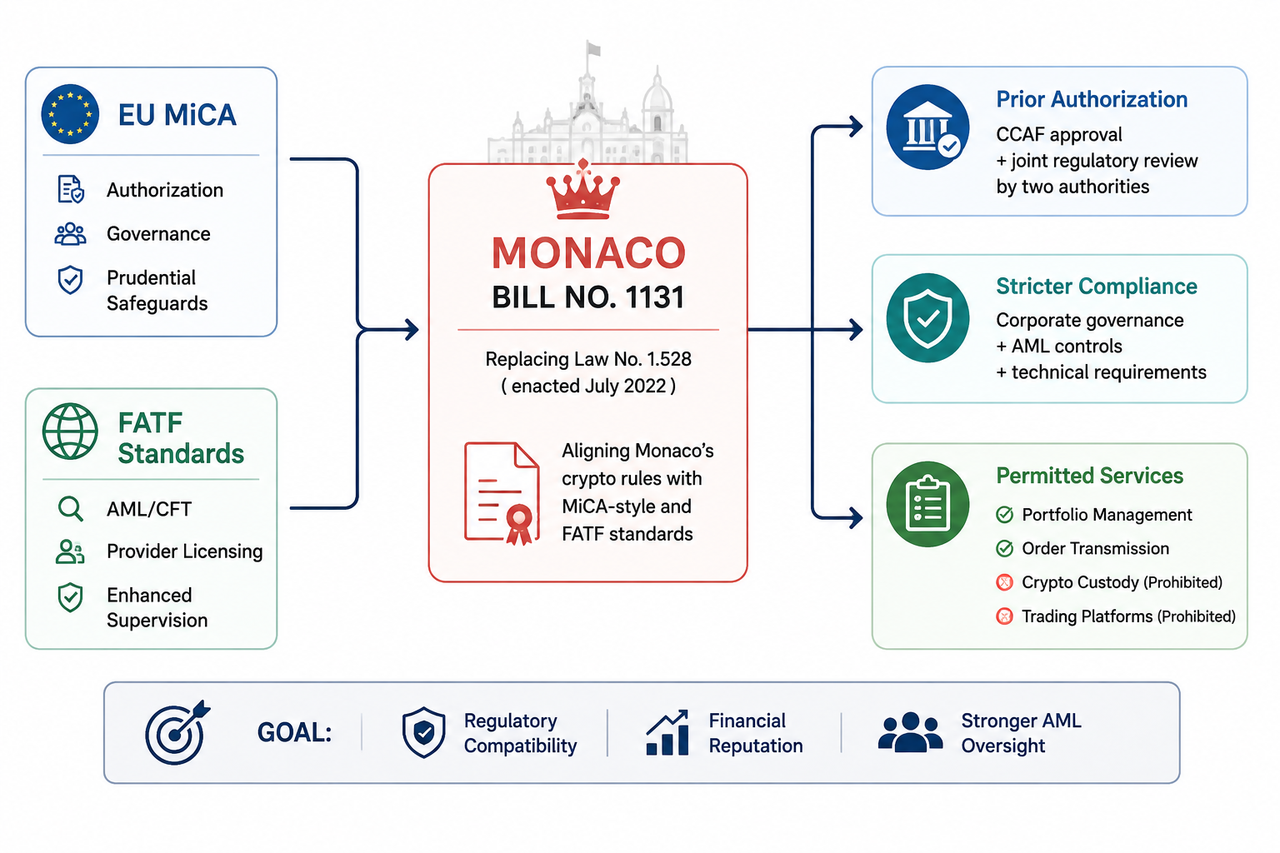
Why Is Monaco Aligning Its Crypto Rules With MiCA and FATF Standards?
Monaco's crypto regulatory reform reflects the broader evolution of international financial regulation. Crypto assets were once handled through fragmented national rules, but international standards increasingly incorporate digital assets into the same supervisory structures used for other financial activities.
The first source of pressure is Europe.
The EU's MiCA regulation creates a common authorization, governance and professional-conduct regime for crypto asset service providers. Although Monaco isn't an EU member state, its economy and financial sector are deeply connected to European capital markets. Rules governing neighboring jurisdictions can therefore influence how banks, investors and counterparties assess Monégasque firms.
That matters especially for firms operating across multiple jurisdictions. A provider whose corporate governance, customer controls or prudential safeguards fall substantially below standards set in European markets can face additional compliance questions from banks and institutional counterparties.
Monaco's response isn't simply to copy the EU's crypto assets regulation. Its proposed rules use MiCA as a benchmark while tailoring the permitted activities and licensing requirements to the Principality's legal framework.
The second source of pressure is the Financial Action Task Force (FATF).
FATF placed Monaco under increased monitoring in June 2024. Being on the FATF grey list doesn't mean a jurisdiction has been excluded from international finance, but it signals strategic deficiencies that the government has committed to addressing.
For an international financial centre, that distinction matters.
Why FATF Standards Matter for Monaco Crypto Regulation
The Financial Action Task Force FATF has progressively brought virtual assets and virtual-asset service providers into the global anti-money laundering framework. FATF standards require jurisdictions to identify relevant providers, subject them to licensing or registration and supervise their compliance with AML/CFT requirements.
Crypto assets present particular challenges because ownership structures and cross-border transfers can sometimes obscure the origin of funds. A transaction may pass through several wallets or service providers in multiple jurisdictions without using the traditional correspondent-banking infrastructure that financial institutions have monitored for decades.
Regulation therefore focuses on the entities around the asset as much as the asset itself.
For Monaco, regulators need to establish who owns and manages each provider, what financial activities it performs, how customers are identified, how suspicious behavior is monitored and whether supervisors can intervene when rules are breached.
This is where stricter operational requirements become relevant. Corporate governance, internal controls, customer due diligence and technical requirements turn general anti money laundering obligations into practical processes.
The FATF grey list covers jurisdictions working with FATF to correct identified deficiencies rather than countries automatically cut off from the global financial system. Yet banks and other financial institutions make independent risk decisions. Additional due diligence can mean transaction delays, higher compliance expenditure and, in some circumstances, increased costs for local institutions.
That creates a strong incentive to demonstrate progress.
How Bill No. 1131 Changes Monaco's Crypto Rules
Monaco filed Bill No. 1131 on August 6, 2026. The new legislation is designed to replace Law No. 1.528, enacted in July 2022, rather than merely amend individual provisions.
The existing law established a relatively broad framework for digital-asset activities, including exchanges, trading platforms and several forms of crypto asset services.
Under the proposed rules, the Monaco crypto regulatory framework would shift toward a narrower model built around authorization, supervision and defined permissible activities.
Providers would need to establish a registered company in Monaco and obtain prior authorization from the Financial Activities Control Commission, commonly known as the CCAF. That prior approval is important because operating legally would depend on satisfying regulatory requirements before crypto services begin, rather than relying mainly on post-launch supervision.
License issuance would also involve joint review by two authorities. This structure increases scrutiny of the applicant's ownership, management, corporate governance, practical and technical requirements and proposed operational services.
The Monaco crypto licensing process consequently begins to resemble authorization for conventional investment services: establishing a company is only the starting point. A provider also has to demonstrate that its governance, controls and business model are compatible with the activities for which it seeks approval.
CCAF's supervisory role would be reinforced by broader enforcement powers intended to prevent non-compliance. Depending on the final text and implementing measures adopted by the National Council, this could give regulators more tools to respond to unauthorized activities or failures to meet compliance requirements.
Which Crypto Services Would Monaco Permit?
One of Bill No. 1131's most significant changes is the proposed definition of permissible crypto services.
Under the supplied framework, authorized activities are limited primarily to portfolio management and the reception and transmission of orders. These activities sit closer to regulated investment services than to running full crypto-market infrastructure.
By contrast, operation of crypto trading platforms and crypto custody would be explicitly prohibited.
This is a notable departure from Monaco's earlier approach and from the broader service perimeter available under the EU's MiCA regulation.
The distinction also clarifies what Monaco MiCA alignment actually means. Monaco is adopting elements of MiCA's regulatory philosophy, including authorization, governance and professional conduct, without necessarily allowing every category of business that MiCA recognizes.
A MiCA-authorized European crypto framework can encompass exchange, execution, custody, trading-platform operation and transfer services. Monaco can pursue similar supervisory standards while drawing a much tighter line around which services providers may conduct locally.
Trading platforms and custodians create different supervisory risks from portfolio management or order transmission.
A custody provider directly safeguards customers' crypto assets. A trading platform operates infrastructure through which orders interact and trades occur. Both can raise questions involving operational resilience, cybersecurity, asset segregation, market integrity and money laundering controls.
Supervising those activities requires significant technical expertise and regulatory resources.
For a small jurisdiction, permitting a narrower range of crypto activities can be a deliberate risk-management choice. Enhanced oversight aims to make the regulated perimeter easier to supervise rather than allowing rapid growth across every type of digital-asset business.
The tradeoff is obvious. Stricter rules may improve regulatory control but make Monaco less attractive to foreign firms whose business models depend on exchange infrastructure or custody.
The transition from Monaco's existing crypto regulation is therefore particularly important for established providers. A service that fitted within Law No. 1.528 may no longer fall within the activities allowed under the replacement framework.
Monaco MiCA Alignment Doesn't Mean Monaco Is Joining MiCA
Monaco's relationship with the EU can cause confusion.
The Principality isn't becoming an EU member, and a Monaco authorization shouldn't be treated as the equivalent of a passportable MiCA license. The European Union's MiCA framework is based on authorization inside the EU regulatory system, while Monaco retains its own government, regulators and legislation.
Instead, Monaco is pursuing regulatory convergence.
MiCA provides a recognizable template covering matters such as corporate governance, prudential safeguards, professional conduct and authorization. Using comparable standards can make Monaco's digital finance sector easier for European counterparties to assess.
There is also a practical cross-border dimension. Crypto providers increasingly operate across multiple jurisdictions, yet authorization granted in one place doesn't automatically permit every operational service elsewhere.
For example, a trader can view Bitcoin market data on an exchange like Gate, but whether execution, custody or another crypto service is available depends on the trader's jurisdiction and the permissions held by the relevant legal entity. Regulatory status increasingly shapes access to the service, not simply access to market information.
The Role of Monaco's Financial and Security Authorities
Bill No. 1131 sits within a wider restructuring of Monaco's regulatory response to financial and digital risks.
The Financial Activities Control Commission remains central to authorization and supervision of covered financial activities. Monaco has also strengthened the institutions responsible for financial-security and digital-security functions, including the Autorité Monégasque de Sécurité Financière and bodies associated with Monégasque digital security.
These institutions shouldn't be treated as interchangeable. Financial supervision, anti-money laundering controls and cybersecurity address different risks even when the same crypto provider may fall within more than one compliance perimeter.
That institutional separation matters in practice. A provider can satisfy licensing requirements while still having obligations concerning AML controls, cybersecurity, data protection or other technical requirements.
Joint review under the proposed authorization framework reflects that broader principle: crypto regulation increasingly requires several forms of expertise rather than a single regulator examining a company in isolation.
Why Monaco's Reputation as a Financial Centre Matters
The enhanced oversight has an economic objective as well as a compliance objective.
Monaco's financial sector depends on relationships with foreign banks, investors and international capital markets. When institutions assess a jurisdiction, legal certainty, supervisory effectiveness and money-laundering controls can influence counterparty decisions.
Monaco's appearance on the European Commission's list of high-risk third countries has added another reputational concern alongside FATF grey-listing. Such classifications can cause institutions dealing with affected jurisdictions to apply stronger due-diligence measures.
The practical consequences aren't uniform. They depend on the institution, transaction and jurisdiction involved. Still, heavier compliance can produce longer processing times and higher administrative costs, and those costs can ultimately influence borrowing costs or financial access for some local institutions.
Improving Monaco's financial reputation is therefore one reason MiCA and FATF alignment matters.
Stronger licensing requirements won't automatically increase investor confidence, nor will a new law alone remove Monaco from an international monitoring list. But credible rules backed by actual enforcement can reduce uncertainty around how crypto businesses are supervised.
Could Bill No. 1131 Help Monaco Leave the FATF Grey List?
Potentially, but crypto regulation is only one part of the process.
FATF evaluates broader anti-money laundering and counter-terrorist financing effectiveness. Its concerns can include suspicious-transaction reporting, beneficial ownership, investigations, sanctions, asset recovery and the resources available to supervisory authorities.
Bill No. 1131 supports that wider effort because FATF standards increasingly require jurisdictions to control virtual-asset activities rather than leave them outside the regulated financial perimeter.
Prior authorization, stricter operational requirements and broader enforcement powers can help Monaco demonstrate that crypto providers aren't operating in a supervisory gap.
Yet legislation is only the first step.
FATF generally focuses on whether controls work in practice. Regulators need to identify breaches, impose proportionate sanctions and show that providers actually comply with their obligations. A formally strict law with weak implementation won't achieve the same result as active supervision.
Costs and Tradeoffs of MiCA and FATF Alignment
Higher regulatory standards have costs.
Crypto asset service providers may need additional compliance staff, corporate governance procedures, transaction-monitoring systems, technical controls and documentation. Prior authorization and joint review can also extend the time required before a business becomes operational.
Those expenses can be substantial for smaller providers.
Stricter rules can also affect unsolicited marketing, customer communications and professional conduct. Where activities resemble investment services, regulators may place greater emphasis on how providers present risks and how customer investment decisions are supported.
For local institutions, the calculation works in both directions. Enhanced regulation creates direct compliance costs, but persistent international concerns over money laundering can produce higher costs of their own through enhanced due diligence, transaction delays or reduced willingness among foreign counterparties to establish relationships.
That is the central regulatory tradeoff.
Monaco isn't positioning itself as a lightly supervised crypto hub. Its proposed framework points toward a digital finance sector integrated more closely with the standards applied to regulated financial activities.
Conclusion
Why is Monaco aligning its crypto rules with MiCA and FATF standards? The answer is regulatory credibility.
Monaco's close relationship with European financial markets makes the EU's MiCA regulation an influential benchmark even though the Principality isn't an EU member. At the same time, FATF grey-listing has created pressure to improve anti-money laundering effectiveness and demonstrate stronger supervision of financial and crypto activities.
Bill No. 1131 brings those priorities together. It would replace Law No. 1.528, require providers to obtain prior authorization from the CCAF, introduce joint regulatory review, strengthen corporate governance and practical and technical requirements, and narrow the crypto services that can be provided from Monaco.
The costs may include higher compliance expenditure, slower license issuance and fewer opportunities for businesses built around custody or trading platforms. The intended benefit is different: a crypto regulatory framework that international banks, investors and regulators can more easily recognize and trust.
For Monaco, MiCA and FATF alignment isn't mainly about maximizing the number of crypto companies operating in the Principality. It's about deciding which digital-finance activities fit within a tightly supervised international financial centre and showing that those rules can be enforced.
FAQ
Is Monaco part of the European Union's MiCA regime?
No. Monaco isn't an EU member state, so a Monaco authorization shouldn't be treated as an EU MiCA authorization. Monaco can nevertheless align its crypto rules with MiCA-style licensing, governance and prudential standards because of its close economic and financial relationship with Europe.
What is Bill No. 1131?
Bill No. 1131 is Monaco's proposed 2026 crypto legislation, filed on August 6, 2026. It is intended to replace Law No. 1.528 of July 2022 and establish stricter licensing requirements, prior authorization, governance and supervision for permitted crypto services.
Does Bill No. 1131 require prior approval from CCAF?
Yes. Under the proposed framework, providers must obtain prior authorization from the Financial Activities Control Commission before providing covered crypto services. License applications are also expected to undergo joint review involving two regulatory authorities.
Which crypto services would Monaco permit?
Under the proposed framework described in Bill No. 1131, permitted activities are focused on portfolio management and the reception and transmission of orders. Operating crypto trading platforms and providing crypto custody would be explicitly prohibited.
Why is Monaco on the FATF grey list?
FATF placed Monaco under increased monitoring in summer 2024 after identifying strategic deficiencies in its AML/CFT framework. Grey-list status means the jurisdiction is working with FATF on an agreed action plan; it doesn't mean Monaco has been excluded from the international financial system.
Could stricter crypto rules improve Monaco's financial reputation?
They can contribute, but legislation alone isn't sufficient. Effective licensing, supervision, enforcement and AML controls can strengthen confidence among foreign firms and financial institutions, while FATF and other international bodies will also assess whether the wider reforms work in practice.
Disclaimer: This content is for educational purposes only and does not constitute legal, regulatory, financial, investment or tax advice. Monaco's proposed legislation may change during the National Council process, and firms should verify the final law, CCAF requirements and applicable cross-border rules before providing regulated services.







