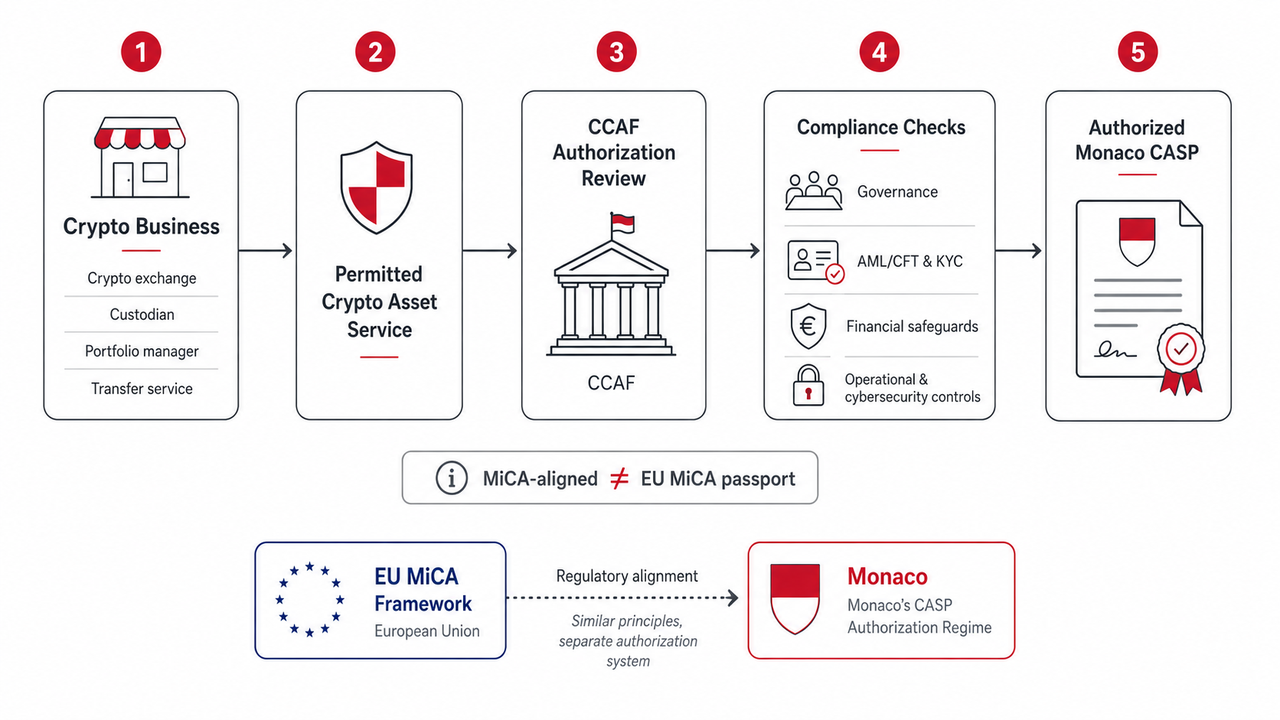
Monaco’s proposed crypto licensing overhaul would move crypto-asset service providers toward a more centralized, prior-authorization model supervised by the Commission de Contrôle des Activités Financières (CCAF). Under Bill No. 1131, exchanges and other businesses providing permitted crypto asset services would need CCAF approval before beginning regulated operations, with stronger governance, prudential, conduct and compliance requirements. The proposal was submitted to Monaco’s National Council in August 2026 and has not yet become final law.
For crypto companies assessing a Monaco CASP license, the practical issue is no longer simply whether a business fits within a broad digital-asset category. Its exact service, corporate structure, operational controls and ability to satisfy local supervision could determine whether authorization is available at all. That matters to crypto exchanges, custodians, advisers and other digital asset companies because Monaco is moving closer to the regulatory logic of the EU’s Markets in Crypto-Assets Regulation (MiCA) without becoming part of MiCA’s EU authorization and passporting system.
Key Takeaways
Bill No. 1131 proposes replacing Monaco’s 2022 crypto framework with a MiCA-aligned regime centered on prior CCAF authorization.
Monaco intends to define more precisely which crypto asset services may be performed in the Principality rather than treating every crypto business model as automatically licensable.
Governance, prudential safeguards, professional conduct and AML/CFT controls would become central parts of authorization and continuing supervision.
Monaco remains outside the European Union, so a Monaco authorization should not be confused with a MiCA CASP license or EU passporting rights.
The proposal is still going through the legislative process, and secondary regulations are expected to determine important technical and operational details.
How Could Monaco’s New Crypto Licensing Regime Change CASP Authorization?
The biggest proposed change is who controls entry into the regulated crypto market and how that entry is assessed.
Monaco’s existing framework dates from Law No. 1.528 of July 7, 2022. The government now considers that framework outdated in light of changes to European crypto assets regulation, including the mica regulation as part of a comprehensive legal framework intended to reduce regulatory fragmentation across EU member states, and international Financial Action Task Force standards. Bill No. 1131 is intended to replace it rather than simply add another layer of rules.
Under the proposed framework, providing regulated crypto services would require prior authorization from the CCAF. Firms seeking to obtain authorization for regulated crypto asset services would be entering a model closer to how crypto service providers are assessed under the MiCA Regulation. The authorization decision would also involve input from the Autorité Monégasque de Sécurité Financière and the Agence Monégasque de Sécurité Numérique, according to information released about the proposal.
Under the proposed framework, providing regulated crypto services would require prior authorization from the CCAF. Firms seeking to obtain authorization for regulated crypto asset services would be subject to a model more closely aligned with the assessment criteria for crypto service providers under the MiCA Regulation. According to information released regarding the proposal, the authorization decision would also involve input from the Autorité Monégasque de Sécurité Financière and the Agence Monégasque de Sécurité Numérique.
That creates a more integrated licensing process. Financial soundness, anti-money laundering systems and technical security would no longer sit in separate compliance silos. A crypto trading platform seeking approval could need to demonstrate that its governance structure, client safeguards, information systems and financial-crime controls work together before regulated activity begins.
Monaco’s existing crypto framework, its proposed transition and the broader regulatory direction are closely connected: the Monaco crypto regulatory transition reflects the move away from the 2022 structure, while the developing Monaco crypto regulation framework places licensing inside wider financial-integrity and supervisory requirements.
Which Crypto Asset Service Providers Could Need CCAF Approval?
A central feature of the proposed crypto rules is that Monaco intends to specify which crypto asset services may legally be conducted in the Principality. The government has described the approach as one that defines permitted activities for asset service providers casps and other crypto businesses operating in defined service categories, rather than every activity involving digital assets, while adapting the regime to Monaco’s financial system.
That distinction matters. Under a permissive model, a crypto company might ask which license category best fits an existing business. Under a more selective model, the earlier question becomes: is the proposed service itself within the activities Monaco permits?
The final scope will depend on the enacted law and secondary regulations. Services associated with crypto exchanges, trading platforms, custody, transfer services, portfolio management or investment advice therefore need to be checked against the precise authorized-service list rather than assumed to qualify. DeFi and NFT projects face uncertainty under MiCA regulations, which is one reason service classification matters.
This resembles the service-by-service logic used for EU crypto-asset service providers under MiCA, where authorization identifies which activities an operator may provide. Under MiCA, Asset Service Providers (CASPs) are assessed by service line, and the same framework also applies service-by-service to crypto asset issuers and providers dealing in other crypto assets. MiCA covers areas including custody, operation of trading platforms, exchange, execution, reception and transmission of orders, advice, portfolio management and transfers.
For example, the BTC/USDT spot market onGate.com illustrates the type of customer-facing exchange activity regulators distinguish from custody, portfolio management or advisory services. The regulatory question is about the services performed around crypto assets, not whether Bitcoin itself requires a CASP license.
What Could the Competent Authority Check During Authorization?
The proposed Monaco CASP authorization process would go beyond forming a legal person and submitting basic corporate information.
Government descriptions of Bill No. 1131 specifically point to stronger corporate governance, prudential requirements, consumer protection rules and rules of professional conduct. CCAF’s supervisory powers would also expand so that it could monitor compliance, apply greater regulatory scrutiny during ongoing supervision, and help prevent unlawful practices.
In practice, an authorization file could therefore need to demonstrate areas such as:
Authorization area
What a crypto firm may need to demonstrate
Corporate governance
Clear management responsibilities, oversight and internal control
Financial safeguards
Capital, prudential arrangements and financial risk controls required by final rules
Client protection
Handling and safeguarding of customer assets and information
AML/CFT
KYC, customer due diligence, monitoring and suspicious-activity controls
Operational controls
Documented processes for providing each authorized crypto service
Cybersecurity
Systems, security governance, resilience and incident management
Conduct
Conflict management, disclosure and professional behavior
In comparable MiCA authorization processes, firms may need to submit hundreds of pages of documentation.
The exact documentation and thresholds should not be treated as settled until the legislation and implementing rules are finalized, and some MiCA filings, including white papers for in-scope offerings, must be submitted in machine-readable iXBRL format. What is already clear is the direction: authorization would look more like supervised financial-services licensing than simple crypto-business registration.
That approach also fits the broader distinction between registration and licensing discussed in global cryptocurrency regulatory frameworks, where market entry increasingly depends on AML/KYC controls, governance and continuing regulatory compliance rather than a one-time filing.
How Would Compliance Requirements Affect Crypto Exchanges?
Crypto exchanges would likely face some of the broadest authorization questions because an exchange can combine several functions: operating a crypto trading platform, executing transactions, transferring crypto assets and sometimes safeguarding client assets.
That means a single brand may need authorization covering several regulated activities. Outsourcing wouldn't necessarily remove the underlying compliance problem either. Where third-party service providers perform important operational functions, regulators can still examine who controls the outsourced activity, how risks are monitored and whether the licensed firm remains accountable.
Protecting client assets, managing conflicts and maintaining market integrity become particularly important for exchanges because customer funds and trading infrastructure can sit inside the same business.
MiCA follows a similar principle. Its framework sets authorization and organizational requirements for crypto service providers while also adding consumer-facing conduct expectations for exchanges alongside client-protection and market-integrity rules. A practical EU authorization can be checked against the ESMA register by legal entity and authorized services, as described in the MiCA CASP license verification process. Roughly 130-140 CASP licenses have been issued EU-wide, which shows authorization is active but still selective.
Monaco, however, would maintain its own authorization process and competent authority rather than relying on national competent authorities in the EU system.
Monaco Crypto Assets Regulation vs. MiCA Authorization
The phrase MiCA-aligned framework needs careful treatment.
Monaco is not an EU member state. Bill No. 1131 draws on the European Union’s Markets in Crypto-Assets Regulation within the broader landscape of EU regulations, but that does not automatically convert CCAF authorization into an EU MiCA authorization and remains separate from existing financial services legislation governing traditional EU authorizations. The Monaco MiCA and FATF alignment is regulatory convergence, not incorporation into the EU passport.
Under MiCA, an authorized CASP can use the Article 65 notification mechanism to provide the services covered by its authorization across european union's markets and relevant EEA markets. That system operates through national regulators, with ESMA and other european securities oversight bodies shaping supervisory standards. A MiCA passport therefore has a cross-border function that a Monaco license should not be assumed to carry.
MiCA’s main CASP rules applied from December 30, 2024. Existing providers could benefit from national transitional arrangements under Article 143, with the EU-wide maximum transition ending on July 1, 2026, and CASPs needing to apply for authorization by July 1, 2026 if they wished to continue operating under the end of that period; member states were allowed to shorten or decline that grandfathering period. By July 2026, more than 300 crypto firms were authorized under MiCA. ESMA subsequently told unauthorized firms remaining after the transition to wind down EU activities.
So a crypto firm serving both Monaco and EU countries may need two regulatory analyses: whether it has the required Monaco authorization and whether its EU operations are covered by a valid MiCA authorization and passporting notification.
Why Anti-Money Laundering Matters to Monaco Crypto Licensing
AML is particularly important because Monaco’s crypto reform is developing alongside broader efforts to strengthen its counter-terrorist financing framework and address identified strategic deficiencies, and Monaco’s regulatory environment is also seeking to provide clarity after its classification as a high-risk jurisdiction.
The FATF placed Monaco under increased monitoring in June 2024. As of its June 19, 2026 review, FATF said Monaco had substantially completed its action plan and warranted an on-site assessment to verify that the reforms were being implemented and sustained. Monaco nevertheless remained on the FATF increased-monitoring list at that review.
That is more precise than simply saying Monaco is trying to “exit the grey list.” It has already reached an important stage of the FATF process, but removal requires further assessment.
For a crypto service provider Monaco authorization can therefore involve more than checking customer identity at onboarding, especially given heightened regulatory scrutiny of AML controls. Effective anti-money laundering controls typically combine customer due diligence with risk assessment, transaction monitoring and escalation of suspicious activity.
A firm dealing with customers, counterparties or transactions connected to high-risk third countries may also need enhanced controls depending on applicable AML rules and the risk involved.
Could Monaco Require an Established Local Presence?
Monaco’s 2022 system already placed importance on local establishment, and the proposed framework continues to point toward locally supervised businesses through established local presence requirements rather than unrestricted cross-border provision.
Still, the exact incorporation, staffing, management-presence and substance requirements under Bill No. 1131 should be treated as provisional until the legislation and secondary regulations are complete. foreign providers shouldn't assume that authorization obtained in an EU country automatically satisfies Monaco’s local requirements, and certain operational services may require a Monaco entity with local substance before firms can obtain authorization.
That could become one of the most consequential differences for international crypto businesses. A group may have centralized technology or compliance systems elsewhere, yet Monaco's competent authority could still expect the Monaco legal person to have sufficient governance, personnel and operational control to be meaningfully supervised locally.
What Happens Before the Proposed Crypto Rules Become Law?
Bill No. 1131 is a proposed framework, not a completed licensing regime.
The National Council must consider the legislation, and if the National Council approves the bill, secondary regulations are expected to follow. The text can also change during that process.
Existing operators therefore shouldn't treat draft requirements as final, but waiting for every detail creates a different risk. Governance maps, AML/CFT systems, cybersecurity documentation, outsourcing inventories, client-asset controls and descriptions of each crypto service can take substantial work to prepare.
A practical approach is to separate the proposed rules from the unresolved implementation points: prior CCAF authorization and stronger supervision are central to the proposal; precise capital thresholds, transitional arrangements, detailed technical standards and some operational conditions depend on the final legislative package.
Risks and Limitations of Monaco Crypto Authorization
The biggest limitation is regulatory timing. Bill No. 1131 may be amended, and secondary regulations can materially affect how authorization works in practice.
There is also a cross-border risk. A Monaco digital asset license does not automatically establish the right to operate in EU countries, just as a MiCA authorization should not be assumed to replace Monaco approval, and that split matters for crypto businesses operating across Monaco and EU markets. Businesses operating between the two systems need to map the legal entity, customer location and regulated service separately.
Finally, tighter compliance requirements can raise operating costs and may be especially burdensome across the crypto industry. Smaller crypto firms may find governance, cybersecurity, prudential and AML obligations more resource-intensive than previous VASP-style or registration regimes, though that doesn't mean firms will necessarily merge or shut down; the commercial effect will depend on the final requirements and each company’s scale.
Conclusion
Monaco crypto licensing could change CASP authorization by replacing a fragmented 2022 structure with a more centralized system moving toward a comprehensive legal framework for digital assets, in which permitted crypto asset services require prior CCAF approval and firms must demonstrate stronger governance, financial safeguards, conduct standards, cybersecurity and AML/CFT controls.
The important distinction is jurisdictional. Monaco is borrowing heavily from MiCA’s regulatory architecture, but it is creating a Monaco authorization administered by Monaco authorities under local supervision, unlike the EU model where national competent authorities oversee licensing under the MiCA Regulation, not an EU CASP passport.
For crypto exchanges, custodians and other service providers, the first question will increasingly be whether a particular crypto service is permitted. The next will be whether the legal entity, local presence and compliance framework are strong enough to obtain and keep authorization.
FAQ
Who would issue a Monaco CASP license under Bill No. 1131?
The proposed central licensing authority is the Commission de Contrôle des Activités Financières. CCAF authorization would be granted with regulatory input involving Monaco’s financial-security and digital-security authorities.
The proposed central licensing authority is the Commission de Contrôle des Activités Financières (CCAF). Authorization from the CCAF would be granted following regulatory input from Monaco's financial security and digital security authorities.
Would every crypto business automatically qualify for Monaco authorization?
No. The proposed framework is intended to define the crypto asset services that may be carried out in Monaco. A service outside the permitted scope should not be assumed to become available merely because the operator meets general compliance requirements.
Does a Monaco crypto authorization work throughout the European Union?
Not automatically. Monaco is outside the EU, while MiCA passporting arises from an authorization granted under the EU framework and the associated cross-border notification procedure.
Has MiCA’s transitional period already ended?
Yes. The maximum Article 143 transitional period ended on July 1, 2026, although individual EU member states could impose shorter arrangements. ESMA has said unauthorized providers remaining after the transition should wind down their EU activities.
Is Monaco still on the FATF grey list?
At the FATF review published on June 19, 2026, Monaco remained under increased monitoring. FATF also determined that Monaco had substantially completed its action plan and warranted an on-site assessment, an important step toward potential removal.
Will Monaco require KYC and AML controls for crypto companies?
Strong AML/CFT controls are consistent with Monaco’s proposed regulatory direction for crypto asset service providers and for crypto asset issuers handling e-money tokens, while the exact operational requirements applicable to each CASP will depend on the final legislation and implementing rules, alongside broader consumer protection rules under the MiCA-style direction of travel.
Disclaimer:This material is for educational purposes and does not constitute legal, compliance, financial or investment advice. Crypto-asset regulation can change quickly, and businesses should verify current requirements with the relevant regulator and qualified legal or compliance professionals before conducting regulated activity. This treatment follows the supplied Gate Learn standard for regulation and other YMYL content, including the need to distinguish verified facts from interpretation and explain jurisdictional uncertainty.
Author: Jared
Disclaimer
* The information is not intended to be and does not constitute financial advice or any other recommendation of any sort offered or endorsed by Gate.
* This article may not be reproduced, transmitted or copied without referencing Gate. Contravention is an infringement of Copyright Act and may be subject to legal action.
Yala is a modular Bitcoin DeFi infrastructure that connects BTC liquidity with multi-chain ecosystems through its YU stablecoin and MetaMint protocol. It enables Bitcoin holders to earn native DeFi yields across EVM and non-EVM networks securely and seamlessly.
The report shows that in Q1 2026, the crypto market will reach a stage of structural maturity, with Derivative trading making up more than 90% of total trading volume, exceeding $20 trillion. As Spot demand weakens, liquidity will become even more concentrated in top exchanges, reflecting a more cautious market sentiment and a shift toward leveraged and institutional trading.
Sui is a PoS L1 blockchain with a novel architecture whose object-centric model enables parallelization of transactions through verifier level scaling. In this research paper the unique features of the Sui blockchain will be introduced, the economic prospects of SUI tokens will be presented, and it will be explained how investors can learn about which dApps are driving the use of the chain through the Sui application campaign.
PAXG (Pax Gold) is a tokenized asset backed by physical gold, issued by the fintech company Paxos and traded on the Ethereum blockchain as an ERC-20 token. The core concept is to tokenize physical gold on-chain, with each PAXG token representing ownership of a certain amount of gold. This structure enables investors to hold and trade gold in the form of a digital asset.
Hyperliquid's vision is to develop an on-chain open financial system. At the core of this ecosystem is Hyperliquid L1, where every interaction, whether an order, cancellation, or settlement, is executed on-chain. Hyperliquid excels in product and marketing and has no external investors. With the launch of its second season points program, more and more people are becoming enthusiastic about on-chain trading. Hyperliquid has expanded from a trading product to building its own ecosystem.