Linea is a Consensys-incubated Type 2 zkEVM Layer 2 where ETH is the sole gas asset and the LINEA token coordinates ecosystem incentives, fund allocation, and dual-burn routing. LINEA has a fixed total supply of 72,009,990,000 tokens—roughly 1,000 times Ethereum’s initial circulating supply at genesis—and public materials frame it as an economic coordination tool rather than a gas token or onchain governance vehicle.
What Is LINEA—and What Is It Not?
LINEA functions as Linea’s native coordination token: it rewards real usage, bootstraps aligned applications and builders, and funds Ethereum-aligned public goods through the Ecosystem Fund. Participation in network growth—onchain activity, liquidity provision, builder contributions—is a primary path to earning LINEA incentives. Public messaging emphasizes access through use, not capital alone.
LINEA does not play three commonly assumed roles: Gas—Linea fees are ETH-only; LINEA does not settle gas. Governance—no onchain governance at launch per public materials; emissions and the fund are Consortium-led, not tokenholder votes. Distribution—no allocation or sale to employees or investors, unlike typical VC token sales.
Every Linea transaction pays gas in ETH, keeping L2 usage coupled to Ethereum’s native economy. Strategic emissions, grants, incentives, and fund deployment are overseen by the Linea Consortium—not by LINEA holder onchain votes. Comparing this design with Linea vs Arbitrum vs Optimism helps separate “what pays gas” from “how tokens incentivize the ecosystem.”
How Is LINEA Supply Allocated?
LINEA’s total supply is 72,009,990,000 tokens (per linea.build tokenomics disclosure, July 2025). Roughly 85% goes to the ecosystem and 15% to the Consensys treasury, split across Early Contributors, the Ecosystem Fund, and the Consensys Treasury:
| Allocation |
Share of supply |
Primary use |
Unlock / release |
| Early Contributors |
10% |
9% user airdrop + 1% strategic builders |
Fully unlocked at TGE |
| Ecosystem Fund |
75% |
Liquidity, exchange readiness, future airdrops, builder grants, public goods |
Two phases: activation + ~10-year decaying emissions |
| Consensys Treasury |
15% |
Long-term alignment, protocol health support |
Five-year lock; non-transferable during lockup |
The 10% Early Contributors bucket includes a 9% user airdrop based on LXP and onchain activity metrics, plus 1% for strategic builders across core apps and communities. Builder allocations follow a curated process—direct grants, milestone vesting, or partner deployments—not a single formulaic distribution.
The 75% Ecosystem Fund is among the largest ecosystem funds cited in public materials. It is managed by the Linea Consortium through a U.S. non-stock entity applying for non-profit status. Deployment spans two phases: near-term Ecosystem Activation (liquidity, exchange readiness, partnerships, future airdrops) and Long-Term Alignment (~10-year decaying schedule for protocol R&D, shared infrastructure, open-source tools, and mission-aligned builders). Public materials estimate roughly 25% of the Fund for activation in the first 12–18 months, with the remaining ~50% released gradually over 10 years (within the 75% total; exact ratios per linea.build disclosures).
Consensys Software retains 15% under a five-year lockup; tokens are non-transferable until the cliff expires. During lockup they may be deployed in-ecosystem (e.g., liquidity or staking capital) to support protocol health—without constituting a yield promise to holders.
At TGE, approximately 22% of total supply (~15.8B LINEA) is expected to circulate, covering the early contributor airdrop, activation programs, and liquidity provisioning; other categories remain locked or vest over time.
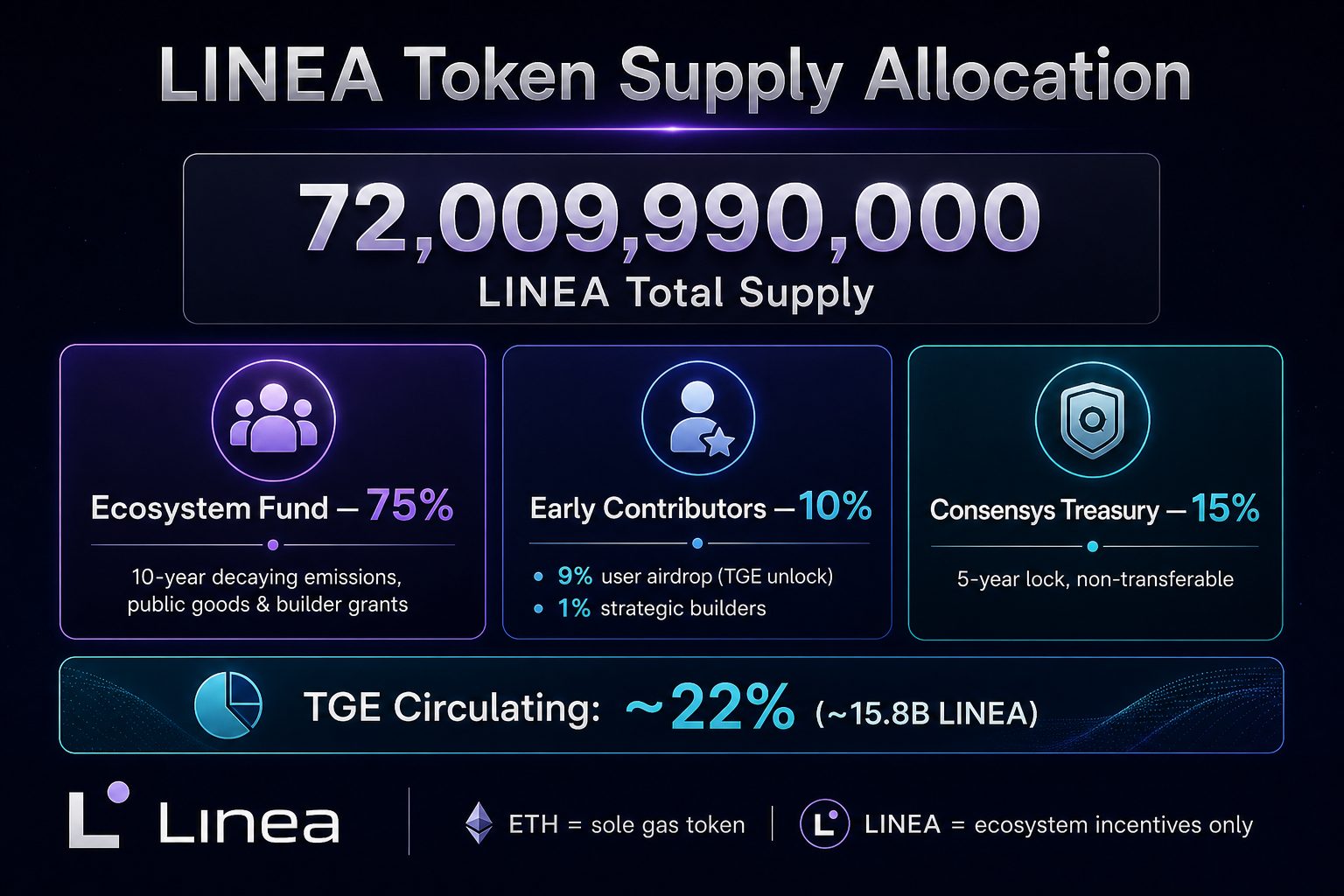
Figure 1. LINEA total supply of 72B and the three-way split: Early Contributors, Ecosystem Fund, and Consensys Treasury.
How Does the Dual-Burn Mechanism Work?
Linea’s dual-burn routes net fee surplus to both ETH and LINEA destruction, structurally linking network usage to both assets’ supply dynamics.
The flow in four steps:
- Users pay gas in ETH on Linea—all fees are ETH-denominated.
- After Layer 1 data, proving, and related costs, the network records net ETH revenue (net fee surplus).
- Roughly 20% of net surplus is burned as ETH, reducing circulating ETH supply.
- Roughly 80% of surplus ETH buys LINEA on market, bridges it, and burns LINEA on Ethereum L1 for consistent L1 supply tracking.
| Surplus share |
Treatment |
Economic link |
| ~20% |
ETH burn |
Ties Linea usage to ETH scarcity |
| ~80% |
Buy LINEA → bridge → L1 burn |
Ties Linea usage to LINEA supply reduction |
Dual-burn requires positive net surplus. Rising L1 costs or low activity can shrink or eliminate burn capacity. The mechanism describes fee routing rules—not a market forecast for ETH or LINEA price or scarcity. Versus Optimistic Rollups that route gas differently, gas token and surplus allocation are key differentiators in Linea vs Arbitrum vs Optimism.
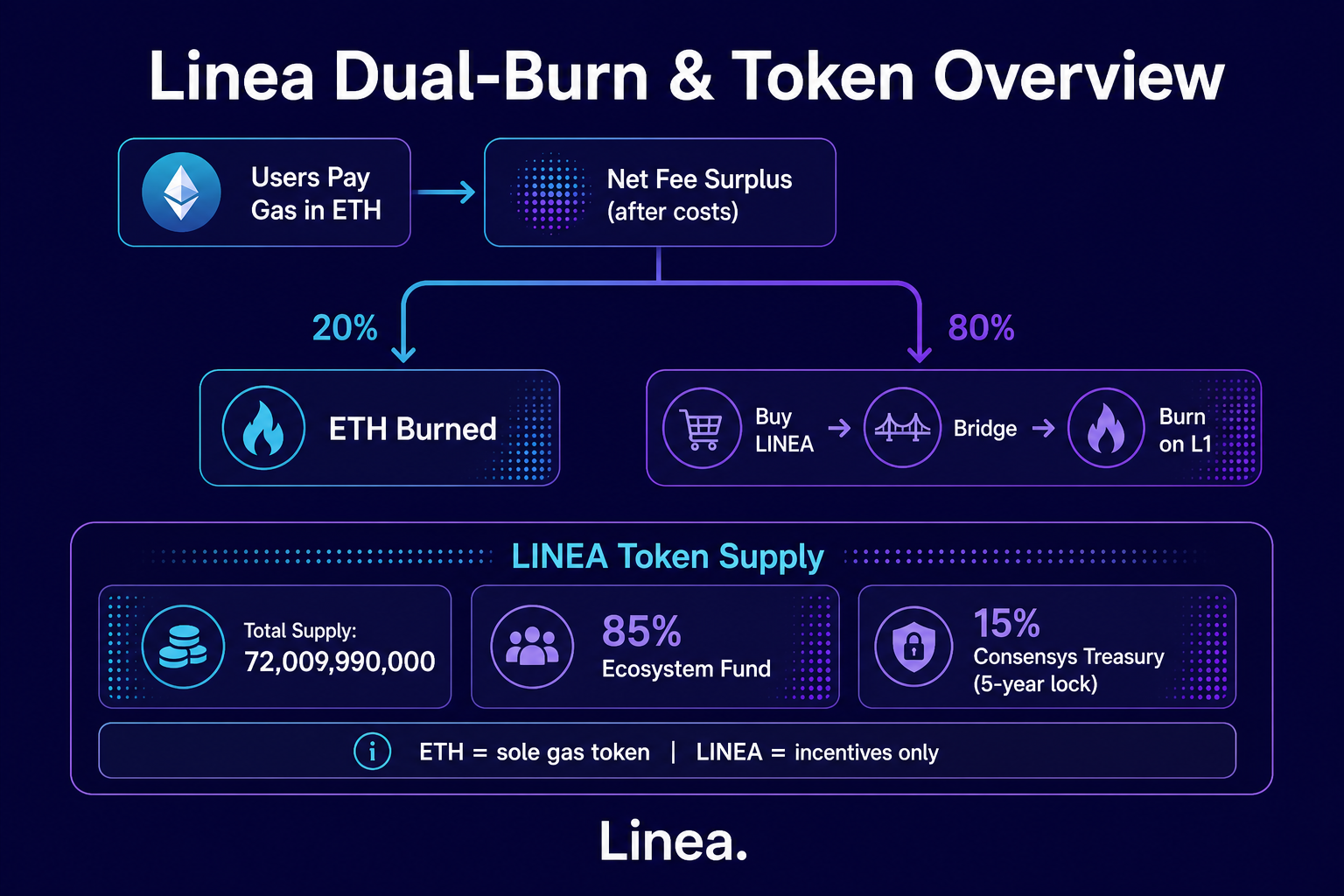
Figure 2. Linea dual-burn path: ~20% ETH burned, ~80% used to buy and burn LINEA on L1.
What Roles Do Linea Association and Consortium Play?
Linea public materials separate execution from strategic stewardship: the Linea Association executes decisions; the Linea Consortium oversees emissions, the Ecosystem Fund, and incentives. Both connect directly to LINEA allocation and airdrop execution.
| Body |
Legal form |
Core function |
| Linea Association |
Swiss non-profit |
Executes Consortium decisions, airdrop execution, ecosystem outreach |
| Linea Consortium |
Strategic stewardship council |
Manages Ecosystem Fund, emission schedule, grants, incentive programs |
| Ecosystem Fund entity |
U.S. non-stock corp. (non-profit pending) |
Holds ~75% ecosystem allocation, independent of tokenholder votes |
The Linea Association (linea.build/association) emphasizes “bootstrapped by Consensys, owned by the Linea community,” focusing on technology adoption, ecosystem apps, and community reach. Airdrop execution—including eligibility standards before the official checker launches—falls under the Association / Consortium framework.
The Linea Consortium includes publicly named Ethereum stewards such as Consensys, ENS Labs, Eigen Labs, SharpLink, and Status. It deploys the Ecosystem Fund’s two phases under an Ethereum-first mandate. Public materials state no tokenholder governance in the LINEA system; strategic decisions follow a Consortium charter (full charter expected before TGE), aiming to avoid pure token-vote pitfalls while retaining collaborative oversight.
Users entering Linea should verify eligibility through Association pages and official checkers on linea.build. Assets reach Linea via the official bridge with contract verification on Lineascan; Linea Bridging provides a standalone checklist for wallet prep, bridging, and balance confirmation.
What Are Common Misconceptions and Risks Around LINEA?
Several misconceptions and structural risks deserve separate review before holding or participating:
Mechanism misconceptions
- Treating LINEA as gas: Linea gas is ETH-only; LINEA does not settle fees.
- Treating LINEA as governance: No onchain governance at launch per public materials; Consortium discretion governs fund and emissions.
- Treating dual-burn as guaranteed deflation: Burn volume depends on net surplus and activity—not a fixed or promised rate.
Allocation and transparency
- The 75% Ecosystem Fund is Consortium-managed; grant and emission pacing depends on charter quality and disclosures.
- Consensys’s 15% is five-year locked but may still affect long-term supply dynamics when deployed for ecosystem support.
- Early contributor airdrops rely on activity metrics and the official eligibility checker; unofficial claim pages and fake LINEA contracts are common phishing vectors.
Operational and L2 risks
- Bridges, sequencers, provers, and smart-contract bugs add technical risk beyond tokenomics.
- TGE circulation (~22% initially) changes float structure—a disclosure topic, not a price view.
- DeFi and third-party apps add contract and counterparty risk; verify bridge URLs, chain ID, and token contracts on linea.build before acting.
Advantages, limits, and risks should be assessed separately: ETH gas alignment and dual-burn are structural design features; Consortium discretion, surplus dependency, and L2 operational risk are constraints in the same system—not investment conclusions.
Summary
LINEA’s total supply is 72,009,990,000 tokens: ~85% ecosystem (10% Early Contributors + 75% Ecosystem Fund) and 15% Consensys under a five-year lock. Linea gas is ETH-only; LINEA handles incentives, fund coordination, and the buy-and-burn leg of dual-burn, with no onchain governance rights at launch per public materials. Net surplus splits ~20% ETH burn and ~80% LINEA buy-and-burn on L1. The Linea Association executes as a Swiss non-profit; the Linea Consortium stewards emissions and the Ecosystem Fund. Understanding tokenomics requires separating gas asset, incentive token, and governance structure—and keeping protocol learning distinct from trading decisions.
FAQ
What is LINEA’s total supply?
LINEA’s total supply is 72,009,990,000 tokens—about 1,000× Ethereum’s initial circulating supply at genesis. The figure comes from linea.build’s July 2025 tokenomics disclosure and covers Early Contributors, the Ecosystem Fund, and the Consensys treasury.
How is the LINEA token allocated?
Roughly 85% goes to the ecosystem: 10% Early Contributors (9% user airdrop + 1% strategic builders, unlocked at TGE) and 75% Ecosystem Fund (activation plus ~10-year decaying long-term alignment). ~15% goes to the Consensys treasury with a five-year lock and no transfers during lockup. ~22% of supply circulates at TGE.
Can LINEA be used to pay gas?
No. Linea gas is paid exclusively in ETH; LINEA is not a gas token. LINEA’s public role is ecosystem incentives and coordination—rewarding users and builders, managing the Ecosystem Fund, and participating in the buy-and-burn leg of dual-burn.
What is Linea’s dual-burn mechanism?
After users pay ETH gas, net surplus (post-L1 costs) is split: ~20% burned as ETH and ~80% of surplus ETH used to buy LINEA, bridge it, and burn on Ethereum L1. The mechanism links usage to both ETH and LINEA supply dynamics; burn volume depends on actual surplus, not a fixed deflation rate.
Does LINEA carry governance rights?
Per public tokenomics materials, LINEA carries no onchain governance rights at launch; there is no tokenholder DAO. Emissions, grants, incentives, and Ecosystem Fund deployment are overseen by the Linea Consortium under its charter, with the Linea Association handling execution—including airdrops.
What are the main risks of holding or using LINEA?
Key risks include mistaking LINEA for gas or governance tokens, dual-burn depending on net surplus rather than guaranteed burns, Consortium discretion over fund transparency, TGE float changes, fake LINEA tokens and phishing claim sites, plus L2-specific bridge, sequencer, and smart-contract risks. Verify contracts and eligibility through official linea.build channels.







