PoW public blockchains have always faced a fundamental trade-off between block interval and confirmation speed. Bitcoin chooses an extremely simple chain and a roughly 10-minute block interval, prioritizing security over speed. Kaspa, however, leverages parallel blocks and GHOSTDAG ordering to increase throughput while retaining the PoW security model. Kaspa (KAS) is a Layer 1 blockchain, with its native KAS token serving both as a trading fee and miner reward. The network is based on a fair launch with no pre-mining.
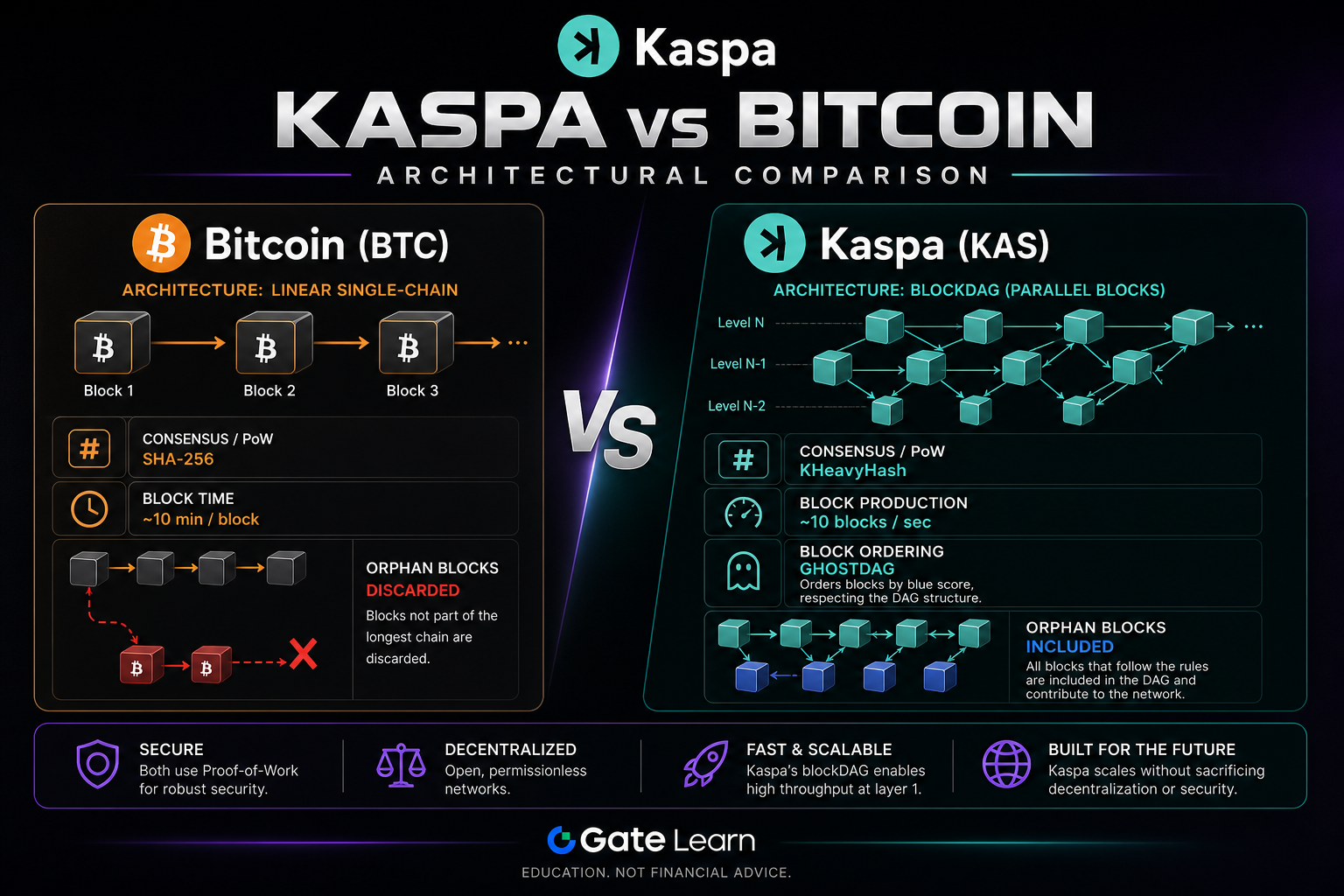
Figure 1. Kaspa (KAS) vs Bitcoin (BTC) architecture comparison: linear single-chain blocks vs blockDAG parallel block production, each with distinct consensus protocols and mining algorithms.
What Is BTC?
Bitcoin (BTC) is the first successful decentralized digital currency network, launched by Satoshi Nakamoto in 2009. Its ledger uses a single-chain structure: each new block references a unique parent block via the block header hash, creating a linear chain from the genesis block.
Bitcoin’s consensus follows the Nakamoto longest chain rule. Miners compete for block production using SHA-256 proof-of-work, and all network nodes accept the chain with the highest accumulated work. The target block interval is about 10 minutes, and the block reward halves every 210,000 blocks. The network is maintained by full nodes, miners, and wallets, with the UTXO model tracking all unspent outputs.
Bitcoin emphasizes minimalism and long-term security with its mature single-chain design. Shortening the block interval significantly increases the orphan block rate, creating a structural constraint.
What Is KAS?
Kaspa (KAS) is a PoW-based Layer 1 blockchain with KAS as its native token and a core architecture built on blockDAG and GHOSTDAG consensus. Unlike Bitcoin’s single-parent block model, Kaspa allows miners to broadcast multiple blocks in parallel within a similar time window, with each new block able to reference one or more predecessors, forming a directed acyclic graph.
Kaspa targets a block production rate of about 10 blocks per second, far exceeding Bitcoin’s 10-minute interval. GHOSTDAG consensus calculates blue and red sets for parallel blocks on the blockDAG, integrating valid blocks into the main sequence while non-winning blocks are not simply discarded. blockDAG and GHOSTDAG address parallel record-keeping and ordered ledger challenges, enabling PoW networks to maintain hashrate competition while increasing throughput.
Kaspa’s mining algorithm is KHeavyHash, and the main full node implementation is RustyKaspa. KAS was issued via a fair launch, with all tokens distributed through mining.
Architecture and Consensus Differences at a Glance
| Dimension |
Bitcoin (BTC) |
Kaspa (KAS) |
| Data Structure |
Single-chain linear blocks |
blockDAG (directed acyclic graph) |
| Block Production |
One valid block per height |
Multiple parallel blocks coexist |
| Consensus Protocol |
Nakamoto longest chain |
GHOSTDAG (PHANTOM family) |
| Target Block Rate |
~10 minutes/block |
~10 blocks/second |
| Orphan Handling |
Usually discarded |
Sorted/marked per GHOSTDAG rules |
| Mining Algorithm |
SHA-256 |
KHeavyHash |
| Block Reward Schedule |
Halves every ~4 years |
Decreases by block height |
| Supply Cap |
21 million BTC |
~28.7 billion KAS |
| Launch Method |
Genesis block, fair launch |
Fair launch, no pre-mining |
| Full Node Implementation |
Bitcoin Core, etc. |
RustyKaspa |
This table summarizes ten key differences in architecture and consensus. Bitcoin prioritizes single-chain simplicity and security, while Kaspa focuses on blockDAG parallelism and high-frequency block production. Their design goals differ, making direct comparison with a single metric inappropriate.
How Do Confirmation Speed and Orphan Handling Differ?
Bitcoin’s confirmation speed is limited by its block interval. A transaction typically waits for at least one new block to be mined and several subsequent confirmations—commonly 1 to 6 blocks, or about 10 minutes to an hour. If multiple miners find valid blocks at the same height, only one chain is retained; others become orphan blocks, and their miner rewards and transactions are excluded from the main chain.
Kaspa’s high-frequency parallel block production shortens the confirmation path. Multiple miners can broadcast blocks nearly simultaneously, and the blockDAG accommodates these parallel blocks. GHOSTDAG incorporates blue set blocks into the main sequence and processes red set blocks according to protocol, so parallel block production no longer automatically means wasted hashrate. Transaction confirmation depends on DAG depth and network conditions, and is typically much faster than traditional single-chain PoW.
| Confirmation & Orphan Dimension |
Bitcoin (BTC) |
Kaspa (KAS) |
| Block Competition Result |
Single winner, others orphaned |
Multiple blocks included in DAG |
| Orphan Fate |
Fully discarded |
Processed by GHOSTDAG blue/red rules |
| Typical Confirmation Wait |
Minutes to hours |
Seconds to minutes (network-dependent) |
| Hashrate Waste Risk |
High orphan rate if interval is short |
Parallel blocks can be validly ordered |
| Reorg Depth |
Based on longest chain rollback |
Based on GHOSTDAG main order and DAG |
This table highlights the differences in confirmation logic. Bitcoin’s orphan handling is straightforward, while Kaspa’s consensus transforms parallel blocks into an ordered ledger. However, high-frequency block production demands greater network propagation and node synchronization.
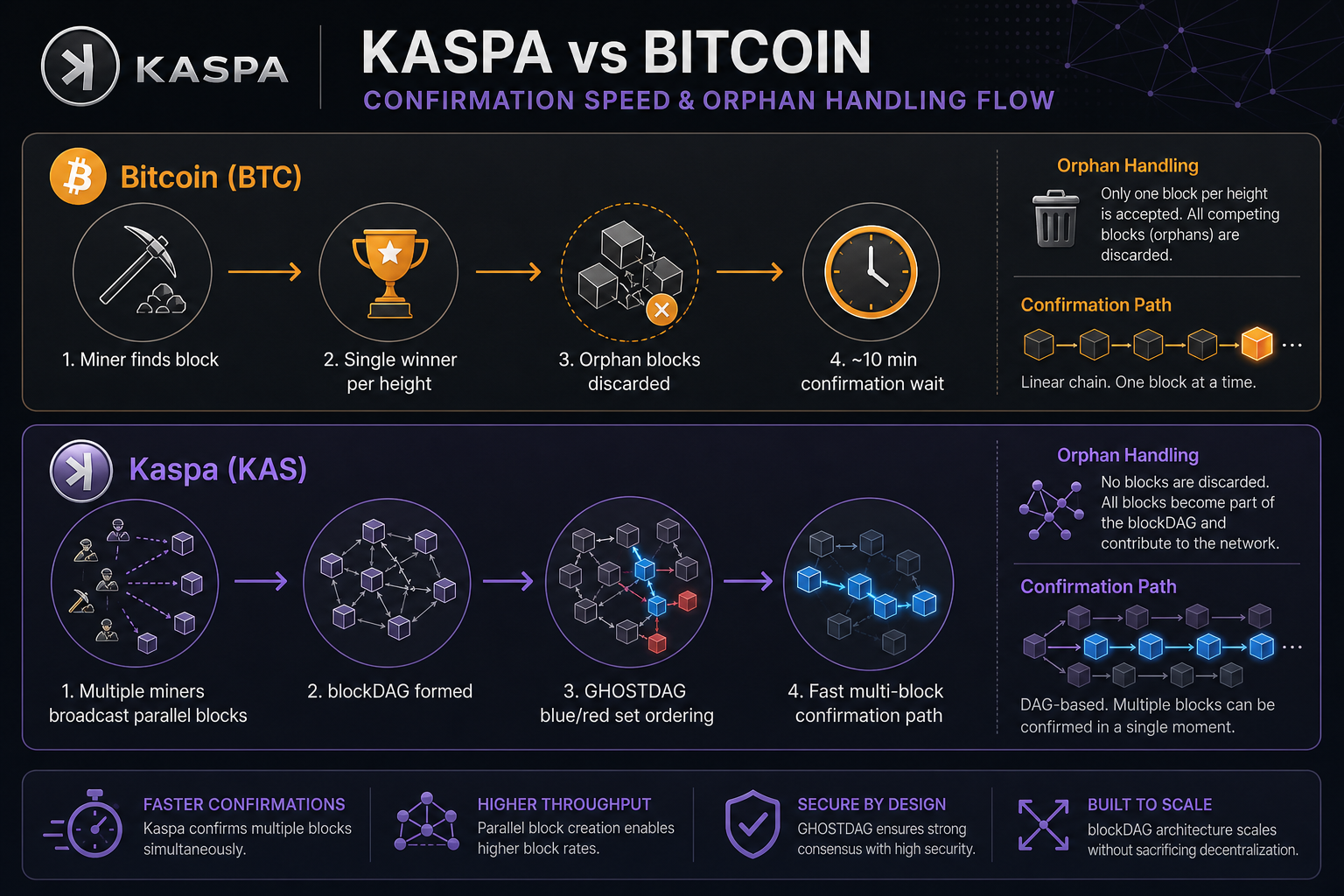
Figure 2. Confirmation speed and orphan handling comparison: Bitcoin’s single-winner orphan discard model vs Kaspa’s blockDAG parallel inclusion in GHOSTDAG ordering.
Token Issuance and Fair Launch Comparison
Both Bitcoin and Kaspa follow a fair launch, with all tokens distributed via mining after the genesis block—no ICO or team allocations. They differ in supply cap, reward schedule, and mining algorithm.
Bitcoin’s supply cap is 21 million BTC, with block rewards starting at 50 BTC and halving every 210,000 blocks, tied to the 10-minute block interval. Kaspa’s supply cap is about 28.7 billion KAS, with block rewards decreasing by block height and distribution aligned with its high-frequency block production. KAS tokenomics and mining revolve around KHeavyHash hashrate competition, reward curves, and trading fee incentives.
| Token Mechanism |
Bitcoin (BTC) |
Kaspa (KAS) |
| Pre-mining |
None |
None |
| ICO/Hidden Allocation |
None |
None |
| Issuance Path |
100% through mining |
100% through mining |
| Supply Cap |
21 million |
~28.7 billion |
| Reward Decrease |
Halves every ~4 years |
Decreases by block height |
| Mining Algorithm |
SHA-256 |
KHeavyHash |
| Trading Fee Role |
Miner incentive supplement |
Miner incentive supplement |
While both follow fair launch principles, their supply scale, reward schedule, and mining hardware requirements differ, leading to independent hashrate distribution characteristics.
What Are the Limitations of This Comparison?
When comparing Kaspa and Bitcoin, it’s important to distinguish design goals, network maturity, and evaluation metrics. Avoid drawing absolute conclusions based on a single criterion.
Design Goal Differences: Bitcoin prioritizes chain simplicity and long-term security; Kaspa focuses on high-frequency parallel throughput, reflecting different engineering trade-offs.
Network Maturity: Bitcoin has operated for over fifteen years with a mature wallet and developer ecosystem. Kaspa’s blockDAG is more complex for third-party integration, and its application ecosystem is still developing.
Evaluation Metric Limitations: Metrics such as confirmation speed, orphan rate, and hashrate distribution are not directly comparable. Kaspa’s high-frequency blocks shorten confirmation times but also increase on-chain data pressure.
Security Model Similarities: Both rely on PoW hashrate competition and are theoretically susceptible to 51% attacks. GHOSTDAG does not replace PoW fundamentals; network propagation and reorg risks still require independent evaluation.
Summary
Kaspa (KAS) and Bitcoin (BTC) are both PoW public blockchains, but they differ fundamentally in ledger structure, consensus protocol, block production rate, orphan handling, and mining algorithm. Bitcoin is built on a linear single-chain and the Nakamoto longest chain, with a 10-minute block interval and orphaned failed blocks. Kaspa uses blockDAG parallel block production and GHOSTDAG for ordered ledgers, targets 10 blocks per second, and uses KHeavyHash mining. Both are fairly launched with no pre-mining, but their supply caps and reward schedules are independent. Understanding these differences helps users evaluate each chain based on their needs, rather than making simplistic judgments about superiority.
FAQ
What are the differences between Kaspa and Bitcoin?
Kaspa uses blockDAG and GHOSTDAG consensus, enabling parallel block production and incorporating competing blocks into an ordered ledger. It targets about 10 blocks per second and uses the KHeavyHash mining algorithm. Bitcoin uses a single-chain structure and the Nakamoto longest chain, producing a block every 10 minutes, with failed blocks usually orphaned, and uses SHA-256 for mining.
What is Kaspa?
Kaspa (KAS) is a PoW-based Layer 1 blockchain using a blockDAG structure and GHOSTDAG consensus. The native KAS token is used for trading fees and miner rewards. The network follows a fair launch with no pre-mining or hidden allocations, and the main full node implementation is RustyKaspa.
What is GHOSTDAG consensus?
GHOSTDAG is Kaspa’s consensus protocol, derived from the GHOST concept and part of the PHANTOM protocol family. GHOSTDAG assigns global order to parallel blocks on the blockDAG through blue set, red set, and heaviest subtree rules, increasing effective throughput for PoW networks while maintaining hashrate competition.
Does Kaspa have pre-mining?
Kaspa follows a fair launch—no pre-mining, no ICO, and no hidden team allocations. All KAS is released through KHeavyHash mining, with a total supply cap of about 28.7 billion, and block rewards decrease by height.
Which confirms faster, Bitcoin or Kaspa?
Kaspa targets 10 blocks per second, so transaction confirmations are typically much faster than Bitcoin’s minute- to hour-long waits. Bitcoin produces a block every 10 minutes, and confirmation depends on subsequent blocks. Actual confirmation time depends on network propagation, hashrate distribution, and node synchronization.
What should be considered when comparing Kaspa and Bitcoin?
Distinguish design goals, network maturity, and evaluation metrics. Bitcoin’s single-chain ecosystem is mature and battle-tested; Kaspa’s blockDAG architecture is more complex and its ecosystem is still developing. Both use PoW security models, and their strengths should be evaluated based on specific use cases—not a single metric.







