Kayon serves as the inference layer within the Vanar AI Native architecture, tasked with the threefold responsibilities of context reading, rule evaluation, and action triggering. Unlike general-purpose AI services that only provide textual responses, Kayon is designed to transform inference results into traceable, onchain execution paths.
This capability is built upon the structured input provided by the Neutron Seed mechanism and works in tandem with the onchain state system outlined in the Vanar Chain (VANRY) Overview. To understand Kayon, the focus is not on model terminology, but on whether the execution chain is stable and auditable.
What Is Kayon's Role in the Vanar Architecture?
Kayon acts as the bridge between contextual inference and strategic execution. On the input side, it receives structured semantic objects and onchain state data. During processing, it evaluates rules and matches conditions. On the output side, it generates executable instructions and writes them to the onchain action channel. This workflow prioritizes verifiability and consistency over one-off answer accuracy.
Think of Vanar as a three-layer core architecture: Chain manages state and settlement, Neutron handles semantic memory, and Kayon connects "structured data" to "executable actions." Without Kayon, readable data and onchain execution remain disconnected. With Kayon, the system achieves a more complete, automated feedback loop.
What Inputs Does Kayon Process? How Is Context Structured?
Kayon processes three types of input: semantic input, state input, and policy input. Semantic input is sourced from structured objects like Seed; state input comes from onchain accounts, assets, and event states; policy input is defined by application-specific execution rules. These three input types collectively determine the final action.
| Input Type |
Source |
Function |
| Semantic Input |
Neutron Seed |
Supplies retrievable business context |
| State Input |
Onchain State |
Provides the current execution environment |
| Policy Input |
Rule Configuration |
Sets executable boundaries and conditions |
The core of context structuring is traceable referencing. Every inference must be auditable—showing which inputs were used, which conditions were met, and which actions were triggered. This feature is critical for auditability and marks a key distinction between Kayon and black-box offchain agent logic.
What Is Kayon's Inference-to-Execution Workflow?
Kayon's typical workflow consists of five steps: receive task, retrieve context, evaluate rules, generate action, and execute/write back. First, it defines the task objective. Next, it pulls the associated Seed and state. Then, it evaluates according to policy. Fourth, it generates the action instruction. Finally, the onchain system executes and records the result.
This process is not a one-off "smart answer," but a repeatable state machine path. Each step should have clearly defined input and output boundaries for easy review and troubleshooting. For process-driven applications, this segmented, observable design offers greater engineering value than single-point model outputs.
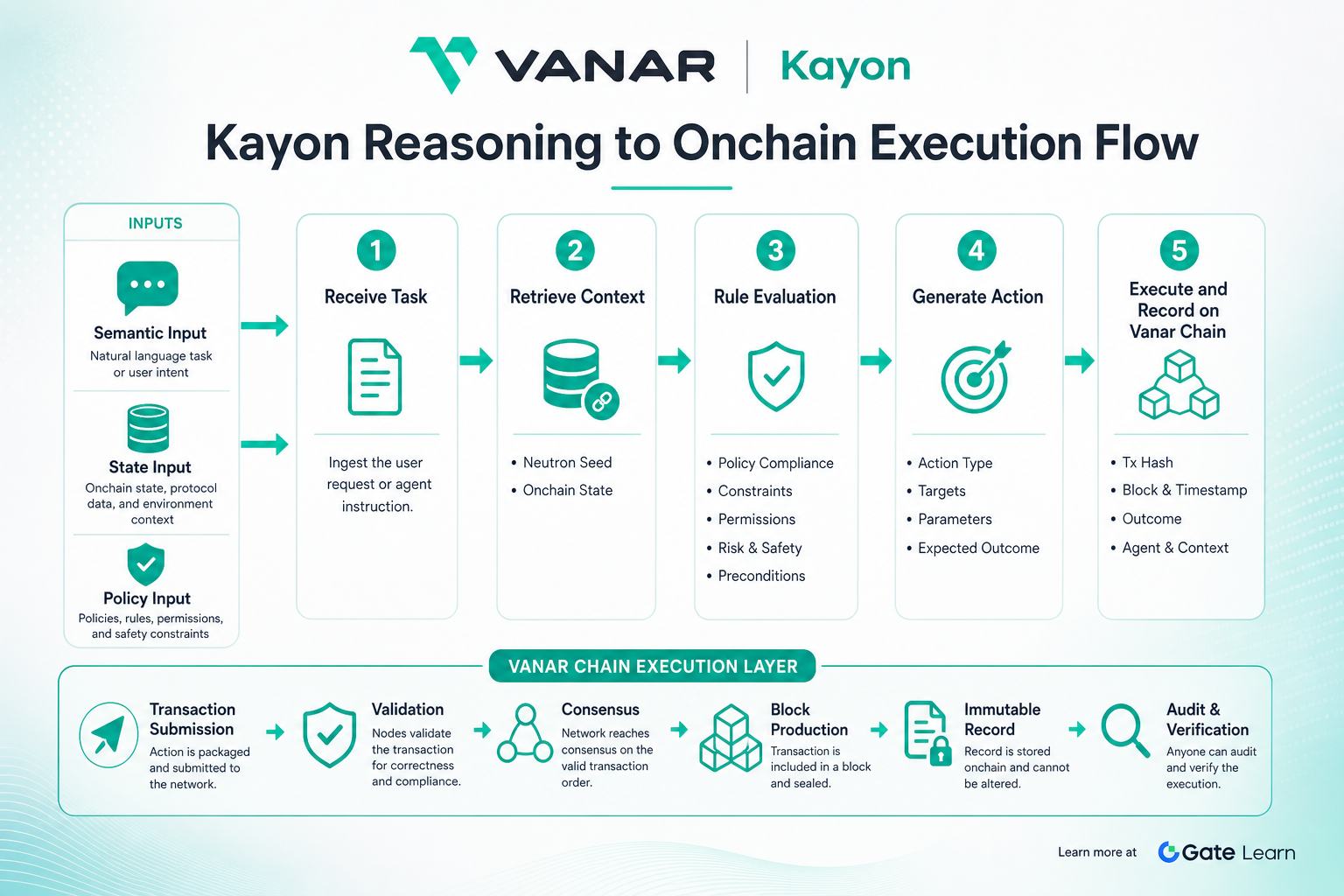 Figure 1. The complete Kayon workflow: from context reading and rule evaluation to onchain action execution.
How Does Kayon Differ from the Traditional "Offchain AI + Onchain Contract" Model?
Traditionally, AI provides recommendations offchain, and contracts execute actions onchain, often requiring several intermediate layers for format conversion, permission checks, and state synchronization. While this setup works, it can lead to problems in complex scenarios—such as unclear decision sources or inconsistent execution criteria.
Kayon aims to streamline this fragmented process by tightly binding key inference steps to onchain state. Not every computation needs to happen onchain, but critical execution decisions must align with verifiable onchain states. This distinction is especially clear in the Comparison of Vanar and External AI Approaches.
What Applications Suit Kayon? When Might It Be Unnecessary?
Kayon is best suited for scenarios that require rule-based decision-making and auditability, such as conditional payments, compliance triggers, asset transfer approvals, and policy-driven automation. These use cases are characterized by complex inputs, clear rules, and accountable outcomes.
For low-risk content generation, one-off Q&A, or lightweight applications not dependent on onchain state, Kayon's architectural advantages may be marginal. Before choosing Kayon, assess whether your business truly needs "inference results that can be executed and audited onchain," rather than simply involving AI.
What Are Kayon's Advantages, Risks, and Limitations?
Kayon's main advantage is its tight integration of inference and execution, reducing cross-system coordination costs and enhancing decision chain traceability. For enterprise-grade process automation, this helps establish clear accountability and audit trails.
However, there are risks and limitations: First, the quality of input data determines the quality of inference—incorrect Seeds lead to incorrect actions. Second, increased policy complexity can introduce rule conflicts and execution anomalies. Third, in rapidly changing business environments, maintaining a high-quality rule system can be costly. This is closely tied to the data governance capabilities of the Neutron Seed mechanism.
Summary
Kayon is not a standalone "chat model layer," but an execution-oriented inference engine within the Vanar architecture. Its value lies in integrating semantic input, policy evaluation, and onchain actions into a single, auditable workflow. For applications requiring process traceability and rule auditability, Kayon offers a more centralized, integrated execution path than traditional external AI solutions.
FAQ
What Is the Core Difference Between Kayon and Standard AI APIs?
Standard AI APIs are mainly used for generating text or recommendations. Kayon, on the other hand, connects contextual evaluation directly to onchain execution. It not only answers questions, but also outputs executable and traceable action results.
Does Kayon Need to Work with Neutron Seed?
Kayon's execution quality depends heavily on structured input, with Neutron Seed being a key source. While other inputs are theoretically possible, lacking unified semantic objects will reduce inference stability and auditability.
Can Kayon Replace All Offchain Business Logic?
No. Kayon is intended for logic that is rule-based and requires onchain verifiable execution. For pure display, low-risk interactions, or rapidly changing logic, offchain implementation is likely more flexible.
What Should Be Confirmed Before Using Kayon?
First, ensure that input data structures are stable, execution rules are clear, and failure rollback paths are complete. Once these three criteria are met, Kayon's integrated inference and execution advantages can be fully realized.