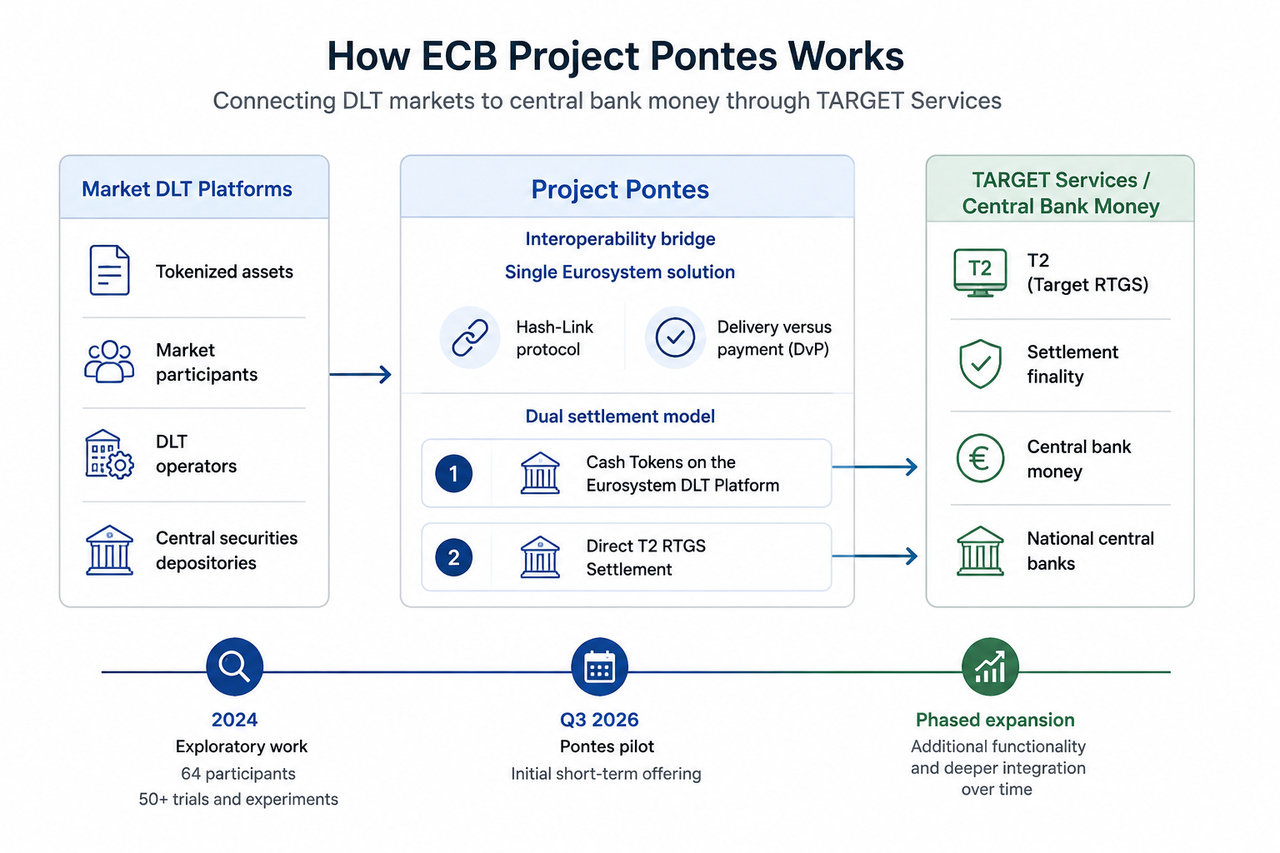
ECB Project Pontes is the Eurosystem's short-term solution for connecting market-operated distributed ledger technology (DLT) platforms with TARGET Services so wholesale transactions can settle in central bank money. Rather than replacing existing central-bank infrastructure with one blockchain, Pontes creates a reliable interoperability mechanism between new DLT markets and the established euro settlement system.
For market participants, banks, central securities depositories and DLT operators evaluating ECB tokenized finance, the practical question is how that bridge actually works. The mechanics come down to a single Eurosystem solution, two settlement routes, delivery-versus-payment synchronization and phased implementation beginning with the planned third-quarter 2026 pilot. This matters because tokenizing an asset doesn't by itself provide the cash settlement asset, legal certainty or connection to central-bank money needed by institutional financial markets.
Key Takeaways
Pontes links market DLT platforms with TARGET Services, allowing DLT transactions to settle against central bank money.
Its dual settlement model supports cash tokens on the Eurosystem DLT platform or direct settlement through T2 RTGS.
The Hash-Link protocol synchronizes delivery versus payment (DvP) and other all-or-none transactions.
Pontes builds on successful results from the Eurosystem's 2024 exploratory work involving 64 participants and more than 50 trials and experiments.
The initial short-term offering is planned to go live by the end of the third quarter of 2026.
How Does ECB Project Pontes Work With Central Bank Money?
Pontes works as an interoperability layer. A tokenized security can remain on an eligible market DLT platform while Pontes coordinates its cash leg with the Eurosystem's distributed ledger technology solution and T2.
There are two settlement routes. Market participants can use cash tokens on the Eurosystem DLT platform, backed through interaction with T2, or settle directly in T2 RTGS. In both cases, settlement finality for the cash leg depends on completion in T2. That preserves the role of central bank money as the safest means of settlement within the financial system while allowing financial-market infrastructure to experiment with DLT innovation.
The Hash-Link protocol provides delivery versus payment and other all-or-none settlement. Asset transfer and payment can therefore be synchronized instead of exposing participants to a situation where one leg completes without the other. Pontes also introduces enhanced automation and more seamless interaction with T2, reducing manual steps across the settlement process.
How Pontes Builds on Three DLT Interoperability Solutions
The Pontes project builds directly on exploratory work conducted from May to November 2024. The European Central Bank and euro-area national central banks tested three interoperability solutions: Deutsche Bundesbank's Trigger Solution, Banca d'Italia's TIPS Hash-Link and Banque de France's Full DLT Interoperability solution, known as DL3S.
Those tests generated useful statistics: 64 participants conducted more than 50 trials and experiments, including real central-bank-money settlement. Use cases included tokenized government and corporate securities, with Slovenia completing its inaugural digital sovereign bond issuance. References grouping the work around “French and Slovenian treasuries” need care: the official ECB material specifically identifies the Slovenian Treasury's sovereign issuance, while France's documented role included Banque de France developing and operating DL3S.
Pontes consolidates lessons from all three systems into a single Eurosystem solution rather than maintaining three separate settlement routes.
Who Can Use Pontes?
Eligibility covers three areas: assets, market participants and market DLT operators. Market participants generally need access to T2, while eligible DLT operators can include authorized central securities depositories, operators under the EU DLT Pilot Regime, overseen payment-system operators and other qualifying regulated financial institutions.
Earlier planning described the eligibility criteria as being finalized by the Eurosystem. That is no longer the current status. The ECB Governing Council approved the use cases and eligibility criteria on December 4, 2025, although the operational and legal frameworks implementing them are being published in line with the relevant launch dates. That distinction matters for legal certainty as the pilot approaches.
Why Pontes Matters for Tokenized Assets and Financial Stability
DLT can change where assets are recorded, but the role of central bank money remains important to financial stability because it provides a common settlement anchor across private financial institutions. Pontes aims to support market innovation without separating tokenized wholesale finance from that anchor. The Eurosystem has explicitly linked this approach to preserving the pivotal role of central bank money and the efficiency and stability of TARGET Services.
This is also why Pontes is a short-term offering, not the final architecture. The ECB Project Appia forms the second track and examines a longer-term integrated financial ecosystem built around tokenisation and DLT. Programmability and smart contracts in central bank operations could support greater automation as that system develops.
Pontes therefore supports broader European aims around a digital capital markets union, the Savings and Investments Union, the international role of the euro and EU strategic autonomy. It isn't intended to turn TARGET Services into a public blockchain. Its aim is narrower: make existing central-bank settlement infrastructure interact reliably with emerging DLT markets.
Conclusion
So, how does ECB Project Pontes work? It places a controlled interoperability layer between market DLT platforms and TARGET Services, allowing tokenized wholesale transactions to settle in central bank money through either Eurosystem DLT cash tokens or T2.
Hash-Link synchronizes asset and cash transfers, T2 provides finality, and a single Eurosystem ledger technology DLT solution combines lessons from three earlier interoperability approaches. The project builds on successful 2024 experimentation while keeping settlement anchored to established central-bank infrastructure. Its pilot is planned for the third quarter of 2026, making Pontes the near-term bridge between Europe's existing wholesale financial system and increasingly tokenized markets.
FAQ
What is ECB Project Pontes?
ECB Project Pontes is a Eurosystem initiative that connects market DLT platforms with TARGET Services so eligible wholesale financial transactions recorded using distributed ledger technology can settle in central bank money. It forms the short-term track of the Eurosystem's broader tokenized-finance strategy.
When will the Pontes pilot start?
The initial Pontes offering is planned to go live by the end of the third quarter of 2026. Implementation is phased, so functionality may expand after the initial pilot rather than arriving as one complete system on launch day.
Does Pontes replace TARGET Services?
No. Pontes connects DLT markets to TARGET Services rather than replacing them. During the pilot, the Pontes solution operates outside the technical perimeter of TARGET Services while interacting with T2 for central-bank-money settlement and finality.
What is the Pontes dual settlement model?
The dual settlement model allows a transaction's cash side to be handled either through cash tokens on the Eurosystem DLT platform or directly through T2 RTGS. Settlement finality for central bank money is tied to completion of the corresponding T2 transaction.
How does Pontes support delivery versus payment?
Pontes uses the Hash-Link protocol to coordinate delivery versus payment. DvP links the transfer of tokenized assets with the corresponding payment so the two legs can execute on an all-or-none basis rather than settling independently.
Have the Pontes eligibility criteria been finalized?
Yes. The ECB Governing Council approved the use cases and eligibility criteria for Pontes and its pilot on December 4, 2025. The criteria cover eligible assets, market participants and market DLT operators, while the relevant operational and legal frameworks are tied to implementation and go-live arrangements.
Author: Jared
Disclaimer
* The information is not intended to be and does not constitute financial advice or any other recommendation of any sort offered or endorsed by Gate.
* This article may not be reproduced, transmitted or copied without referencing Gate. Contravention is an infringement of Copyright Act and may be subject to legal action.
Yala is a modular Bitcoin DeFi infrastructure that connects BTC liquidity with multi-chain ecosystems through its YU stablecoin and MetaMint protocol. It enables Bitcoin holders to earn native DeFi yields across EVM and non-EVM networks securely and seamlessly.
Sui is a PoS L1 blockchain with a novel architecture whose object-centric model enables parallelization of transactions through verifier level scaling. In this research paper the unique features of the Sui blockchain will be introduced, the economic prospects of SUI tokens will be presented, and it will be explained how investors can learn about which dApps are driving the use of the chain through the Sui application campaign.
PAXG (Pax Gold) is a tokenized asset backed by physical gold, issued by the fintech company Paxos and traded on the Ethereum blockchain as an ERC-20 token. The core concept is to tokenize physical gold on-chain, with each PAXG token representing ownership of a certain amount of gold. This structure enables investors to hold and trade gold in the form of a digital asset.
Hyperliquid's vision is to develop an on-chain open financial system. At the core of this ecosystem is Hyperliquid L1, where every interaction, whether an order, cancellation, or settlement, is executed on-chain. Hyperliquid excels in product and marketing and has no external investors. With the launch of its second season points program, more and more people are becoming enthusiastic about on-chain trading. Hyperliquid has expanded from a trading product to building its own ecosystem.
PAXG (Pax Gold) is a tokenized asset backed by physical gold reserves, launched by fintech firm Paxos and issued as an ERC-20 token on the Ethereum blockchain. The core concept is to digitally represent real-world gold assets, allowing investors to hold and trade gold via the blockchain network. Because each PAXG token corresponds to a specific quantity of physical gold, its price is theoretically expected to closely track the global gold market.