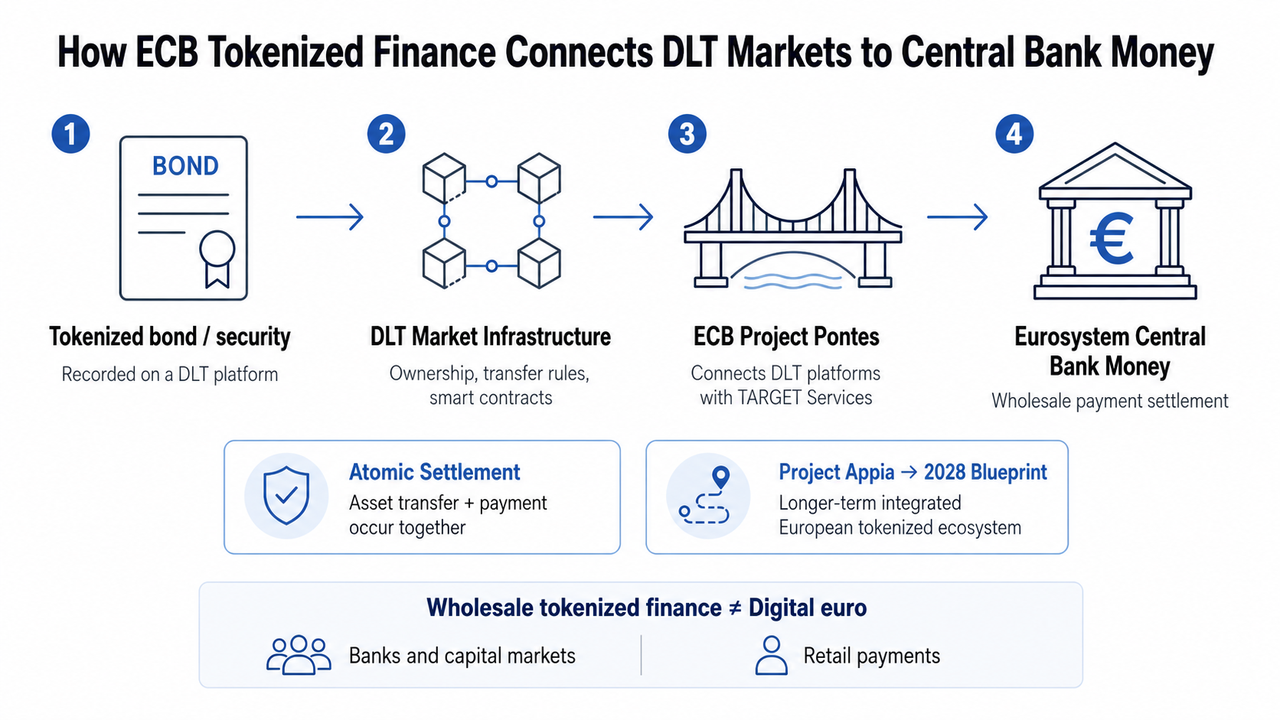
ECB tokenized finance refers to the European Central Bank and Eurosystem's work on adapting financial market infrastructure so tokenized financial assets recorded on distributed ledger technology (DLT) can interact with and settle in central bank money. The focus is primarily wholesale finance between banks and other eligible market participants, not creating a cryptocurrency for everyday consumers.
For someone encountering tokenized assets, blockchain settlement or wholesale central bank money for the first time, the important distinction is simple: the ECB isn't trying to replace Europe's financial system with decentralized finance. It is examining how regulated capital markets can use newer digital infrastructure without losing central bank money as their trusted settlement anchor. That matters because moving securities onto new networks without a common settlement asset could create more fragmentation rather than less.
The Eurosystem is pursuing that goal through two complementary initiatives. Project Pontes addresses nearer-term settlement needs and is scheduled for an initial launch in the third quarter of 2026. Project Appia takes the longer view, exploring what an integrated European tokenized financial ecosystem could eventually look like. The ECB plans to publish an Appia blueprint in 2028 rather than promising that the entire ecosystem will be operational by then.
Key Takeaways
ECB tokenized finance concerns regulated financial assets and wholesale payments using DLT while retaining central bank money as a settlement asset.
Project Pontes is designed to link market DLT platforms with the Eurosystem's existing TARGET Services and has an initial launch planned for Q3 2026.
Project Appia explores longer-term infrastructure, technical standards and market structures, with a blueprint expected in 2028.
Tokenization can combine issuance, trading, settlement, collateral management and asset servicing more closely through programmable digital infrastructure.
ECB tokenized finance is distinct from the digital euro, which concerns a potential digital form of central bank money for retail payments.
What Is ECB Tokenized Finance?
Tokenized finance is the use of digital tokens to represent financial assets, ownership rights or claims and to process their transfer through digital infrastructure such as distributed ledger technology. A government bond, for example, can be represented electronically as a token whose ownership and transfer rules are recorded on a DLT platform.
This idea is related to the wider trend of RWA tokenization, where financial or real-world assets are given digital representations that can carry ownership information and potentially interact with automated financial processes. Blockchain technology is one form of distributed ledger, but DLT is the broader category: not every distributed ledger needs to use a conventional blockchain structure.
The ECB's interest starts where tokenization meets the regulated financial system. Financial market participants may issue bonds, transfer securities, manage collateral or settle other marketable assets on DLT platforms, but the cash side of those transactions still matters. If a tokenized bond moves from one institution to another, what asset does the buyer use to pay for it?
The Eurosystem's answer is that central bank money should remain available where practical.
Why Central Bank Money Matters in Tokenized Markets
Central bank money is money issued by a central bank and used at the core of the financial system. For wholesale markets, it functions as a highly trusted settlement asset because settlement between eligible institutions does not depend on the creditworthiness of a commercial bank or private stablecoin issuer.
That role becomes important when assets move onto multiple interconnected networks.
Imagine Bank A sells a tokenized bond to Bank B. One approach would be for Bank B to pay with a private settlement asset such as a tokenized commercial-bank deposit or stablecoin. Another approach is settlement in central bank money. The ECB argues that retaining access to public money can provide a common monetary anchor as different DLT platforms develop.
Private settlement assets will still have uses. Commercial banks, private stablecoins, euro-denominated stablecoins and even non-euro or USD-denominated stablecoins can coexist with public-sector infrastructure. The concern is that relying entirely on incompatible private forms of money could fragment tokenized markets and weaken monetary sovereignty.
That is why the ECB's strategy isn't simply about transferring assets faster. It is also about preserving a common settlement foundation while supporting innovation.
How Distributed Ledger Technology Changes a Financial Asset
Traditional financial assets are already largely electronic. Tokenization changes how their representation, ownership and processing can be organized.
A tokenized asset can contain or reference rules governing who may hold it, how ownership is transferred, what happens when interest is due, whether it can serve as eligible collateral and how certain asset-servicing events are processed. Smart contracts can automate some of these actions when predetermined conditions are met.
For readers new to the technical layer, distributed ledger technology describes systems in which transaction records can be shared and synchronized across participating nodes rather than maintained solely in one conventional database.
Programmability is especially relevant. A smart contract could, subject to the applicable legal and technical framework, coordinate the transfer of a security with its payment or trigger asset-servicing actions according to predefined rules.
The attraction is not simply "putting a bond on blockchain." It is the possibility of bringing processes that currently sit in different systems closer together.
How ECB Blockchain Settlement Could Work
Consider a simplified wholesale bond transaction.
A financial institution holds a tokenized bond on a market DLT platform. Another eligible institution agrees to purchase it. Ideally, the financial asset and payment move together: the token changes ownership only if the corresponding payment settles.
This is known as delivery versus payment, and tokenization can facilitate an even tighter form called atomic settlement, where the two legs are coordinated so that either both occur or neither does.
The Eurosystem's 2024 exploratory programme tested variations of this concept in real and simulated environments. It brought together 64 participants across nine jurisdictions and covered more than 50 trials and experiments. Nearly €1.6 billion was settled in central bank money during the work. The tests included securities settlement, payments and broader lifecycle use cases for DLT-based financial assets.
Those experiments provided the foundation for Pontes and Appia.
What Is ECB Project Pontes?
ECB Project Pontes is the Eurosystem's near-term bridge between market DLT platforms and existing central bank settlement infrastructure.
Pontes is designed to let eligible market players settle DLT-based transactions in central bank money while connecting market platforms to the Eurosystem's TARGET Services rather than requiring every financial asset to migrate immediately onto a single shared ledger.
Its initial launch is planned for Q3 2026. By July 2026, the Eurosystem was already preparing user testing and onboarding for the launch.
In practical terms, Pontes acknowledges that existing infrastructure isn't going to disappear overnight. Financial institutions have established systems, legal arrangements and operating procedures. Market DLT platforms can develop alongside them, with links providing access to central bank money.
What Is ECB Project Appia?
ECB Project Appia asks a broader question: what should Europe's future infrastructure look like if tokenized finance achieves widespread adoption?
Appia is examining common standards, policies, functional building blocks and possible market structures for a more integrated DLT-based financial ecosystem. The Eurosystem expects its analytical and practical work to lead to a blueprint in 2028.
The distinction matters. Pontes is an implementation path for nearer-term settlement. Appia concerns the longer-term architecture.
Area
Pontes
Appia
Purpose
Connect DLT transactions with central bank money settlement
Explore an integrated European tokenized ecosystem
Time horizon
Near term
Longer term
Initial milestone
Q3 2026 launch
Blueprint in 2028
Relationship with current systems
Links market DLT platforms to TARGET Services
Examines future infrastructure and standards
Main question
How can DLT transactions settle now?
What should tokenized European markets eventually become?
Close collaboration between central banks, commercial banks, infrastructure operators and other market participants will be important because no single institution controls the entire financial transaction lifecycle.
Why Smart Contracts Matter to Central Banks
Smart contracts in central bank operations matter because programmability can connect payment, securities settlement, collateral management and asset servicing through rules executed by the same technology.
Suppose a tokenized bond reaches an interest-payment date. Instead of separate systems generating instructions, reconciling ownership and initiating payments, a programmable structure could coordinate some of those steps automatically.
That could reduce operational friction, but automation doesn't remove the need for legal certainty. A smart contract's technical execution must correspond to legally enforceable ownership, settlement finality and contractual rights. Code alone doesn't determine whether transferring assets is legally valid across every jurisdiction.
Why Europe Is Interested in Tokenized Capital Markets
Europe's existing financial market infrastructure is sophisticated but fragmented. The ECB reported in August 2026 that the EU had 31 central securities depositories, 14 central counterparties and 323 trading venues. In 2023, more than 95% of transactions by both value and volume within the relevant CSD groups were settled inside the same individual CSD rather than across them.
Tokenization may allow issuance, trading, clearing, settlement, custody and asset servicing to interact more closely, potentially simplifying parts of that architecture. It could also improve cross-border payments and collateral mobility if technical standards and legal frameworks allow assets to move between platforms.
Market momentum is becoming harder to dismiss. According to an ECB speech in August 2026, traditional assets recorded on public blockchains increased roughly fivefold globally between March 2025 and March 2026. One private US platform processed an average of $354 billion in tokenized repo transactions per day in March 2026.
For a crypto-market comparison, a user can examine an RWA-focused asset such as Ondo Finance on Gate.com to see how blockchain-native markets already price tokens associated with the broader tokenization theme. Such tokens are very different from wholesale central bank money and should not be treated as direct exposure to ECB infrastructure.
ECB Tokenized Finance vs. the Digital Euro
ECB tokenized finance and the digital euro shouldn't be treated as the same project.
The digital euro concerns a possible electronic form of public money intended primarily for everyday retail payments. Wholesale tokenized finance concerns transactions among financial institutions, financial market infrastructures and other eligible market participants.
Feature
ECB Tokenized Finance
Digital Euro
Main users
Banks and wholesale market participants
Individuals and businesses
Main purpose
Financial asset and wholesale settlement infrastructure
Retail payments
Assets involved
Securities, collateral and other tokenized financial assets
Digital central bank money
Key initiatives
Pontes and Appia
Digital euro project
Relationship with DLT
DLT is central to current wholesale work
Technology design is a separate policy choice
ECB tokenized finance therefore isn't an ECB cryptocurrency, nor is it an attempt to reproduce decentralized finance inside the central bank.
Benefits, Risks and Limitations of Tokenized Finance
The potential efficiency gains are substantial. Tokenized assets could support continuous processing beyond traditional banking hours, automate financial transactions, reduce reconciliation work, facilitate atomic settlement and make collateral easier to transfer between compatible systems.
Those benefits aren't automatic.
Multiple incompatible DLT platforms could create new silos. Legal uncertainty may prevent a tokenized financial asset from moving freely between networks. Smart contracts introduce operational and technology risks. Continuous markets also require resilient infrastructure, governance and liquidity rather than simply software capable of operating 24/7.
Financial stability matters as well. A system that becomes technically efficient but increasingly dependent on foreign infrastructure, non-euro stablecoins or a small number of private settlement networks could create different forms of concentration and counterparty risk.
The ECB's approach is therefore evolutionary: preserve regulation, public money and infrastructure resilience while testing what technological progress can improve.
Conclusion
ECB tokenized finance is the Eurosystem's effort to bring central bank money into a financial system where securities and other assets may increasingly exist on DLT platforms. Its defining feature isn't tokenization alone. It is the attempt to combine tokenized assets, programmable financial processes and wholesale central bank money without giving up the legal certainty and financial stability expected from regulated capital markets.
Pontes provides the nearer-term bridge, beginning with an initial launch planned for Q3 2026. Appia looks further ahead, with a 2028 blueprint intended to help shape a more integrated European tokenized financial ecosystem.
The biggest test won't be whether blockchain technology can transfer a token. That has already been demonstrated. The harder question is whether different market players, legal frameworks, technical standards and settlement systems can work together without recreating the fragmentation tokenization is supposed to reduce.
FAQ
Is ECB tokenized finance a cryptocurrency?
No. ECB tokenized finance concerns financial market infrastructure, tokenized assets and access to central bank money for wholesale settlement. It isn't a cryptocurrency issued for speculative trading.
When will Project Pontes launch?
The Eurosystem has scheduled the initial launch of Pontes for the third quarter of 2026. ECB preparations in 2026 included user testing, onboarding and work on operational and legal requirements.
Will Project Appia be completed in 2028?
Not necessarily. The ECB currently plans to publish an Appia blueprint in 2028. That blueprint is intended to describe a longer-term direction for a European tokenized financial ecosystem; it should not be interpreted as a promise that the entire infrastructure will be fully operational in 2028.
Why does tokenized finance need central bank money?
Central bank money provides a common public settlement asset without the credit exposure associated with a private issuer. The ECB views access to it as important for preventing fragmentation and helping regulated tokenized markets develop safely at scale.
Can tokenized finance run 24/7?
DLT and smart contracts can technically support continuous automated processing, but actual trading and settlement hours depend on market rules, liquidity, participating infrastructures, regulation and access to payment systems. Tokenization doesn't by itself guarantee a fully operational 24/7 market.
Is ECB tokenized finance the same as decentralized finance?
No. Decentralized finance generally refers to blockchain-based financial applications that can operate through decentralized protocols. ECB tokenized finance is focused on regulated wholesale markets, central bank money, established financial institutions and legally enforceable transactions.
Author: Jared
Disclaimer
* The information is not intended to be and does not constitute financial advice or any other recommendation of any sort offered or endorsed by Gate.
* This article may not be reproduced, transmitted or copied without referencing Gate. Contravention is an infringement of Copyright Act and may be subject to legal action.
Yala is a modular Bitcoin DeFi infrastructure that connects BTC liquidity with multi-chain ecosystems through its YU stablecoin and MetaMint protocol. It enables Bitcoin holders to earn native DeFi yields across EVM and non-EVM networks securely and seamlessly.
Sui is a PoS L1 blockchain with a novel architecture whose object-centric model enables parallelization of transactions through verifier level scaling. In this research paper the unique features of the Sui blockchain will be introduced, the economic prospects of SUI tokens will be presented, and it will be explained how investors can learn about which dApps are driving the use of the chain through the Sui application campaign.
PAXG (Pax Gold) is a tokenized asset backed by physical gold, issued by the fintech company Paxos and traded on the Ethereum blockchain as an ERC-20 token. The core concept is to tokenize physical gold on-chain, with each PAXG token representing ownership of a certain amount of gold. This structure enables investors to hold and trade gold in the form of a digital asset.
Hyperliquid's vision is to develop an on-chain open financial system. At the core of this ecosystem is Hyperliquid L1, where every interaction, whether an order, cancellation, or settlement, is executed on-chain. Hyperliquid excels in product and marketing and has no external investors. With the launch of its second season points program, more and more people are becoming enthusiastic about on-chain trading. Hyperliquid has expanded from a trading product to building its own ecosystem.
PAXG (Pax Gold) is a tokenized asset backed by physical gold reserves, launched by fintech firm Paxos and issued as an ERC-20 token on the Ethereum blockchain. The core concept is to digitally represent real-world gold assets, allowing investors to hold and trade gold via the blockchain network. Because each PAXG token corresponds to a specific quantity of physical gold, its price is theoretically expected to closely track the global gold market.