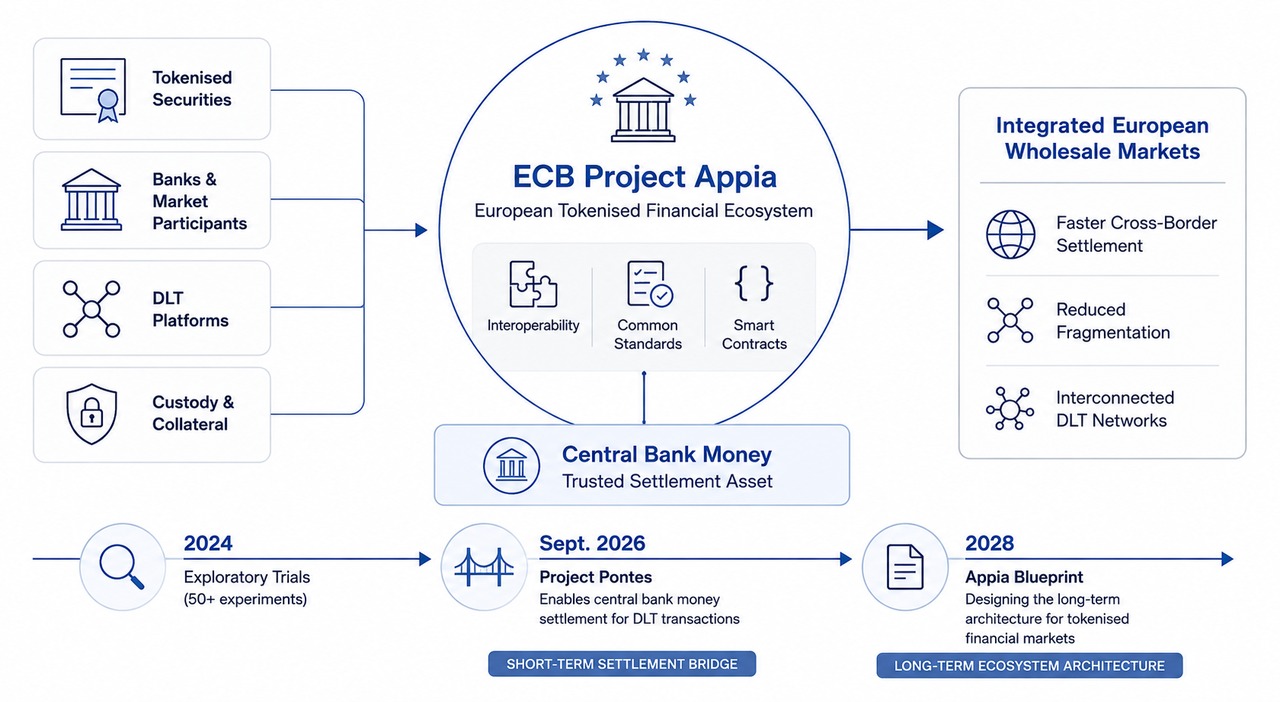
ECB Project Appia is the Eurosystem’s long-term initiative for designing a European tokenised financial ecosystem in which central bank money remains the trusted settlement anchor. It looks beyond a single blockchain or settlement service. The European Central Bank and euro-area national central banks are examining how trading, settlement, custody, collateral, asset servicing and other wholesale financial services could work across interconnected distributed ledger technology networks.
For anyone trying to understand where Europe’s financial markets may be heading, the important distinction is between Pontes and Appia. ECB Project Pontes is the shorter-term operational track for settling DLT-based transactions in central bank money. Appia is the longer-term architecture project: it asks what an integrated European market for tokenised assets should eventually look like.
The Appia roadmap was published on March 11, 2026, and the Eurosystem expects its analytical and practical work to culminate in a blueprint in 2028. Its architecture has deliberately not been fixed yet. Single-network, multiple-network and hybrid configurations remain under consideration.
Key Takeaways
ECB Project Appia is the Eurosystem’s long-term strategy for European tokenised wholesale financial markets, covering infrastructure, interoperability, standards, settlement, collateral, governance and regulation.
Central bank money remains central to the model. The aim is to allow financial innovation without replacing the public settlement asset that anchors today's monetary system.
Pontes and Appia are complementary initiatives. Pontes provides near-term central bank money settlement for DLT transactions, while Appia develops the broader architecture for tomorrow's tokenised markets.
Appia doesn't assume that Europe will use one blockchain. The Eurosystem is studying a shared European ledger, multiple interconnected networks and combinations of those approaches.
The Appia blueprint is expected in 2028, informed by market consultation, experiments and operating experience from Pontes.
What Is ECB Project Appia?
The Appia initiative is a strategic Eurosystem programme investigating how Europe's wholesale financial markets could operate when securities, money and other financial assets are increasingly represented as digital tokens.
Tokenisation means issuing or representing an asset as a digital token, typically recorded using distributed ledger technology (DLT). Instead of several institutions maintaining separate records and repeatedly reconciling them, DLT can allow authorised market participants to work from synchronised transaction records.
This can matter throughout an asset's lifecycle. Issuance, trading, settlement, custody, collateral management and asset servicing may eventually interact more directly, while smart contracts can automate predetermined actions when specified conditions are satisfied. Gate Learn's overview of real-world asset tokenisation shows the broader principle: tokenisation changes how ownership or financial claims can be represented and transferred, although institutional securities introduce far more demanding legal, settlement and governance requirements.
Appia applies that idea specifically to tokenised wholesale financial markets. It isn't a new retail cryptocurrency, a trading platform or a replacement for commercial banks.
The initiative builds on Eurosystem exploratory work conducted between May and November 2024. That programme involved 64 participants carrying out more than 50 trials and experiments involving new technologies for wholesale central bank money settlement. The results helped lead to the Eurosystem's dual-track strategy of Pontes and Appia.
Why the European Central Bank Wants Central Bank Money at the Centre
Tokenising a bond or security solves only one part of a transaction. Someone still has to pay for it.
In today's financial system, major wholesale transactions can ultimately be settled using central bank money, which does not expose participants to the credit risk of a commercial settlement provider in the same way as privately issued money. The Eurosystem wants that monetary anchor to remain available when financial activity moves onto DLT platforms.
That objective links Appia with the broader concept of ECB tokenized finance: digital innovation may change the technological rails, but the Eurosystem doesn't want tokenised markets to become detached from central bank money settlement.
This has implications beyond individual trades. Central bank money supports the smooth functioning of payment systems, monetary policy implementation and financial stability. If European wholesale markets eventually split across numerous incompatible DLT networks using different settlement assets, liquidity and collateral could become fragmented rather than more efficient.
Appia is therefore partly an integration project. The Eurosystem wants common standards and interoperable infrastructure to lower barriers to entry, support competition and make cross-border transactions easier without forcing every market participant onto the same technological platform.
How Distributed Ledger Technology Could Fit Into Appia
One of Appia's biggest unresolved questions concerns the network architecture itself.
A future European tokenised financial ecosystem could theoretically use a single shared network functioning as basic infrastructure. Alternatively, financial institutions and market infrastructures could operate on multiple interconnected networks, with interoperability standards allowing assets and money to move between them.
A hybrid structure is also possible.
The Eurosystem hasn't selected a winner because each configuration involves trade-offs. A shared infrastructure could make standardisation and interoperability easier. Multiple networks may support competition, technological diversity and resilience, but they also create a greater need for common technical standards and mechanisms that can transfer assets safely between DLT platforms.
Appia will study these alternatives against market conditions, technology, regulation and geopolitical factors. European governance is another consideration because one of the project's objectives is strengthening Europe's strategic autonomy and resilience while preserving the euro's continued relevance as an international currency.
Pontes and Appia: Two Parts of One Strategy
Pontes and Appia solve different time-horizon problems.
Area
Pontes
Appia
Main role
Near-term operational settlement
Long-term ecosystem design
Focus
Connect DLT activity with central bank money
Design an integrated European tokenised financial ecosystem
Infrastructure
Links market DLT platforms with TARGET Services and develops Eurosystem DLT capabilities
Studies possible future network architectures, standards and governance
Initial milestone
Launch in September 2026
Roadmap published March 2026
Longer-term milestone
Gradually enhanced after launch
Blueprint expected in 2028
Relationship
Generates operating experience for Appia
Helps determine future Pontes enhancements
Pontes is scheduled to go live in September 2026. It connects market DLT platforms with the Eurosystem's TARGET Services, allowing the cash leg of qualifying tokenised transactions to settle in central bank money. Later Pontes enhancements are planned to include longer operating hours, greater programmability and eventually 24/7 capabilities.
Appia takes what is learned from that practical work and asks what should come next. The relationship also works in reverse: Appia's analytical findings can gradually influence how Pontes develops.
That makes the dual-track structure important. Europe doesn't have to wait until the entire long-term architecture has been decided before market participants can conduct DLT-based transactions using central bank money.
The Appia Roadmap and the 2028 Blueprint
The Appia roadmap combines analytical research with practical experimentation and cooperation among the Eurosystem, public sector bodies, regulators, legislators and market participants.
Its work extends well beyond settlement technology. The ECB has identified areas including technical standards and interoperability, tokenised assets, monetary policy implementation, collateral management, infrastructure for tokenised central bank money, cross-border connectivity, legal and regulatory foundations, governance and resilience.
The planned 2028 blueprint isn't simply a specification for one ECB blockchain. It is intended to set out findings, recommendations and principles for an integrated ecosystem and clarify what role the Eurosystem should play within it.
That distinction matters because the architecture remains market driven as well as public-sector shaped. Banks, securities infrastructures, custodians and other providers would continue developing financial products and services. The Eurosystem's role is focused on the monetary anchor, infrastructure questions, common standards and conditions that can support an integrated market.
Why Appia Looks Beyond Tokenised Settlement
Moving the settlement stage onto DLT while leaving every other part of the securities environment fragmented would capture only part of tokenisation's potential.
Appia consequently considers an end-to-end ecosystem. A tokenised asset may pass through issuance, trading, clearing or matching, settlement, custody, collateral use and servicing. If those stages require incompatible systems and repeated reconciliation, simply recording the asset on a distributed ledger doesn't automatically improve efficiency.
Smart contracts could eventually automate some interactions between these stages. For example, a transaction could be structured so the asset moves only when the corresponding payment can settle, reducing principal risk through delivery-versus-payment mechanisms. Programmability could also affect collateral workflows or other conditional financial operations.
The role of smart contracts in central bank operations is particularly relevant here because tokenised central bank money could eventually interact programmatically with tokenised securities while still operating within monetary policy, legal and risk controls.
The catch is that automation doesn't remove the need for governance. Legal enforceability, cybersecurity, privacy, operational resilience, interoperability and responsibility when something fails still matter.
Appia, the Digital Euro and the EU DLT Pilot Regime
Appia should not be confused with the digital euro.
The digital euro is primarily a retail central bank money initiative intended for payments by people and businesses. Appia focuses on wholesale financial markets, where banks, financial institutions and market infrastructures settle securities and other large-value transactions.
The EU's DLT Pilot Regime is different again. It creates a regulatory framework within which certain DLT-based market infrastructures can operate under specified conditions. Appia addresses the wider question of how European tokenised finance could eventually connect across technologies, markets and public infrastructure.
These complementary initiatives illustrate that digital innovation in Europe is occurring at several layers: retail payments, wholesale settlement, securities infrastructure and regulation.
Why Appia Matters for European Financial Markets
Europe's financial markets remain divided across national systems, legal arrangements and post-trade infrastructures. Tokenisation could reproduce that fragmentation if individual DLT platforms develop as isolated networks.
Appia attempts to address the problem before those silos become permanent.
Common standards could make it easier for a tokenised security issued on one infrastructure to interact with custody, settlement or collateral services elsewhere. Cross-border wholesale finance could become faster or operationally simpler if institutions don't need as many disconnected reconciliation processes.
There is also a strategic dimension. The Eurosystem says Appia should support European control over basic financial infrastructures, strengthen resilience and preserve the euro's international relevance. These are objectives rather than guaranteed outcomes; achieving them will depend on market adoption, regulation, technical interoperability and cooperation across the European Union.
For a practical contrast, Gate.com's RWA market category shows how blockchain-linked asset themes already appear in public crypto markets. Appia deals with a very different layer: the institutional infrastructure through which tokenised financial assets and central bank money could eventually interact across Europe's wholesale system.
What Could Limit Project Appia?
Appia is a roadmap, not a finished infrastructure.
Technical interoperability remains difficult when DLT networks use different token formats, smart-contract environments and governance rules. A design that works technically may still face legal barriers across jurisdictions.
There are also policy trade-offs. Lower barriers can support competition, but open access must coexist with financial stability and operational safeguards. A single network could simplify interoperability but create concentration concerns. Multiple interconnected networks may improve diversity while making coordination harder.
Existing financial infrastructure won't disappear overnight either. TARGET Services, securities depositories, payment systems and established market processes continue to perform important functions. Appia is therefore better understood as a gradual attempt to determine how today's financial system and tomorrow's tokenised markets can converge.
Conclusion
ECB Project Appia is the Eurosystem's long-term framework for deciding how a European tokenised financial ecosystem should be built. Its central idea is straightforward: financial assets and infrastructure may become more programmable and distributed, but central bank money should continue to provide the trusted settlement anchor.
Pontes handles the nearer-term challenge by enabling central bank money settlement for DLT-based transactions. Appia looks further ahead, considering the complete architecture of tokenised wholesale finance, including interoperability, standards, collateral, monetary policy, governance, regulation and cross-border connectivity.
The blueprint expected in 2028 should make that vision more concrete. Until then, Appia remains deliberately exploratory. The final European ecosystem could use one shared network, multiple interconnected DLT networks or a combination of approaches. What matters to the Eurosystem is that digital innovation improves integration rather than creating another layer of fragmented financial infrastructure.
FAQ
What is ECB Project Appia?
ECB Project Appia is the Eurosystem's long-term initiative for designing an integrated European tokenised financial ecosystem. It examines infrastructure, interoperability, standards, governance and how central bank money can remain the settlement anchor for wholesale financial markets.
When will Project Appia launch?
Appia isn't being launched as a single operational platform on one date. Its roadmap was published on March 11, 2026, and the Eurosystem aims to produce an Appia blueprint in 2028.
What is the difference between Pontes and Appia?
Pontes is the operational near-term solution for settling DLT-based transactions in central bank money, while Appia develops the longer-term architecture for European tokenised finance. Pontes' experience will inform Appia, and Appia's findings will help guide Pontes enhancements.
Is Project Appia a digital euro?
No. Appia focuses on wholesale tokenised financial markets and infrastructure. The digital euro primarily addresses retail central bank money and everyday digital payments.
Will Appia use one blockchain?
That hasn't been decided. The Eurosystem is examining a single shared network, multiple interconnected DLT networks and combinations of both, with the final approach depending on technological, regulatory, market and broader economic conditions.
Why is central bank money important to Appia?
Central bank money provides a common public settlement asset without the credit risk associated with a private issuer. The Eurosystem wants that monetary anchor to remain available even if securities, collateral and other wholesale financial activities increasingly move onto DLT-based infrastructure.
Author: Jared
Disclaimer
* The information is not intended to be and does not constitute financial advice or any other recommendation of any sort offered or endorsed by Gate.
* This article may not be reproduced, transmitted or copied without referencing Gate. Contravention is an infringement of Copyright Act and may be subject to legal action.
Stablecoins were originally designed as dollar substitutes within exchanges, primarily used for asset pricing and trade settlement. As on-chain financial ecosystems have matured, their role has expanded beyond simple payments to include collateral assets, cross-chain liquidity mediums, and unified settlement units. In particular, as AI systems and automated agents begin to participate directly in economic activity, demand has risen sharply for programmable value units capable of instant settlement. This shift is pushing stablecoins toward the role of foundational financial infrastructure.
PAXG (Pax Gold) is a tokenized asset backed by physical gold, issued by the fintech company Paxos and traded on the Ethereum blockchain as an ERC-20 token. The core concept is to tokenize physical gold on-chain, with each PAXG token representing ownership of a certain amount of gold. This structure enables investors to hold and trade gold in the form of a digital asset.
In the competition for DeFi liquidity, high-inflation mining alone is no longer enough to build lasting advantages. Aerodrome applies the ve(3,3) economic model to redesign token emissions, voting mechanisms, and revenue distribution, creating a liquidity flywheel centered on governance and cash flow. This article examines AERO tokenomics, the veAERO locking mechanism, and protocol revenue models to explain how Aerodrome builds a sustainable DeFi economic system.
PAXG (Pax Gold) is a tokenized asset backed by physical gold reserves, launched by fintech firm Paxos and issued as an ERC-20 token on the Ethereum blockchain. The core concept is to digitally represent real-world gold assets, allowing investors to hold and trade gold via the blockchain network. Because each PAXG token corresponds to a specific quantity of physical gold, its price is theoretically expected to closely track the global gold market.
AERO is the native token of Aerodrome Finance, a core decentralized exchange and liquidity protocol in the Base ecosystem. It is primarily used for liquidity incentives and ecosystem operations. veAERO is a governance NFT that users receive by locking AERO, representing both voting power and the right to share protocol revenue. Through a dual track structure of AERO as a utility token and veAERO as a governance credential, Aerodrome separates liquidity usage value from long term governance power, allowing participants to act as liquidity providers, governance decision makers, and revenue sharers within the same system.
In the early stages of the crypto market, traditional stablecoins mainly relied on single-reserve or single-collateral models. Their primary focus was price stability and payment convenience, which allowed them to become foundational tools for on-chain trading and capital flows. As the market has entered a more mature financial phase, however, this structure has begun to reveal limitations, including high concentration risk and the difficulty of balancing liquidity with yield. These constraints have driven the evolution toward multi-layer collateral and portfolio-based designs, such as the dual-layer hybrid collateral architecture proposed by United Stables, which seeks to redefine the underlying logic of stable assets.