For central banks, commercial banks and market participants assessing tokenised finance, the benefit isn't simply that blockchain makes transactions faster. The bigger change is coordination. Reserves, collateral, settlement instructions and eligibility rules could interact within the same programmable workflow, potentially allowing monetary policy operations to respond more quickly when liquidity conditions change.
The catch is that faster markets create faster risks. Automated margin calls, more frequent settlement and around-the-clock markets can increase intraday demand for central bank reserves and transmit stress more quickly. The European Central Bank (ECB) has specifically warned that programmability needs to be considered alongside those new liquidity dynamics.
Key Takeaways
-
Smart contracts can automate liquidity provision, collateral checks, margin processes and settlement when predefined conditions are met.
-
Programmable central bank money could give central banks more flexible tools for adjusting interest rates, collateral requirements, access conditions and emergency liquidity operations.
-
Tokenised collateral can be locked, valued, substituted and released within digital workflows, reducing manual reconciliation and settlement friction.
-
Atomic settlement can reduce principal and counterparty risk, but less reliance on netting may increase participants' intraday liquidity requirements.
-
Central bank money remains important because tokenisation changes the technology of settlement without removing the need for a trusted settlement asset.
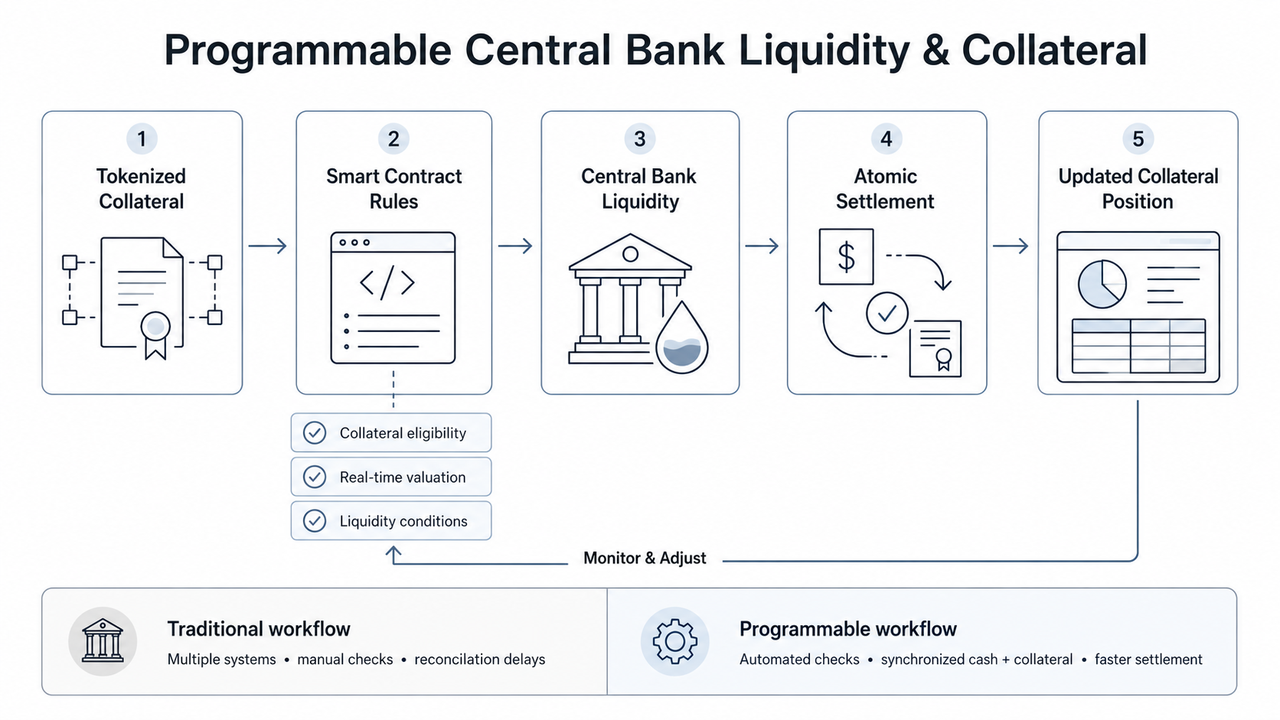
Why Do Smart Contracts Matter for Central Bank Liquidity and Collateral?
A smart contract is code that performs an action when specified conditions are satisfied. Applied to central banking, it could convert parts of monetary policy implementation from a sequence of messages, approvals and reconciliations into rules that execute directly on a programmable platform.
Consider a conventional collateralised liquidity operation. A commercial bank pledges eligible collateral, the collateral must be identified and valued, eligibility must be checked, the appropriate amount of central bank money must be transferred, and records across several systems may need reconciliation.
On a programmable system, those steps can potentially become connected.
A smart contract could check whether a security is eligible collateral, verify its value and applicable haircut, lock the asset, transfer reserves and record the transaction. If the collateral later falls below a required value, the system could request additional collateral or execute an approved substitution under predefined rules.
The New York Fed's Project Pine, a joint research study with the BIS Innovation Hub, tested this broader idea in hypothetical tokenised wholesale financial markets. Its prototype covered functions including open-market operations, interest on reserves and collateral management, and was designed so parameters could be modified for different central-bank frameworks. Tests across ten hypothetical normal and stressed market scenarios found that the prototype could execute intended operations immediately under the conditions tested. The project was experimental and did not constitute Federal Reserve policy.
That distinction matters. Technical feasibility doesn't mean central banks are about to replace existing monetary policy infrastructure with public blockchains.
How Programmable Central Bank Money Could Change Liquidity Operations
Programmable central bank money refers here to central bank money that can interact with executable rules within digital financial infrastructure. In wholesale markets, that primarily concerns central bank reserves rather than a retail central bank digital currency distributed to the public.
The central bank's underlying economic role would remain familiar. It could still expand liquidity during financial stress, absorb liquidity when conditions require it, conduct collateralised operations and influence interest rates. Programmability changes how those actions can be executed.
For example, a liquidity facility could specify:
-
which banks have access;
-
which assets qualify as collateral;
-
the haircut applied to each asset;
-
the applicable interest rate;
-
how much liquidity can be obtained;
-
when collateral must be returned or substituted; and
-
what happens if market conditions cross predefined thresholds.
A central bank could then adjust approved parameters without redesigning an entire operational workflow. Project Pine specifically investigated a toolkit that could be calibrated for standard and emergency market operations.
This is one reason the ECB's approach to tokenized finance places central bank money within the new infrastructure rather than treating DLT markets as a separate financial system.
The idea is especially relevant during stress. Liquidity conditions can deteriorate quickly when collateral prices fall or market participants become reluctant to lend. If reserves and eligible assets operate in compatible programmable environments, liquidity provision could respond closer to the speed at which the underlying market is moving.
Why Central Bank Money Still Matters in Tokenised Financial Markets
Faster settlement doesn't remove settlement risk unless participants can trust the asset being received.
Central bank money occupies a special position because it is a direct claim on the central bank. The ECB describes tokenised central bank money as necessary for providing a risk-free settlement asset in tokenised markets. Without it, transactions may have to settle in private instruments carrying issuer or credit risk.
That is why commercial bank deposits, stablecoins and central bank reserves shouldn't be treated as interchangeable simply because all three can exist in digital form. Stablecoins may serve useful payment or trading functions, but they are private liabilities rather than central bank reserves. Their reserve arrangements, redemption mechanisms and credit exposure differ.
This distinction also separates wholesale programmable central bank money from many discussions about retail CBDCs. According to the Atlantic Council's CBDC Tracker, 146 countries and currency unions representing more than 98% of global GDP were exploring a central bank digital currency as of May 2026, but those initiatives span very different retail and wholesale models.
China illustrates the scale digital currency systems can reach. By the end of November 2025, the digital yuan had processed 3.48 billion cumulative transactions worth CNY16.7 trillion, according to Chinese government information citing the People's Bank of China. Yet the design and policy goals of the e-CNY shouldn't be assumed to match the wholesale tokenised-reserve architecture being considered in Europe.
Smart Contracts and Real-Time Tokenized Collateral Management
Collateral is where programmability becomes particularly practical.
Today, collateral management can involve separate custodians, central securities depositories, settlement systems, valuation processes and messaging networks. Moving an eligible security from one part of the financial system to another can therefore take operational effort even when both parties agree on the economic transaction.
Tokenisation can make assets easier to mobilise because ownership, transfer instructions and programmable rules can exist in compatible digital infrastructure.
A smart contract could potentially:
-
lock tokenised collateral when liquidity is borrowed;
-
confirm whether an asset meets collateral eligibility rules;
-
apply the appropriate haircut;
-
obtain updated valuation information;
-
request additional collateral after a price movement;
-
substitute one eligible security for another; and
-
release collateral after repayment.
The ECB has described a similar future in which smart contracts could request additional collateral or substitute securities in real time.
In April 2025, DTCC announced a digital collateral management platform designed to demonstrate tokenised, real-time collateral workflows, showing that these concepts are already being tested in mainstream financial-market infrastructure rather than only in crypto-native markets.
Tokenisation can therefore increase what might be called collateral velocity: how quickly an asset can be identified and mobilised for another permitted financial transaction. An eligible security that would otherwise remain operationally trapped during a settlement process could potentially become available sooner.
For a public-market illustration of the broader tokenisation concept, Gate.com's tokenized stocks show how traditional asset exposure can be represented through blockchain-based instruments. These market products are fundamentally different from eligible central-bank collateral or central bank money, but the distinction helps show why legal ownership, eligibility and settlement status matter as much as the token itself.
Atomic Settlement Can Synchronize Liquidity and Collateral
Atomic settlement means that interconnected parts of a transaction either complete together or don't complete.
For a tokenised repo, the transfer of collateral and the corresponding payment in central bank money could occur as one coordinated transaction. The ECB has noted that if reserves and collateral share a programmable environment, a standard repo could be executed atomically without separate messaging and reconciliation.
That can reduce delivery-versus-payment settlement risk. One participant doesn't have to transfer securities and then wait for cash to arrive through another process.
The same concept matters internationally. BIS Project Agorá is testing a shared programmable platform combining tokenised central bank reserves with tokenised commercial bank deposits for wholesale cross-border payments. The BIS says its prototype supports atomic multi-currency settlement and can embed workflow logic, compliance requirements and conditional payment triggers into transactions.
The same concept is also of international relevance. The BIS Project Agorá is testing a shared programmable platform that integrates tokenised central bank reserves with tokenised commercial bank deposits for wholesale cross-border payments. The BIS states that its prototype supports atomic multi-currency settlement and is capable of embedding workflow logic, compliance requirements and conditional payment triggers into transactions.
That could address some weaknesses of current payment systems, where time zones, operating hours, multiple intermediaries and sequential processes can fragment liquidity.
Why Faster Settlement Can Also Increase Liquidity Risk
There is an important counterpoint: instant settlement isn't automatically more liquidity-efficient.
Traditional financial markets use netting extensively. Instead of settling every transaction separately in real time, offsetting obligations can be combined so that only the net amount must be funded.
Atomic settlement can reduce settlement exposure but may require money and securities to be available sooner. Tokenised markets operating around the clock could also generate liquidity needs outside today's normal central bank and payment-system schedules.
Automated margin calls create another issue. If a smart contract reacts immediately to falling collateral values, many institutions could face demands for additional collateral at nearly the same time. Forced asset sales could then amplify the original price decline.
The ECB has explicitly highlighted this possibility, along with the risk that more frequent and less nettable payments increase banks' intraday reserve requirements.
Programmability therefore shouldn't mean uncontrolled automation. Central banks may need circuit breakers, human override mechanisms, carefully designed collateral rules and controls that prevent automated liquidations from worsening financial stress.
European Central Bank Projects, the Euro Area and Common Standards
The euro area provides one of the clearest examples of how these ideas could move from experimentation toward financial infrastructure.
ECB Project Pontes is the Eurosystem's shorter-term route for settling DLT-based wholesale transactions in central bank money. The ECB has described Pontes as connecting market DLT platforms with TARGET Services while also developing a Eurosystem-operated DLT settlement environment.
Programmability is expected to become more important as that infrastructure develops. ECB Executive Board member Isabel Schnabel said in August 2026 that Pontes explicitly foresees smart-contract functionality and 24/7 operations after its initial launch.
Project Appia takes a longer view. Its roadmap examines how tokenised wholesale central bank money, collateral services and potentially shared or interoperable ledgers could form part of an integrated European financial ecosystem. The ECB expects Appia's work to culminate in a blueprint in 2028.
Common standards are central to that development. A tokenised world composed of incompatible ledgers could simply reproduce today's fragmentation in a new technological form. Interoperability, legal settlement finality, collateral eligibility, cybersecurity and governance therefore matter alongside the distributed ledger technology itself.
What Could Go Wrong With Central Bank Smart Contracts?
Central bank smart contracts would become part of critical infrastructure, so coding errors have consequences far beyond an ordinary decentralized application.
A faulty rule could value collateral incorrectly, reject eligible assets, release reserves under the wrong conditions or disrupt settlement. Cyber attacks, compromised external data and operational failures also become important when financial transactions depend on automated execution.
There is also a governance problem. Monetary policy occasionally requires judgment. Central banks responding to an unexpected crisis may need to alter interest rates, access conditions, collateral rules or liquidity facilities quickly. Code must support that flexibility rather than constrain policymakers to conditions imagined in advance.
Project Pine remains an experiment precisely for this reason. Its findings establish technical possibilities, not a finished model for Federal Reserve or other central-bank operations.
Legal questions are equally significant. A transaction being final on a distributed ledger doesn't automatically establish settlement finality under every jurisdiction's law. Central securities depositories, regulators and central banks must still determine how digital records map to legal ownership and existing securities rules.
Conclusion
Smart contracts matter for central bank liquidity and collateral because they could connect policy rules directly with execution. Programmable central bank money could allow eligible collateral to be checked automatically, liquidity to be supplied under predefined conditions, repo transactions to settle atomically and operational parameters to change much faster than workflows built around disconnected systems.
But speed changes risk as well as efficiency. Tokenised financial markets may require liquidity more frequently, automated collateral calls can propagate stress faster, and instant settlement can reduce some of the netting advantages embedded in existing markets.
The likely role of smart contracts is therefore not to replace central banks or automate monetary policy itself. It is to give central banks a programmable operational layer through which reserves, collateral and settlement can function at the speed of tokenised markets while preserving governance, financial stability and the role of central bank money as the settlement anchor.
FAQ
What is programmable central bank money?
Programmable central bank money is central bank money that can interact with predefined digital rules or smart contracts. In wholesale finance, this could allow reserves to be transferred automatically when collateral, access and settlement conditions are satisfied.
Can smart contracts provide central bank liquidity automatically?
Technically, they can execute a predefined liquidity operation automatically once specified conditions are met. The central bank would still determine the policy framework, eligible institutions, collateral rules, interest rates, limits and governance surrounding that operation.
How do smart contracts improve collateral management?
Smart contracts can automate collateral eligibility checks, valuation, haircuts, locking, substitution, margin calls and release. Connecting those processes can reduce manual reconciliation and allow collateral positions to be updated closer to real time.
Are stablecoins a replacement for central bank reserves?
Not in the institutional settlement sense. Stablecoins are privately issued liabilities, while reserves are direct claims on a central bank. Tokenised markets may use both, but their credit risk, legal status and settlement characteristics differ.
Could programmable settlement increase financial stability?
It could reduce certain operational, reconciliation and settlement risks, particularly through atomic delivery-versus-payment. However, instant margin calls, reduced netting and faster transmission of market stress can create new liquidity and operational risks, so the effect depends heavily on system design.
Why are Pontes and Appia important for programmable central bank money?
Pontes is bringing central bank money settlement closer to DLT-based wholesale markets in the euro area, while Appia examines the longer-term architecture of an integrated tokenised financial ecosystem. Together, they show how settlement, programmability, collateral services and common standards may develop as tokenised finance expands.







