That distinction matters for issuers, compliance teams and market participants assessing tokenized securities. Putting a token on chain doesn't remove the transfer agent's legal functions. The practical question is how issuance, ownership changes, minting and burning, wallet controls, corporate actions and reconciliation fit into a regulated securities ledger.
The issue became more timely on September 1, 2026, when the Securities and Exchange Commission proposed its first substantive modernization of transfer agent rules in roughly four decades. The proposal expressly addresses electronic and blockchain-based recordkeeping and would add reporting requirements concerning distributed-ledger and tokenized-security activity.
Key Takeaways
-
Blockchain transfer agents can maintain securities ownership records on a distributed ledger, including an official Master Securityholder File, subject to existing SEC recordkeeping, reporting, safeguarding and other regulatory requirements.
-
The transfer agent remains accountable for the authoritative holder record. Blockchain technology changes the recordkeeping infrastructure, not the underlying responsibility to maintain accurate ownership records.
-
Tokenized securities can connect issuance, transfers and wallet controls to a blockchain share registry, while personal investor information may remain in controlled off-chain systems.
-
Smart contracts can enforce some transfer restrictions and automate processing, but software doesn't replace legal review, investor protection or the transfer agent's supervisory functions.
-
The SEC's September 2026 proposal would require greater reporting of DLT and tokenization activity, reflecting how far transfer-agent business operations have moved beyond rules written largely in the late 1970s and early 1980s.
How Can Transfer Agents Use Blockchain for Securities Ownership Records?
A transfer agent's basic job is to keep the issuer's ownership records correct as securities are issued, transferred, cancelled or otherwise changed. Under the Exchange Act, transfer-agent functions include countersigning securities upon issuance, monitoring for overissuance, registering transfers and changing record ownership through bookkeeping entries.
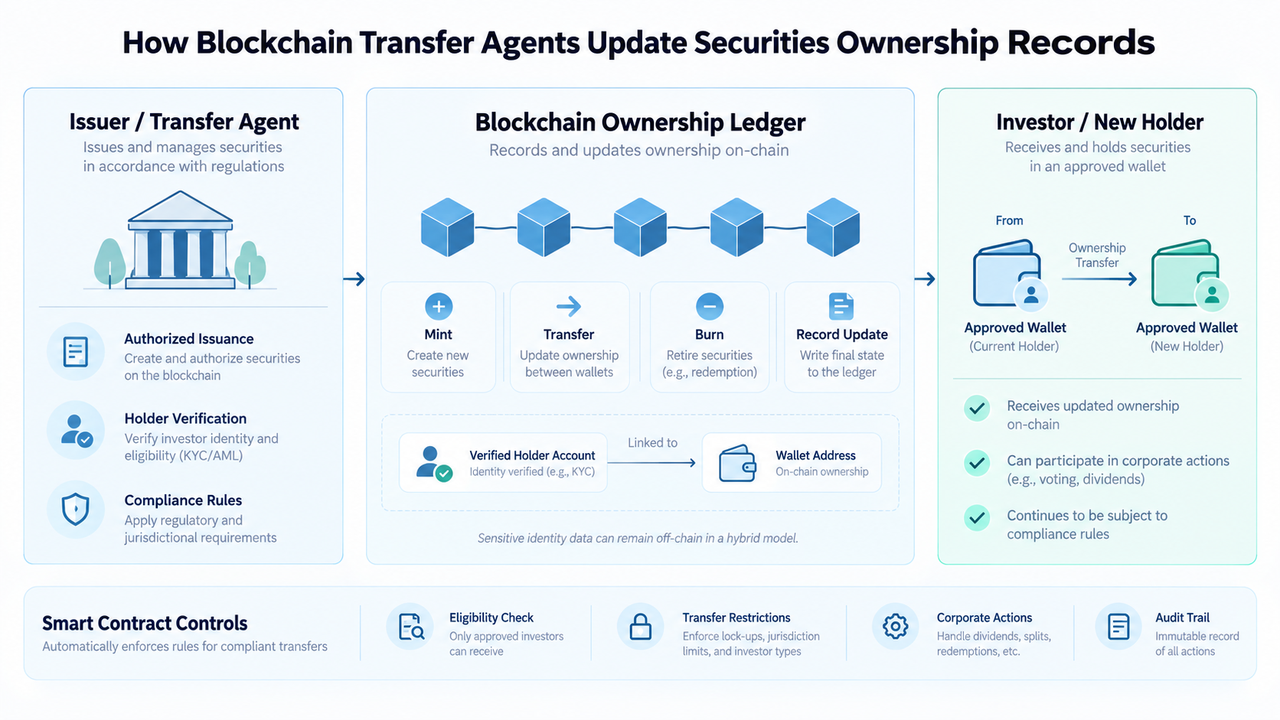
With blockchain technology, those bookkeeping entries can be represented as transactions on a distributed ledger. A blockchain share registry might associate an approved wallet address with a securityholder account, record the quantity held, and update the position when an eligible transfer occurs.
This is an important distinction from simply creating a crypto asset whose price tracks a stock. In blockchain securities recordkeeping, the question is whether the ledger forms part of the legally recognized ownership-record system. Tokenization, by comparison, describes representing an equity, debt or another interest with cryptographic tokens; the legal rights attached to those tokens depend on the structure.
For a live-market example of that distinction, Gate.com's gStocks tokenized securities illustrate how conventional shares can be represented through tokenized products. Such products shouldn't automatically be treated as equivalent to an issuer's Master Securityholder File simply because blockchain technology is involved.
How Transfer Agents Maintain an On-Chain Ownership Ledger
The Master Securityholder File is the authoritative record of who owns an issuer's securities. It functions as the official list of individual record-holder accounts recognized by the issuer, comparable to a stockholder ledger or stockholder register under state corporate law.
A digital transfer agent can structure that record across several connected components.
| Transfer-Agent Function |
Possible Blockchain Role |
| Issuance |
Mint or create tokenized units corresponding to authorized securities |
| Holder registration |
Associate eligible securityholder accounts with approved wallet addresses |
| Transfer processing |
Record debits and credits after a permitted share transfer |
| Cancellation |
Burn or immobilize tokens when securities are cancelled, redeemed or converted |
| Ownership records |
Maintain balances and transaction information in the securities ownership ledger |
| Restrictions |
Apply smart-contract or administrative controls to eligible transfers |
| Audit trail |
Time-stamp and link transaction details across the chain |
| Reconciliation |
Compare ledger positions with transfer journals, control records and connected systems |
In practice, not every piece of data needs to live on chain. Transaction information such as a wallet address, asset balance, number of shares, ownership percentage, purchase date and transaction ID can be maintained on blockchain, while names, tax IDs, physical addresses and other non-public investor information remain in the transfer agent's proprietary systems.
That hybrid architecture can reduce the data-privacy problem created by writing sensitive shareholder information to a public blockchain. It also means there may still be a central location for protected identity data even when transaction records are distributed across nodes holding their own copy of the ledger.
Issuance, Minting and Burning of Tokenized Securities
For issuer-sponsored tokenized securities, issuance begins with the legally authorized quantity of securities, not with an unrestricted smart-contract mint function.
The transfer agent must monitor issuance so that blockchain balances don't create an overissuance relative to the issuer's authorized securities. A compliant workflow might mint tokens when shares are issued, move them between approved addresses when ownership changes, and burn them after redemption or cancellation.
This is where a tokenized securities transfer agent differs from an ordinary token administrator. The token's blockchain supply has to remain connected to the issuer's securities records and applicable laws.
Compliance-oriented token standards can support these mechanics. For example, ERC-3643 for real-world assets combines token transfer functions with identity and compliance controls, illustrating how permissions can be added to blockchain-based assets.
Wallet Controls and Smart Contracts
A wallet address can serve as a technical destination for tokenized securities, but control of a private key alone doesn't necessarily resolve every legal question about registered ownership.
Transfer agents may need mechanisms for approving addresses, blocking prohibited transfers, recovering positions after credential loss, responding to court orders, handling restrictive legends and updating an account when the holder's details change.
Smart contracts can make some of that processing automatic. They may check whether both addresses meet specified eligibility conditions before a transaction executes, enforce holding or jurisdictional restrictions, or help automate corporate actions such as distributions and stock splits.
The catch is that automated compliance is only as reliable as its rules, source data and controls. A smart contract can't determine by itself whether every regulatory condition has been satisfied unless the required information is available to it. Transfer agents therefore remain responsible for oversight even when processing is heavily automated.
Distributed Ledger Technology and Securities Transfers
A distributed ledger can shorten the gap between an approved ownership change and the corresponding record update. Once a valid transaction is accepted, the updated position can be visible to authorized market participants without several organizations separately entering the same transaction.
That can reduce reconciliation work and provide a permanent, auditable sequence of transaction information. Since blocks link transactions cryptographically and include ordering information, unauthorized retrospective changes are harder to conceal than edits in an isolated database.
It is still too broad to say that blockchain automatically creates instantaneous securities settlement. A securities transfer may involve broker dealers, custodians, banks, cash movements, alternative trading systems and other market infrastructure. The asset leg can update quickly while the legal, cash or intermediary parts of settlement follow different processes.
This is why reconciling on-chain share records remains relevant even when the blockchain functions as a shared source of truth. Interoperability matters as much as ledger speed.
Blockchain Transfer Agents Under the SEC Regulatory Framework
As of June 30, 2026, there were 327 registered transfer agents in the United States regulatory system. Most were supervised directly by the Securities and Exchange Commission, while certain bank transfer agents remained under banking regulators.
The September 1, 2026 SEC proposal is a significant update because most federal transfer-agent rules were first adopted in the late 1970s and early 1980s. It isn't a final rule yet; the proposal remains part of the rulemaking process.
Among the proposed Form TA-2 changes, registered transfer agents would report the number of securities issues for which distributed ledger technology was used to maintain the Master Securityholder File. They would also report tokenized-security activity by model and provide additional information about issues serviced.
Those requirements help explain why the SEC is modernizing transfer-agent rules: regulatory oversight now has to account for electronic recordkeeping, uncertificated securities, blockchain projects and business models that barely existed when the underlying rules were developed.
Importantly, SEC guidance already allows a registered transfer agent to use distributed ledger technology as its official Master Securityholder File, or as a component of it, when all applicable federal securities-law requirements are satisfied. A duplicate off-chain “digital twin” isn't inherently required simply because the official record uses blockchain.
Could Transfer Agents Become Blockchain Validators?
Blockchain can change the operational role of a transfer agent, but calling every transfer agent a decentralized validator would go too far.
In a permissioned system, a transfer agent might operate or supervise nodes that validate transaction data before ownership records change. Other approved entities could maintain their own copy of the distributed ledger, improving shared visibility across the entire chain.
Yet regulatory responsibility remains identifiable. Under the SEC's proposed framework, only one recordkeeping transfer agent would remain responsible for maintaining and updating the Master Securityholder File for a particular securities issue, although that entity may use service companies, co-transfer agents, linked files or particular technologies.
So the likely model isn't “no central responsibility.” It is distributed infrastructure with a clearly accountable regulated entity.
Risks of Putting Securities Ownership Records On Chain
Blockchain recordkeeping introduces different failure modes from a conventional securities database.
Privacy is one. Public blockchains aren't suitable places for unrestricted publication of tax IDs, physical addresses or other sensitive investor data. Hybrid architectures can keep confidential identity records off chain while using the distributed ledger for selected transaction details.
Cybersecurity remains central. Private-key compromise, faulty wallet controls, smart-contract vulnerabilities, incorrect permissions and unavailable infrastructure can affect processing even if historical blockchain data itself hasn't been altered.
Record differences can still occur. Blockchain doesn't eliminate mismatches between the ownership ledger, transfer journal, custody records or other systems. Under the proposed regulatory framework, discrepancies in the Master Securityholder File would still need to be identified and resolved.
Interoperability is another practical constraint. Existing broker dealers, alternative trading systems, banks, custodians and other financial-market infrastructure may use different databases, settlement systems and regulatory processes. A transfer agent can move one part of recordkeeping on chain without moving the entire securities lifecycle there.
Finally, regulatory status depends on what the digital asset represents and how the securities are issued, held and transferred. A crypto exchange, alternative trading system, broker-dealer and SEC registered transfer agent perform different functions. Moving records on chain doesn't collapse those categories into one entity or create a safe harbor from applicable regulations.
Conclusion
Transfer agents can use blockchain for securities ownership records by making distributed ledger technology part of the infrastructure that records issuance, holder balances, approved wallet addresses, transfers, cancellations and other changes in registered ownership.
The strongest use case is not simply turning shares into tokens. It's connecting a blockchain-based securities ownership ledger to an accountable recordkeeping process in which the transfer agent can maintain accurate records, enforce necessary controls, reconcile discrepancies and produce records for regulators.
Blockchain may reduce duplicate processing and make ownership changes easier to audit, but it doesn't remove the transfer agent's crucial role. Under current SEC guidance and the direction of the September 2026 proposal, technology can change how the record is maintained; responsibility for accurate recordkeeping, safeguarding and regulatory compliance remains with the registered transfer agent.
FAQ
Can a transfer agent use blockchain as the official securities ownership record?
Yes. A registered transfer agent may use distributed ledger technology as its official Master Securityholder File, or as a component of it, when applicable federal securities-law requirements are satisfied.
Does a transfer agent need an identical off-chain copy of an on-chain share registry?
Not necessarily. A separate off-chain “digital twin” isn't automatically required simply because the Master Securityholder File uses DLT. A hybrid system may still keep confidential investor information off chain while recording selected ownership and transaction data on chain.
Can smart contracts automatically enforce securities transfer restrictions?
They can automate restrictions that are accurately represented in code and supported by the required identity or compliance data. Human and organizational oversight is still necessary because legal eligibility, exceptions and regulatory obligations aren't always fully determinable from blockchain data.
Are tokenized securities the same as cryptocurrencies?
No. Tokenized securities use digital tokens to represent securities or related interests, while crypto assets and virtual currencies can have very different legal characteristics. Whether a token represents actual equity, debt, beneficial entitlement or only economic exposure depends on its issuance and legal structure.
Not automatically. DLT can make ownership-record updates faster and reduce reconciliation between participating systems, but securities transactions may still depend on broker-dealers, trading venues, custodians, banks, cash settlement and other financial-market infrastructure.
Are the SEC's 2026 transfer-agent blockchain rules already final?
No. The Securities and Exchange Commission issued a proposed rule on September 1, 2026. The proposal seeks to modernize transfer-agent regulation and its treatment of electronic and blockchain-based recordkeeping, but proposed requirements should not be described as final rules until the rulemaking process is completed.