For issuers, transfer agents, asset managers and investors following tokenized stock regulation, the important point isn't simply that the SEC has recognized blockchain technology. The proposal attempts to fit newer technology into long-standing transfer agent functions such as maintaining official ownership records, processing transfers, safeguarding assets and funds, handling corporate actions and supporting accurate clearance and settlement.
Key Takeaways
-
The SEC proposed updated transfer agent rules on September 1, 2026, addressing an infrastructure rulebook that hasn't been substantively modernized since rules adopted in the late 1970s and early 1980s.
-
Registered transfer agents can use electronic and blockchain-based recordkeeping, but the technology doesn't remove their obligations under federal securities laws.
-
The proposal addresses tokenized securities, distributed ledger technology, electronic communications, reporting, safeguarding, operational resilience and cybersecurity risks.
-
Blockchain may change where ownership information is stored and how transfers are processed, but accuracy, accessibility, investor protection and regulatory oversight still matter.
-
The proposal remains subject to a public comment period lasting 60 days after publication in the Federal Register.
Why Is the SEC Modernizing Transfer Agent Rules for Tokenized Securities?
The central problem is a mismatch between old rules and modern market infrastructure.
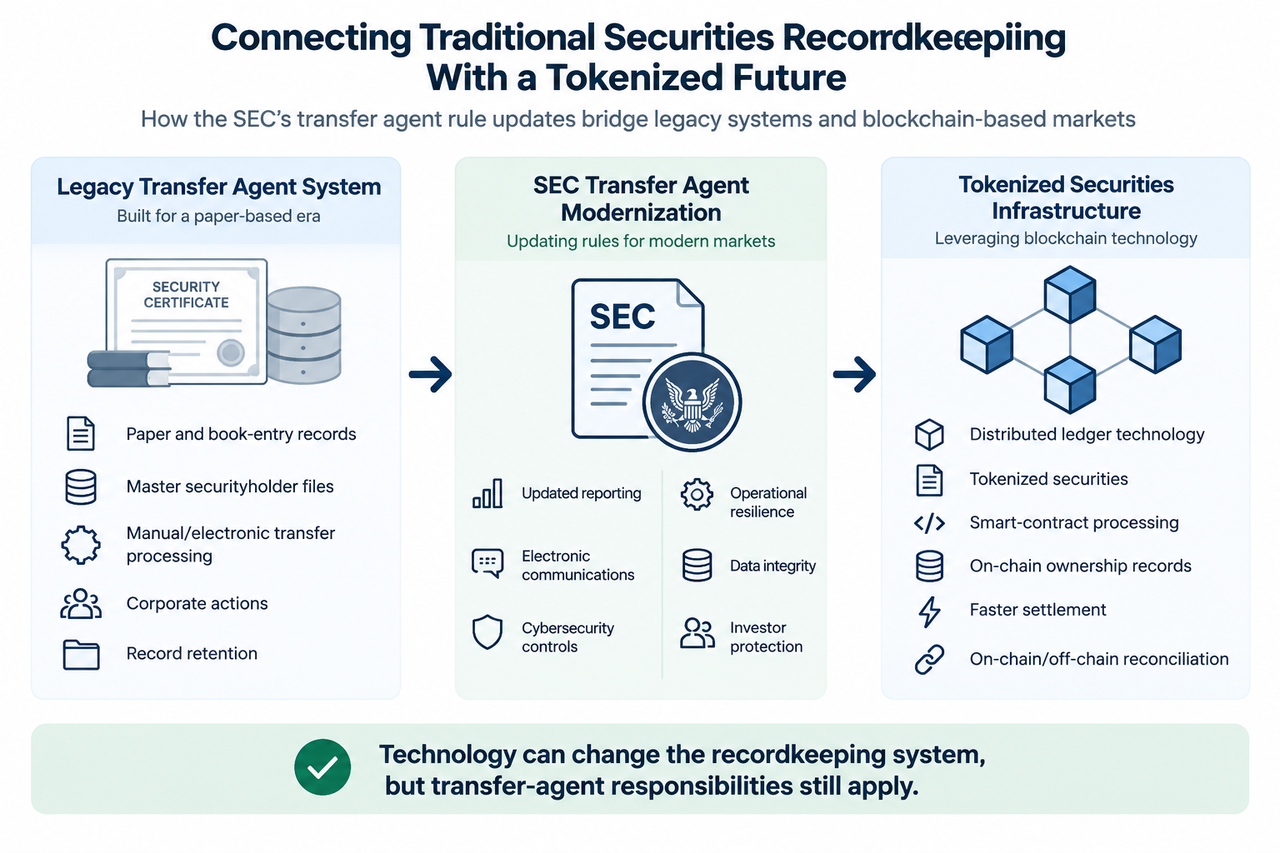
Most federal transfer agent rules were introduced when investors commonly held paper security certificates and many transfer agent activities involved manual certificate processing. Today's transfer agents work in an interconnected electronic market and may maintain book-entry ownership records, distribute dividends, administer investment plans, process corporate actions and provide technology services.
Transfer agents are a key component of the national clearance and settlement system. Their statutory functions include countersigning securities at issuance, preventing overissuance, registering transfers, exchanging or converting securities and changing record ownership through bookkeeping entries. Those responsibilities explain why blockchain securities recordkeeping is primarily an ownership-infrastructure question rather than simply a crypto trading issue.
The SEC's concern is that transfer agents' current processes changed much faster than the Commission's rules. The proposing release points to a widening gap between decades-old regulation and modern processing, recordkeeping, safeguarding and technology-dependent operations.
Why Registered Transfer Agents Matter to Modern Securities Markets
A transfer agent helps determine who the issuer recognizes as a securityholder and processes changes to that record. It may also handle distributions, lost securityholders, restrictive legends and other operational tasks connected with securities ownership.
Those responsibilities don't disappear when an asset becomes tokenized. A blockchain address can represent part of the recordkeeping architecture, while other information such as an investor's name, tax information or contact details may remain off-chain.
SEC staff had already clarified before the September 2026 proposal that a registered transfer agent may use distributed ledger technology as its official master securityholder file, or as part of it, provided applicable recordkeeping, reporting, examination, prompt posting, safeguarding and other requirements are satisfied. The agency also said a duplicate off-chain "digital twin" isn't inherently required.
That distinction matters. The new SEC blockchain rules aren't simply granting permission to use a blockchain for the first time. They are attempting to make the regulatory framework itself better reflect electronic and on-chain operating models.
The mechanics of updating ownership, minting or burning representations and controlling transfers are central to how blockchain transfer agents work.
How Distributed Ledger Technology Changes Transfer Agent Functions
Distributed ledger technology can allow transaction information such as wallet addresses, balances, issuance dates and transaction identifiers to exist on-chain. A transfer agent may then connect those records with identity and securityholder information held in another system.
The regulatory question becomes more difficult when token transfers happen automatically through blockchain networks or smart contracts. If an on-chain transfer occurs, the transfer agent must still know whether the resulting ownership record is legally and operationally accurate.
The SEC's proposal specifically considers how on-chain and off-chain databases should be associated so that transferring a tokenized security on a blockchain results in the corresponding change to the master securityholder file. It also raises questions about records maintained on blockchain networks that a transfer agent doesn't exclusively control.
In practice, this makes reconciliation a regulatory function rather than an optional technical convenience. The relationship between blockchain entries and the legally relevant ownership register is why on-chain share records must be reconciled carefully.
SEC Proposes More Detailed Reporting for Digital Assets
Another reason for transfer agent modernization is visibility.
Existing Form TA-2 reporting gives the Commission information about transfer agent activities, including accounts administered, turnaround performance, funds distributed and lost securityholder accounts. The September proposal would expand and revise those reporting requirements.
The proposed Form TA-2 includes reporting categories for tokenized securities, including issuer-sponsored and third-party-sponsored models. That could give the SEC a clearer picture of how many securities issues registered transfer agents service through tokenized structures and how quickly blockchain-based activity is entering regulated securities infrastructure.
This matters for supervision. A regulatory framework written before distributed networks existed can't effectively monitor an industry if its forms don't capture how firms actually conduct operations.
Why Clearance and Settlement Rules Need to Address Blockchain Risks
Blockchain can improve certain operational processes, but it creates a different risk profile rather than eliminating risk.
The SEC identifies blockchain data integrity, security of tokenized securities, distributed ledger operating models and smart-contract-driven processes among the issues transfer agents increasingly have to manage. Existing rules were also largely silent on information security, cybersecurity, disaster recovery and operational risk associated with connected electronic systems.
The proposal would therefore introduce a broader risk-management approach covering material custody, operational and cybersecurity risks and business continuity.
Consider a smart contract that automates ownership transfers. Faster settlement may reduce manual processing, but a coding error, compromised permission system or incorrect synchronization between on-chain and off-chain records could create a different problem: the technology may execute exactly as programmed while the resulting ownership record is wrong.
Regulatory modernization is meant to keep investor protection attached to the function, regardless of which database performs it.
Federal Securities Laws Still Apply to Tokenized Securities
Tokenization changes the technical representation of an asset; it doesn't automatically change its legal character.
A token representing a security can remain subject to federal securities laws even when issuance, ownership or transfer is recorded through a blockchain. The regulatory analysis is also different from determining whether a crypto asset itself constitutes a security or investment contract.
That broader distinction has become increasingly important as the SEC develops rules for crypto assets while separately modernizing infrastructure used for conventional and tokenized securities. In August 2026, for example, the Commission separately proposed Regulation Crypto Assets, including exemptions and a conditional safe harbor relating to investment contracts.
For tokenized shares, ownership architecture also needs to be separated from products that merely track a stock's price. Gate.com's Tokenized Stocks section, for example, can illustrate price-linked digital asset products, while a regulated tokenized security may involve legally recognized securities ownership and registered transfer-agent records. The label "tokenized stock" by itself doesn't establish which structure applies.
A similar distinction appears in the development of regulated market infrastructure, including the SEC's Nasdaq tokenized securities pilot, where tokenization is incorporated into existing securities-market arrangements rather than treated as a way around them.
What Transfer Agent Modernization Could Mean for Tokenized Assets
If adopted substantially as proposed, the rules could give market participants a clearer regulatory pathway for using modern electronic infrastructure while preserving traditional transfer agent responsibilities.
That doesn't amount to a blanket SEC endorsement of every blockchain network or tokenized asset model. Registered transfer agents would still need to satisfy specific requirements concerning records, processing, safeguarding, compliance and regulatory examination.
The proposal is technology-aware rather than technology-exempt. It recognizes that blockchains may form part of an official securities recordkeeping system while asking how integrity, accessibility, security and operational resilience should be maintained.
That approach could matter as more issuers experiment with tokenized assets. A blockchain can make ownership transfers programmable. Smart contracts can automate parts of issuance and processing. Electronic communications can replace workflows originally designed around paper. Yet someone still has to ensure that the authoritative record is correct and that investors can exercise the rights attached to their securities.
Risks and Unresolved Questions in the SEC Transfer Agent Rules
Several issues remain open because this is a proposing release.
The Commission is asking for public input on how blockchain records should satisfy record retention and examination requirements, how information distributed across on-chain and off-chain systems should be coordinated, and what controls should apply when a transfer agent doesn't exclusively control the underlying blockchain.
There are also practical tradeoffs. Immutable blockchain records may improve auditability, but incorrect transactions aren't necessarily easy to reverse. Faster settlement can reduce processing delays while leaving less time to correct mistakes. Smart contracts may automate compliance logic, but software failures can create operational or cybersecurity exposure.
Jurisdiction matters too. SEC transfer agent rules govern U.S. securities-market activities under the relevant federal framework; they don't establish a worldwide standard for regulation of crypto assets or tokenized securities.
Conclusion
The SEC is modernizing transfer agent rules because the infrastructure for recording and transferring securities has moved far beyond the paper-based environment in which much of the existing framework was created.
Its September 1, 2026 proposal attempts to bring electronic communications, distributed ledger technology, tokenized securities, updated reporting and modern operational risks into the registered transfer-agent framework while preserving the underlying goals of accurate ownership records, safe processing, investor protection and reliable clearance and settlement.
For tokenized securities, the bigger regulatory shift isn't that blockchain replaces securities law. It's that securities regulation is beginning to describe more explicitly how established responsibilities can operate when the authoritative records themselves may live partly or entirely on-chain.
FAQ
Are the SEC's new transfer agent rules already in effect?
No. The September 1, 2026 release is a proposal, not a final rule. The SEC states that the public comment period will remain open for 60 days after publication in the Federal Register.
Can registered transfer agents already use blockchain?
Yes. Under SEC staff guidance, distributed ledger technology may be used as the official master securityholder file or a component of it if the transfer agent continues to satisfy applicable federal securities-law requirements.
Does the SEC proposal recognize tokenized securities?
Yes. The proposal expressly discusses tokenized securities, blockchain-based recordkeeping, distributed ledgers and smart contracts, and proposed Form TA-2 reporting would collect information about tokenized securities serviced by transfer agents.
Why does cybersecurity matter for blockchain transfer agents?
A transfer agent may depend on connected systems, private operational infrastructure, blockchain networks and automated processes. The SEC proposal therefore considers data integrity, operational resilience, business continuity and cybersecurity alongside traditional safeguarding responsibilities.
Does tokenizing a stock remove it from securities regulation?
No. Changing the recordkeeping or technological representation of a security doesn't by itself remove the underlying instrument from applicable securities laws. The relevant legal rights, issuance structure and transactions still have to be considered.