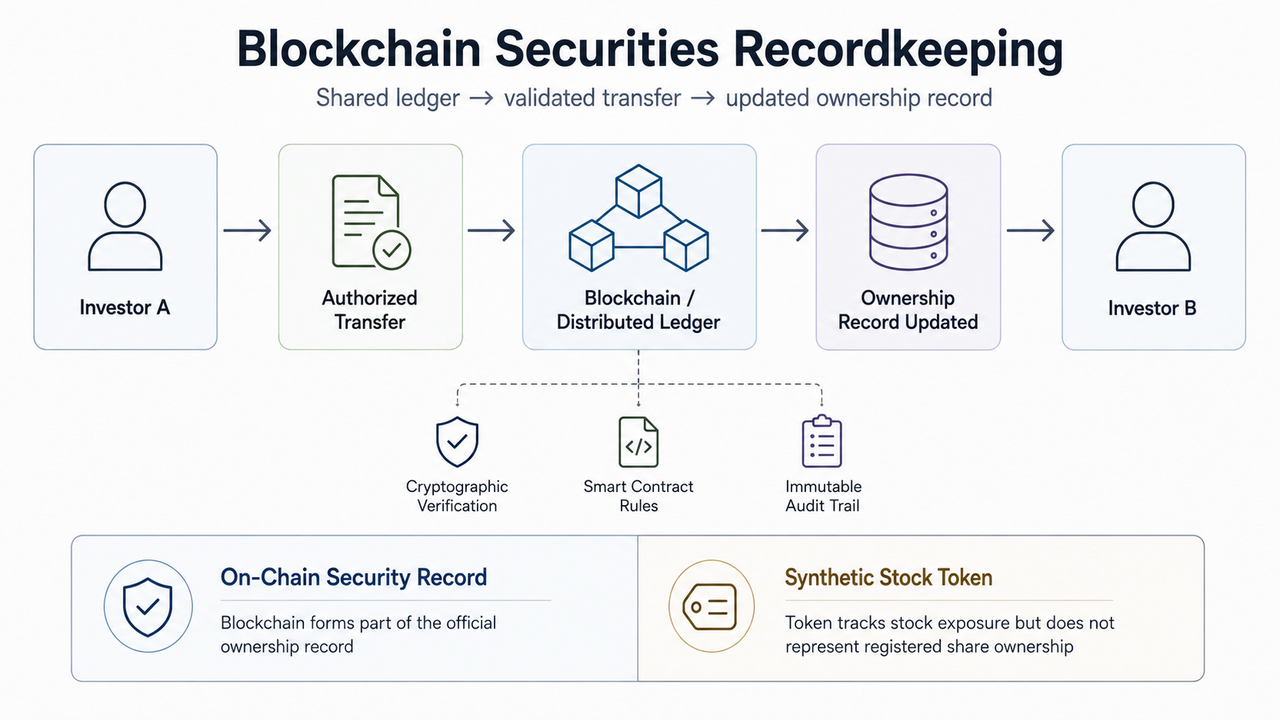
Blockchain securities recordkeeping is the use of blockchain or distributed ledger technology to record who owns a security, when ownership changes and, in some structures, which record legally controls the shareholder register. It can make securities records more synchronized, programmable and auditable. But putting a stock-related token on a blockchain does not necessarily mean that the token itself is an official share or that its holder appears on the issuer's shareholder register.
That distinction matters for investors trying to understand tokenized shares, financial institutions modernizing market infrastructure and anyone comparing blockchain stock ownership records with price-tracking digital assets. A blockchain can function as part of the authoritative securities ledger, act as a transaction layer that feeds an off-chain register, or simply record a separate token whose value references a stock.
In practice, the technology is the easy part to describe. The harder question is: what legal right does the blockchain record actually represent?
Key Takeaways
Blockchain securities recordkeeping uses a shared digital ledger to record securities ownership and transfers, potentially replacing or complementing conventional databases.
A blockchain may form part of an issuer or transfer agent's official shareholder record, but not every tokenized stock is structured this way.
Cryptographic signatures, timestamps and linked transaction records can create a tamper-evident audit trail, while smart contracts can automate permitted transfers and other administrative processes.
Tokenization and share ownership aren't synonymous. A token may represent the security itself, beneficial ownership of an underlying security or only economic exposure to its price.
Blockchain can shorten reconciliation and settlement workflows, but settlement speed still depends on regulation, cash settlement, custody, identity controls, network design and other market infrastructure.
What Is Blockchain Securities Recordkeeping?
Blockchain securities recordkeeping applies blockchain technology to the records traditionally used to determine ownership of stocks, bonds and other securities.
A conventional shareholder register may be maintained in a centralized database by an issuer or its transfer agent. When securities change hands, brokers, custodians, depositories, clearing organizations and other financial institutions can maintain their own transaction records as well. Those records have to agree, or discrepancies have to be reconciled.
A distributed ledger changes the technical architecture. Instead of several parties independently updating databases and later comparing them, authorized network participants can work from a shared ledger whose state is updated according to agreed rules.
The U.S. Securities and Exchange Commission has explicitly recognized that a registered transfer agent may use distributed ledger technology for its official Master Securityholder File, provided applicable securities-law requirements are met. The SEC has also noted that a transfer agent can maintain blockchain data such as wallet addresses, balances and transaction IDs while keeping names, tax identifiers and other private information off-chain.
So blockchain securities recordkeeping isn't simply “putting stocks on Bitcoin” or converting every shareholder's identity into public blockchain data. It is a broader data-management model for maintaining and transferring securities records.
How Blockchain Technology Changes a Securities Register
A blockchain is a type of distributed database in which network participants maintain a sequence of transaction data according to defined blockchain protocols.
A simplified blockchain transaction record may include the asset involved, originating and receiving addresses, quantity, transaction ID, timestamp and a cryptographic signature. Transactions are grouped into a data block, and each new block can contain a cryptographic hash linking it to the previous block. Altering historical block data would therefore affect the cryptographic relationships that follow it.
For securities recordkeeping, the basic workflow can look like this:
An investor or authorized intermediary initiates a securities transfer.
The system checks identity, transfer restrictions, available balances and other applicable rules.
The blockchain network uses its permitted validation process to validate transactions.
The ownership change is added to the transaction ledger.
Relevant participants obtain an updated view of the record.
If an off-chain master register remains authoritative, the blockchain transaction may trigger or support an update to that register.
The result can be a clearer audit trail than a process in which traditional business networks maintain numerous copies of the same data and repeatedly reconcile them.
This is also where blockchain transfer agents become important. A transfer agent still has administrative and regulatory responsibilities even when blockchain software performs part of the recordkeeping workflow.
Blockchain Network Models for Securities
Not every securities ledger needs a public blockchain network.
Public Blockchain Network
Public blockchains allow broad network participation. Bitcoin and Ethereum are familiar examples, although their architectures and purposes differ substantially.
The Bitcoin blockchain, introduced when the Bitcoin network launched in January 2009, records Bitcoin transactions and uses Proof of Work as its consensus mechanism. Bitcoin demonstrated that multiple computers could maintain an ordered transaction history without relying on a single central authority.
Ethereum extended the model toward programmable blockchain applications. Since launching in 2015, Ethereum has supported smart contracts and later transitioned from Proof of Work to Proof of Stake in 2022.
Public networks can provide transparency and broad interoperability, but regulated securities introduce requirements around identity, privacy, transfer restrictions and regulatory compliance that don't exist for ordinary cryptocurrency transfers.
Private Blockchain Network
A private blockchain network restricts access to approved participants. Financial institutions can therefore determine who may submit transactions, validate transactions or inspect particular blockchain data.
Private blockchains are often closer to existing institutional data-management requirements because network participation can be controlled.
Consortium Blockchain Network
A consortium blockchain network distributes control among several approved organizations rather than giving one organization complete authority or allowing unrestricted public participation.
For securities markets, a consortium could theoretically include issuers, custodians, transfer agents, financial institutions or other regulated entities. Permissioned blockchain networks can preserve elements of a distributed network while keeping access within a defined business network.
None of these architectures automatically makes a securities system decentralized in the same sense as Bitcoin. Legal authority over a security may still reside with an issuer, transfer agent or regulated intermediary.
How Blockchain Stock Ownership Records Work
The most important part of blockchain stock ownership records is determining which record counts as the authoritative ownership record.
The SEC's January 2026 framework for tokenized securities describes several possible structures. In one issuer-sponsored model, an issuer or its agent integrates distributed ledger technology into the master securityholder file. A transfer of the crypto asset on the blockchain then results in the corresponding transfer of the actual security. In that arrangement, the on-chain database records are part of the official ownership system.
Another model keeps the official security off-chain. The blockchain token is used to communicate or initiate a transfer, after which the issuer or its agent updates the conventional master securityholder file.
A third-party structure can be different again. An intermediary might own securities in the traditional system and issue tokens representing an interest linked to those securities.
This is why on-chain share-record reconciliation matters. A perfectly valid blockchain transaction doesn't by itself resolve a mismatch between the blockchain data, custodian records and legally authoritative shareholder register.
Digital Securities Register vs. Traditional Database
A traditional database and a securities ledger blockchain can both record transactions accurately. Their main difference is how records are controlled, shared and updated.
Feature
Traditional Securities Database
Blockchain-Based Securities Ledger
Data control
Usually centralized
Can be shared across approved nodes
Ownership updates
Central administrator updates records
Network rules coordinate updates
Audit history
Depends on database controls and logs
Cryptographically linked transaction history
Reconciliation
Often required across multiple ledgers
Shared state may reduce duplicate reconciliation
Programmability
Application-layer automation
Smart contracts can automate ledger rules
Privacy
Centrally controlled
Depends heavily on network architecture
Settlement
Uses existing clearing and settlement infrastructure
Can support atomic or near-real-time workflows
Error correction
Database administrator can amend records
Usually requires a new corrective transaction
Calling blockchain records “immutable” needs some precision. Blockchain architecture can make historical records strongly tamper-evident, but blockchain systems can still experience software bugs, governance intervention, compromised private keys or consensus attacks.
For example, a 51% attack concerns an attacker controlling sufficient consensus power to reorganize or censor transactions on certain networks. It doesn't mean an attacker can simply rewrite every type of blockchain at will.
Smart Contracts and Financial Transactions
Smart contracts are programs deployed on a blockchain that execute defined logic when specified conditions are satisfied.
In securities recordkeeping, smart contracts could check whether a wallet is eligible to receive a security, restrict transfers between jurisdictions, enforce holding conditions or coordinate corporate actions. They can also support streamlined processes by reducing repeated manual instructions.
Imagine a tokenized share that may only be transferred between verified investors. Instead of processing the transfer first and discovering a compliance problem later, a smart contract could check an approved-address list before the new transaction is accepted.
That can reduce operational errors, but automation doesn't eliminate regulatory responsibility. A faulty smart contract can enforce the wrong rule very efficiently.
Blockchain applications in decentralized finance already demonstrate how digital assets can interact with programmable protocols, although regulated securities usually require additional identity, custody and compliance controls.
Can Blockchain Make Securities Settlement Instant?
Blockchain can significantly shorten the technical movement of digital assets, and some architectures can make delivery and payment atomic: either both sides of a transaction complete or neither does.
That is different from saying every blockchain security settles “in seconds.”
Traditional securities settlement involves more than changing an ownership field. Cash movement, custody, compliance, clearing obligations, market rules and finality all matter. A blockchain network may process a transaction in seconds or minutes while the wider legal settlement process takes longer.
A properly integrated system could still produce substantial gains. Shared records reduce the need for different participants to compare multiple ledgers, while synchronized ownership updates can reduce reconciliation work and operational errors.
Potential lower transaction costs also come from removing duplicated processes, not simply from “eliminating intermediaries.” Many intermediaries perform legally required or economically useful functions and may remain part of a tokenized system.
Tokenized Securities Records and Tokenized Shares
Tokenization means representing rights or economic interests using digital tokens recorded through blockchain systems.
For an issuer-sponsored tokenized security, the token itself can be integrated with the issuer's official ownership records. FINRA describes tokenized securities as including securities issued and transferred on blockchain where the issuer or transfer agent maintains the securityholder registry on-chain, as well as traditional securities held by an intermediary that recognizes token holders as beneficial owners.
This broader model sits within the growing real-world asset sector. Traditional securities, Treasury instruments and other assets can be represented as digital assets, although their legal structures differ. The Gate Learn overview of real-world assets in DeFi illustrates how off-chain financial assets can be connected with blockchain infrastructure.
The catch is that the words “tokenized share” can conceal several very different arrangements.
On-Chain Securities vs. Synthetic Stock Exposure
For beginners, this is the distinction worth remembering.
Structure
What the Blockchain Token Represents
Is On-Chain Transfer Necessarily a Share Transfer?
Typical Holder Rights
Issuer-sponsored on-chain security
The security itself
Potentially yes
Rights of the security, subject to its terms
Hybrid security record
Token connected to an off-chain master register
Not necessarily; off-chain update may be required
Depends on legal structure
Custodial/beneficial-interest token
Interest backed by securities held by an intermediary
Usually not direct registered ownership
Defined by issuer/custodian arrangement
Synthetic or price-linked token
Economic exposure to a stock price
No
Usually no direct shareholder rights
Stock derivative
Contract based on stock performance
No
Contractual rights rather than share ownership
A token can therefore track Apple, Tesla or another public company's share price without putting the token holder on that company's shareholder register.
That distinction is especially relevant when looking at crypto-market products. Gate's own tokenized-stock documentation says certain stock tokens are on-chain derivative assets linked to underlying stock prices rather than actual company shares, and holders don't receive shareholder voting or governance rights.
For a practical example, users can inspect the Gate.com Tokenized Stocks market and compare a product's underlying reference asset, issuer terms and holder rights instead of assuming that an on-chain stock symbol means registered share ownership.
Why Blockchain Securities Recordkeeping Can Matter
The strongest case for blockchain securities recordkeeping isn't that blockchains are automatically superior to every traditional database. It is that securities markets frequently involve many organizations maintaining related records.
A shared ledger can give approved network participants a synchronized view of transactions. That can reduce repeated data entry, reconciliation delays and inconsistencies between systems.
Blockchain technology can also provide:
Tamper-evident ownership history: cryptographic links make unauthorized historical changes easier to detect.
Real-time or near-real-time record updates: ownership information can change as permitted transactions are processed.
Transparent audit trails: authorized parties can trace past transactions and ownership changes.
Programmability: smart contracts can automate transfer restrictions and administrative workflows.
Data integrity: consensus mechanisms and cryptographic signatures help prevent unauthorized transaction entries.
Streamlined settlement: securities and payment legs can potentially be coordinated more closely.
The SEC's September 1, 2026 proposal to modernize transfer-agent rules is a useful sign of how infrastructure is changing. The proposal explicitly addresses the technological environment in which transfer agents operate, including electronic communications and blockchain technology. It remains a proposal, not a final rule.
The mechanics behind that regulatory shift are reflected in why the SEC is modernizing transfer-agent rules: securities recordkeeping technology has advanced substantially while core U.S. transfer-agent rules date largely from the late 1970s and early 1980s.
Data Storage, Privacy and Private Keys
Putting securities records on-chain creates a data-management question: what should actually be stored there?
Publishing names, addresses, tax identifiers or other sensitive investor information on a public blockchain would create obvious privacy concerns. A more practical blockchain architecture may separate information.
Off-chain: investor name, address, tax information, identity documents and other private records.
The SEC has acknowledged this type of hybrid architecture for transfer-agent records.
Private-key management also matters. Losing control of a private key is very different from losing a password to a traditional database. Regulated securities systems therefore need procedures for compromised keys, lost credentials, legal orders, inheritance and mistaken transfers.
An immutable record is useful only when the system also has a lawful way to correct mistakes.
Blockchain Applications Beyond Securities
Many of the same blockchain properties appear in other industries, although the requirements differ.
In supply chain management, a shared ledger can track goods and their provenance across a supply chain. Healthcare systems have explored blockchain-based controls for patient data. Property systems can use distributed records for transaction and ownership histories, while voting applications have investigated cryptographic audit trails.
Other blockchain projects explore peer-to-peer energy markets, digital currency, payment processing and decentralized finance.
These examples shouldn't be treated as interchangeable. A supply-chain record, patient record and regulated share register face different privacy, governance and legal requirements. Blockchain solutions work best when the architecture matches the problem rather than when blockchain is added simply because the technology exists.
Risks and Limitations of Blockchain Securities Recordkeeping
Full-stack adoption of blockchain in securities markets is still evolving.
Legal ownership can diverge from token possession. A wallet may control a token without being the registered shareholder if the token is only a wrapper, beneficial interest or derivative.
Blockchain data can still be wrong at the point of entry. Cryptography protects recorded data from certain kinds of alteration; it can't prove that inaccurate off-chain information was correct when entered.
Private keys create operational risk. Theft or loss can require recovery mechanisms that differ from ordinary blockchain transfers.
Smart contracts introduce software risk. Programming errors, faulty permissions or poorly designed upgrades can disrupt transactions.
Public networks create privacy and compliance challenges. Permissionless access and transparent transaction history may conflict with requirements governing personal or confidential securities data.
Private networks reintroduce trust assumptions. Restricting network participants can improve privacy and regulatory control, but it also reduces the open participation associated with decentralized systems.
Finally, regulatory treatment varies by jurisdiction. Tokenization doesn't remove securities laws, shareholder-rights rules, custody requirements or transfer-agent obligations merely because a transaction uses blockchain software.
Conclusion
Blockchain securities recordkeeping uses blockchain technology as part of the infrastructure for recording securities ownership, transfers and transaction history. Its clearest advantages come from synchronized records, auditable ownership changes, programmable workflows and the possibility of reducing reconciliation between multiple financial systems.
But the blockchain record has to be interpreted together with the security's legal structure.
An issuer-backed share recorded directly in an authoritative digital securities register is fundamentally different from a token that represents beneficial ownership through an intermediary, and both differ from synthetic stock exposure that merely follows a share price.
For beginners, the most useful question isn't simply, “Is this stock on-chain?” It is “Does this blockchain record constitute the security's ownership record, connect to an authoritative register, or only represent economic exposure?”
That answer determines what the token actually means.
FAQ
Is blockchain securities recordkeeping the same as tokenized stocks?
No. Blockchain securities recordkeeping describes the infrastructure used to maintain ownership and transaction records. Tokenized stocks are digital assets representing or referencing equities, and their legal relationship with the underlying shares depends on how the product is structured.
Can a blockchain be the official shareholder register?
Potentially. In the United States, SEC staff has stated that a registered transfer agent may use distributed ledger technology as its official Master Securityholder File or a component of it, provided the applicable legal and recordkeeping requirements are satisfied.
Does owning a stock token mean I own the underlying company share?
Not necessarily. Some tokens may constitute or represent securities, others can represent beneficial interests in securities held elsewhere, and some products only provide price exposure. Investors need to examine the issuer, custody arrangement, shareholder rights and authoritative ownership record.
Are blockchain securities transactions instantly settled?
They can potentially settle much faster, including through atomic or near-real-time processes, but instant settlement isn't automatic. Network confirmation, payment finality, compliance checks, custody systems and applicable securities-market rules can all affect the actual settlement timeline.
Are blockchain securities records completely immutable?
Blockchain records are generally designed to be tamper-evident and resistant to retrospective alteration. That doesn't make a blockchain immune to faulty data, smart-contract bugs, compromised keys, governance actions or consensus attacks.
Why use a permissioned blockchain for securities?
A permissioned or private blockchain network can restrict network participation to approved organizations. That makes it easier to combine distributed recordkeeping with identity controls, privacy requirements and regulatory compliance than on a fully permissionless public network.
Disclaimer
This content is for educational purposes only and does not constitute investment, legal, tax or financial advice. The legal rights attached to tokenized securities and blockchain-based financial products depend on their structure and jurisdiction. Users should review the relevant issuer documents, custody arrangements and applicable regulations before making financial decisions.
Author: Jared
Disclaimer
* The information is not intended to be and does not constitute financial advice or any other recommendation of any sort offered or endorsed by Gate.
* This article may not be reproduced, transmitted or copied without referencing Gate. Contravention is an infringement of Copyright Act and may be subject to legal action.
The report shows that in Q1 2026, the crypto market will reach a stage of structural maturity, with Derivative trading making up more than 90% of total trading volume, exceeding $20 trillion. As Spot demand weakens, liquidity will become even more concentrated in top exchanges, reflecting a more cautious market sentiment and a shift toward leveraged and institutional trading.
Solana faces both opportunities and challenges in its development. Recently, severe network congestion has led to a high transaction failure rate and increased fees. Consequently, some have suggested using Layer 2 and appchain technologies to address this issue. This article explores the feasibility of this strategy.
This article introduces the technical principles, framework, and applications of Zero-Knowledge (ZK) technology, covering aspects from privacy, identity (ID), decentralized exchanges (DEX), to oracles.
Sui is a PoS L1 blockchain with a novel architecture whose object-centric model enables parallelization of transactions through verifier level scaling. In this research paper the unique features of the Sui blockchain will be introduced, the economic prospects of SUI tokens will be presented, and it will be explained how investors can learn about which dApps are driving the use of the chain through the Sui application campaign.
TronScan is the primary blockchain explorer for the TRON network. It allows users to check TRX and TRC-20 transactions, inspect wallet balances, analyze smart contracts, monitor tokens, and view network activity without logging in. By connecting a compatible wallet such as TronLink, users can also transfer assets, stake TRX, vote for Super Representatives, and interact with TRON ecosystem applications.