ePBS (EIP-7732) stands out as one of the most thoroughly examined mechanisms in the Glamsterdam upgrade, fundamentally redefining the collaboration between proposers and builders by embedding their relationship directly within clear protocol boundaries. Rather than merely swapping out a component, ePBS redraws the lines of responsibility, making the block production process more transparent, monitorable, and auditable.
This mechanism’s role in the Glamsterdam upgrade framework is to restructure “who is responsible for what,” while BAL (EIP-7928) and parallel execution focus on “how to constrain state access before execution.” Both are integral to the upgrade, but each addresses distinct challenges. As outlined in the Glamsterdam vs. Dencun/Fusaka comparison, Dencun primarily enhances capacity and user experience, while ePBS targets the structural dynamics of block production collaboration.
What Is ePBS (EIP-7732)?
ePBS explicitly defines the interface and division of responsibilities between proposer and builder at the protocol level. Traditionally, this collaboration has relied on external middleware and community conventions, making it difficult to quickly assign responsibility when issues arise. ePBS restructures these critical interactions, enabling greater verifiability throughout the process.
The immediate benefit of this approach is enhanced observability. Node operators can now establish precise metrics for proposal, construction, and validation phases, instead of attributing anomalies to generic “network jitter” or “overall congestion.” For infrastructure teams, this enables alerting rules to evolve from broad thresholds to granular, layered indicators.
Within the Glamsterdam roadmap, ePBS transitions Proposer-Builder Separation (PBS) from a community practice to a protocol-level requirement. As detailed in the Ethereum.org roadmap and EIP-7732, ePBS is a core EIP for this phase, working alongside mechanisms like BAL to deliver structural upgrades.
What Are the Structural Issues in Traditional PBS Models?
While the traditional approach remains viable, scaling exposes three primary issues: excessively long collaboration chains, difficulty isolating problems, and opaque external dependencies. During network peaks, delays in block construction or validation anomalies often require tracing across multiple components, driving up response costs.
Moreover, numerous external collaboration points mean system stability is influenced not just by protocol logic but also by variations in ecosystem implementations. For applications and node operators requiring consistent service levels, this uncertainty translates into higher operational risk. MEV-related activities also become harder to audit when collaboration interfaces lack transparency.
| Issue Type |
Typical Symptoms |
Impacted Parties |
| Collaboration chain too long |
Tracing anomalies across components |
Node operators, infrastructure providers |
| Opaque external dependencies |
Middleware behavior difficult to audit |
Validators, MEV researchers |
| Mixed metrics |
Difficult to layer alerts |
Operations and risk control teams |
The table above summarizes the structural limitations of traditional PBS at scale. These challenges do not undermine the value of current practices but highlight the engineering necessity of clearer protocol boundaries.
How Does ePBS Redefine Proposer and Builder Responsibilities?
ePBS is not about “empowering one side,” but about “clarifying boundaries.” Proposers are responsible for consensus decisions, builders for block construction, and validation is executed under more explicit constraints. With these boundaries clearly defined, system design can separate testing and monitoring by responsibility.
| Collaboration Aspect |
Unclear Boundaries Scenario |
ePBS-Driven Scenario |
| Responsibility |
Long traceability during anomalies |
Stage-based accountability and audit |
| Monitoring Design |
Mixed metrics, difficult to interpret |
Layered metrics, actionable insights |
| Operations Strategy |
Reliance on experience |
Rule-based, executable responses |
This table illustrates improvements in engineering governance, not just throughput. Mechanism optimization still requires robust client implementation and mainnet validation. Cross-client regression testing during testnet phases is critical for evaluating whether ePBS meets its objectives.
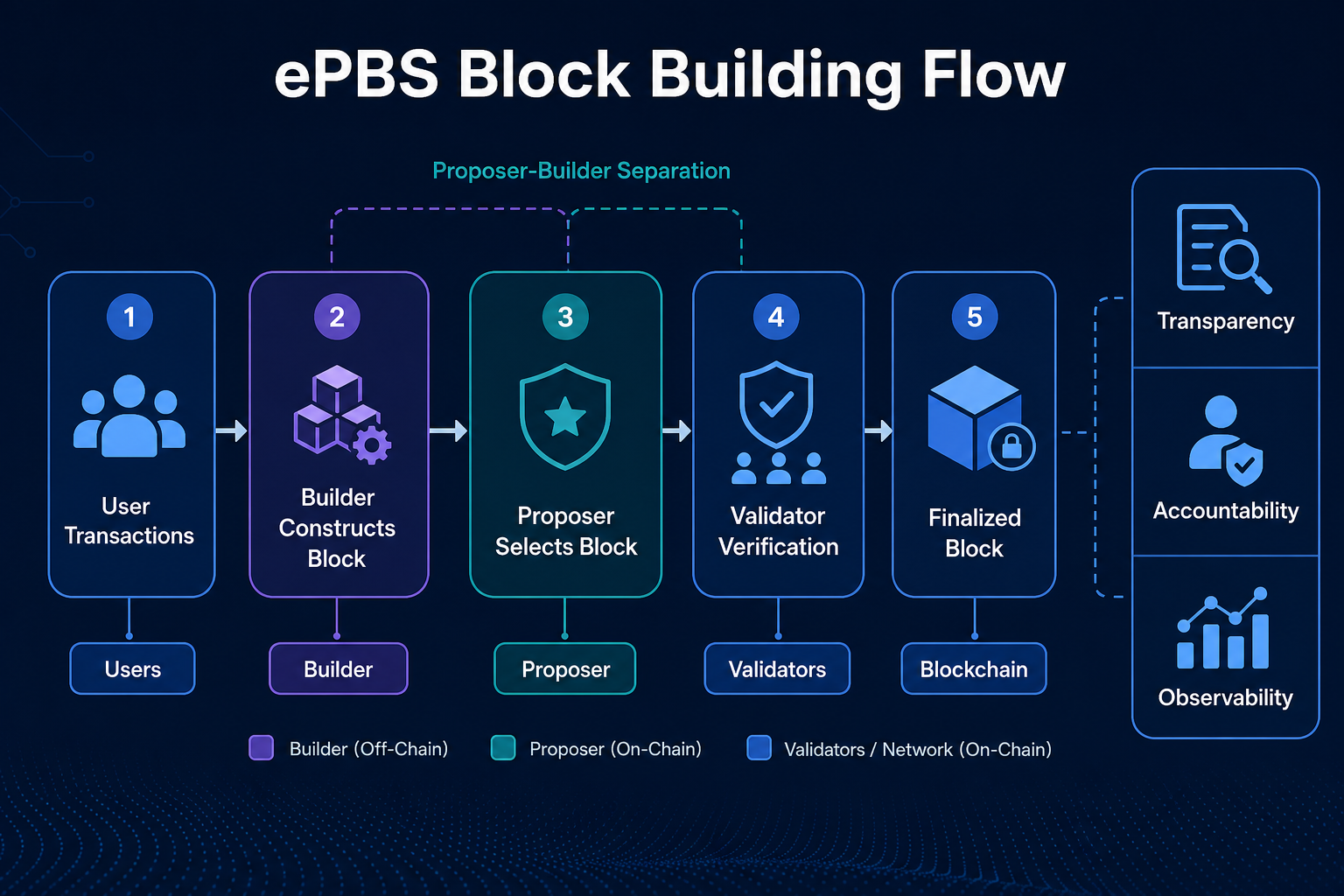 Figure 1. ePBS block production flow: clear separation of proposer and builder responsibilities.
How Will ePBS Affect Network Stability and Execution Expectations?
With clearer responsibility boundaries, network behavior becomes more interpretable, and alerting rules can target construction delays, proposal anomalies, and validation failures in a layered manner. DeFi protocol systems that depend on block production cadence—such as liquidation bots and aggregation routers—must closely examine behavioral changes before and after the upgrade; this aligns with the metric reset requirements described in Glamsterdam’s impact on DApps.
Assessing network stability should go beyond average block times to include tail latency and reorg frequency. If ePBS can localize anomalies to specific process stages, it will, over time, help reduce the impact of “unexplainable jitter” on ecosystem confidence.
What Are the Potential Impacts of ePBS on Validator Rewards and the MEV Ecosystem?
ePBS may alter both the reward structure and risk exposure for validators along the collaboration chain. Rewards depend not only on visible distribution ratios but also on execution stability, anomaly rates, participation thresholds, and competitive dynamics. Validators must reassess their operational strategies under the new model and ensure alignment with layered monitoring, window guarding, and rollback conditions as outlined in the node upgrade preparation checklist.
For the MEV ecosystem, the most significant change is the behavioral constraint imposed by standardized collaboration interfaces. Clearer rules reduce gray areas for manipulation but also accelerate strategy evolution. The primary focus should be on long-term stability and verifiability rather than short-term profit fluctuations. Research groups and node operators can use public testnet data to monitor ePBS’s impact on ordering and construction behaviors.
What Implementation Challenges Does ePBS Face?
First, ensuring client implementation consistency is a major challenge. A unified design does not guarantee consistent implementation across clients; rigorous cross-client testing and regression remain essential. Second, ecosystem education is necessary—application and node teams must understand the new boundaries to avoid misattributing systemic changes to isolated failures.
Third, managing the upgrade window is critical. Even with full technical readiness, mainnet deployment timing must consider network load, ecosystem synchronization, and monitoring capabilities. Launch is only the beginning; ongoing observation and parameter tuning are equally important. Adjustments to deployment windows based on test feedback are standard engineering governance and do not necessarily signal a change in mechanism direction.
Summary
The core value of ePBS (EIP-7732) is elevating block production collaboration from “operable” to “interpretable, monitorable, and auditable.” It does not promise a single-point breakthrough but reduces structural risk by clarifying lines of responsibility. For upgrade participants, the priority is to convert mechanism changes into actionable operations and development strategies.
FAQ
What Is the Most Fundamental Change in ePBS (EIP-7732)?
The key change is the protocol-level clarification of the collaboration boundary between proposer and builder. ePBS emphasizes verifiable responsibilities and traceable exceptions, in contrast to models that rely on external conventions.
Will ePBS Directly Lead to Significant Fee Reductions?
ePBS primarily addresses collaboration structure and stability governance; fee outcomes still depend on network demand and implementation quality. It should not be seen as a standalone fee reduction mechanism.
How Are ePBS and BAL (EIP-7928) Related?
ePBS focuses on the boundaries of block production collaboration, while BAL addresses constraints on pre-execution state access. Each operates at a different layer, and together they form a complementary framework in Glamsterdam.
Why Should Validators Pay Special Attention to ePBS?
Because it will impact collaboration paths, monitoring metrics, and approaches to risk and reward assessment. Validators who fail to update their operational frameworks may face delayed responses after the upgrade.
Do ePBS and the Dencun Upgrade Address the Same Issues?
No. Dencun focuses on capacity and usability improvements, while ePBS targets structural reforms in block production collaboration. They serve different roles within the same roadmap and should not be evaluated using identical criteria.