Callout boards and KOL panels now sit in the discovery layer of meme coin trading platforms, making signal literacy a practical skill for intermediate traders. Unlike a named stock recommendation, a Solana meme coin callout carries no disclosure duty, so one post can be conviction or paid promotion.
One asymmetry governs the rest: a KOL post is marketing, a KOL wallet is evidence. Buying before a post, exiting without one, and unpurchased paid mentions stay invisible on a timeline.
Key Takeaways
- A crypto callout is a public token mention with a contract address; a KOL is defined by market influence, not followers.
- Callouts move small-cap meme coins because thin order books turn a few hundred buyers into a supply shock.
- A KOL post is marketing and a KOL wallet is evidence, so on-chain confirmation outranks social conviction.
- Callout and KOL panels aggregate attention and activity; they neither verify nor endorse a token.
What is a callout in crypto?
A callout is a public naming of a token, typically with the contract address (CA) attached so followers can trade it immediately. The format is low-friction: a ticker, a CA, and a short thesis on X, Telegram, or YouTube.
The contract address matters more than the ticker, because meme coin tickers are unrestricted and duplicated freely. Callouts also differ from broader crypto signals: with no entry, exit, or sizing specified, a callout transfers attention, not a plan.
Callout format decides how much of a call can be checked. A bare contract address post carries no argument to test, leaving verification to the reader, while a thread stating holder distribution, liquidity depth, or a narrative thesis is auditable, since each claim can be checked on-chain.
Closed venues weaken the record. A call inside a Telegram or paid alpha group leaves no public timestamp outsiders can inspect, and forwarded screenshots can be cropped or backdated. A livestream call is timestamped by the broadcast, yet a deleted recording erases it.
What are KOL (key opinion leaders) signals and where do they come from?
KOL signals come from accounts whose token mentions reliably shift trading behavior. The term KOL, short for key opinion leader, entered crypto from Asian marketing vocabulary, but in the crypto world it also refers to credible key opinion leaders and opinion leaders whose knowledge shapes sentiment in the broader blockchain industry, not just a borrowed label. In Solana meme coin trading, it names a narrower role: an account whose mentions work as tradeable input, judged by market influence rather than followers.
Four types exist, and type predicts signal quality: macro analysts, technical traders, project researchers, and promotional accounts paid for mentions, where conflicts concentrate. Stronger thought leaders and other leaders in this niche are often developers or educators, and they educate their audience in ways that help position projects within the serious Web3 ecosystem. By contrast, crypto influencers often prioritize reach and entertainment over expertise, while KOL influence rests more on expertise. Macro fluency does not qualify an account to vouch for a micro-cap token, and the FTC's disclosures 101 for social media influencers requires disclosure of paid relationships.
The signal forms on a timeline that begins before the public post: a small X community is created; a KOL joins it, a behavioral pre-call signal visible to anyone tracking membership; the contract address appears inside that community, making the token identifiable while attention stays contained; the public callout comes last.
Information lead and verifiability move in opposite directions: the earliest stage offers the largest lead and nothing to check, since no contract address exists yet, while by the public callout the address is verifiable and the lead is gone.
How does a callout move a meme coin's price?
A callout moves price through a short mechanical sequence, not through fundamentals:
-
A KOL posts a token with its contract address.
-
Followers buy inside the same narrow time window.
-
The order book is thin, so a few hundred buyers create a supply shock.
-
The move attracts momentum traders and bots scanning for velocity.
-
The loop reinforces itself until attention rotates elsewhere.
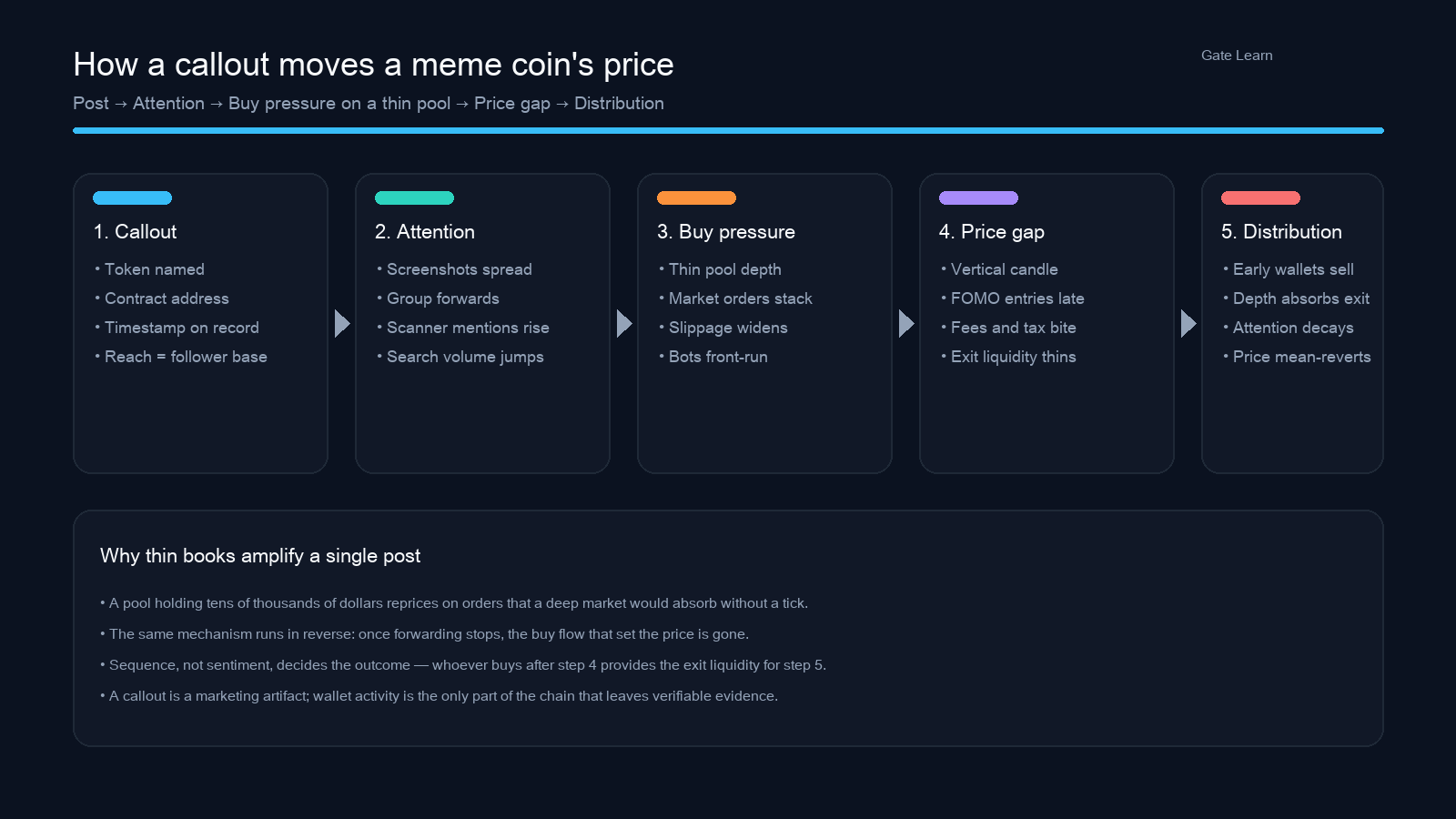
Figure 1. How a callout travels from post to attention, buy pressure on a thin pool, price gap, and distribution.
The supply shock comes from order-book depth rather than audience size. A newly launched meme coin holds a thin layer of resting sell orders near the traded price, so incoming buys consume the available asks and step up through higher levels. Volume a deep market absorbs without moving can lift a thin one by multiples.
Momentum traders and bots amplify the move without reading the callout. Screeners rank tokens by volume and price velocity while bots monitor new pairs and volume spikes, so both react to the price change rather than the post, and their buying is triggered by the buying before it.
The same thinness works in reverse once new buyers stop arriving. Few resting bids sit below the price, so selling walks the book down as fast as buying walked it up, and the loss lands on whoever entered last.
How do you verify a KOL signal on-chain?
Verification means checking whether the wallets behind a callout did what the post implies. That includes source verification and wallet behavior before acting: identify who made the claim, review their track record, and confirm whether onchain interaction matches the narrative. KolScan, Stalkchain, Dune dashboards, and block explorers expose entry timing, position size, and exits for labeled KOL addresses — the discipline whale tracking tools apply to large holders.
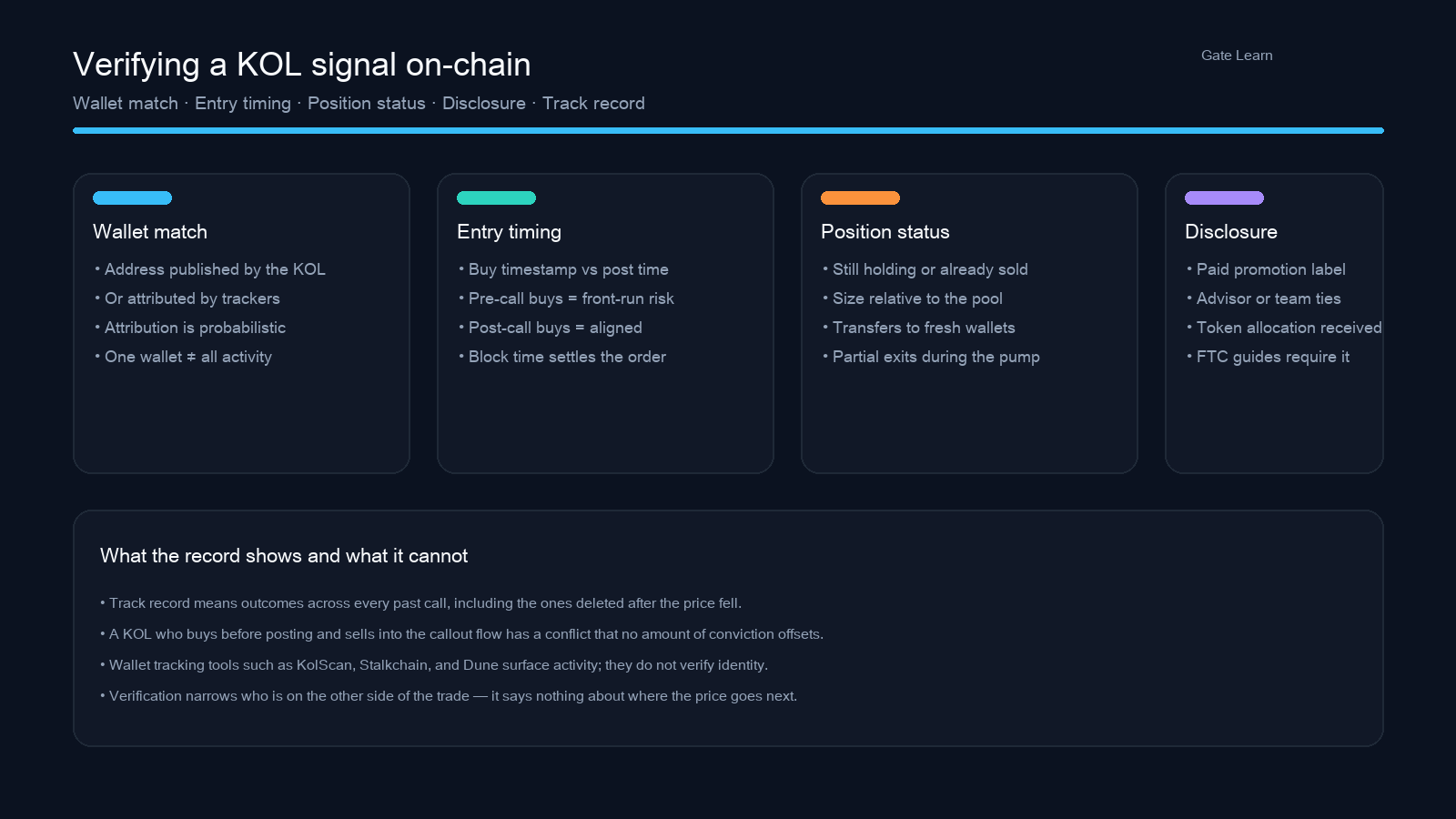
Figure 2. Four dimensions of on-chain KOL signal verification: wallet match, entry timing, position status, and disclosure.
Unique address growth is the first dimension: buying that spreads across new addresses differs from one wave, and a new-holder curve that spikes then flattens marks a burst of followers, not durable distribution. Supply concentration shows how much a few addresses control, and social heat with flat address growth warrants caution.
Wallet sequencing separates three cases a timeline cannot: a wallet that bought before the post front-ran the followers who acted on it; one that bought after moved alongside them; one that never bought points to a paid mention. Sell records then show whether the wallet distributed into the volume its own post created.
Attribution has limits: labels come from third-party tools and a KOL can trade from unlabeled wallets, so evidence of buying counts for more than its absence. Pre-call signals sit earlier, such as a KOL joining a newly created, small X community; several unrelated KOL wallets buying one token in a short window is KOL consensus, and more than three within an hour is uncommon and more meaningful. Pattern reading holds up only when callout timing is cross-referenced against on-chain data rather than treated as a standalone input.
What are the risks, track record, and conflicts of interest behind KOL calls?
Paid promotion is the structural risk, and it is rarely labeled. The FTC's endorsement guides treat undisclosed compensated endorsements as deceptive, so "not financial advice" does not remove disclosure duties, yet enforcement reaches a fraction of crypto callout activity.
Several conflict structures recur. Payment in tokens rather than cash ties a KOL's payoff to the price the post creates. Promotion timed inside an unlock window hands insiders liquidity to sell into. Misleading callouts can also be part of pump-and-dump schemes designed to inflate token prices before insiders exit. Coordinated accumulation across accounts before a synchronized posting window imitates organic KOL consensus, so consensus counts only when buy timestamps are checked against post timestamps. That matters because some voices carry enough weight to move flows quickly, which is what makes buy timestamps more informative than reputation.
Exit liquidity is the same problem stated structurally: followers buying after a callout supply the demand that lets earlier holders sell, so the callout redistributes value from later entrants to earlier ones, and a KOL who accumulated beforehand sits on the earlier side.
The defensible use stays narrow — a callout is a lead awaiting verification, needing one non-social confirmation such as on-chain activity, liquidity, or holder distribution, and carrying weight only where it converges with independently reached conclusions, the standard behind checking whether a meme coin is legit and doing your own research. A successful callout does not prove the caller has a repeatable edge or a sound trading process, and none of this is trading advice.
Callout and KOL panels increasingly appear beside the order form. Gate Trenches is an exchange-based on-chain trading product: a Gate account searches a token by name or pastes a contract address to trade on-chain assets, needing no separate wallet, private keys, or manual bridging. Its Callout panel, KOL panel, and active-account display share the order-form interface, making it a platform that consolidates communications, materials, and activity tracking around token discovery in the signal-and-execution-on-one-screen category.
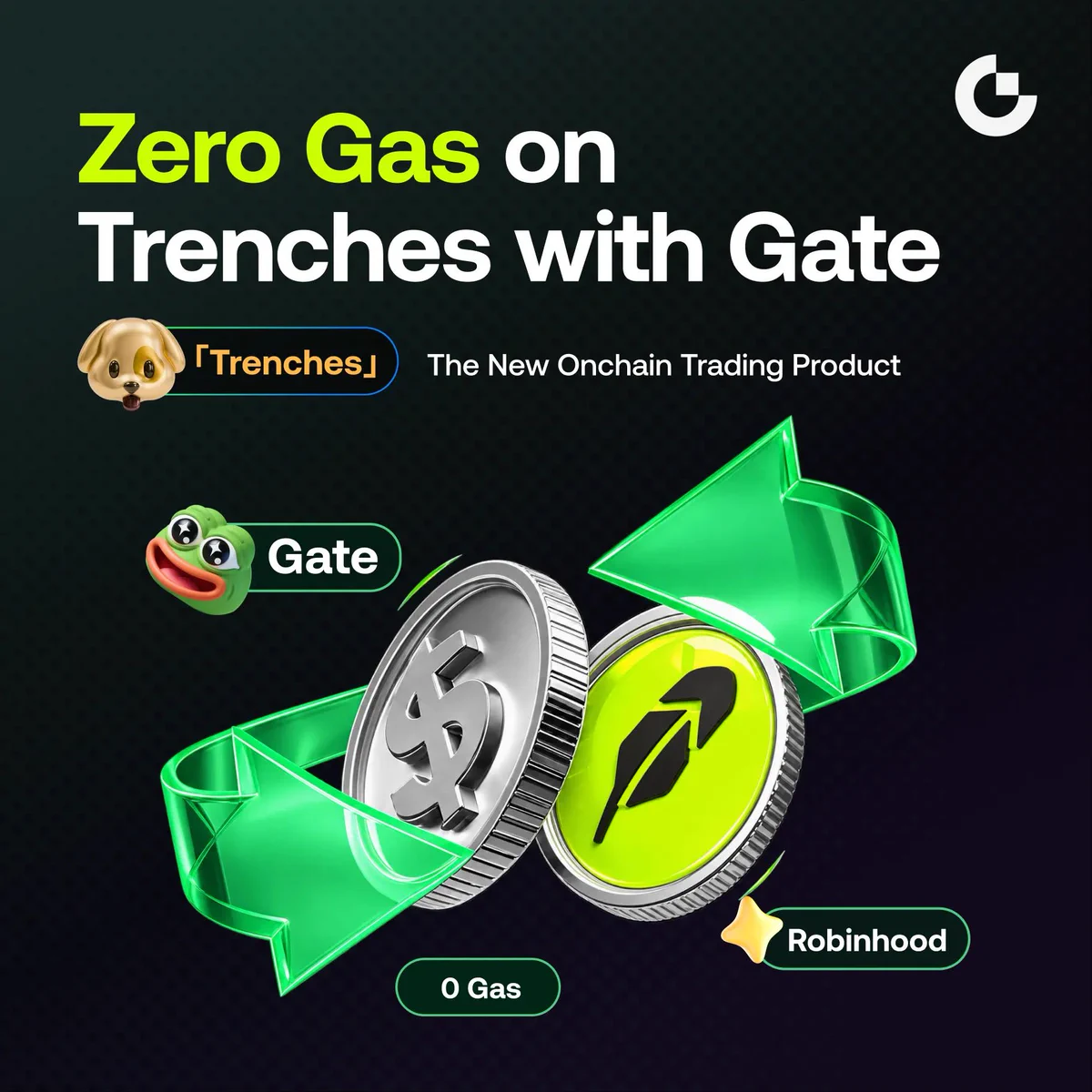
Gate Trenches spans more than a dozen networks: Robinhood Chain, Solana, Ethereum, Gate Layer, BNB Chain, Base, SUI, Arbitrum, World Chain, Avalanche, Polygon, Linea, ZKsync, Optimism, and Berachain. At launch on September 7, 2026, trading fees were 0.5% on both sides, with a limited-time gas-free arrangement for Robinhood Chain assets, per the Gate announcement; fees and chain coverage change, so the announcement and product page govern.
A panel of this kind reads as a display of attention distribution: it ranks which tokens are discussed and traded most inside one venue by activity rather than quality, and says nothing about supply concentration, liquidity durability, or who is selling into it. For a team, such tools can help track engagement and compare groups of active accounts, including who seems interested, but they do not validate projects.
One boundary stays fixed: a callout or KOL panel concentrates discussion and trading activity into one view, which is neither verification nor endorsement of a token, even if it may raise awareness and short term visibility through these programs. It narrows a candidate set; on-chain checks decide which candidates survive, and whatever a panel surfaces is already crowded.
Summary
Crypto callouts are public token mentions carrying contract addresses, and KOL signals are the subset with enough market influence to move thin order books. Format, venue, and the timeline from a new community to a public post decide how much can be audited and how much lead remains. The mechanism is a supply shock from synchronized buying, not a valuation event, and wallet evidence separates a verifiable lead from a marketing post.
FAQ
What does callout mean in crypto?
A callout in crypto is a public post naming a token with its contract address so followers can trade it immediately. Unlike broader market signals, some callouts add more detail, for example timing or thesis, but many still omit structured trade levels; duplicated meme coin tickers make that address decisive, and the venue — X, a Telegram group, or a livestream — decides how much an outsider can later verify. Treat any callout as a prompt to verify, not a complete instruction.
What is a KOL in crypto trading?
A KOL, or key opinion leader, is an account whose token mentions are treated as trading input, and stronger KOLs can collaborate with communities to influence behavior through informed recommendations rather than simple visibility. The qualifying test is market influence, not followers, so a mid-sized account that reliably moves order books ranks as a KOL while a larger account that does not is closer to commentary. The most effective KOL partnerships support protocol adoption and community growth when the campaign narrative aligns with the projects, because a clear strategy, credible partner fit, long-term vision, and disciplined development all shape measurable success.
Are KOL calls profitable?
Profitability cannot be read from a post: the post is marketing, the KOL wallet is the evidence. Entry before posting, silent exits, and unpurchased paid mentions appear only on-chain. Wallet history, not call history, is the measurable record. In some sectors, especially DeFi, profitable-seeming KOL activity can coincide with growth events such as token launches that raise Total Value Locked (TVL), which still does not by itself prove lasting value.
Is a KOL the same as an influencer?
Influencer describes audience scale; KOL describes market influence over trading behavior in a token. Influencers are often useful for awareness and short bursts of attention, while KOLs tend to carry more expert credibility; a large following can exist without KOL status, and a smaller account with concentrated trader attention can qualify. Order-book response, not reach, separates them. bitboy crypto is a useful example of a large crypto influencer profile.
How do you verify a KOL signal on-chain?
Trace the wallets: KolScan, Stalkchain, Dune dashboards, and block explorers reveal when a KOL address entered and whether it exited. Check unique address growth and the new-holder curve too. Labels are incomplete, so evidence of buying outweighs its absence.