For crypto scalpers using 1-minute to 5-minute charts, these settings help identify short-term price movements, potential entry and exit points, and trend direction. However, faster signals also create more market noise, making confirmation and risk management essential.
Key Takeaways
-
The 5 EMA and 9 EMA respond quickly to small price movements, making them useful for short-term scalping.
-
The 9 EMA and 21 EMA combination helps identify momentum shifts through crossovers and pullbacks.
-
The 50 EMA acts as a broader trend filter, while the 200 EMA provides additional directional context.
-
Combining EMA signals with RSI, MACD, volume or Bollinger Bands can help reduce false signals.
-
EMA settings work more consistently in trending markets than in range-bound conditions, but no configuration guarantees profitable trades.
What Is an Exponential Moving Average (EMA)?
An exponential moving average (EMA) is a technical indicator that tracks average prices while giving greater importance to recent price data. It reacts faster to price shifts than a simple moving average (SMA), making it useful for scalping strategies.
An SMA assigns equal weight to prices within its calculation window. An EMA applies exponentially declining weights, allowing recent closing prices to influence the indicator more strongly.
According to TradingView's EMA documentation, the standard EMA calculation uses:
EMA = (Closing Price × Multiplier) + (Previous EMA × (1 − Multiplier))
Where:
Multiplier = 2 ÷ (EMA Period + 1)
A shorter period increases sensitivity to price fluctuations. Longer periods smooth price data more heavily, helping reveal trends without reacting to every candle.
For instance, the 9 EMA tracks short-term price momentum, while the 50 EMA provides a broader perspective on market direction.
Best EMA Settings for Scalping Crypto on Minute Charts
The most widely used moving average settings for crypto scalping depend on execution speed, trend confirmation requirements and market structure.
| EMA Settings |
Chart Timeframe |
Primary Use |
| 5 EMA + 9 EMA |
1-minute |
Fast momentum entries |
| 9 EMA + 21 EMA |
1–3-minute |
Crossover signals |
| 9 EMA + 21 EMA + 50 EMA |
3–5-minute |
Trend-following scalping |
| 20 EMA + 50 EMA |
5–15-minute |
Intraday trend confirmation |
| 9 EMA + 21 EMA + 200 EMA |
5-minute |
Broader directional filtering |
These are conventional starting configurations, not statistically proven optimal settings. Their effectiveness varies across cryptocurrencies, volatility regimes and transaction costs.
5 EMA and 9 EMA for Fast Price Movements
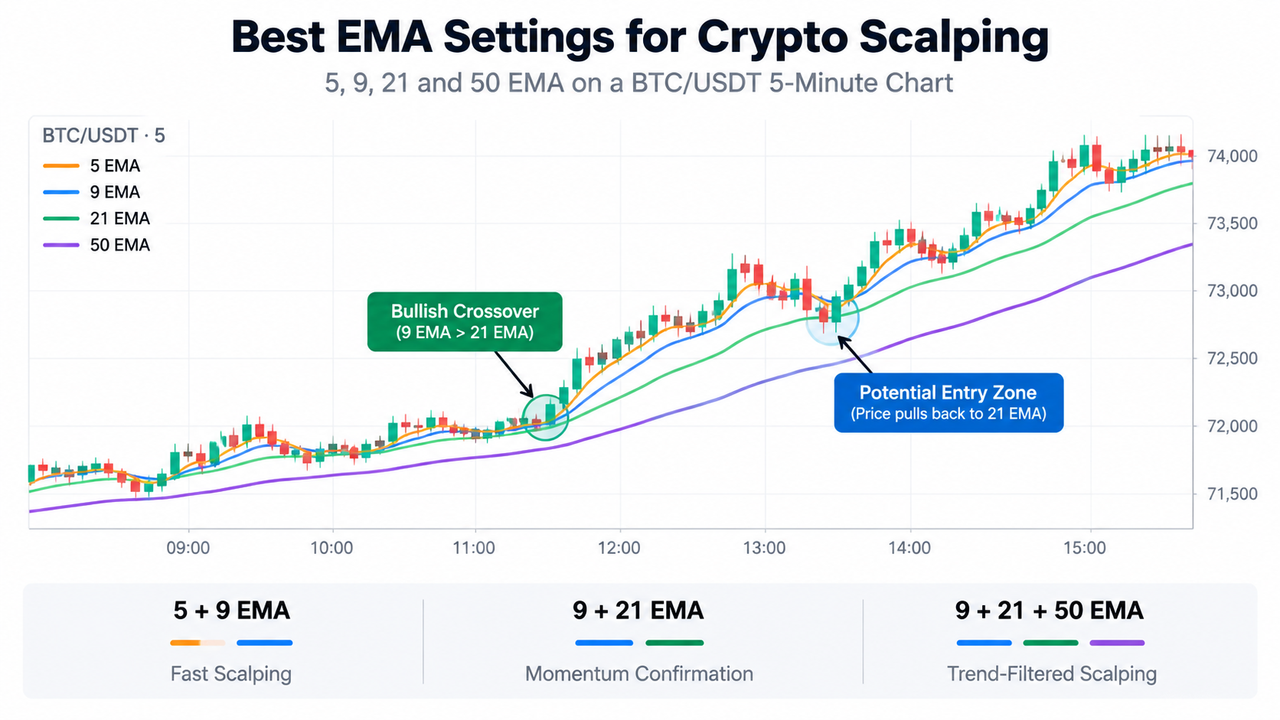
The 5 EMA responds rapidly to the latest candles, while the 9 EMA provides a slightly smoother reference.
When the 5 EMA crosses above the 9 EMA, scalpers may interpret the move as strengthening bullish momentum. A downward crossover suggests weakening short-term buying pressure.
The catch is sensitivity. On 1-minute charts, volatility spikes frequently create misleading crossovers, especially when price remains range-bound.
9 EMA and 21 EMA for Trend Confirmation
The 9/21 combination is a common choice for balancing speed with confirmation.
A 9 EMA crossing above the 21 EMA suggests bullish momentum. A cross below indicates bearish momentum. Neither signal establishes that a sustainable trend reversal has occurred.
Many traders prefer entries after price pulls toward the 21 EMA and subsequently resumes its previous direction.
This approach combines crossover information with price action rather than relying on a single buy or sell signal.
9 EMA, 21 EMA and 50 EMA for Three-Layer Analysis
Adding the 50 EMA creates a three-EMA setup that separates entry timing from overall trend identification.
A bullish alignment appears when:
Price > 9 EMA > 21 EMA > 50 EMA
The reverse arrangement indicates bearish alignment.
The 50 EMA filters trades against the broader intraday trend, while the 9 EMA helps identify immediate momentum shifts.
The relationship between EMA 9, EMA 20 and EMA 50 follows similar principles, although changing the middle parameter slightly alters crossover timing.
How Market Volatility Changes EMA Settings
Market volatility affects whether short or long EMA parameters are practical.
In trending markets, upward-sloping moving averages often indicate an uptrend, while downward slopes suggest weakening price action or a downtrend.
EMAs may also act as dynamic support and resistance. If price approaches a rising 21 EMA, holds nearby and rebounds, traders may interpret the reaction as potential trend continuation.
During sideways markets, repeated price crosses can create unreliable sell signals and premature entries.
A 200 EMA can provide additional session context, although its interpretation depends on the selected timeframe. Traders may also compare EMA behavior with volatility indicators for crypto trading before choosing parameters.
How to Use EMA Signals for Entry and Exit Points
A practical EMA scalping strategy combines trend direction, pullback behavior and predetermined exit strategies.
Consider a hypothetical BTC/USDT trade on a 3-minute chart.
-
Identify direction: Confirm that price and the 9 EMA remain above rising 21 and 50 EMAs.
-
Wait for a pullback: Watch price approach the 9 or 21 EMA without breaking the previous swing low.
-
Confirm momentum: Look for a bullish candle close and renewed upward movement.
-
Define risk: Place a stop-loss below a relevant structural level, accounting for volatility.
-
Plan the exit: Use nearby resistance, a predetermined reward-to-risk target or weakening momentum as potential exit points.
A trader can examine these conditions on the Gate.com BTC/USDT spot chart, comparing EMA alignment with current candles and trading volume.
A price cross alone isn't sufficient. Market structure, liquidity and transaction costs determine whether the entry and exit offer a reasonable opportunity.
Combining Exponential Moving Averages With Other Indicators
EMAs primarily track trend direction. Additional technical indicators can help evaluate momentum, market sentiment and volatility.
RSI: The Relative Strength Index identifies overbought or oversold conditions. RSI above 70 or below 30 may signal stretched momentum, although strong trends can maintain extreme readings.
MACD: The Moving Average Convergence Divergence indicator compares moving averages to evaluate momentum direction. Agreement between MACD and EMA signals can strengthen trend confirmation, although both rely on historical price data.
Bollinger Bands: These measure volatility around a moving average. Expanding bands can indicate increasing price dispersion, while narrowing bands suggest compression.
Trading volume: Rising volume during a price breakout can add confirmation to an EMA signal. The relationship between volume and crypto trend confirmation helps distinguish participation from price movement alone.
Combining indicators can reduce false signals under some conditions, but correlated indicators may simply repeat the same information.
EMA vs. Other Moving Averages for Intraday Trading
Different moving averages handle smoothing and responsiveness differently.
-
SMA: Assigns equal weight to observations within its calculation period.
-
WMA: Uses linearly increasing weights for more recent prices.
-
HMA: Combines weighted averages to reduce lag while retaining smoothness.
-
ALMA: Applies Gaussian weighting to smooth price data and control responsiveness.
The WMA versus EMA approach to scalping illustrates how weighting methods change indicator behavior.
EMA remains popular because it balances responsiveness with relatively simple moving average settings. The ideal choice still depends on personal preference, historical testing and market conditions.
Risk Management When Scalping With EMAs
EMA-based scalping exposes traders to frequent signals, sudden volatility spikes and execution costs.
Transaction fees and slippage can consume much of the expected profit from quick trades. Tight stop-loss orders can limit planned exposure, but may also trigger during normal fluctuations.
The U.S. Securities and Exchange Commission's order-type guidance explains why stop orders do not guarantee a particular execution price. Crypto venues have their own execution rules.
Proper position sizing should reflect stop distance, account size and risk tolerance. Trading psychology matters too: chasing crossovers after missed entries can lead to impulsive decisions.
Diversifying exposure across assets may reduce concentration risk, although correlated cryptocurrencies can decline together.
Conclusion
The best EMA settings for scalping crypto are typically 5/9 for faster signals, 9/21 for momentum-based entries, and 9/21/50 for trend-filtered trades.
The 50 EMA helps establish overall market direction, while shorter averages identify possible entry and exit opportunities.
No single configuration works across every cryptocurrency or market condition. Effective scalping requires price-action confirmation, realistic execution costs, disciplined risk management and evaluation against historical data.
Frequently Asked Questions
What are the best EMA settings for 1-minute crypto scalping?
The 5 EMA and 9 EMA are common starting settings for 1-minute scalping because they react quickly to small price movements. However, they are highly sensitive to market noise, so additional trend confirmation is useful.
Is the 9 EMA or 21 EMA better for scalping?
The 9 EMA responds faster and is generally used for entry timing. The 21 EMA smooths more fluctuations and helps identify pullback zones and short-term trend direction. Many scalpers combine both.
Is the 50 EMA useful for scalping crypto?
Yes. The 50 EMA commonly acts as an intraday trend filter rather than a precise entry indicator. Its slope and position relative to price can help identify the prevailing market bias.
Should scalpers use the 200 EMA?
The 200 EMA can identify broader trend direction on the selected chart. However, it reacts slowly and should not be treated as a standalone entry signal.
What are the best EMA settings for 5-minute day trading?
The 9/21/50 combination is a practical starting point for 5-minute trading. Traders seeking fewer short-term signals may prefer 20/50, particularly when evaluating broader intraday price movements.
Can EMA settings predict trend reversals?
No. EMA crossovers identify changes in historical price momentum and may lag actual turning points. Price structure, volume and complementary momentum indicators can provide additional context, but cannot guarantee reversal predictions.
Disclaimer
This content is for educational purposes only and does not constitute financial or investment advice. Cryptocurrency trading involves substantial risk, including rapid price changes, liquidity constraints, fees and slippage. Technical indicators and historical performance do not guarantee future results. Product availability and trading rules may vary by jurisdiction.