Within the AKEDO (AKE) ecosystem, creator monetization is structured as a multi-path system—not just a single play-to-earn cycle. The model integrates advertiser engagement, protocol revenue sharing, platform ad revenue, and $AKE incentives, all running concurrently. To fully understand the creator-side economic logic, it’s essential to know how these four monetization paths are activated, how fees are settled, and how the Launchpad facilitates content tokenization.
Traditional GameFi models typically depend on token inflation or gameplay rewards for revenue. In contrast, AKEDO unifies branded content games, protocol revenue recycling, and platform ad pools, enabling creator output to connect simultaneously with advertisers and the protocol layer. The $AKE tokenomics further close the loop by weaving together prompt and publish fees, staking revenue sharing, and new token LP pairing.
From an on-chain digital asset perspective, monetization hinges on content quality, audience structure, and transparent disclosure rules, rather than fixed yields. Each monetization path has its own mechanics, fee parameters, and risk boundaries, which should be evaluated alongside the whitepaper’s Overview and Tokenomics.
What are the four monetization paths?
The whitepaper Overview identifies four parallel monetization paths for creators: Advertiser-Related Games, Protocol Revenue Sharing, Platform Advertising Revenue, and $AKE Incentives. These paths can be combined, with settlement criteria and ratios determined by platform disclosures.
| Path |
Key Mechanism |
Revenue Trigger |
| Advertiser-Related Games |
Branded content embedded in gameplay |
Ad engagement (e.g., clicks) |
| Protocol Revenue Sharing |
Protocol income shared with creators |
Protocol-side income |
| Platform Advertising Revenue |
Share of platform ad revenue pool |
Platform ad settlement |
| $AKE Incentives |
Token rewards for ecosystem contribution |
Matched to contribution and incentive rules |
These four paths correspond to different economic segments: content exposure, protocol revenue recycling, platform ad revenue, and token incentives. The first three are primarily settled in fiat or protocol income, while the fourth is settled in $AKE. Creators can leverage multiple paths, but each requires verifiable engagement, clear disclosure rules, and smart contract execution.
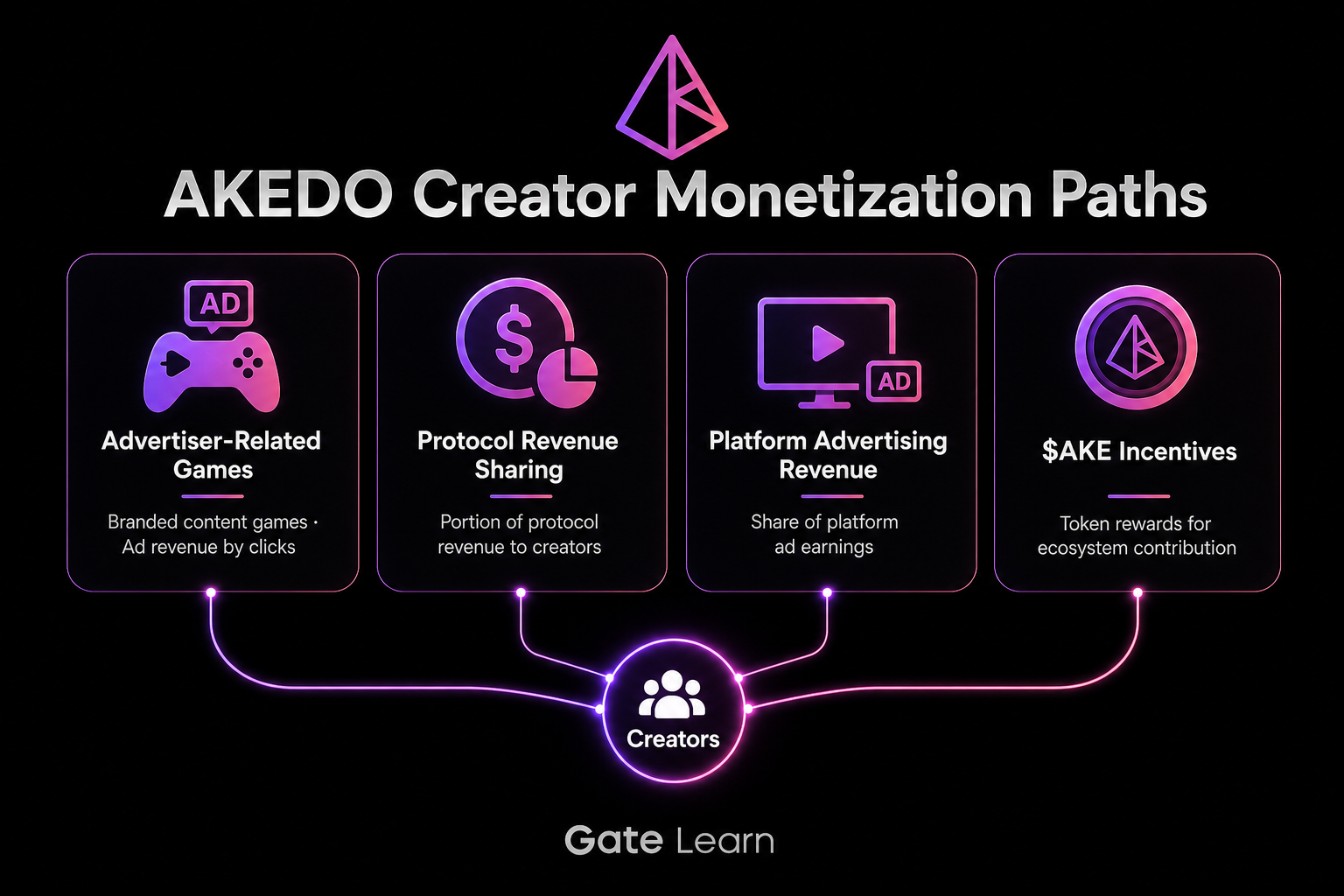 Figure 1. The four AKEDO creator monetization paths: branded ad games, protocol revenue sharing, platform ad revenue, and $AKE incentives converging to creators.
How does the advertiser-customized game mechanism work?
Advertiser-Related Games are games created by users that incorporate branded content, generating ad revenue based on engagement metrics such as clicks. The core principle is “playable content as a vehicle for brand exposure,” rather than static banners—players interact with brand elements within the game, and engagement behaviors are part of the billing model.
This path requires creators to seamlessly weave brand messaging into gameplay and storytelling without compromising playability. The volume and quality of traffic and clicks impact overall revenue; platform compliance checks and content reviews determine whether a game qualifies for the ad pool. Compared to pure entertainment games, branded games require stricter alignment with brand guidelines and engagement standards.
Protocol Revenue Sharing allocates a portion of protocol income to reward and incentivize creators, while Platform Advertising Revenue allows creators to share in the platform’s ad revenue pool. Protocol revenue is tied to core protocol cash flows, whereas platform ad revenue depends on advertising operations—these are distinct and may operate in parallel.
Protocol revenue sharing links creator contributions directly to protocol income; platform ad revenue sharing is a secondary distribution from the ad pool. Eligibility, distribution ratios, and payment schedules are governed by public rules. It’s important to distinguish these mechanisms, as staking-related protocol fee splits are primarily allocated to stakers and burning, not directly to creator ad revenue.
How are $AKE incentives awarded? Are they the same as staking rewards?
$AKE Incentives are distributed to creators who drive platform growth, paid out as token rewards. According to the whitepaper, about 31.5% of the community allocation is reserved for creators, with around 8% specifically for creator rewards; release schedules are subject to official disclosures.
Staking rewards are a separate utility: users who stake AKE share in protocol fees, which are split approximately 33% to the platform, 33% to stakers, and 33% burned. Both creator incentives and staking rewards involve $AKE, but eligibility and triggers differ: creator incentives are based on ecosystem contribution and creator rules, while staking rewards depend on staking activity and protocol fee volume.
What is the relationship with content assetization via Launchpad?
The Creator Launchpad provides tools for aggregating games and issuing tokens with one click, enabling content to be tokenized. Newly issued tokens are typically paired with AKE in the liquidity pool, establishing a “creation output—token discovery—$AKE LP” pathway. While this is similar in concept to the tokenization mechanisms seen in platforms like pump.fun, the implementation, risk structure, and compliance boundaries differ; no yield or investment superiority is implied.
The Launchpad doesn’t replace the four monetization paths—instead, it offers an additional route for content tokenization. Game aggregation, bonding curve discovery, and LP pairing introduce volatility and liquidity risks. Creators must distinguish between revenue from ads/protocol sharing and market price volatility following token issuance—these are fundamentally different economic outcomes. The ecosystem’s Adodo and AKEDOG NFT projects provide assetization from the pet and card asset side, complementing but distinct from Launchpad token issuance.
Compared to AKEDO vs. traditional GameFi, which relies on long-term professional development and a single play-to-earn cycle, AKEDO integrates natural language creation, ad revenue sharing, and Launchpad tokenization within a unified creator funnel. This results in more diversified revenue streams, heavily dependent on traffic and disclosure rules.
What fees and rules must creators confirm?
AI Creation tools require creators to pay in AKE for prompts and publishing: approximately $0.10 per prompt and $10 per publish. Fees are settled in AKE, with the actual number of tokens determined by exchange rates and platform display. Before publishing, creators should verify their balance, publishing status, and whether the work qualifies for revenue sharing or incentive pools.
| Item |
Public Parameter |
Description |
| Prompt |
~$0.10 per use |
Paid in $AKE |
| Publish |
~$10 per use |
Paid in $AKE |
| Protocol fee split |
~33% / 33% / 33% |
Platform / staker / burn |
| New token liquidity |
Paired with $AKE LP |
Launchpad issuance |
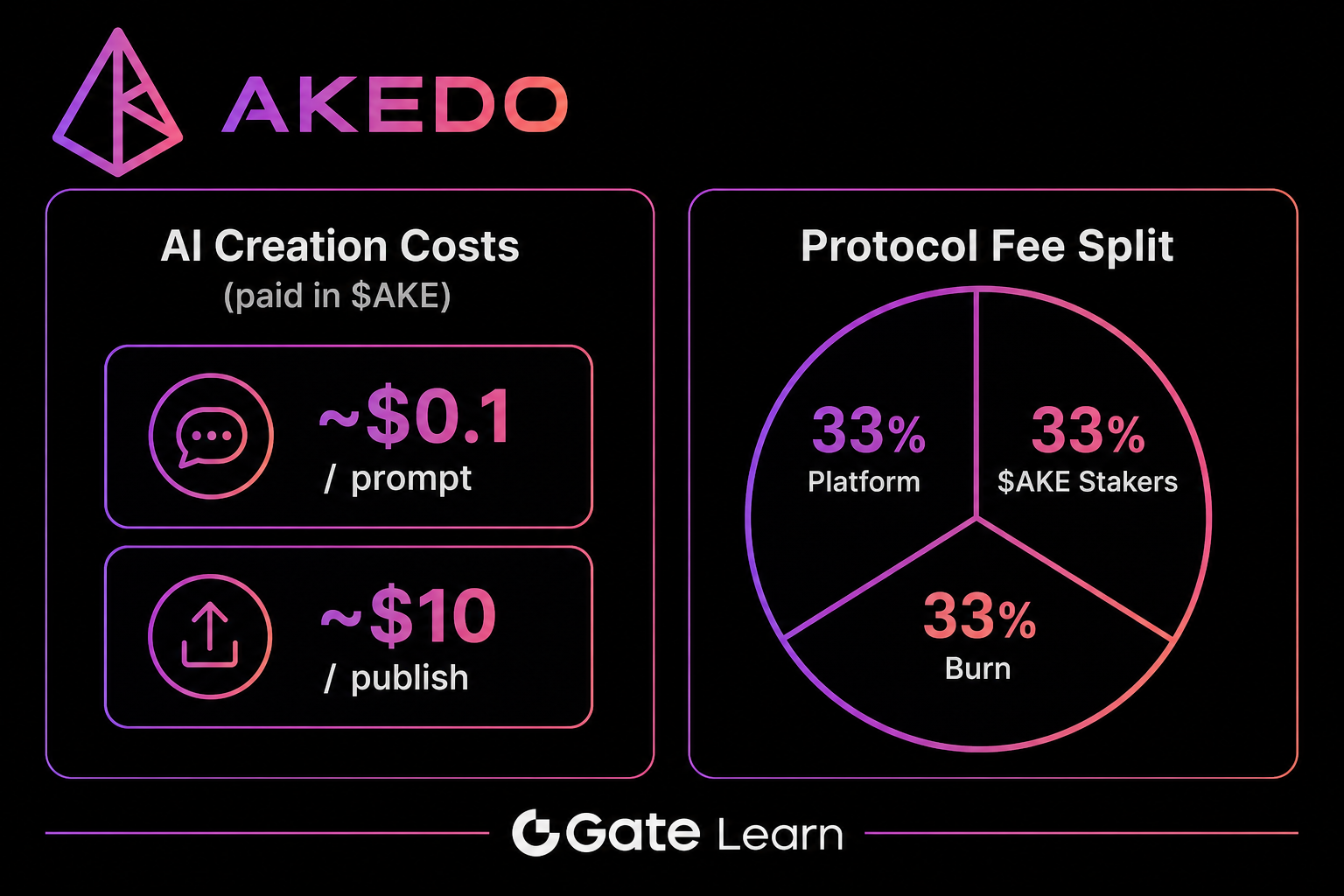 Figure 2. AI creation fees (about $0.10/prompt, $10/publish) and protocol fee split (platform / staker / burn, approximately 33% each).
The fee table shows a clear cost threshold for creators. Protocol fee splits mainly benefit the platform, stakers, and burning, and do not directly correspond to creator ad revenue shares. Creators should also confirm ad settlement criteria, protocol sharing eligibility, $AKE incentive requirements, and Launchpad pairing and disclosure rules.
What risks and limitations do creators face?
Advantages include parallel monetization paths—ad engagement, protocol recycling, platform ads, and token incentives can be combined; multi-agent systems lower the creation threshold, and Launchpad provides tools for content assetization. Limitations include reliance on agent output and manual iteration for content quality; revenue share size depends on traffic and disclosure rules; ad monetization is subject to brand review and engagement standards.
Risks include smart contract and key security, phishing sites and counterfeit tokens, confusion between ad revenue and protocol sharing, and volatility from Launchpad tokenization. The Telegram/TON access layer and BNB Smart Chain settlement layer may also be misinterpreted as a single account system. Each advantage, limitation, and risk should be considered independently; no yield is guaranteed.
Summary
AKEDO’s creator monetization model centers on four concurrent paths: branded ad games generate income through engagement, protocol revenue is partially allocated to creators, platform ad revenue is shared, and AKE ecosystem contributions are rewarded. Creation and publishing fees are paid in AKE (about $0.10/prompt, $10/publish); protocol fees are split roughly one-third each to the platform, stakers, and burning. Launchpad connects game aggregation and token issuance, with new tokens paired with $AKE LP, serving as content assetization tools rather than ad revenue mechanisms. Before participating, verify official sources, whitepaper, and platform rules, and distinguish between ad revenue, protocol sharing, staking utility, and token issuance risks.
FAQ
How do AKEDO creators monetize?
Monetization channels include Advertiser-Related Games (branded content games earn ad revenue through engagement), Protocol Revenue Sharing, Platform Advertising Revenue, and $AKE Incentives. These paths can be combined, with specific ratios and settlements disclosed by the platform; no fixed yield is promised.
What is $AKE used for?
$AKE is used to pay for AI creation and publishing fees (about $0.10/prompt, $10/publish), can be staked to earn a share of protocol fees, and serves as the liquidity pair for new game tokens issued via Launchpad. Protocol fees are split approximately 33% each to the platform, stakers, and burning.
How do you create and publish a game on AKEDO?
Creators enter a natural language prompt, and multi-agent collaboration generates playable content. Publishing is completed by paying a fee of about $10 (in $AKE). Before publishing, confirm your $AKE balance, project status, and eligibility for ad or incentive participation.
How does AKEDO use AI for game creation?
After describing the gameplay in natural language, World Builders, Rule Designers, Balancers, and Storytellers handle map design, mechanics, fairness, and narrative, respectively. Multi-agent collaboration outputs playable content; the whitepaper notes that the design process can be completed in about two minutes, following a vibe coding workflow.
What fees and risks should creators be aware of?
Creators should confirm $AKE costs for prompts and publishing, ad and protocol revenue sharing rules, and Launchpad issuance and liquidity risks. Additional considerations include smart contract security, counterfeit assets, and the separation of social access and mainnet settlement. This is not investment advice.