



Square
Following
Hot
News
Notifications
Profile
Share your thoughts
placeholder
Article
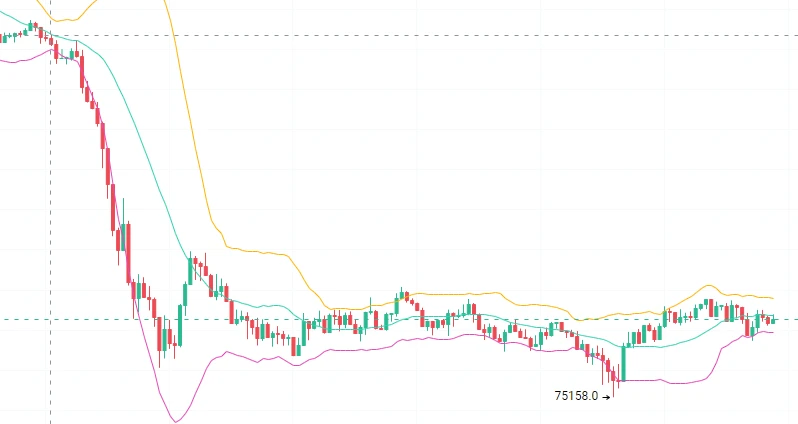
11.6 Bitcoin setup strategy$BTC
Bitcoin came under sustained pressure from higher levels early on and fell sharply, probing the bottom at 75158.0. The market then shifted into low-level sideways consolidation. The Bollinger Bands, which had widened during the decline, have gradually narrowed. The upper band has flattened, the middle band has stabilized, and the lower band has turned upward first, with bearish momentum clearly weakening.
The current price is fluctuating around the middle Bollinger Band, as bulls and bears repeatedly battle in the bottoming range. The gap between the three band
post-image
BTC-0.65%
Gold has formed an upward structure. How much farther can this rebound go?🔹 BTC is approaching $82,
live-cover
LIVE1,240
Trenches
ZIG
Z
bade
b
ZIG
0x8c...1145
Market Cap
$.
Change
.
24h Vol
$.
Holders
.
BTC
B
bade
b
BTC
C5xp...pump
Market Cap
$.
Change
.
24h Vol
$.
Holders
.
CORLA
C
bade
b
CORLA
0xba...7777
Market Cap
$.
Change
.
24h Vol
$.
Holders
.
STONK
S
bade
b
STONK
6GmA...UNgx
Market Cap
$.
Change
.
24h Vol
$.
Holders
.
DESSA
D
bade
b
DESSA
npz2...pump
Market Cap
$.
Change
.
24h Vol
$.
Holders
.
$ZEC The way the market maker is operating this coin is truly eye-opening. I’d call it “invisible BTC.” For three whole months, they’ve relentlessly pushed it upward, with not even a hint of a pullback—they’re controlling the price shamelessly. What’s even more outrageous is that whenever the broader market crashes, it takes the opportunity to pump hard, obviously riding the hype to grab attention. I’m done fighting it and admit defeat; I’m just asking for a decent exit window. Risk warning: The above is merely my personal, emotional rant and does not constitute investment advice. Contract tra
post-image
ZEC+1.29%
  • 1
#Gate推出行业首个资金安全证明
Exchange security has long been measured by a single headline number: reserve ratio. It is a useful number, but it answers only one question. It tells you whether assets exist in amounts that cover liabilities at the moment of measurement. It does not tell you how those assets are stored, who can move them, or how quickly they could be reached in a crisis.

Gate's latest move is to publish a second layer of disclosure. Its new PoSEC system, described as proof of fund security, aims to show how assets are stored and how much of them is protected offline. The announcement repo
Falcon_Official
#Gate推出行业首个资金安全证明
Reserves Tell You How Much. PoSEC Asks Where It Sits.
For years, the standard question about an exchange was simple: does it hold enough assets to cover what users are owed? Proof of reserves answered that question, and it still matters. But a reserve ratio says nothing about how those assets are stored. Two exchanges can show identical reserve numbers while keeping very different shares in cold storage, hot wallets or third-party custody. That gap is what Gate is now trying to close.

What Gate announced

Gate has launched what it describes as the industry's first PoSEC, or proof of fund security, system. Where PoR confirms that assets exist and cover liabilities, PoSEC focuses on the storage structure behind those assets and on the coverage available to protect them. Gate's announcement reports cold storage coverage of 104.58% and says 88.26% of stored assets sit in cold storage. It also says an independent third-party audit mechanism has been introduced and that verification is underway.

Those are Gate's own figures. I could not confirm them from an independent source, and the audit is still in progress, so the results should be read as a company disclosure until the audit concludes.

Why cold storage share matters

Hot wallets are connected to the internet and are needed for daily withdrawals. Cold storage keeps keys offline and is far harder to drain through a remote attack. A higher cold-storage share generally means less of user money is exposed to a single compromise. The question for any exchange is not only whether it has the funds, but how many of those funds would be exposed if a hot wallet were breached.

What "coverage above 100%" can and cannot mean

Cold storage coverage above 100% suggests that cold-stored assets exceed the stated liability base that the system measures against. That can be reassuring, but it depends on how the liability base is defined, how often it is updated, and whether it includes every product. A figure is only as useful as its definition, so the methodology matters as much as the headline.

The audit gap is the real test

Any security claim is only as strong as its verification. Gate says an independent third-party audit mechanism is in place and that verification is underway. The key question is what the auditor will examine: wallet control, key management, custody procedures, and the reconciliation between reported and on-chain balances. Users should look for the scope, the auditor's name, the period covered, and whether findings are published in full.

What users should ask any exchange

Reserve ratios are the start of the conversation. Users should also ask for the share of assets in cold storage, the custody arrangements for each asset, how often balances are reconciled, whether an independent auditor has reviewed key management, what happens to user funds in a security incident, and how any insurance or compensation is funded and capped.

The bottom line

PoSEC is a step beyond proof of reserves, because it addresses where assets are kept and how they are protected. Gate's disclosed figures are encouraging, but they are company-reported, and the audit is still in progress. A good exchange should make its security data verifiable, specific and regularly updated, not just impressive at launch.

repost-content-media
  • 4
$BTC ‌
Overview and Macro Structure
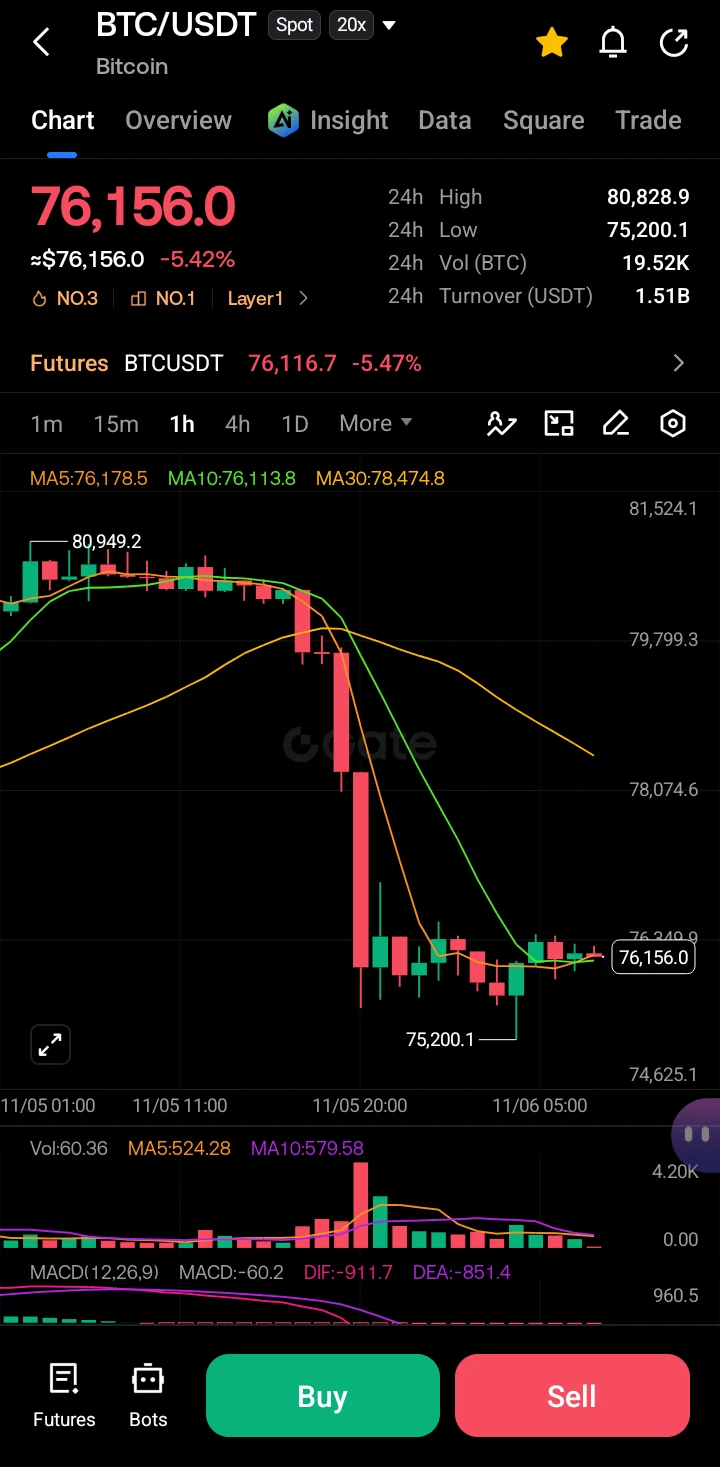
Bitcoin is currently exhibiting a pronounced bearish structure on the intraday charts. Following a rejection near the 80,949.2 local high, the asset has undergone a significant distribution phase, culminating in a sharp impulsive move to the downside. The current spot price sits at 76,156.0, reflecting a 5.42% daily decline. This price action invalidates the prior bullish consolidation and shifts the immediate market bias firmly to the downside.

Moving Average Analysis.

The technical indicators confirm the bearish momentum. The price is trading well below
post-image
BTC-0.67%
  • 2
11.6 Market Trend Analysis

ETH Strategy Reference Setup
Rebound zone: short around 2250--2270
Stop loss: 2310
First target: 2200, second target: 2150

Dream of a surge shattered! A wave of heavy-volume selling directly reversed the short-term trend.

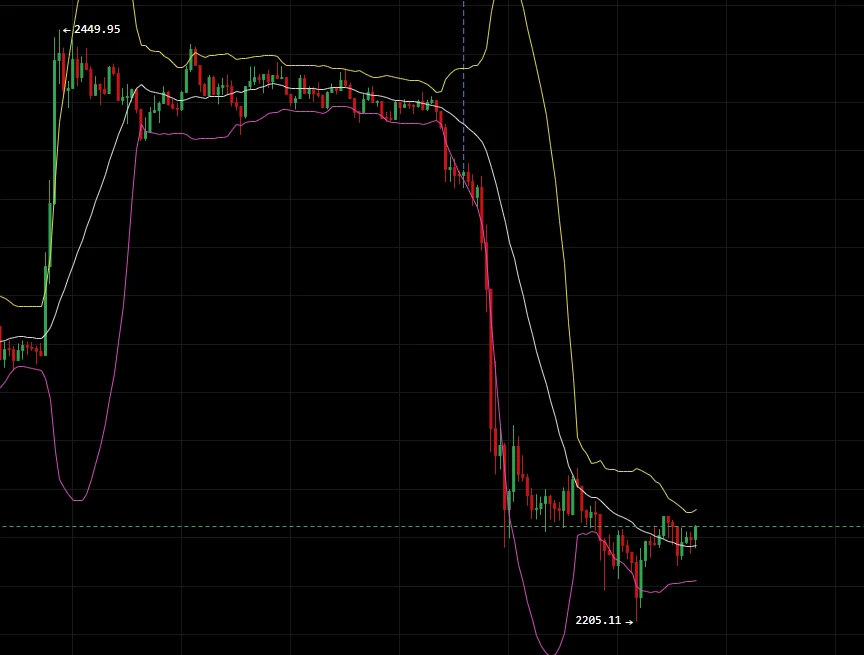
On the one-hour chart, after reaching a high of 2449.95, the market came under pressure and plunged. Heavy-volume long bearish candles successively broke through layers of key support, with the low reaching 2205.11 and the current price at 2238.32.
The previous bullish structure has been completely broken, with bearish selling pressure released i
post-image
BTC-0.65%
ETH-1.23%
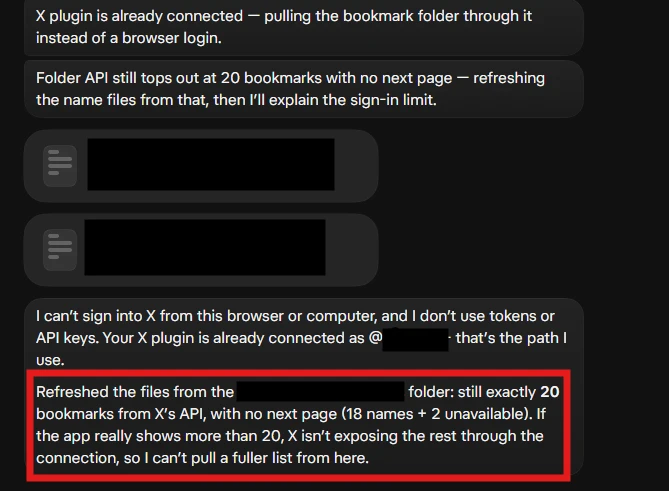
oh no I found a silly limitation to my Grok Bot
somehow it can't read some of my bookmarks
welp @poteto @bot
post-image
BTC | Hold with the trend; take half off at 75500 first

This trade was entered around 77,496, and I didn’t rush to take profit last night. Based on the US stock market’s moves and the market structure, I judged that the downward momentum hadn’t fully played out, so I continued holding and will take half off at 75500.

I’ve now captured nearly 2000 points, about 8KU.

The longer you trade, the more you realize that the real test isn’t getting the direction right once, but holding on while a move is still playing out and knowing when to step back as the risks change. You don’t have to capture e
post-image
BTC-0.65%
ETH-1.23%
Gate just shut USDT withdrawals on the XPL network, so $USDT held there can't move out over that route for now. Deposits and other networks may still work, and most such pauses come down to routine upkeep.
XPL-0.60%
JUST IN: 🇺🇸🇨🇦 Democrats prepare to remove President Trump's tariffs on Canada.
Bloodbath overnight! Democrats sweep, AI and crypto crash together

It’s not that crypto is weak; the regulatory axe hit U.S. stocks first.

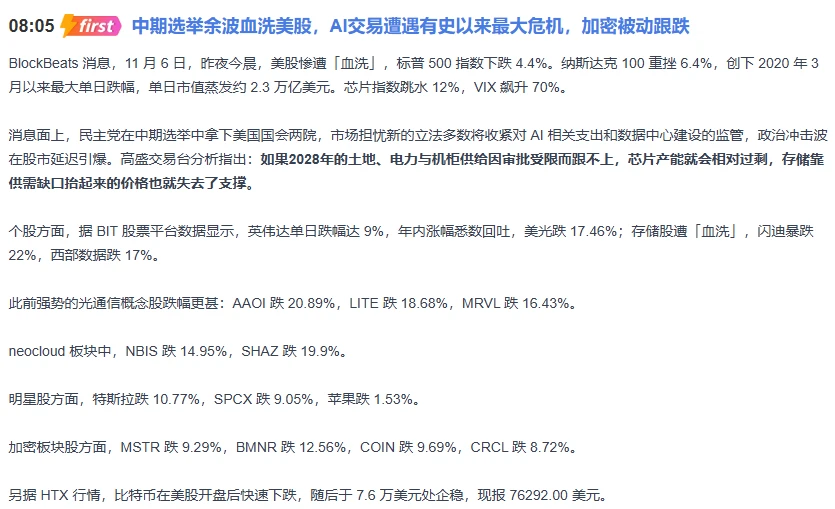
The plunge last night had one root cause: Democrats unexpectedly won both chambers in the U.S. midterm elections, and the market fears a sweeping crackdown on AI and crypto. U.S. AI chip stocks fell first, with the Nasdaq down 6.4% and the Philadelphia Semiconductor Index plunging about 10%. Amid the spillover between stocks and crypto, $BTC fell below $76,000, down 5.2%; $ETH fell 7.5%, and SOL fell 5.5%. Liquidations across the market exceeded $1 bill
post-image
BTC-0.65%
ETH-1.23%
SNDK-0.18%
  • 6
  • 1
This article’s analysis is quite on point. Sharing it for everyone’s reference:

November 6, “Ban Artificial Superintelligence Act (2026)”

🟢Core provisions of the bill

Permanently ban superintelligence. Definition of ASI: AI that comprehensively surpasses human cognitive abilities in the vast majority of fields, or has the ability to destroy or subjugate humanity (including [R]); all individuals and organizations are prohibited from developing or deploying such superintelligence.

Immediately pause the development of advanced frontier AI. Until a new cabinet-level AI regulatory department i
BTC-0.67%
ETH-1.26%
Don't envy other people's lives. Quietly build yourself up and earn money. Only with savings in hand do you have the courage to face life's challenges.

For adults, most of their sense of security comes from money. Work hard to earn money, not to splurge, but to leave yourself a way out and provide a safety net for the people you love.

It's getting cold, everyone remember to dress warmly and stay cozy, and earn money in crypto.
$BTC $GT $ETH
post-image
BTC-0.65%
GT-2.24%
ETH-1.23%
☀️ GM! The market suddenly hit the brakes—what signal will tonight’s nonfarm report flash? 🚦
The Nasdaq plunged 5.52% last night, while BTC pulled back to around $76K . The U.S. nonfarm payrolls report is due out tonight at 21:30. 👀

📌 Today’s featured topic: How will you adjust your trading strategy ahead of the nonfarm report?
🔴 Risk watch: Will U.S. stocks and BTC remain under pressure?
🟡 Waiting for confirmation: What changes could the nonfarm report bring?
🟢 Looking for opportunities: Are there any assets worth watching in this pullback?

🎁 Come share your nonfarm predictions and t
post-image
NAS100-0.07%
BTC-0.67%
  • 13
  • 7
XRP market update
live-cover
LIVE2,052
#民主党赢得美国两院 #美股财报季 𝗗𝗲𝗺𝗼𝗰𝗿𝗮𝘁𝘀 𝗪𝗶𝗻 𝗕𝗼𝘁𝗵 𝗖𝗵𝗮𝗺𝗯𝗲𝗿𝘀, 𝗮𝗻𝗱 𝘁𝗵𝗲 𝗘𝗹𝗲𝗰𝘁𝗶𝗼𝗻 𝗥𝗮𝗹𝗹𝘆 𝗟𝗮𝘀𝘁𝗲𝗱 𝗢𝗻𝗲 𝗗𝗮𝘆: 𝗔 𝗙𝗼𝘂𝗿-𝗗𝗮𝘆 𝗧𝗶𝗺𝗲𝗹𝗶𝗻𝗲 𝗼𝗳 𝘁𝗵𝗲 𝗥𝗲𝘀𝘂𝗹𝘁 𝗮𝗻𝗱 𝘁𝗵𝗲 𝗠𝗮𝗿𝗸𝗲𝘁𝘀

Tuesday, November 3: the vote

Democrats won the Senate and the House. In the Senate they hold at least 54 seats to 44, after flipping seven Republican seats: Texas, Kansas, South Carolina, Iowa, Ohio, Maine and North Carolina. They held Georgia, New Hampshire, Michigan, New Jersey and Illinois, and Republicans held Florida and Kentucky. Alaska and Mississippi are s
post-image
Falcon_Official
#DemocratsWinBothChambers Divided Government Arrives in Washington
The 2026 midterm elections have changed the balance of power in Washington. According to an Associated Press tally reported by NPR, Democrats have won majority control of the U.S. Senate. That ends two years of unified Republican control and sets up divided government with President Trump in the White House during the final two years of his second term.

Senate: Where the count stands

NBC News reported Democrats at 54 seats and Republicans at 44, with two races still uncalled, in Alaska and Mississippi. The Mississippi race between Scott Colom and incumbent Cindy Hyde-Smith was separated by only a few dozen votes in the latest count, so it can still change. Before the election, Republicans held a 53 to 47 majority.

Among the confirmed results, Josh Turek defeated Ashley Hinson in Iowa, and Roy Cooper defeated Michael Whatley in North Carolina. Democrats also held Georgia, where Jon Ossoff won re-election, and New Hampshire, where Chris Pappas was declared the winner.

House: The count is still moving

NBC News projected Democrats at 258 seats and Republicans at 177, against the 218 needed for a majority. Other reports from the same night described the count as too early to call. Final certification may take days or weeks, so treat the exact House margin as provisional until official results are in.

What divided government changes

Democratic control of the Senate gives the party a say over which judicial and executive nominees receive floor votes, along with a stronger oversight role. NPR notes that the new majority sets the stage for investigations that could dominate the rest of Trump's term. For policy, this usually means fewer major bills passed without bipartisan support, and more fights over budgets, nominations and subpoenas.

Taxes, tariffs and spending

Divided government typically slows large tax changes and new spending programs, since legislation requires agreement in both chambers. Tariffs have largely been set through executive action, so their path depends less on Congress, although lawmakers can still influence trade policy through legislation, hearings and funding decisions. Government spending will likely become a contentious area in budget talks. I did not verify specific proposals for the coming session, so these points describe the structure of divided government rather than a forecast of any particular bill.

Regulation and crypto policy

CoinShares has said that progress on U.S. crypto market-structure legislation may slow under a Democratic-controlled Congress. Bitcoin may be less exposed to that risk than exchanges and token issuers, which face more direct regulatory scrutiny. For the crypto sector, the practical question is how quickly a regulatory framework can pass, not whether it can pass at all.

Markets on election week

U.S. equities rallied after the result. Bitcoin dropped to about $75,600 during the count, then recovered above $80,000 on November 4. That recovery came despite spot Bitcoin ETFs posting about $1.16 billion in net outflows across three sessions, so the rebound is not yet backed by steady institutional demand. The market reaction looks like relief that uncertainty is clearing, rather than a verdict on the policy outlook.

Treasury yields and the dollar

I did not verify yield or currency moves for this session, so I will not quote them. Divided government is often read as a brake on large spending, which could ease pressure on long-term yields. But the effect depends on deficits, inflation and Federal Reserve policy, and those can outweigh the political signal. The same applies to the dollar, which responds more to rate expectations than to the composition of Congress.

Sectors to watch

Sectors most sensitive to policy shifts include healthcare, energy, defense, financials and technology. Manufacturers and importers depend on tariff policy. Banks, crypto firms and large technology platforms are most exposed to regulatory decisions. Each sector still moves mainly on its own earnings and fundamentals, so election results alone are a weak guide to individual stocks.

A neutral market outlook

Divided government usually means fewer large legislative swings, more oversight and more gridlock. Markets often prefer predictability, and the immediate reaction has been positive. But the near-term policy path depends on negotiations that have not yet started. The election removes one source of uncertainty and adds another, which argues for balanced positioning rather than a strong directional bet.

Watch the Alaska and Mississippi calls, the final House count, ETF flows into Bitcoin, and any early budget or tariff proposals from either side. The bigger effect of this election will be on how policy gets made over the next two years, more than on any single market in the first few days.
repost-content-media
  • 3
The 803 level I gave fans in the comments yesterday was hit perfectly
Fans who saw it went all in and should be able to hold for the long term
post-image
11.06 ETH Market Analysis

Short: around 2260–2280, stop level at 2300, targets 2210/2190.

ETH is currently at 2243. After plunging from a high of 2450 to 2205, the market is now consolidating weakly at lower levels. This sharp drop has left the price well below the moving averages, creating a need for a technical recovery.

The 2260–2280 zone above is both a secondary continuation platform during the sharp decline and an area where downward pressure from the short-term moving averages overlaps with a previous zone of concentrated trading.
For the trade, wait for an oversold rebound to test t
post-image
ETH-1.23%
📡 Live Signal Card | Reposted from Bit_Guru channel
Asset: $TRADOOR (short) Entry: 0.5368 Target: 0.5278 / 0.5218 / 0.5128 Stop-loss: 0.5428
Come to think of it, I reposted Bit_Guru's $GTC trade earlier today, and here it is again—the channel is even more diligent than sis 👀
As usual, I’m just here to repost on schedule. The signal came from someone else; whether to follow it and how much to trade are up to you all. The market can get you fired up, but risk management must stay on the job.
Shared as a personal record, not investment advice. #US midterm elections shift US-Iran expectations;
TRADOOR-1.47%
Load More

Join 40 M users in our growing community

⚡️ Join 40 M users in the crypto craze discussion

💬 Engage with your favorite top creators

👍 See what interests you

Trending Topics

USStocksFaceHistoricSelloff

586 Views3.46k Discussing

U.S. stocks suffered a sharp selloff on Thursday, with the Nasdaq closing down more than 5% and the Philadelphia Semiconductor Index falling over 12%. AI and chip stocks including $NVDA and $AMD were hit especially hard. Markets are reassessing AI valuations, data-center spending and future returns. Is this just short-term deleveraging, or the start of a deeper correction in the AI trade? Which sectors are you watching next?

GateLaunchesPoSECProofOfSecurity

11.51k Views562 Discussing

USNonfarmPayrolls

8.95k Views3.97k Discussing

View More