Square
Following
Hot
News
Notifications
Profile
Share your thoughts
placeholder
Article
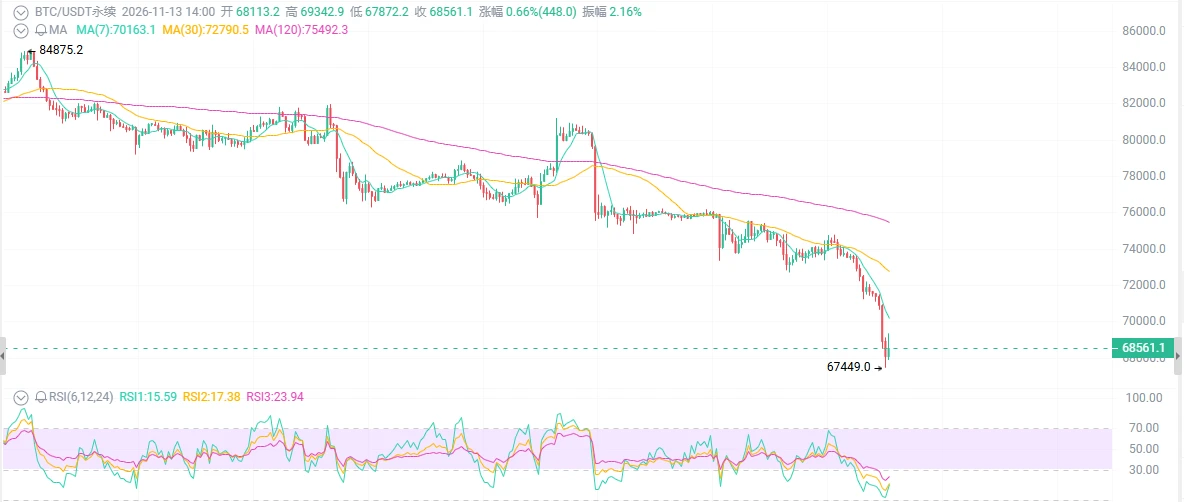
BTC at 68,500: Are you cutting or holding?
October CPI came in hot, the probability of a rate hike surged to 80%, ETFs saw $1.28 billion in outflows in a week, $1 billion in long positions were liquidated, and the Fear Index fell to 19. Everyone is calling for a crash. But just now, BTC bounced hard from 67,500 to 68,500—was this sharp drop the final shakeout, or a bull trap before a bigger plunge?

First, the surface picture: the screen is full of bearish news, but have you noticed one thing?

BTC has fallen from its ATH of 126,200 to 68,500, a 45% retracement. It dropped 6% in 24 hours, hitt
post-image
BTC-0.67%
SOL-0.77%
NVDA-4.49%
ETH-1.26%
Today Market update
live-cover
LIVE2,153
Trenches
mihao
m
bade
b
mihao
4Cxj...pump
Market Cap
$.
Change
.
24h Vol
$.
Holders
.
AGT
A
bade
b
AGT
0x5d...e274
Market Cap
$.
Change
.
24h Vol
$.
Holders
.
FOOD
F
bade
b
FOOD
FTu5...pump
Market Cap
$.
Change
.
24h Vol
$.
Holders
.
IDOL
I
bade
b
IDOL
0x3b...ab07
Market Cap
$.
Change
.
24h Vol
$.
Holders
.
AI
A
bade
b
AI
2T56...pump
Market Cap
$.
Change
.
24h Vol
$.
Holders
.
$ETH The rebound is merely a correction; the bear market isn’t over!

Yesterday, ETH plunged from around 2064, successively breaking key levels like 2000 and 1950, and hit a low of 1893. The bears launched a powerful move, breaking straight through the bulls’ defenses!

Although it has rebounded from the lows, this looks more like a technical correction after the sharp drop and does not mean the trend has reversed.

That’s right—I’m still bearish for now. The 1940–1950 range is a key short-term resistance zone. If the rebound fails to break through it decisively, ETH could still retest the pre
post-image
ETH-1.23%
#GateOctoberTransparencyReport📉 ETH briefly fell below $2,000—is it really time to find a new bottom?

BTC continued to weaken, and ETH also failed to hold $2,000, briefly dipping to around $1,983.

ETH has faced considerable pressure recently. 👀

💰 ETF outflows, institutional buying still needs to recover

📊 Inflationary pressures persist, and sentiment toward risk assets remains cautious

⚡ Leveraged liquidations intensify, further amplifying short-term volatility

Bulls and bears are divided again: some believe the area around $2,000 is worth watching, while others worry that funds have
ETH-1.26%
BTC-0.67%
  • 3
Gold short from 4130 to 3860! 270 points of room—enough for everyone to have a prosperous New Year! This round’s publicly shared trade signal also hit its target perfectly! Shared publicly and in advance for friends still lost in the fog—remember to follow Qingyao!
What Is the Long/Short Ratio? Why Doesn’t a Higher Number of Longs Mean the Market Will Definitely Rise?

In crypto trading, many people see the long/short ratio rise and assume bullish sentiment is strengthening, then choose to chase long positions. But market sentiment and actual price movements do not always align. The long/short ratio can help us understand traders’ positioning tendencies, but it cannot directly determine how the market will move next.

First, what is the long/short ratio?

The long/short ratio measures the relative proportion of long and short positions in a particular ma
post-image
GM CT, happy Friday.
@primus_labs is working on a simple problem,how to prove information is genuine without exposing private details.
From financial records to online activity, users should be able to verify what matters without sharing everything behind it.
That is important for building applications people can use without giving up control of their personal information.
Have a productive day fam.
post-image
  • 1
Although Jensen Huang voluntarily resigned, NVIDIA employees wrote a joint letter demanding that he be reinstated as CEO.
post-image
NVDA-4.49%
#白宫提交CFTC与SEC两党委员提名 Nominate ⚖️ **Crypto Regulation: Clarity Is the Key to Institutional Adoption**

In my view, the most important thing for the crypto industry right now is **regulatory clarity**.

Large institutions need legal certainty, transparency, and investor protection before increasing their exposure to digital assets.

With clear regulations:
- Institutional investors can enter the market with greater confidence.
- Innovation in the crypto industry can develop more sustainably.
- ETF and derivatives product approvals could open up broader market access.
- Investor protection will be
post-image
$BABYDOGE Looking at the weekly chart is depressing; switching to the 1M chart leaves no hope at all. The project was launched to save stray dogs, but I haven’t seen any dogs being saved—only more and more “seven-course dog meat feasts.” Baby Doge holders are looking more and more like dog bones: skin and bones, with their wallets shrinking by the hour, let alone by the day, month, or year.
BABYDOGE-1.56%
putting all my money in bitcoin here so that I won't have to pay any unrealised gains tax anytime soon
post-image
BTC-0.67%
#USJoblessClaimsBeatExpectations
US Jobless Claims Rise Above Expectations — A Cooling Labor Market Could Complicate the Fed’s Next Move

The latest US employment data introduces another important variable into an already complicated economic environment. Initial jobless claims increased to 200,000, exceeding market expectations of 194,000. Although the difference is relatively small, the reading adds to signs that the American labor market may gradually be losing some momentum.

However, the bigger picture requires careful interpretation. At 200,000 claims, unemployment filings remain histor
post-image
BTC-0.67%
SPX+0.33%
  • 1
  • 2
If all employees’ appeals succeed, Jensen Huang returns, and the stock makes a V-shaped reversal, anyone who bought the dip a few days ago will never have to worry about being poor again.
All NVIDIA employees, keep it up!
post-image
NVDA-4.49%
  • 1
When Signals Across Multiple Timeframes Conflict, Which One Should You Follow?

The daily chart shows an uptrend, the 4-hour chart is pulling back, and the 15-minute chart suddenly signals a breakout. Faced with conflicting charts, many traders hesitate: Should they buy, sell, or keep waiting?

The problem isn’t necessarily that one timeframe is wrong, but whether you’ve defined each timeframe’s role in advance.

First, determine your trading time horizon.

If you’re a short-term trader, you need to be clear about your intended holding period and exit conditions. If you plan to hold for severa
post-image
What Is Overfitting? Why Can More Perfect Parameters Make a Strategy More Fragile?

A trading strategy performs almost perfectly in historical backtests, with a high win rate, a smooth equity curve, and a small maximum drawdown. It seems to have found a market pattern. But once it enters the real market, it may suffer frequent losses. One important reason behind this is overfitting.

First, what is overfitting?

Simply put, it means a strategy has adapted too closely to specific fluctuations and random events in historical data, without actually extracting patterns that can continue to work ov
post-image
17 years after Bitcoin's creation:
• still 10 minutes per block
• still capped at 21 million
• still adjusts difficulty every 2016 blocks
• still decentralized
• still open source
• still SHA-256
• still 99.99% uptime
• still never hacked
• still immutable
• still growing
Yet most people still think it's going to zero.
post-image
BTC-0.67%
What Is a Stop-Loss? Why Doesn’t Setting One Completely Prevent Losses?

In cryptocurrency trading, a stop-loss is an important risk management tool, but many traders mistakenly believe that setting one will strictly limit losses to their expected range. In reality, a stop-loss can help execute a risk plan, but it cannot guarantee the final execution price.

First, what is a stop-loss?

A stop-loss is an order to close a position or sell when the price reaches a preset condition, in order to limit potential losses. For example, if the price falls below a predetermined risk level after you buy,
post-image
What Is Slippage? Why Isn’t the Price You See When Placing an Order Necessarily the Final Execution Price?

In cryptocurrency trading, many people see one price when placing an order, only to find that the actual price is different after execution. This phenomenon is commonly known as slippage. It may seem like only a slight price difference, but in highly volatile markets, large trades, or leveraged trading, it can significantly affect trading costs and the final outcome.

First, what is slippage?

Slippage is the difference between the expected execution price and the actual execution price.
post-image
crypto market update btc
live-cover
LIVE2,445
Microsoft gave Mac a tool to “find the culprit.”
Which process is eating memory? Which program is connecting to the internet in the background? How many child processes is an app launching?
The Mac version of Process Explorer lets you see all of this.
When things slow down, first check CPU/memory usage; if you spot an unfamiliar process, check its file path, signature, and TCP/IP connections. Find the cause first—don’t start killing processes indiscriminately.
Supports macOS 14 and later.
Official project:
post-image
MSFT+0.36%
Load More

Join 40 M users in our growing community

⚡️ Join 40 M users in the crypto craze discussion

💬 Engage with your favorite top creators

👍 See what interests you

Trending Topics

JensenHuangResigns

510.8K Views7.9K Discussing

Jensen Huang has resigned as NVIDIA CEO and stepped down from the board. CFO Colette Kress will serve as interim CEO while NVIDIA considers internal and external successors. $NVDA fell more than 10% in premarket trading following the announcement. With one of AI’s most influential leaders stepping aside, markets are now reassessing NVIDIA’s leadership stability, AI strategy, and long-term valuation.

GateIPOAccessAnthropic

277.4K Views2.6K Discussing

Dr.HanOxfordUnionSpeech

144.1K Views427 Discussing

View More