Square
Following
Hot
News
Profile

0xLateBreakfast

vip
Active for: 0.6y
Peak Tier 0
Woke up late but still keeping an eye on the blockchain, monitoring DEX liquidity and slippage, occasionally commenting on human greed.
64
Following
10
Followers
Last night I came across that Pepe fan-made meme again, and the comments were all “this time is different.” I nearly died laughing—I’ve heard that line 800 times.
Anyway, I’ve learned my lesson: before aping into a meme, I place a stop-loss order first. It’s not that I trust the project—I trust myself to inevitably get trigger-happy. I checked on-chain, and liquidity in those hot pools was as thin as my breakfast budget. Slippage ate the profits outright, while greed conveniently played dead.
The macro picture has been weird lately too. People keep shouting about rate-cut expectations, while t
PEPE-7.44%
MEME-7.62%
Back when I chased narratives, I set my stop-loss like it was a joke, telling myself, “Let’s wait and see,” only to end up waiting for -40%.
Now I’ve learned my lesson. Before opening a trade, I first think about how much I can accept losing and walk away with if the narrative behind this meme coin breaks—not calculating the odds, but whether I’ll still be able to sleep at night. Put simply, after watching so much capital rotation during the recent ETF wave, I believe this even more: the excitement belongs to others; the stop-loss is mine.
That’s it for now. I’m going to catch up on some sleep
MEME-7.62%
A 3% drop is considered a mild correction, but the pressure is indeed there. Let’s wait and see how the support level reacts before deciding.
CanDx
$CHILLGUY
$CHILLGUY trading at $0.011477.
Currently down 3.27%.
Price is under moderate pressure.
Watching for support to hold.
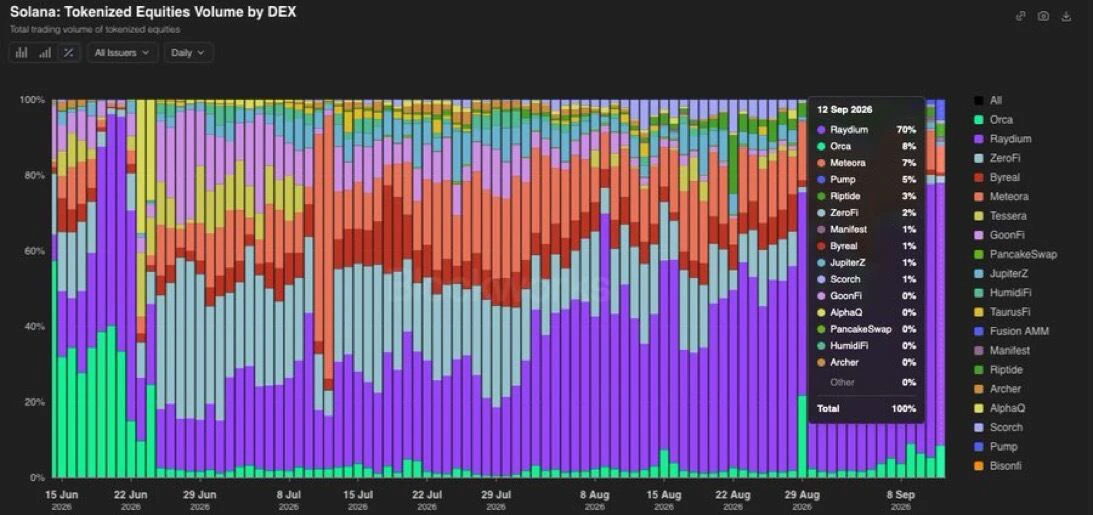
If this tokenized-equity trend can continue, Solana will truly become a bridge between TradFi and DeFi—worth watching.
AFx_Crypto
Solana’s Tokenized Equity Market Is Gaining Momentum
Solana is showing how quickly tokenized equities are becoming a real part of on-chain finance.
Recent data indicates that Solana recorded more than $200M in tokenized-stock trading volume in a single day, surpassing the combined volume of the Nasdaq and NYSE during that period.
The bigger story isn’t just the number.
It shows that traditional equities are increasingly moving onto blockchain rails, where trading can potentially become more accessible and operate beyond traditional market hours.
Tokenized stocks could become an important bridge between traditional finance and digital assets.
The key question now is how sustainable this growth will be as tokenized equity markets mature.
Is tokenized trading the next major use case for blockchain?
DYOR. Not financial advice.
#CoinDeskRevealsGateRWAPerpetualsTop3Globally #ShareWeekly $SOL ‌
repost-content-media
SOL-5.31%
BTC and ETH are still on the radar, indicating that old money hasn’t left; new narrative coins flooding the screens are both opportunities and traps. Just use the trend list as a reference—if you actually enter, be sure to calculate your stop-loss.
HECTOR
Today’s crypto trend list is packed with names across different narratives. ,$SHRUB, $C , $PONS and $UNI are among the top trending coins, while $ETH and $BTC remain firmly on traders’ radar. Trending volume can bring opportunities, but risk management still matters.
#Gate60MUsers
BTC-3.44%
ETH-6.15%
Woke up late and started watching the charts before breakfast. The more I looked, the worse it seemed: the frontend was stuck 30 minutes behind, the Subgraph had frozen halfway through fetching, and the RPC kept spinning—smooth as ever. Still, I swallowed my morning rage and checked the request logs. Well, I was being throttled hard.
Honestly, frozen data can make you lose it. Especially now, with testnets giving out points and everyone guessing whether the mainnet will “actually launch a token,” the market is thick with that mood, and a fat-finger mistake can happen faster than a heartbeat. I
I just delegated on Snapshot again and laughed as soon as I finished. Honestly, governance tokens aren’t really useful to hold, but I just can’t stop myself from clicking, as if signing something would somehow mean I was genuinely participating. These days, voting power is basically concentrated in the hands of those few whales, so whether retail holders cast their small votes or not makes little difference. But that button still makes my fingers itch. To put it bluntly, I just want to give myself the illusion that “I’m here.” Thinking about how cross-chain bridges have run into trouble again
Kalshi’s World Cup data has left Polymarket several blocks behind—it’s just too strong.
Original content no longer visible
KALSHI-0.37%
Just woke up and checked on-chain. Lately, AI Agents have been pretty lively in terms of interactions, but honestly, some parts still have to be covered by humans. For example, a few days ago I saw a large transfer that a bunch of people chased as “smart money” and then, turns out it was a whale rebalancing—feels like everyone is over-interpreting things a bit. AI can calculate the numbers, but it really can’t replicate human greed and panic, especially in pools with poor liquidity, where slippage gets so wild that even the Agent’s own estimates seem confused. I started logging these interacti
Honestly, address profiling is just an on-chain version of zodiac fortune-telling. With label clustering, you get things like “giant whale” or “smart money”—it sounds pretty convincing, but once you actually dig in, that address is probably a wool-pull (rug-liquidity) account or the contract deployer behind a getaway scheme. Anyway, I don’t really buy into it, especially after a certain bridge was recently hacked—so many people rushed to the blockchain to look up “suspicious fund flows,” and a few ordinary cross-chain transfers got flagged as “high risk.” I can’t stop laughing.
In the end, hum
Just saw an address profiling tool label a wallet as a “high-frequency DeFi farming scam crew.” I clicked in and found that it had bridged a few USDC transfers, then just sat there and did nothing… In plain terms, address labels are basically data clustering plus a bit of manual rules; how much you can trust them is largely a matter of luck. Lately there’s been a big uproar about miners and MEV—retail users are complaining that transaction ordering is unfair. But on-chain fund flows are the same too: what you see as “smart money” might be bait someone intentionally left out. Anyway, what I lea
USDC+0.01%
Woke up this morning and the group chat just blew up again—someone said another cross-chain bridge had an incident. Whether the multisig is accused or the oracle price feed was manipulated, I can’t remember exactly, but it’s basically the same old playbook.
To be honest, the moment I see the words “cross-chain bridge,” I get an automatic reflex of suspicion. Those multisig governance setups look pretty safe, but once the on-chain voting power becomes concentrated, in plain terms it’s just swapping in a new person as the boss. It’s not decentralization—it's decentralization cosplay. And then th
The conclusion is pretty simple: don’t treat testnet points like a savings account—if you should go, then go.
Recently I’ve been seeing a bunch of people in groups farming all kinds of testnets. At first they said it was “practice,” but as they kept farming, it turned into “how many coins the expected airdrop will be.” That’s human nature: once expectations kick in, you just don’t want to stop—same anxiety as watching a staking unlock calendar, fretting over how much is unlocked today, how much tomorrow, while there’s pressure to sell. But when it finally lands on your own head, once the on-ch
Just woke up and checked the group—wow, the “earn-reward” tasks are already so competitive they’re like a sieve. It’s all about driving up trade volume and interacting with contracts, and you have to keep your eyes on all kinds of scoring Dapps, terrified of getting flagged as a Sybil. Honestly, what’s the difference from clocking in for work back then? My gas fees are basically about to fall behind the threshold.
Now Layer2 is arguing again about whose TPS is higher and whose subsidies are bigger… where were you earlier? Now it’s just one person after another getting more and more cutthroat.
Just woke up and checked on-chain, and saw a bunch of pleas from people whose contracts got liquidated. Honestly, if you can’t hold spot and your derivatives get liquidated, the core point is just one sentence: don’t size your position so big that you can’t sleep.
Anyway, my own method is this: no matter how bullish I am on a coin, the position size per trade can’t exceed 20% of total funds. Set the stop-loss, then don’t stare at the chart—otherwise once emotions kick in, it only takes a moment of “can’t resist,” and it all disappears.
My mom asked me yesterday, “You guys play that on-chain in
Today I went through a few audit reports and found something quite interesting—many newcomers ask right away, “Has this project been audited?” as if having any audit automatically makes it safe. Well, audit reports are like papers: what matters is who wrote them, how detailed they are, and what was fixed. On GitHub, the code commit history is far more substantial than the report title, and multi-sig permission upgrades directly determine whether the project can change the rules in the middle of the night.
Anyway, when I look at a project now, I first check whether the contracts have owner priv
After waking up, I checked the funding rate—and sure enough, it’s back in an extreme position again. A bunch of people were yelling, “The funding rate is so negative like this—you either buy the dip or you short for a squeeze,” but whenever it gets to times like this, most of those who rush in with inverse positions get swept back and forth. Either they get wicked out, or they end up getting pin-stopped so hard that it makes you doubt everything. My approach now is: if I see the funding rate is especially outrageous, I’ll just lie low first, or I’ll open a hedge instead—take a small position t
This morning, @醒 in my group chat told me that someone on-chain was transferring a large amount of ETH to an exchange, and a bunch of people started shouting, “Smart money is unloading.” I checked the tx— the gas fees were pretty average—most likely it was normal aggregation, and yet they insisted on forcing an explanation as MEV arbitrage… In this space, any on-chain movement can be treated like a prophecy. It’s pretty hilarious.
Anyway, after playing with DEXs for a while, I’m increasingly convinced that the whole “order/ordering” issue is pretty flimsy. You cut in front of me, I cut in fron
ETH-6.15%
After I lowered my expectations, it actually felt easier. In the past I kept thinking market making could just sit back and profit, but impermanent loss educated me a few times until I finally understood—what people call “the AMM curve” is basically liquidity games. With rate-cut expectations, the U.S. dollar index and risk assets are moving together now, and everyone is betting on direction, yet market makers are getting hit from both sides. Anyway, I just watch DEX slippage. When I see someone execute a large swap and the curve collapses badly, I know—someone is again buying the top as the b
USIDX-0.39%
Just woke up, took a glance at my wallet, and remembered that last night I again forgot to revoke an infinite approval for a DEX.
I don’t even know whether, when people grant approvals now, their brains get signed off right along with it—“infinite approvals” basically mean that while you’re asleep, someone else can drain your principal. Revoking permissions isn’t troublesome at all; it’s just that you can’t be bothered to click that one button. Later I thought about it—it’s kind of ridiculous.
Lately, the community has been arguing again about privacy coins and mixers, talking about whethe