SafeKeeper

vip
Active for: 0.3y
Peak Tier 0
Focused on DeFi insurance (Nexus Mutual) and secure storage of stablecoins. Enjoy explaining smart contract vulnerabilities, with a style similar to technical blogs.
A lot of people think that market making is just putting money in to collect trading fees, lying back and earning, and that impermanent loss sounds like something someone mentioned but they didn’t really pay much attention to. Over the past couple of days, I looked at a few AMM curves. To be honest, with the same two coins, the slippage and liquidity depth can differ a lot across different pools…
With Uniswap V2’s constant-product model, when prices swing a lot, your position changes pretty aggressively—especially during extreme moves at both ends of the market—so it gets skewed quickly. Put s
UNI5.29%
L1-18.44%
View Original
  • Reward
  • Comment
  • Repost
  • Share
Recently I keep seeing a bunch of people grinding social mining—every day they check in for a few badges, invite others, leave their accounts idle, and accumulate a pile of points, but they don’t even know what they can actually redeem. I’m just the type who studies nonces and failed transactions; in theory, this stuff has nothing to do with me. But when I look at those rules, I really want to complain. Basically, it’s selling your attention to the project team and getting back a string of database numbers—compared with real on-chain rewards you can actually take home, the value-for-money is r
RWA0.00%
View Original
  • Reward
  • Comment
  • Repost
  • Share
I was just watching a transaction in the mempool, and I honestly almost laughed in anger. When the network is congested, setting your gas a bit lower is basically handing your fate to someone else—miners just drop your transaction into the pending pool and it won’t budge for half the time. Mine was worse once: I set the nonce order wrong, and it got stuck in the queue—then all following transactions had to line up and wait for it to be processed. That feeling is like a big truck breaking down on the highway in front of you, and you can only stare blankly behind it.
Put simply, the mempool is l
View Original
  • Reward
  • Comment
  • Repost
  • Share
I’m just a lousy engineer who spends every day staring at nonces. I really can’t stand it anymore—whenever I open the chain, it’s all “badge farmers” spamming transactions. For some project’s social points and identity badges, they each go wild, blasting gas to fight for the block-packing order. In the end, once you add it up, they still come out at a net loss—but they think they’re pretty Web3. Honestly, some projects do all this just to keep your attention and drain your time value; it’s not really meant to get you to actually use the chain.
These days, the comparison between RWA and U.S. Tr
RWA0.00%
View Original
  • Reward
  • Comment
  • Repost
  • Share
Someone always thinks that market making is just lying down to earn money—throw the coins into the pool and wait to collect trading fees. I looked at on-chain data; these people probably haven’t even seen what an AMM curve looks like. To put it plainly, market making is you providing free liquidity to the whole market. When price fluctuations get a bit larger, impermanent loss will get you—directly, and your fees will be what gets eaten up. You think you’re working a job? No—you’re basically working for traders.
Especially for those new L1/L2 that hand out incentives and boost TVL: old users m
L1-18.44%
ETH2.82%
View Original
  • Reward
  • Comment
  • Repost
  • Share
Just saw in the group that people are circulating the same rumor about a stablecoin reserves audit. Honestly, every time an unpeg rumor comes out, I find it pretty boring. A bunch of people are fixated on Twitter sentiment charts and rushing in based on vibes, and they don’t even care what the on-chain data actually looks like. PFPs and memberships—let’s be real—are basically attention games. They can pull in a wave in the short term, but without anything real, who can keep holding on in the long run?
From the technical angle, if the contracts are written badly, the nonces are a mess, and gove
View Original
  • Reward
  • Comment
  • Repost
  • Share
I just reviewed a project’s treasury spending proposal. The budget is burning faster than my home electricity meter, and the proposal is packed with a long list of empty words for milestones—things like “technical research” and “community building.” Honestly, whether the project team is really doing work can’t be judged by how they spend money. You have to see whether they dare to turn milestones into quantifiable, verifiable deliverables. For example, if they say “optimize transaction ordering,” can they attach real measured data showing an MEV decline? If they say “privacy compliance,” would
View Original
  • Reward
  • Comment
  • Repost
  • Share
I just muted that “DEFI Chinese big group” again. Honestly, every time I see people complain that the chain is lagging, I get so angry—if you don’t even know about RPC rate limiting, you just blame the nodes for not doing their job.
Anyway, I’ve been thinking about this lately: why, after switching to several indexers, the data still looks visibly “glitched”? Later I checked the Subgraph sync logs—just for one pool’s swap events, it has to pull more than a hundred times. Debugging this kind of issue pushed my blood pressure right up. To put it simply, it’s rate limiting plus records not being
View Original
  • Reward
  • Comment
  • Repost
  • Share
Hey, now that you look at it, whether the project team is actually doing serious work— you really can’t just judge by those “milestone” breaking news they post on their Twitter. To put it bluntly, once many teams think about issuing tokens, they start piling up all kinds of seemingly impressive “milestones,” like “mainnet launch,” “ecosystem partnerships,” and so on. But if you scan on-chain activity, most of the treasury spending ends up as market-maker gas fees or some inexplicable large transfers. Tell me, is that money really being spent well?
Actually, from an engineering perspective, the
ETH2.82%
View Original
  • Reward
  • Comment
  • Repost
  • Share
After looking around a bunch of yield aggregators recently, I feel those APY numbers are starting to look more and more like performance art.
To put it simply, a lot of these pools’ underlying mechanics are just several layers of contract nesting: from A vault to B strategy to C lending—and in the end, what exactly gets redeemed? You don’t even know who the counterparty is. **For my part, once I lowered my expectations, I felt a lot more at ease**—if you don’t want to grind through the points-style system that’s so cutthroat, then just honestly check the on-chain real liquidity and contract
View Original
  • Reward
  • Comment
  • Repost
  • Share
Discussions about restaking have heated up again recently. The idea of compounded rewards sounds great, but don’t treat the logic of shared security as a one-size-fits-all solution. Testnet token-earning farming and speculation about mainnet token launches are flying everywhere. In plain terms, everyone just wants to bet on a certain expectation, but any one of the pitfalls—like on-chain nonce failures or issues with transaction packaging order—can leave you working in vain. What I don’t regret is bringing an engineering perspective to look at these things; at least I wasn’t led astray by illu
View Original
  • Reward
  • Comment
  • Repost
  • Share
I just saw in a group chat people reposting screenshots about stablecoins de-pegging. Honestly, ever since the spike last year, I’ve been too lazy to open on-chain audit reports. People keep shouting “it broke again, it broke again,” but when you actually look at the block explorer, the pool depth hasn’t moved much, and the arbitrage bots are still running just fine. There’s too much information, and it really causes anxiety. My filtering method is super simple now: I only look at on-chain liquidity that isn’t held in CEX custody, and the nonce distribution of failed txs. Any emotional talk wi
ETH2.82%
View Original
  • Reward
  • Comment
  • Repost
  • Share
Just translated a liquidation transaction—turning out the oracle feed delay is pretty interesting. Liquidations are supposed to front-run, but the prejiā machine’s quote lagged by half a beat instead, giving arbitrageurs more room. Put plainly, the on-chain price doesn’t line up with the real price, and the liquidation line/bust threshold looks a bit shaky.
Lately, the chatter around social mining has been pretty hot too. “Attention mining” sounds great, but the oracle feed logic is right here in front of us—there’s no way you can set the liquidation price based on like counts, right? My guess
View Original
  • Reward
  • Comment
  • Repost
  • Share
Honestly, attention is even harder to抢 than gas fees. The hotspots rotate like a carousel—right after you stake and it gets hyped into a new shared security paradigm, the next moment it gets dragged and called a set of nested “doll” stacking buffs. I figured it out early: piling on concepts isn’t as good as watching the nonce—on-chain games are fundamentally about packaging order and success rate. Why all the flashy stuff?
Sometimes it’s really annoying. Every time I open the group chat, it’s all “Did you get on this narrative?” Where’s the data? Where’s the logic? One by one, they follow the
View Original
  • Reward
  • Comment
  • Repost
  • Share
Recently everyone has been obsessing over comparing TPS between L2s at full speed—like a beauty pageant. But honestly, after messing with on-chain stuff for so long, I feel that if AI Agents really take over on-chain interactions, the hardest part won’t be the flashy stuff—it’ll be the most basic “dirty work.” For example: when nonces get messed up, transactions get stuck in the mempool, or gas spikes so high that you tell it to change, but it’s still stuck fighting to the death with its pre-set logic.
Later I thought it was kind of funny. Everyone’s hyping it to the heavens, but in practice e
View Original
  • Reward
  • Comment
  • Repost
  • Share
Seeing the new L1 launch incentives, the old hands happily mine, then claim and sell—making a great time of it. I only jot down one line in my notes: To you, the profit is sandwich margins; on-chain, all you see is someone else’s transaction fees. After all, arbitrage is inherently zero-sum—better to study how nonce can still save a bit of gas; what you save is what really counts as yours.
L1-18.44%
View Original
  • Reward
  • Comment
  • Repost
  • Share
The millstone stage is psychological warfare; once the chips have been handed over, things naturally take off—hold on tight and don’t panic.
View Original
YakuzaTheoryTrends
$LAB Keep it turning! Once everyone has handed over their chips, that’s when 🧧🧧🧧🧧🧧🧧🧧🧧🧧🧧🧧🧧🧧🧧🧧🧧🧧🧧🧧🧧🧧🧧🧧🧧🧧🧧🧧🧧🧧🧧🧧🧧🧧🧧🧧🧧🧧🧧🧧🧧🧧🧧🧧🧧🧧🧧🧧🧧🧧🧧🧧🧧🧧🧧🧧🧧🧧🧧🧧🧧🧧🧧🧧🧧🧧🧧🧧🧧🧧🧧🧧🧧🧧🧧🧧🧧🧧🧧🧧🧧🧧🧧🧧🧧🧧🧧🧧🧧🧧🧧🧧🧧🧧🧧🧧🧧🧧🧧🧧🧧🧧 pulls the price up!
repost-content-media
  • Reward
  • Comment
  • Repost
  • Share
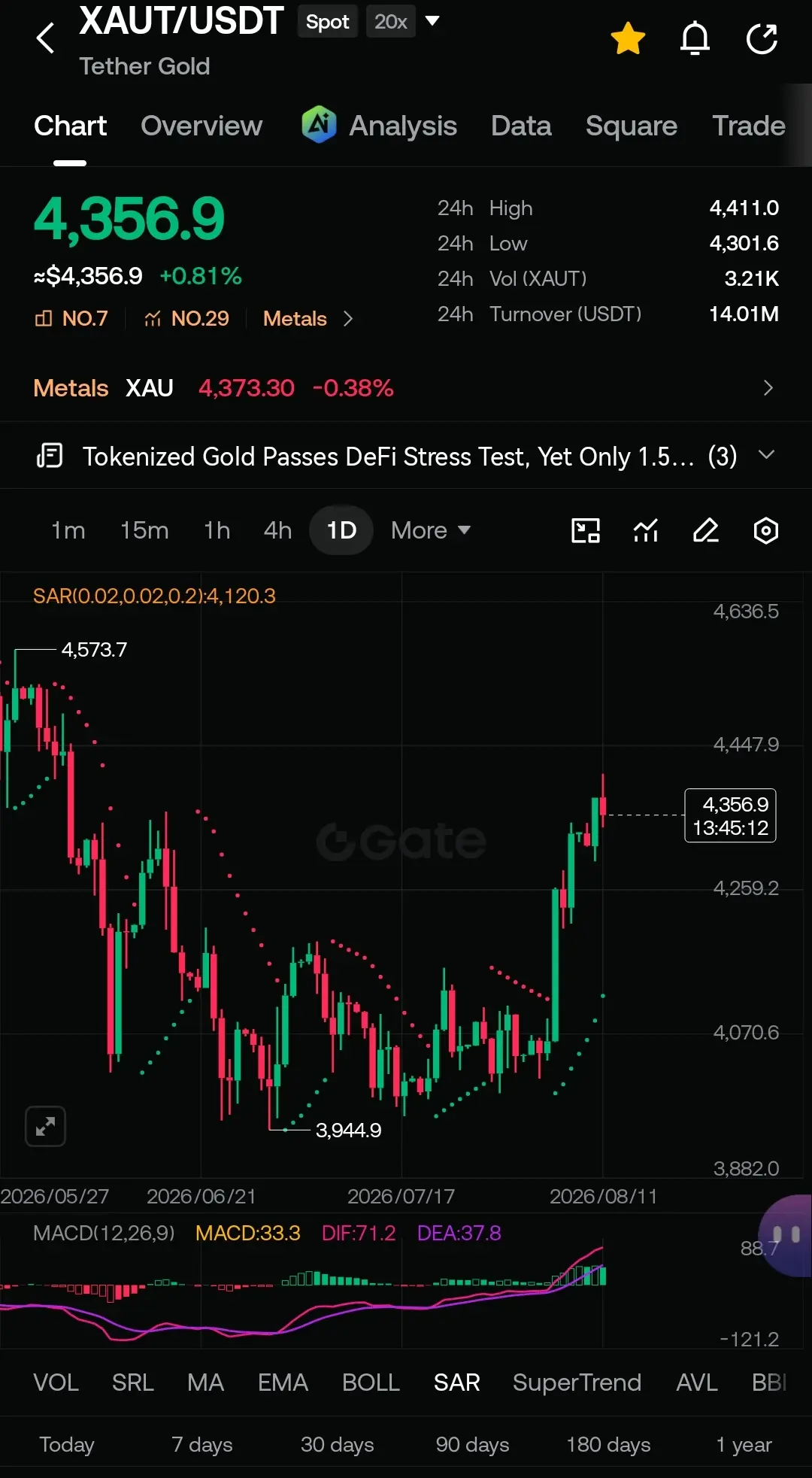
WTI jumps above 74, while gold instead breaks through 4,100—why has this safe-haven logic split?
GLDX0.33%
PAXG0.39%
View Original
CoinNetwork
CryptoNews News: Iran announced over the weekend that it would close the Strait of Hormuz. The United States struck Iran twice early this morning, and the U.S.-Iran situation has escalated again. At the start of trading on Monday, WTI crude oil rose more than 3%, nearing $74 per barrel. Spot gold fell below the $4,100 level, down nearly 0.8%. Spot silver dropped more than 2%, to $58.65 per ounce. Nasdaq futures fell 0.4%. The U.S. dollar index (DXY) strengthened by more than 10 points, and 10-year Treasury futures fell by 5 points.
  • Reward
  • Comment
  • Repost
  • Share
Strategy's earnings report timeline is set quite far out, with a Q2 2026 target first. Let's see what BTC's price will be by then.
BTC0.72%
View Original
WuSaidBlockchainW
Wu Says learned that Strategy announced it will release its 2026 second-quarter financial results after the US stock market closes on July 30, 2026, and will hold a live video web seminar to discuss the results at 5:00 PM ET (5:00 AM Beijing time on July 31) on the same day.
  • Reward
  • Comment
  • Repost
  • Share
The decentralized identity sector will eventually explode, and whether Worldcoin can succeed depends on whether it is genuine infrastructure or Altman's PR machine.
WLD0.08%
View Original
KingAlpha
Worldcoin (WLD) Market
Update
Worldcoin (WLD) continues to attract global attention as one of the most innovative blockchain projects focused on digital identity and artificial intelligence. The project aims to build a decentralized identity network that enables users to verify their uniqueness while accessing Web3 applications securely. As Al technology continues to evolve, Worldcoin is positioning itself at the intersection of blockchain, digital identity, and financial inclusion.
Market analysts believe increasing interest in decentralized identity solutions and Al-powered applications could support Worldcoins long-term growth. Trading activity remains active as investors monitor ecosystem expansion, user adoption, regulatory developments, and overall cryptocurrency market sentiment. Continued innovation and strategic partnerships remain important factors that could strengthen the project's future outlook.
Although short-term price volatility remains expected, many investors remain optimistic about WLD because of its unique vision and expanding ecosystem. As blockchain technology and artificial intelligence become more integrated into everyday digital services, Worldcoin is expected to remain one of the most closely watched Al-related cryptocurrencies. Investors should always conduct independent research, monitor market developments carefully, and apply proper risk management before making investment decisions.#gStocksTokenizedStocksLive #WeakNFPShakesRateHikeOdds #PredictWorldCup🇧🇷vs🇳🇴 #ETHBreaks1700 #MetaSellsComputeTriggersChipSlump $WLD $WLD
repost-content-media
  • Reward
  • Comment
  • Repost
  • Share
  • Pinned