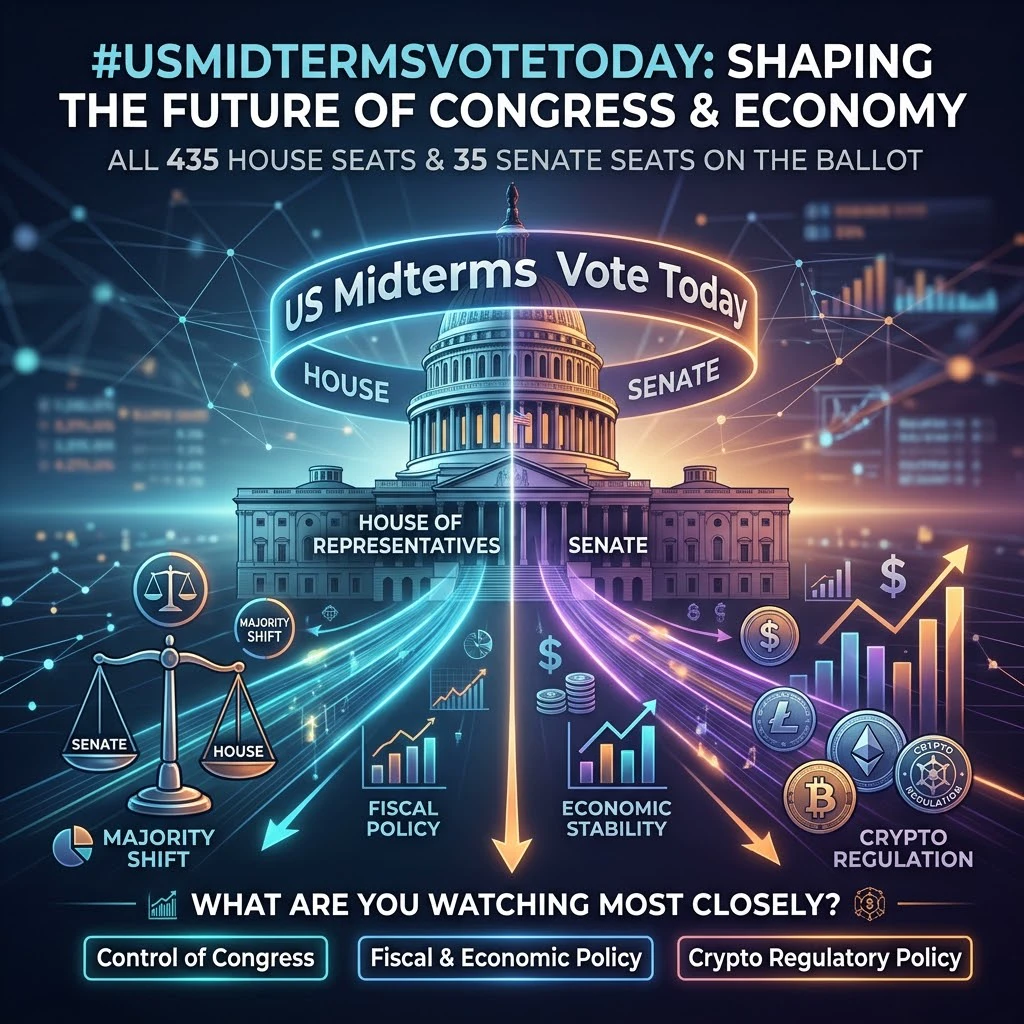










#美国中期选举今日投票 #WCTCS9 Countdown to the U.S. Midterm Elections! Is the S&P 500 Set for a New Rally?
The U.S. midterm elections will be held on November 3, with whether Republicans can continue to control Congress becoming a key focus for global financial markets.
With Democrats expected to retake control of the House of Representatives, investors are closely watching how the election results will affect U.S. fiscal policy, government spending, tariffs, and artificial intelligence (AI) regulation.
Historical data shows that the S&P 500 typically performs strongly in the six months after U.S. midterm elections, but will this trend continue in 2026? This article examines three possible election outcomes and their potential impacts on U.S. stocks, tech stocks, U.S. Treasury yields, and market sentiment.
U.S. midterm elections: Control of Congress is key. As the 2026 U.S. midterm elections approach, investors are watching to see whether Republicans can continue to control Congress or Democrats will regain control of some of it.
Currently, Republicans control the White House, House of Representatives, and Senate, making the key question in this election whether control of Congress will change. Historically, the president's party often loses some seats in Congress during midterm elections.
In 18 of the 20 midterm elections since World War II, the president's party lost seats in the House of Representatives. Current election forecasts favor Democrats retaking the House, while the Senate race is relatively closer.
Why are the House of Representatives and Senate so important? The U.S. Congress consists of the House of Representatives and the Senate. Both chambers participate in lawmaking, but their responsibilities differ.
Because legislation usually needs to pass both chambers before it can be submitted to the president for signature, control of Congress affects how easily the government can advance its policies.
If the two chambers are controlled by different parties, the legislative process may face more gridlock. Conversely, if the governing party controls both chambers, the government has more room to advance its policy agenda.
Why do the U.S. midterm elections affect U.S. stocks? For investors, the importance of the election lies not only in which party wins, but also in how the results could change government policy. If Congress is controlled by different parties, major tax and government spending policies may be harder to pass.
Some market participants believe this could benefit markets, as fewer policy changes may help reduce uncertainty and give businesses and investors a relatively predictable operating environment.
Historical data shows: U.S. stocks typically perform strongly after midterm elections. Historically, the S&P 500 has often posted strong returns after U.S. midterm elections.
According to historical statistics:
Midterm election years: From the end of October, the S&P 500 has returned an average of 14.3% over the following six months.
Non-midterm election years: The average return over the same period is 3.7%.
Fourth quarter: Historically, seasonality indicates that it is typically the strongest quarter of the year for U.S. stocks.
However, historical average returns do not indicate future performance. Interest rates, corporate earnings, geopolitical developments, and the overall economic environment can all affect U.S. stock performance independently of election results.
How could three possible election outcomes affect U.S. stocks? The midterm elections could produce three main scenarios, and different combinations of congressional control could have different effects on policy and financial markets.
Scenario 1: Democrats win the House, Republicans hold the Senate. This would result in a divided Congress. If Democrats control the House while Republicans continue to control the Senate, new tax and government spending bills could be harder to pass.
At the same time, the government could face stricter oversight from the House, while Republicans would continue to have influence over judicial and senior government appointments. For financial markets, the key question is whether legislative gridlock would help reduce policy uncertainty and create a more stable, predictable operating environment for businesses.
Scenario 2: Democrats win both the House and the Senate. If Democrats gain control of both chambers, they would have greater influence over the legislative agenda and government oversight. The current administration could face stronger policy resistance, while government spending, appointments, and regulatory direction could also come under closer scrutiny.
The tech sector is particularly worth watching. If Democrats push for stricter AI regulation, data privacy protections, or oversight of the tech industry, this could affect the operating environment for related companies. For tech stock investors, the key question is whether regulatory changes will affect companies' future growth prospects.
Scenario 3: Republicans continue to control both chambers. If Republicans successfully hold the House and Senate, the current administration would have more room to continue its policy agenda and face fewer congressional constraints.
Policy continuity may give some investors confidence, particularly those expecting further government support or legislative action for certain industries. However, issues such as the government budget deficit, tariffs, and geopolitical developments will remain.
Markets will watch whether policy continuity provides clearer direction or whether existing fiscal and trade uncertainties continue to affect investor sentiment.
Three major policy areas for investors to watch after the election
Regardless of which party ultimately gains control of Congress, the following three policy areas could have broader impacts on financial markets.
1. Fiscal policy and government spending
If Democrats control Congress, they may impose more restrictions on legislation that expands the fiscal deficit and increase scrutiny of government spending. If this lowers market expectations for fiscal expansion, it could affect inflation expectations and demand for U.S. Treasuries. However, the actual direction of U.S. Treasury yields and the dollar will still depend on Federal Reserve monetary policy and the overall economic outlook.
2. Iran conflict and defense spending
Control of Congress could also affect future U.S. funding for the Iran conflict and related military operations. If additional military appropriations are restricted, market expectations for the duration and intensity of the conflict could change.
If tensions ease, concerns about disruptions to energy supplies could lessen, easing pressure on oil prices and inflation expectations. This could also further affect U.S. Treasury yields, the dollar, and overall market sentiment.
3. AI and tech industry regulation
The tech industry will also be closely watching the post-election regulatory environment. If Democrats control Congress, they may push for stronger AI-related regulation, including data protection, market competition, and the use of AI technologies.
At the same time, investors have already begun to question whether the massive capital expenditures by large tech companies and hyperscalers can generate sustainable returns.
Therefore, any changes in regulation or the direction of government support could affect market perceptions of tech stocks, especially companies with a high share of AI business.
What key indicators should investors watch in U.S. stocks after the election results are announced?
In addition to which party wins, investors can also keep an eye on the following four areas.
1 Senate control. Since the House is considered more likely to change hands, the Senate election results could be key to determining the final balance of power in Congress. If Republicans hold the Senate, the U.S. could have a divided Congress. If Democrats win both chambers, they could place greater constraints on the current administration's policy agenda.
2 Market volatility. Uncertainty ahead of a major election could lead to increased short-term market volatility. As the results become clearer, markets may rebound as uncertainty fades. However, actual performance will still depend on how investors interpret the results.
3 Policy signals. Developments related to tariffs, government spending, the Iran conflict, and AI regulation could provide important clues about the future direction of policy. These policy changes could also further affect business operations and investor expectations.
4 Corporate earnings and economic data. Even after the election results are determined, corporate earnings, U.S. inflation data, and interest rate expectations will remain important factors affecting the S&P 500. Therefore, investors should not judge the future direction of U.S. stocks solely on political outcomes.
How will the S&P 500 perform after the U.S. midterm elections?
The U.S. midterm elections could change the future policy environment, but their actual impact on the stock market will still depend on how investors interpret the results alongside economic conditions and business developments.
Historically, the S&P 500 has typically performed well in the months after midterm elections. However, past performance does not guarantee future returns, and investors still need to monitor changing market conditions.
For investors following U.S. stocks, the S&P 500, and the tech sector, the question worth considering may be more than just which party wins the election. More importantly, will the election results bring clearer policy direction to markets, or introduce a new wave of uncertainty?#广场交易达人