
Square
Following
Hot
News
Profile

BlackVelvetBluePeony

vip
Active for: 0.6y
Peak Tier 0
Doesn't like to argue, enjoys paying attention to details: protocol parameters, risk boundaries, governance game theory. Occasionally posts beautiful pictures and shares some fun facts.
69
Following
10
Followers
5
Liked
When it comes to privacy, say too much and it sounds like preaching; say too little and it looks like you're playing dumb.
Anyway, being on-chain these days isn't much different from running naked. You think modular DA layers make data more distributed and secure, but for ordinary users... it just means the fees are charged somewhere else. Let developers get excited about that—the little bit we have in our wallets can still be analyzed down to the last detail.
As for the compliance boundaries, my expectations are pretty low: don't expect project teams to take the fall for you, and don't think
I’ve always thought of queued on-chain transactions as being a lot like cutting in line in real life. Once, I was minting something and lowered the gas fee a bit too aggressively to save 0.005 ETH, only to watch helplessly as a transaction next to mine got confirmed first, with the settlement order completely reversed within the same block. That was the first time I viscerally realized how valuable “ordering rights” are.
These past couple of days, new L1s/L2s have been offering incentives to attract TVL, and longtime users in the comments keep shouting “farm, withdraw, sell.” But really, farmi
ETH+0.21%
I’ve seen people discussing bundles, but retail traders really don’t need to study them that deeply. Knowing that “someone might cut in line beside you when you place an order” is basically enough. The complicated stuff is how other people make a living—we just need to look at the outcome.
When funding rates hit an extreme today, I watched the market for a long time. The group kept arguing over whether it was a reversal or a bubble squeeze, but there was still no conclusion by the end. Anyway, I don’t chase this. When funding rates are extreme, I usually just watch the show; if I actually had
After falling for so long, $0.005-0.007 is the bottom range. Once buying comes in, the target is directly $0.015-0.02—it’s time to get on board.
Stuart_Crown
$XAI has been bleeding for months. But charts don't bleed forever.
We are entering THE zone: $0.005 - $0.007
If this holds and buyers step in, this could be the reversal we've been waiting for.
Next targets: $0.015 - $0.02
This is where bottoms are made. 👀
#GateTop1GrowthInJuly #GateCardTripleUpgrade
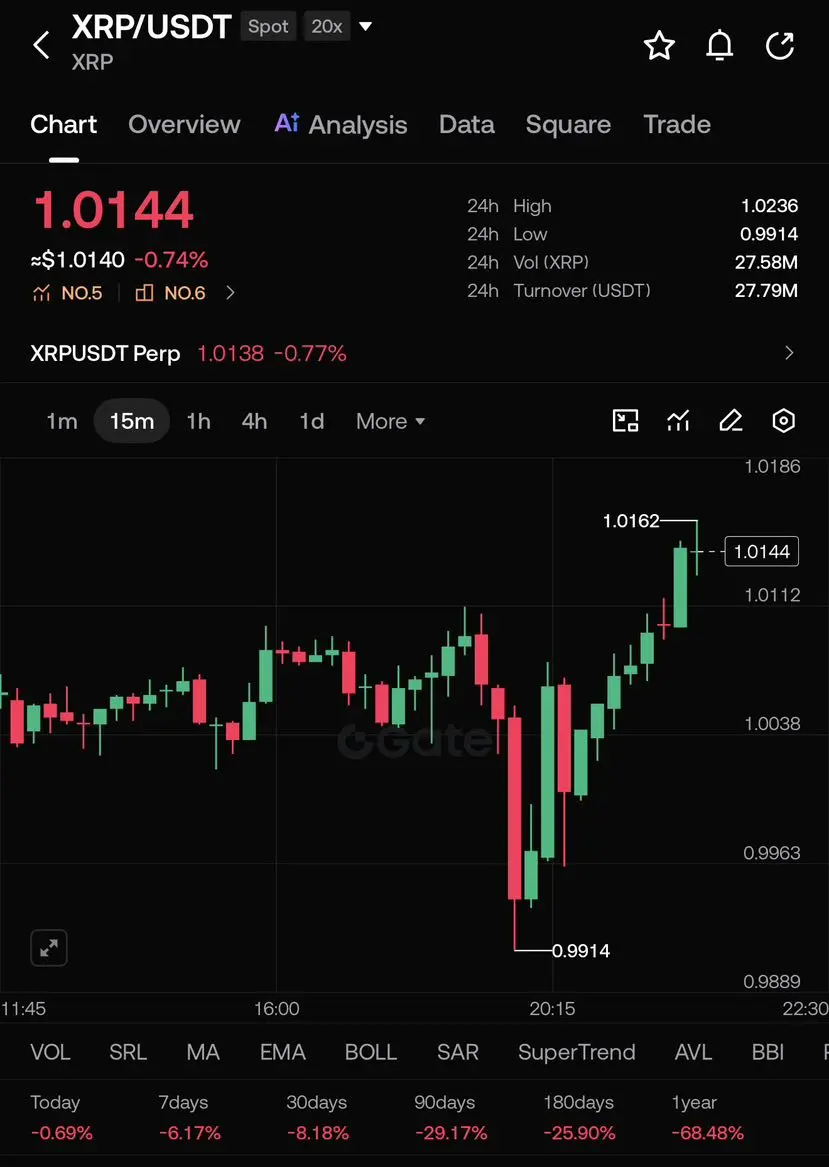
XRP rebounded from 0.9914 to above 1.01, with bulls buying steadily around 1.00, but 1.0160–1.0235 remains a tough resistance zone. Stay bullish as long as 1.00 holds; if it breaks, watch out for a retest. Short-term copy traders should pay attention to stop-losses.
LedgerBull
$XRP is trading inside a bullish recovery after rebounding strongly from the intraday low at 0.9914.
The market remains cautiously bullish in the short term, with buyers reclaiming control above the 1.0000–1.0060 support zone while sellers continue to defend the 1.0160–1.0235 resistance area. A clean breakout above resistance could trigger another leg higher, while losing support would shift momentum back to the downside.
EP
1.0080–1.0120
TP
TP1 1.0160
TP2 1.0236
TP3 1.0320
SL
0.9990
XRP briefly flushed liquidity below 1.0000, printing an intraday low at 0.9914, before buyers stepped in with strong demand and pushed price back above the psychological 1.01 level. The recovery suggests buyers are attempting to regain short-term momentum, but price is still approaching a key resistance zone. As long as XRP continues to hold above the 1.00 support area, another attempt toward the daily high remains possible. However, a failure to defend support could lead to another retest of lower liquidity before buyers regain full control.
Let’s go $XRP ‌
repost-content-media
XRP-0.07%
Just saw a discussion about oracle price feed delay. Honestly, this is pretty subtle—delaying by a few seconds doesn’t matter much when the market is stable, but once volatility turns wild, it becomes a catalyst for liquidation. Put simply: if the quote comes in slowly, your position might get liquidated based on the “historical price.” Is that fair or unfair?
Lately, I’ve been seeing people talk about ETF fund flows and U.S. stock risk appetite as if they’re tied together, and it feels a bit funny. Market sentiment is being steered by these macro narratives, but the on-chain, real liquidation
Sometimes I feel like macro stuff is pretty mystical, but when interest rates move, my positions in my account start to shake right along with it. I set a rule for myself: even if rate-cut expectations get really hot, I don’t chase those narrative coins that are being spun way out of control. I’d rather watch the on-chain fund flows more closely. Lately, the air drops and points-reward tasks have turned into something like a day job. A friend of mine checks his signatures every day, saying he feels like he’s doing gig work. Honestly, I also got tempted to jump into the grind for a while, but l
Just saw that Gate has rolled out yet another badge quest, and the points leaderboard is getting pretty long… Honestly, I was tempted too—because who doesn’t love free stuff? But then I noticed one thing: once you start chasing badge progress every day with check-ins, doing tasks, and refreshing interactions, your time gets chopped up, and your attention gets scattered too.
These days, I’d rather use that time to dig into the protocol documentation parameters, or to see who’s quietly changing the voting logic in governance proposals. Recently, the broader market has also been getting pushed ar
This morning the gas spiked like crazy—one transfer got stuck for half an hour before it went through. Honestly, the mempool queue was kind of interesting: you could watch your transaction spin around in the “pending pool,” while a bunch of people next to you paid higher tips to cut in line. Basically, it’s an auction. So when I’m in a hurry, I’ll check the average fee rate of pending txns; if I don’t want to overpay, I’ll just wait—anyway it’ll eventually get into a block.
Recently I’ve been seeing lots of new chains rolling out incentives; boosting TVL has been wild. Old users are yelling “m
I just read an analysis of modular blockchains. Honestly, for regular users, you don’t really need to care about how they’re broken down—because the final experience is just faster, cheaper, and more stable with block production. It’s like taking photos with your phone: you don’t need to know how many pieces of glass are in the lens—the point is whether the photo looks good.
But over on privacy coins and mixers, things have been pretty heated lately, with compliance boundaries being debated back and forth. I’m not entirely sure what counts as “clean.” Sometimes I think transparency is good, an
Just looked at the protocol parameters of an RWA project—the redemption clause is pretty interesting. It says “liquidity is good,” but in practice the redemption period is extended to T+3, with a slippage buffer mechanism in between. Plainly put: no matter how pretty the on-chain assets look, the real test comes down to whether they can actually be paid out when it’s time to redeem.
Recently, during the airdrop-season task push, the platforms’ anti-sybil measures have been so strict they feel like they’re checking household registration. With a points-based system, the “farming” crowd is basic
RWA+0.39%
Stop-loss is really just like a breakup—dragging it out while it doesn’t really end only makes you lose more. Admitting it sooner not only saves on interest, but is also less stressful. In the past, I always thought, “Just hold on a bit longer, maybe it’ll come back,” and it ended up costing me so much that I was checking my account at midnight—watching it only made me more clear-headed. 😅 In the end, I figured it out: if you need to cut, cut. Treat it as tuition. The interest I save can still go toward a nice meal.
Lately I’ve been looking at L2—there’s talk about competing on TPS and also s
I just looked into AI Agent on-chain interactions. Honestly, automated contract execution is pretty cool, but details like permission management and parameter fine-tuning— I still feel like a human should take a look to feel secure. Just now, I turned off an automatically authorized contract, and only then did I feel at ease. By the way, funding rates have been swinging a lot lately; the community is guessing whether it’s a reversal or whether it will keep draining. I think it’s more interesting to see who deflates first during the bubble phase. In any case, no matter how smart the technology
I just checked a new protocol’s GitHub commit history and found that in their multisig upgrade there are two addresses belonging to the same person via different wallets, with the signature timestamps less than 3 minutes apart. That doesn’t necessarily mean anything is wrong—it's just that once you look at these details a lot, you can’t help feeling there’s still a gap between “transparency” and “trust.”
The audit report is similar. The team name they looked for sounds pretty big, but the audit scope didn’t cover the upgrade logic for the governance contracts. Then if the multisig later change
Recently, I’ve been looking at on-chain transfer records and found that a lot of people treat “coincidences” as mysterious events… in fact, most so-called “coincidence” transfers are just arbitrage bots or the settlement routes of cross-chain bridges. One address strings multiple steps together, making it look like big players are matching orders or laundering funds—but in reality, it’s simply automated cold-wallet aggregation. It’s kind of boring, but it feels great to puncture the illusion.
With the whole modular DA thing, developers are all excited. As a retail user, I’m still confused… abo
Just took a look around at the funding rates—some of it is downright extreme, and honestly kind of interesting. Whether you’re running a counterparty position or trying to dodge volatility, at bottom it’s basically betting on whether you can hold your nerve.
Some people think earning funding fees is risk-free profit, but in extreme markets, if you get the direction wrong, an unrealized loss can quickly wipe out your gains from several days. Personally, I’d rather stay tucked in, make fewer moves—especially when I see those re-staking “Russian doll” structures getting criticized pretty harshly.
Recently I’ve been looking into options—honestly, it’s kind of addictive. On one side, the buyer keeps staring at that bit of time value getting chewed up; on the other, the seller steadily collects that time value. In any case, there’s always this itch in my mind. Want to buy, but I’m afraid it’ll end up going to zero. Want to sell, but I’m afraid a black swan will slap me in the face. Sometimes I see miners arguing with validators about unfair MEV ordering, but think about it—doesn’t the options market have the same kind of game between retail traders and market makers? Big money grinds pati
Just saw a PFP project rolling out new member benefits. Honestly, I’m a bit tired of this whole “NFTs’ long-term brand value” narrative—it really doesn’t feel fresh anymore. I’ve still got a few images I once thought were great, but as the benefits keep iterating, they start to feel more and more like points-based tasks: locking up funds, filling out questionnaires, recruiting people, and “holder-exclusive” benefits popping up out of nowhere. But let’s be real—it’s still about keeping themselves alive by siphoning attention.
And that drop season recently was the same. The hype got so intense t
TOKEN-1.75%
I just came across some chain game token pumping again. Honestly, my hands are a bit itchy. But after checking a few on-chain data points recently, the more I looked, the clearer it got—what people call an “economic model” is ultimately a tug-of-war between the inflation schedule and the studio’s dump schedule; in the end, it’s always a race to see who can move faster. The model is too similar—endless minting plus one-click sell pressure. This morning I even told myself: don’t assume every pump is an information advantage. In many cases, it’s just your emotions pressing the buy button for you.
Recently, I’ve been seeing all kinds of task platforms flooding the feed—social mining, points, badges, and each one is more competitive than the last. Honestly, I’m not really in the mood to chase them.
Signing in every day to clock in and earn points—suddenly it’s like going to work. The airdrop season is even more outrageous: a lot of people grind desperately just to get an identity, but then once anti-sybil checks are run, it’s all for nothing. When I read through those rules, it just feels like something isn’t right—what exactly do they want: the points, or the identity itself? If it’s on