DivergenceScout

vip
Active for: 0.4y
Peak Tier 0
Always look for price and RSI, MACD divergences at tops and bottoms, reverse hidden divergences, and other reversals. When others are fearful, I take a little greed, calmly place orders.
I took a loss on a trade during the day, so I’m writing it down to learn my lesson.
The pool’s depth was obviously terrible, but the price looked alright at the time, so I figured I could get in and out quickly without any issues. Then my order immediately ate through a large chunk of the liquidity. Looking back, I had bought through several levels of the order book myself. Slippage really isn’t something you can judge just by looking at the bid-ask spread; depth distribution and the pace of order placement also have to be factored in. From now on, I’ll check where the liquidity is before plac
To be honest, I used to be easily won over by the words “creator economy.” I thought that as long as the content was good enough, fans would pay creators directly and middlemen could get lost—what an ideal world. Later, after watching a few on-chain projects struggle with royalties, and seeing secondary-market prices plunge, I realized that creator income is always the first thing to get cut. That’s when it suddenly hit me: ideals are ideals, but liquidity is king.
I used to get hyped whenever I saw celebrities shilling something. Now, instead, I’ve gotten into the habit of first looking at wh
Recently, watching on-chain transactions has given me some thoughts. Words like builder and bundle are coming up more and more, but honestly, retail traders really don't need to understand them too thoroughly. You only need to know this: a group of bots specifically watches other people's trades and front-runs them, so you can easily take a loss if your slippage settings aren't tight enough. Anyway, my attitude now is: stay away from complicated strategies and just use basic operations with proper protection.
Today I saw a lot of people discussing modularity and the DA layer narrative. Devel
Honestly, the market’s liquidity lately… has been pretty grueling. I see quite a few people still agonizing over “buying the dip,” but I feel that figuring out how to “stay alive” first is more practical. It’s not that buying the dip is wrong, but when you have no ammunition on hand, even the best opportunities are just someone else’s story.
Over the past couple of days, RWA and on-chain yield products have been repeatedly compared with U.S. Treasury yields, and I actually find the comparison interesting. If even basic liquidity has to depend on the external environment’s generosity, then argu
RWA+2.61%
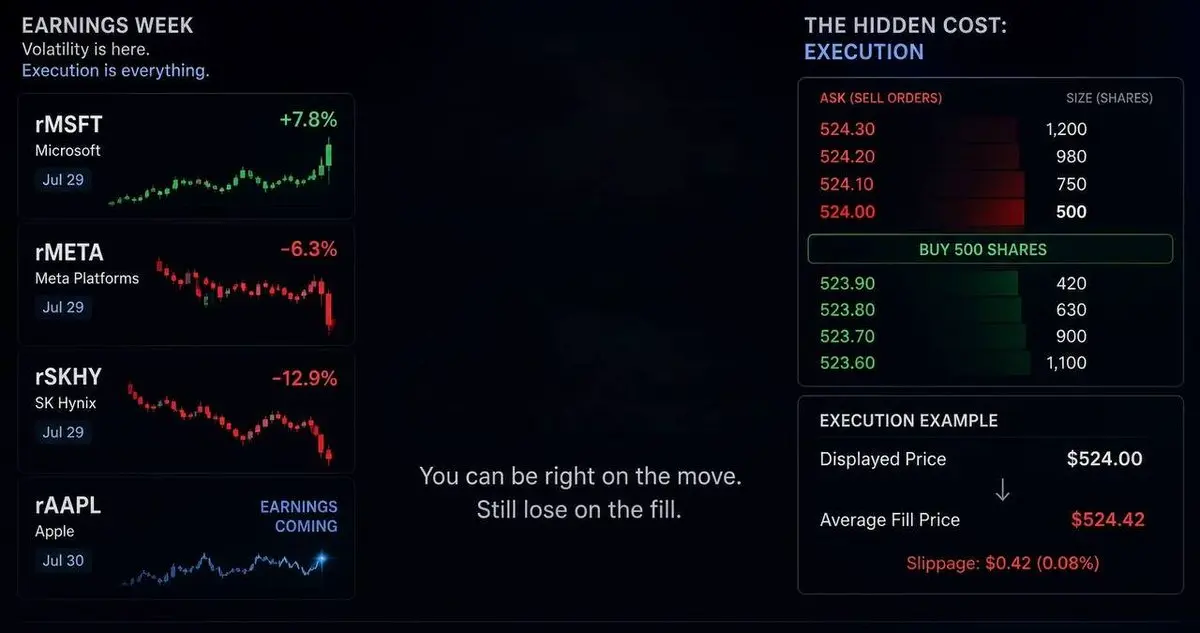
It’s so disappointing to be right on direction but have your profit wiped out by slippage—what a loss. I’m looking at rToken’s order book depth: large orders can get filled closer to the displayed price. Plus, after opening the position, you can use it as collateral. But since earnings reports bring big volatility, you have to manage your positions and risk yourself.
Holaitsak47
Not financial advice. Just how I’m approaching earnings week. DYOR.
Seen people being focused on whether Microsoft, Meta or Apple beat expectations.
I’m thinking what will it actually cost me to get into the trade?
Earnings week is where execution matters most.
The move happens fast, volatility explodes, and what looks like a good entry on your screen isn’t always the price you end up getting. Once your order starts eating through the book, slippage quietly becomes part of the trade.
You can be right on direction and still give back a meaningful part of your edge simply because execution wasn’t efficient.
That’s one reason I’ve been looking at rToken for these names.
The order book is built with deeper liquidity, so larger orders are designed to fill closer to the displayed price instead of quickly moving through multiple levels. During earnings, I think that’s a more important advantage than most traders realize.
Another thing I like is that once the position is open, it doesn’t have to sit idle inside the account. It can also be used as margin or pledged for a loan if needed, although I’d only consider that with proper risk management given how volatile earnings weeks can be.
That’s how I’m approaching this week’s reports.
Again, this is just my personal trading approach not financial advice. Size appropriately and manage your own risk.
repost-content-media
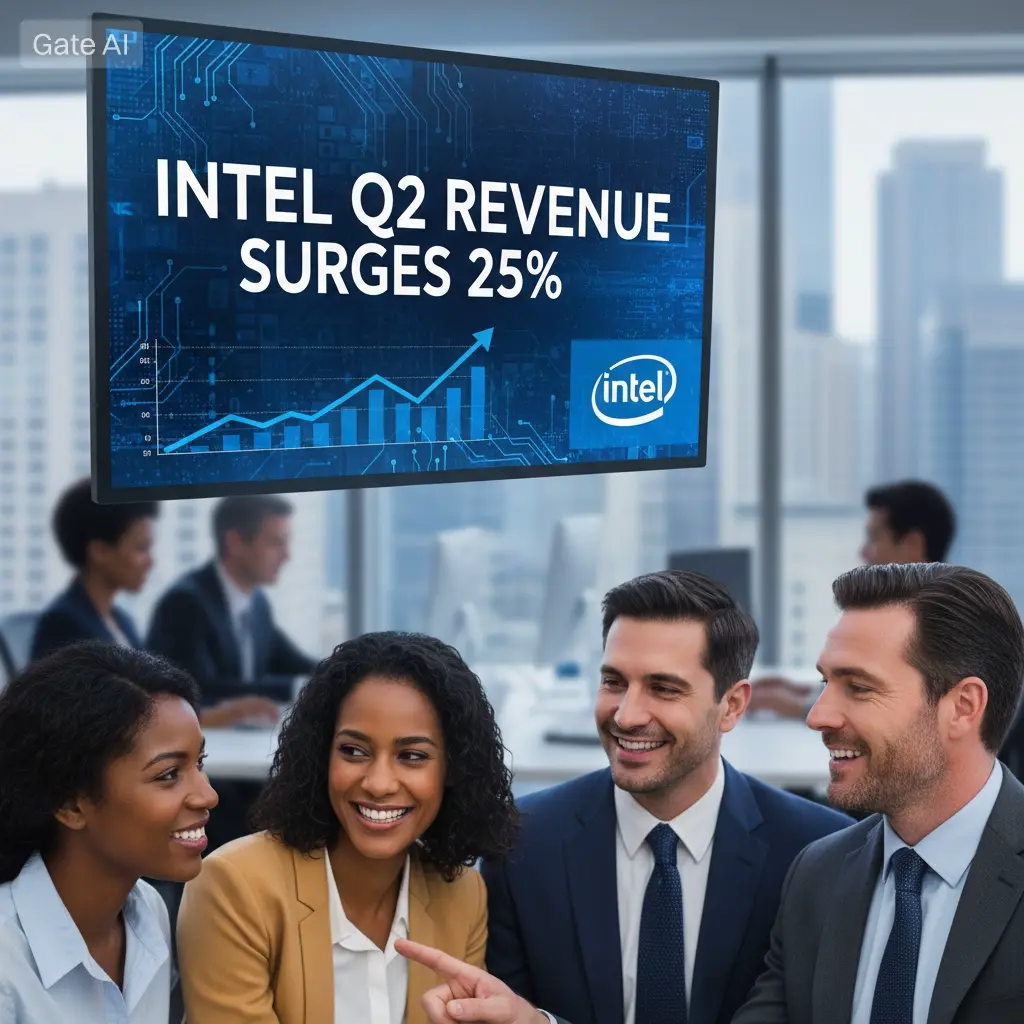
A 25% surge in revenue shows that Intel’s long-term strategy and research and development investment are starting to pay off, with strong demand for AI, cloud computing, and high-performance computing. Seizing this window of opportunity, the semiconductor industry looks promising. As an investor, seeing such data boosts confidence even more.
2In1
#IntelQ2RevenueSurges25%
Intel’s latest quarterly results send a clear message: innovation, execution, and long-term strategy continue to shape the future of the semiconductor industry. A remarkable 25% revenue surge demonstrates strong momentum and highlights growing confidence in Intel’s ability to adapt, compete, and create value in an increasingly technology-driven world.
Strong financial performance is more than just a number—it reflects customer demand, strategic investments, and operational improvements. As industries continue to embrace artificial intelligence, cloud computing, advanced manufacturing, and high-performance computing, semiconductor companies remain at the center of global technological progress.
Intel’s impressive quarter showcases how focused execution can translate into meaningful business growth. Continued investment in product development, manufacturing capabilities, and next-generation technologies positions the company to meet evolving market demands while strengthening its competitive position.
The revenue increase also signals improving business momentum across key operating segments. Strong execution, expanding partnerships, and growing adoption of advanced computing solutions demonstrate how innovation continues to drive sustainable performance even in a highly competitive market.
For investors, industry professionals, and technology enthusiasts, these results offer valuable insight into broader market trends. Financial growth from a major semiconductor company often reflects increasing enterprise technology spending, expanding AI infrastructure, stronger data center demand, and continued digital transformation across industries.
As organizations accelerate their digital initiatives, demand for faster processors, efficient computing platforms, and intelligent infrastructure continues to rise. Companies that successfully balance innovation with operational excellence are better positioned to capture emerging opportunities while delivering long-term value.
Intel’s performance also reinforces the importance of resilience in a rapidly changing technology landscape. Strategic planning, disciplined execution, and continuous investment in research and development remain critical factors for sustaining growth and maintaining industry leadership.
Beyond quarterly numbers, this achievement highlights the broader evolution of the semiconductor ecosystem. From artificial intelligence and edge computing to autonomous systems and cloud services, advanced chips power the technologies shaping modern business and everyday life.
The growing demand for high-performance computing solutions is transforming industries including healthcare, finance, manufacturing, automotive, education, telecommunications, and scientific research. As digital transformation accelerates worldwide, semiconductor innovation becomes increasingly essential for enabling smarter applications, faster processing, improved energy efficiency, and greater scalability.
Market participants closely monitor quarterly earnings because they provide valuable indicators about customer demand, industry trends, production capacity, and future investment priorities. A strong earnings report can strengthen market confidence while demonstrating effective business execution under dynamic economic conditions.
Innovation remains one of the most significant competitive advantages in the technology sector. Continuous advancements in processor architecture, manufacturing processes, AI acceleration, and software optimization allow companies to deliver greater performance while addressing the evolving needs of businesses and consumers alike.
Sustainable growth requires more than short-term financial success. It depends on long-term vision, consistent investment, talented teams, strategic partnerships, and the ability to anticipate future market opportunities. Companies that embrace these principles are often better equipped to navigate industry shifts and maintain lasting relevance.
Intel’s latest quarterly performance serves as an example of how strategic focus, operational discipline, and technology leadership can create meaningful business momentum. While every quarter presents new challenges and opportunities, consistent innovation remains a powerful driver of future growth.
The semiconductor industry continues to be one of the most influential sectors in the global economy. Every advancement in computing, artificial intelligence, networking, cybersecurity, and digital infrastructure creates new possibilities for businesses, governments, researchers, and consumers around the world.
As technology continues evolving, staying informed about major industry developments helps investors, professionals, and enthusiasts better understand where innovation is heading and how it may shape future opportunities across multiple sectors.
Every earnings season offers valuable lessons about resilience, adaptability, and execution. Strong financial performance reflects not only successful products but also effective leadership, customer trust, operational efficiency, and the ability to respond to changing market conditions.
Whether you follow technology markets, invest in innovation, or simply enjoy tracking industry trends, Intel’s latest results provide an important snapshot of the continuing evolution of the global semiconductor landscape.
The future of technology will be built on faster computing, smarter AI, stronger infrastructure, and continuous innovation. Companies that remain committed to advancing these capabilities will continue playing a vital role in shaping tomorrow’s digital economy.
Share your thoughts on Intel’s latest performance and what you believe it means for the future of the semiconductor industry. Join the conversation, exchange insights, and stay informed as technology continues to evolve.
Join Now
@Gate_Square
#SummerCreationCamp
repost-content-media
INTC+4.52%
HIP-3’s open-interest ratio has climbed above 33%. The momentum is a bit intense—Hyperliquid’s governance token is starting to become a real risk-exposure anchor.
WuSaidBlockchainW
Wu Says learned that, per a post by Hyperliquid News, the share of HIP-3 daily open interest in Hyperliquid’s total open interest rose to 33.36%, reaching a record high. This ratio has continued to rise since the start of this year; after the end of March, it mostly stayed at around 27% or above, and has recently climbed further.
HYPE+1.32%
SpaceX’s $75 billion IPO—does this valuation include even Mars colonization? U.S. stocks in 2026 are going to blow up.
CoinNetwork
CoinWires reports that the U.S. IPO market is expected to have a record-breaking year in 2026, with SpaceX making its debut via an initial public offering (IPO) valued at $75 billion. The booming IPO market in 2026 shows strong investor confidence and diversification, and may once again reshape the global financial landscape.
SPCX-1.19%
Circle secures a federal trust bank license—this move is big enough. The denial of that Bitcoin bond proposal in New Hampshire was also to be expected; the timing and tempo differ too much from state to state.
CoinNetwork
CoinWize news: The U.S. Department of Justice (DOJ) is preparing to end its prosecution of Bitclub network operator Matthew Goettsche, while Circle has received federal approval to establish a national trust bank. New Hampshire rejected a Bitcoin-backed bond proposal. These three developments show different approaches between federal law enforcement, bank regulation, and state financing. Circle’s national trust bank will initially serve Circle and its affiliates.
CRCL-1.17%
BTC+1.05%
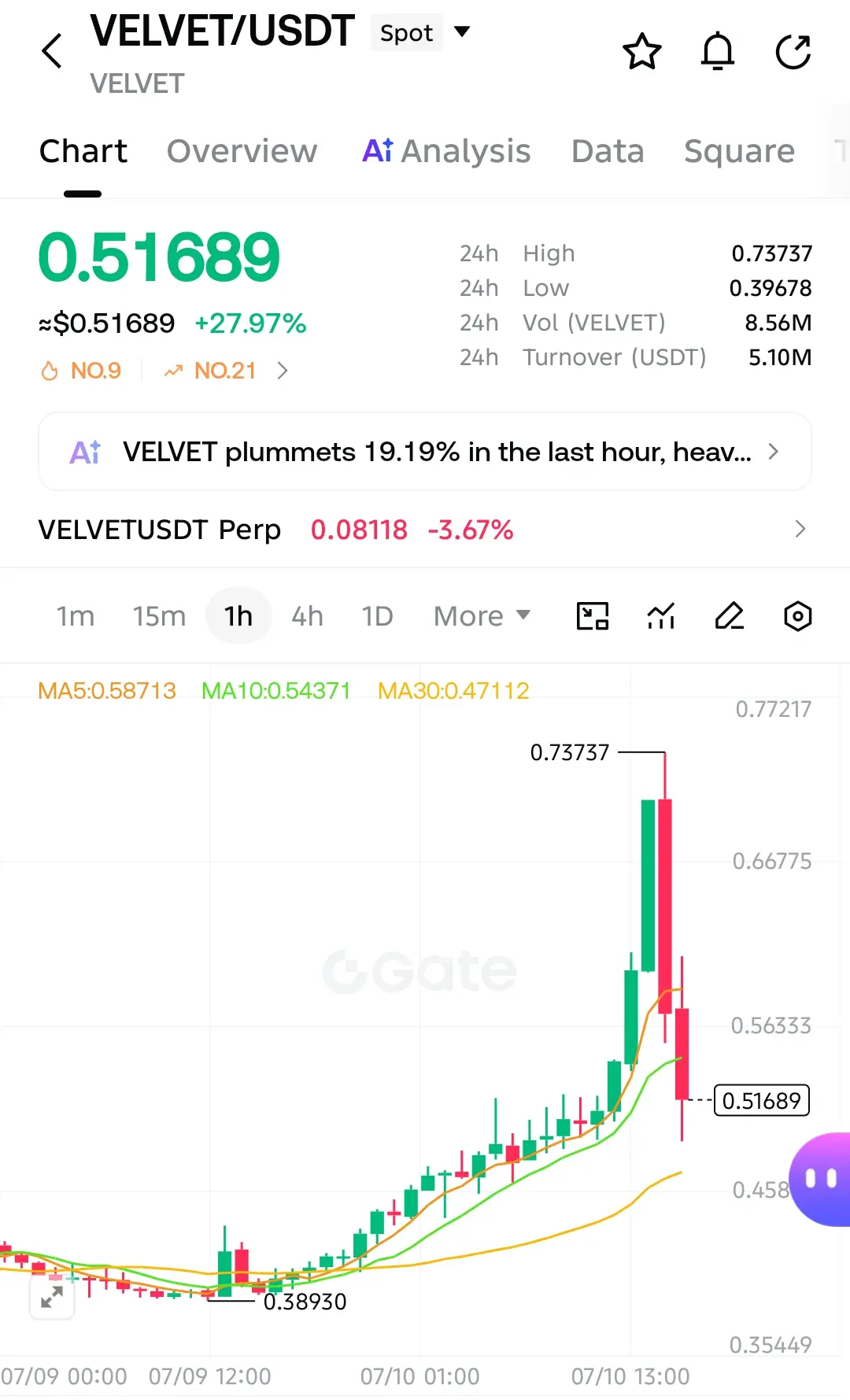
This trend is a classic long/short squeeze that kills both sides: first it blows up the long positions, then it crushes the short positions. Now the 0.5–0.52 range is a great risk-reward trading spot; if it breaks below the MA30, exit.
Mason_Lee
$VELVET
Violent pump to 0.73737 followed by a sharp 19% crash. Price now sitting below MA5 and MA10 but holding above MA30 (0.47112). Momentum is bearish short-term, but the structure could find support here for a relief bounce. A reclaim of 0.54371 shifts the bias back to upside. Losing 0.47112 opens the door to a retest of 0.39678.
• Entry Zone: 0.5000 – 0.5200
• TP1: 0.54371
• TP2: 0.58713
• TP3: 0.66775
• Stop-Loss: 0.4600
#VELVET #PredictWorldCup🇪🇸vs🇧🇪 #USIranWarCloudsGather #GUSDYieldRisesto3.8% #WorldCupChampionPrediction
repost-content-media
At 3:00 a.m., I saw a whale address transfer an eight-figure sum to a CEX, and the comments section started shouting “smart money is escaping the top.” I stared at the screen for a moment—what does that have to do with the liquidation level I just calculated?
Actually, when you’re three steps from the red line, the most important thing isn’t figuring out how many steps are left—it’s asking yourself first: does this position come from a restlessness that keeps you up, or is it a real strategy? I’ve seen people hold on when they’re three steps away, only to miss a step and get caught; I’ve also
800 BTC with 20x leverage — is this whale betting their life on a rate cut, or painting a target for the market?
CoinNetwork
According to Lookonchain monitoring, a mysterious whale has opened 20x long positions on BTC within the past 5 days through 4 newly created wallets (possibly controlled by the same person), totaling 800 BTC—worth approximately $47 million at current prices.
BTC+1.08%
Is the Middle East powder keg about to blow up again? The IDF’s latest stance has directly ramped up the tension to a peak—crypto guys, watch out and take precautions to avoid risk.
CoinNetwork
Coin World News, local time on the 29th, Israeli Defense Minister Israel Katz recently elaborated on Israel's latest geopolitical military strategy on multiple fronts including Lebanon, Iran, and the Gaza Strip in a closed-door conversation with military journalists. Katz clearly stated that the Israel Defense Forces are prepared to take independent military action against Iran, and reiterated that the IDF will maintain a long-term military presence in southern Lebanon. Katz revealed that the IDF has selected targets for strikes inside Iran and is ready to take independent military action, and is currently closely monitoring the interaction steps between the United States and Iran. Katz said that if Iran launches missiles at Israel, Israel will carry out a "devastating" retaliation inside Iran, and claimed that "Israel could be at war with Iran tomorrow." But he also emphasized that Israel will not interfere with the actions of US President Donald Trump regarding Iran.
Shorting at highs and still narrowing floating losses, that risk control has some real skill.
CoinNetwork
CoinWorld News: The floating loss on the short positions opened at high prices by trader MU has narrowed from $5.17 million (-68.63%) to $3.91 million (-44.48%). The current coin price is $1,057.70, the liquidation price is $1,612.71, and the position size is $14,660,779.70. MU was previously the largest short seller of ZEC in the crypto market, and recently has been favoring opening short positions at high prices in the US stock market, with profits exceeding $48 million in half a year.
1.96 trillion USD, a single chain achieved this scale—Tron is quietly making big money this time.
CoinNetwork
BlockBeats News, OnchainDataNerd reports that Tron's stablecoin transaction volume reached $1.96 trillion in the first quarter of 2026. This figure is not a typo; as a single chain, Tron is quietly driving real-world dollar transaction volumes that most networks cannot reach. Moreover, the trading situation in the second quarter has already become even hotter.
TRX+1.12%
Geopolitical conflicts escalate again, how will safe-haven assets perform?
CoinNetwork
CoinWorld News: According to the Israeli military, it killed Lebanese Hezbollah militants and attacked launchers in the Nabatieh area.
Hackers loot 20 million dollars; Hoskinson makes it sound easy, but those who lost their coins truly lost real money.
CoinNetwork
Crypto news, Cardano founder Charles Hoskinson stated that the $20 million attack on the Cardano project is an "unfortunate reality of cryptocurrency." He pointed out that although the amount of ADA lost may not be significant compared to other crypto hacking incidents, it does not comfort users who might lose "all their ADA." He emphasized, "Whenever they lose anything, it is a hurt to them."
The old Fed folks really know what they’re doing—lattice charts are, in fact, an expectation-management tool; not submitting them is actually more authentic.
CoinNetwork
CryptoWorld News: Former Federal Reserve Vice Chairman Clarida said he is not surprised that Fed Chair Powell did not submit a dot plot.
Maji, this wave of ETH long positions is about to hit the liquidation line, from over a hundred million to tens of millions and now this, the money made from NFTs all goes into filling the contract holes, even veteran traders are shaking their heads.
CoinNetwork
CoinWorld News, Ma Ji Huang Licheng reduced 3,300 ETH long positions, which is approximately $5,915,640 at the current price. His total holdings amount to $10,994,760, with an average price of $1,755.24, and a current profit and loss of -$63,292.82, a decline of -14.39%. The current price of the coin is $1,745.19, and the liquidation price is $1,741.85. This trader previously profited from blue-chip NFTs, but since October, his funds have shrunk from over 100 million to several hundred thousand dollars.
ETH+0.68%
IDO fundraising plummeted 85% month-over-month. This data makes people's scalps tingle. With the market so cold, can we still wait for spring in the next cycle?
CoinNetwork
CryptoWorld News reports that, according to CryptoRank data, in the second quarter of 2026, early issuance/IDO fundraising amounted to $58,000,000, down 85% quarter-over-quarter, marking the worst quarterly record in nearly five years. The number of public sales fell from 105 in the first quarter to 37, a 65% decline. In May, 13 token sales were completed, the lowest single-month level since December 2020. In the first quarter of 2025, there were 429 public sales, raising $849,000,000, and the current fundraising amount is more than 14 times smaller than that peak.
View More