BlueChipSkeptic

vip
Active for: 0.5y
Peak Tier 0
Doesn’t believe in miracle coins or blue-chip myths, loves to break down narratives. Looks at TVL, holding concentration, and unlock curves—talks tough but knows when to cut losses.
The moment your phone battery drops to 20%, you instinctively start looking for a charger—would you say that counts as the body’s built-in loss-cutting instinct? Money works the same way: once rate expectations tighten, risk appetite flinches first, and all the cash hides in places where it can catch its breath.
This wave of meme coins and celebrity shilling has incredible attention-grabbing power, but the old players’ warning—“don’t be the one holding the bag at the end”—makes more and more sense the more I think about it. After examining the token allocation structures behind several narrati
MEME-1.51%
To be honest, every time I see people hype that putting RWA on-chain can bring trillions in liquidity, I just want to laugh. Without getting into other things, if you tokenize US Treasuries or real estate, on-chain trades settle in seconds—but what about redemptions? The terms say “T+2” to “T+7”. In this process alone, compliance review and KYC can easily hold you up for three days. Liquidity? It’s just a number illusion.
Recently, those big on-chain transfers have been interpreted by various big V accounts as “smart money” making moves. But in my view, it’s mostly institutions rebalancing or
Recently I’ve been seeing a bunch of people praising modular blockchains—things like modular execution layers and data availability layers—packaged like building blocks, like it’s all just LEGO. Honestly, if you ask me how it feels? **For ordinary users, there’s really no obvious difference in experience**. Gas is still congested, and cross-chain is still a hassle. At most, the backend engine changed, while the frontend interface looks the same.
To put it bluntly, modularity is mainly a shift in developer narrative—it's meant to optimize infrastructure by splitting the on-chain “factories,”
Lately I’ve been noticing all kinds of address classification labels—things like “smart money,” “giant whales,” and “institutional addresses.” The more detailed they get, the more they start to feel like fortune-telling. To put it simply, labels are just clusters of historical behavior. Once market sentiment or the logic behind fund flows changes, how accurate can they still be? At any rate, I don’t really believe addresses can directly predict direction—at most, they can serve as a reference.
Over the past couple of days, I talked with a friend. The moment a region’s tax-increase policy came
When I first started, I got caught up in it too—I went all in at once. During the day I stared at the K-line chart, and at night I dreamed about wicks like pins, even when I went to sleep I was thinking about whether I’d get liquidated. Later I slowly switched to a grid strategy plus DCA—basically, it was admitting that I didn’t have the luck to eat the swing trades, and I didn’t want to stake all my emotions on the price. Being able to sleep soundly is the real skill.
And now it’s the same during the airdrop season. The task platforms’ anti-bot (anti-sybil) measures make people’s scalps tingl
I just watched a bunch of AI Agent demos that automatically do on-chain interactions. Honestly, it’s pretty cool, but I can’t shake the feeling that something feels fake. You tell me—now Agents can run arbitrage by themselves, calculate slippage, and even write contracts. But what about when it really matters? For example, when a cross-chain bridge runs into liquidity depletion, or when a new protocol just launched and its TVL suddenly explodes but the position concentration is 90%—can it really tell whether it’s a shitcoin or a blue-chip? Anyway, I don’t dare trust it all.
Yesterday my mom ev
I just saw a project’s TVL jumping up a lot, but when I looked at the unlock schedule, it starts linearly releasing next month, and the top 10 holders account for 80% of the concentration… I immediately closed the page.
Actually, I’ve been thinking about this lately: why does being in a floating loss keep people up more than being in a floating profit? It’s clearly all market volatility, yet losing 5% and gaining 5% feel completely different. I guess when you’re losing money, that regret—“I could have done better”—is stronger than the happiness from making money. Things like social mining and
To be honest, every time something happens with stablecoins, everyone’s first reaction is to wait for confirmation before bailing. This tactic is indeed useful when a cross-chain bridge is hacked or when an oracle malfunctions and misprices—but when it comes to the stablecoins you hold yourself, can you really afford to wait until the reserves audit is out? At least I don’t trust the promises from “blue chips.” The TVL looks high, but once the concentration of holdings is pulled, you get shocked. To put it plainly, the mindset behind a bank run is: the more you say it’s fine, the more I want t
I just watched the charts for the whole night again, and Grid trading and going all-in are really two different things in terms of sleep quality. Grid/DCA is like fixed-schedule work: prices jump around, but I only check the profit from time to time—if I lose, it’s still basically the same, and I can sleep normally at night. When you go all-in in one shot, you end up staring at the K-line charts until dawn, and your heart runs along with the candle wicks. Recently, hardware wallets have been out of stock, and there are plenty of people on my social circle scrambling to buy. But if your chips a
I’m just a retail “chive” by fate. A couple of days ago, a trade slipped on slippage and it hurt—what I wanted to buy, and the spread I was going to eat, all got fed into the depth. Looking back, that token’s liquidity was as thin as paper, and my order placement rhythm was too rushed. I threw in a batch of orders all at once and got pushed straight to the next tier, instantly increasing my cost by two or three ticks. Now whenever there’s a big on-chain transfer, a bunch of people start shouting, “Smart money is here.” I think it’s probably the exchange’s cold wallets moving around—if I blindl
TOKEN+0.58%
STA’s move this time is pretty interesting—straight up putting third-party stock tokens on the fire. The whole thing can be summed up in just one sentence: only official registration counts as the “real” one, and the platform-issued tokens carry risk that users take on themselves. As traditional finance players enter the RWA space, the contest for speaking rights and rule-setting power is officially underway.
CoinNetwork
CoinJie.com reports that the Securities Transfer Association (STA), an industry organization for U.S. securities transfer agent providers, sent a letter to the U.S. Securities and Exchange Commission (SEC), calling for future rules on tokenized securities to prioritize tokenized stocks that are authorized by listed companies and recorded in the official shareholder register, rather than stock tokens issued on third-party platforms. STA believes that third-party stock tokens may expose investors to platform, custody, and counterparty risks, and weaken shareholders’ rights.
I saw someone spinning a "coincidental transfer" into a conspiracy theory. Honestly, I traced that chain address myself last night. It boils down to three steps: bridge → mix → CEX hot wallet, with a two-day gap in between. If you insist on calling it the project team moving funds around... sure, whatever. With all the nested narratives going around, everyone's on edge.
My own habit is to check concentration of holdings first, then the unlock schedule, and only after that consider the motivation behind a transfer. This time the data was clean, but clean doesn't mean problem-free. After all thi
Highest inflow since early May, institutions seem to be accumulating at the 61k level, short-term liquidity narrative is coming back.
CoinNetwork
Coin World News, U.S. spot Bitcoin ETFs recorded a single-day inflow of $221.7 million recently, the highest level since early May, while Bitcoin price also rebounded above $61,000.
Bitwise's analysis this time is quite interesting; STRC has dropped like a flare, and a bottom consensus is forming.
CoinNetwork
Crypto World News reports that Bitwise says STRC’s sell-off signal suggests the bottom of the crypto market is about to arrive. The asset management firm noted that the sharp drop in STRC’s perpetual preferred stock is a sign of the crypto cycle’s maturity, not evidence that the company is about to face a crisis. Bitcoin recently fell below $60,000, aligning with STRC’s decline from its predetermined $100 par value, prompting investors to question whether the company is willing to maintain preferred dividend payments. Although the sell-off has roiled the market, Bitwise believes the company is fundamentally well-capitalized, with liquid assets of approximately $52 billion and liabilities of about $7 billion. In a blog post on Wednesday, Bitwise Chief Investment Officer Matt Hougan said: “STRC’s volatility is a natural and important part of the crypto cycle. I think we are approaching the bottom.”
STRC+0.14%
Hassett is in a rush: with inflation at 4%, don’t raise rates—long live a prosperous supply. Translation: It’s an election year; the stock market can’t crash—Powell, you handle it.
CoinNetwork
CoinWorld News: Trump advisor Hassett, in an interview with Fox Business Network, urged the Federal Reserve not to raise interest rates. He pointed out that the Fed's preferred inflation gauge is currently above 4%, while Warsh emphasized that bringing it down to 2% is non-negotiable. Hassett argued that the economy is in a "supply-driven boom" and that raising rates in this context would be a macroeconomic mistake. His remarks indicate that the White House still has strong opinions about the Fed's policy-making approach.
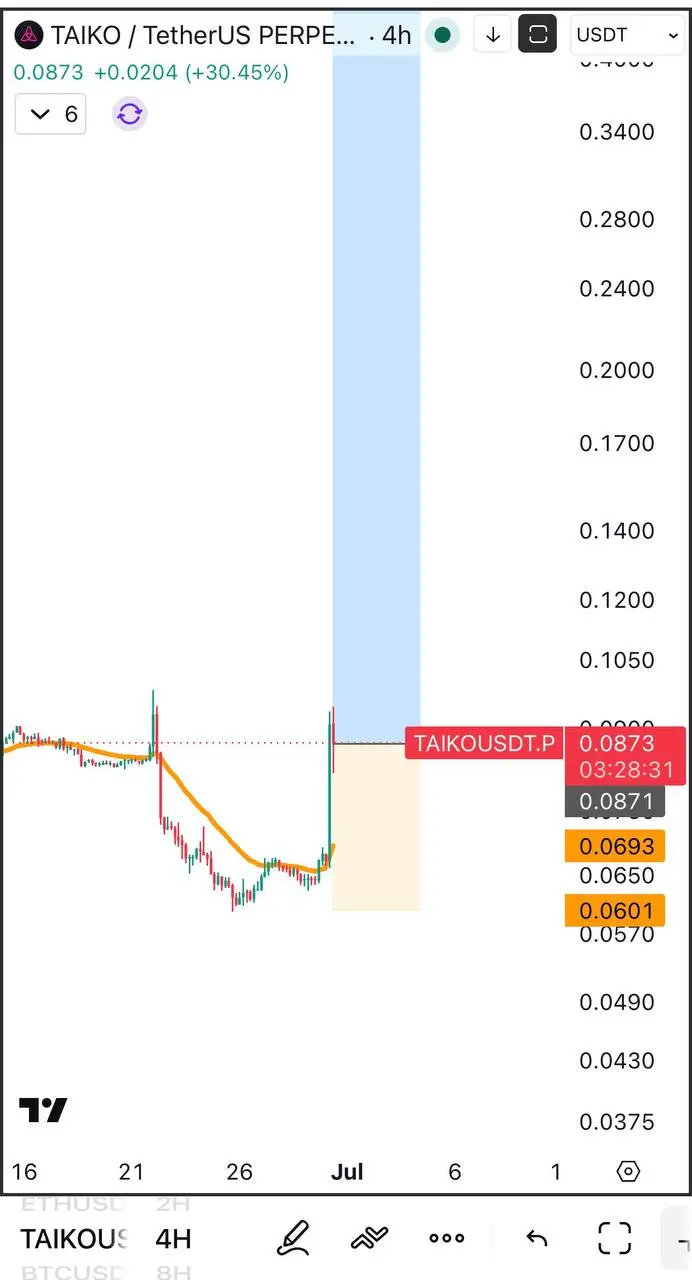
Is the clean breakout a real breakout or a bull trap? Wait for the daily close.
ELIX
$TAIKO just woke up. 🚀
Clean breakout. Strong momentum. Buyers stepped in exactly where they needed to.
If this breakout holds, the next leg could catch many traders off guard. 👀
Momentum is building—don't chase, wait for confirmation. 📈
#TAIKO #Crypto #Altcoins
repost-content-media
Finally got to meet in person—no matter how much we chat online, it’s better to grab a drink offline. World Cup predictions—let’s go!
CoinNetwork
CoinWorld News: XBIT DEX stated that today has finally arrived for the World Cup prediction event. With an excited heart and trembling hands, they look forward to meeting everyone in person on site, turning online discussions into on-site hype.
How long can Trump's trust in Wosh last? The expectation of interest rate cuts is also on hold.
CoinNetwork
CryptoWorld News: U.S. Treasury Secretary Bessant said: (Regarding the Federal Reserve and interest rate cuts) U.S. President Trump is confident in Federal Reserve Chair Wosh.
Under the night sky of southern Lebanon, ordinary civilians’ lives became the numbers that kept rising in the statistics column.
CoinNetwork
Gate.io News reports, according to the Lebanese National News Agency: Since last night, the Israeli airstrikes on southern Lebanon have increased the death toll to 5 people.
View More